

Two years ago, a handful of CEOs made a decision that reads today like a strategic hinge point: treat generative AI not as a bolt-on efficiency toy but as the company’s operating fabric. The consequences are already visible — from network-platform vendors embedding agentic architectures into product roadmaps to small manufacturers using smart glasses and conversational agents to capture tribal knowledge — and the signal is clear for Windows admins, IT leaders and CEOs: the race isn’t just about tooling, it’s about organizational redesign. "thinking bigger with AI" actually means
The phrase “AI-first” has become corporate shorthand, but real AI-first transformations share two uncommon traits. First, they treat AI as an architectural foundation — a data-and-agent stack that routes and reasons over live business signals. Second, they reorganize people, processes and governance around that architecture rather than merely layering models on top of existing workflows. The Chief Executive feature that prompted this conversation profiles several CEOs who followed this playbook, documenting investments, workforce changes and product launches that together illustrate a new operating model.
This isn’t speculatan established broadband-platform company, publicly described a multi-year investment and roadmap to make agentic AI a product and operational centerpiece — an investment it quantified and packaged as a platform evolution. Other firms in the feature — IgniteTech, Agiloft, MyCOI / illumend, Redmond Waltz and Metomic — provide a cross-section: large public software vendors, mid-market SaaS players, industry-focused incumbents and small manufacturers all pursuing the s scales and with distinct tactics.
This is not merely promotional language. The technical choices Calix describes — Vertex AI, Gemini family models, BigQuery, Spanner and GKE orchestration — are concrete design decisions meant to support multi-tenant, latenciesensitive operations and secure data residency for service-provider customers. Those choices reflect a pragmatic engineering posture: treat foundation-model inference and stateful orchestration as first-class infrastructure, and pay for the observability, governance and resiliency that productionized AI demands.
Why it matters to IT and Windows-focused operations: agentic platforms demand new telemetry practices (decision logs, model versioning and audit trails) and tighter integration into identity, role-based access control and endpoint management. If you’re responsible for a Windows estate, expect new requirements around SSO, endpoint data protection and secure connectors to cloud AI runtimes as vendors embed agents into workflows.
MyPersonas is marketed as an on-demand digital clone — a way to surface a subject-matter expert’s knowledge 24/7 in a conversational format. Eloquens AI targets the age-old email overload problem by orchestrating human+AI replies at scale, with claims of multilingual response capabilities and fast turnaround. Those claims come with caveats — novelty, integration complexity and compliance risk — but they signal a common logic: combine retrievable institutional memory with active orchestration to scale human judgment.
For Windows admins, that means offering sanctioned automation channels (PowerShell or WinRM-integrated agents, approved connectors to Microsoft 365 and Outlook), while enforcing data-loss prevention and auditing so that agent activity is visible and recoverable.
Agiloft’s public guidance also speaks to the technique of agent design: tool integration (APIs, CRMs), memory systems (for context persistence) and human-in-the-loop checkpoints. This is the pattern every compliance or legal workflow should expect: automation that is conservative where risk is high and progressively more autonomous where outcomes are well-understood.
This strategic split — operating a legacy outsourced service while building a separate AI-native company — is a viable pattern for regulated verticals. It lets the incumbent preserve revenue while experimenting with new delivery economics under a dedicated governance and talent model. For risk- and compliance-heavy Windows environments (for example, enterprise procurement systems tied to on-prem Active Directory permissions), the lesson is to treat AI-native products as separate release tracks with distinct data contracts and auditability expectations.
The takeaway for small-to-midsize Windows shops is pragmatic: AI democratizes knowledge capture and reduces onboarding friction. A small team’s integration of hands-free capture and searchable knowledge bases (hosted in secure cloud or on-prem repositories) can deliver outsized productivity gains without enterprise-scale platform builds. But even here, ensure that captures are stored with appropriate access controls, retention policies and backup strategies.
For Windows IT leaders and business decision-makers, the immediate mandate is pragmatic: pilot with governance, instrument everything, and design for portability. In parallel, invest in people so the organization can supervise and iterate on agentic systems rather than being surprised by them. The upside is not just incremental efficiency — it’s new kinds of products, new business models and the possibility of turning institutional knowledge into a continuous competitive advantage.
The CEOs thinking bigger with AI are doing more than buying licenses; they’re redesigning companies. The question for every leader is simple but urgent: will you be the one who uses AI to win, or the one who gets run over by someone who did?
Source: Chief Executive The CEOs Thinking Bigger With AI
The phrase “AI-first” has become corporate shorthand, but real AI-first transformations share two uncommon traits. First, they treat AI as an architectural foundation — a data-and-agent stack that routes and reasons over live business signals. Second, they reorganize people, processes and governance around that architecture rather than merely layering models on top of existing workflows. The Chief Executive feature that prompted this conversation profiles several CEOs who followed this playbook, documenting investments, workforce changes and product launches that together illustrate a new operating model.
This isn’t speculatan established broadband-platform company, publicly described a multi-year investment and roadmap to make agentic AI a product and operational centerpiece — an investment it quantified and packaged as a platform evolution. Other firms in the feature — IgniteTech, Agiloft, MyCOI / illumend, Redmond Waltz and Metomic — provide a cross-section: large public software vendors, mid-market SaaS players, industry-focused incumbents and small manufacturers all pursuing the s scales and with distinct tactics.
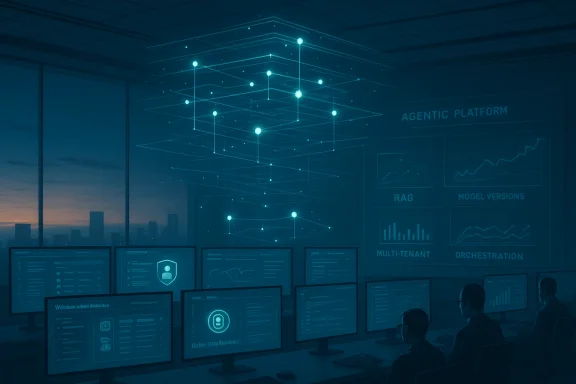 Calix: AI as platform — scale, investment and agentic ambitions
From pilot to platform
Calix’s shift is emblematic of the move from pilots to platform. Management disclosed a multi-year commitment to AI, describing significant spending to rewrite its broadband platform as an “agentic” architecture capable of deploying coordinated AI agents across operations, marketing and customer engagement. The company says it has embedded model context, knowledge graphs and RAG (retrieval-augmented generation) primitives into a unified data layer so agents can act with context and trust.This is not merely promotional language. The technical choices Calix describes — Vertex AI, Gemini family models, BigQuery, Spanner and GKE orchestration — are concrete design decisions meant to support multi-tenant, latenciesensitive operations and secure data residency for service-provider customers. Those choices reflect a pragmatic engineering posture: treat foundation-model inference and stateful orchestration as first-class infrastructure, and pay for the observability, governance and resiliency that productionized AI demands.
The productization of agency
Calix’s roadmap includes agent-to-agent communication and an “Agent Workforce” that can automate multi-step tasks. The implication is straightforward: when agents can coordinate reliably, companies can recompose internal workflows (for example, trouble-ticket resolution or subscriber onboarding) as agent-first processes with humans supervising exceptions. That design changes vendor-customer relationships because the vendor now sells a managed agentic capability, not just software licenses.Why it matters to IT and Windows-focused operations: agentic platforms demand new telemetry practices (decision logs, model versioning and audit trails) and tighter integration into identity, role-based access control and endpoint management. If you’re responsible for a Windows estate, expect new requirements around SSO, endpoint data protection and secure connectors to cloud AI runtimes as vendors embed agents into workflows.
IgniteTech: workforce overhaul, product bets and the human-in-control narrative
Re-skilling, remodeling and product bets
IgniteTech’s CEO executed a radical workforce pivot: stipends for employee learning, “AI Mondays,” and the creation of new roles for “AI innovation specialists” — moves designed to seed both capability and culture. The company followed that reorganization with concrete product launches (MyPersonas and Eloquens AI), positioned as patent-pending, human-centered agentic solutions for institutional knowledge and email management respectively. These launches were publicized through formal press channels and keynote appearances.MyPersonas is marketed as an on-demand digital clone — a way to surface a subject-matter expert’s knowledge 24/7 in a conversational format. Eloquens AI targets the age-old email overload problem by orchestrating human+AI replies at scale, with claims of multilingual response capabilities and fast turnaround. Those claims come with caveats — novelty, integration complexity and compliance risk — but they signal a common logic: combine retrievable institutional memory with active orchestration to scale human judgment.
The governance paradox
IgniteTech’s playbook highlights a persistent paradox: to scale agentic capabilities you must decentralize creation (let front-line teams build agents), but you also must centralize governance (model controls, escalation flows, and human override). The practical result is a two-speed organizational design: rapid, low-code experimentation at the edge; centralized guardrails and production hardening in a core platform team.For Windows admins, that means offering sanctioned automation channels (PowerShell or WinRM-integrated agents, approved connectors to Microsoft 365 and Outlook), while enforcing data-loss prevention and auditing so that agent activity is visible and recoverable.
Agiloft: contract lifecycle management and the first real-world agent wins
Agiloft’s case is instructive because legal and contract processes are high-trust, high-risk workflows. The company’s definitional work — distinguishing simple chatbots from goal-oriented, multi-step AI agents — matters in practice. Agiloft demonstrates how an AI agent can autonomously evaluate a contract, decide whether additional security review is needed, and route a document into the correct approval sequence. These are multi-step, auditable decisions that replace bottlenecks without removing human accountability.Agiloft’s public guidance also speaks to the technique of agent design: tool integration (APIs, CRMs), memory systems (for context persistence) and human-in-the-loop checkpoints. This is the pattern every compliance or legal workflow should expect: automation that is conservative where risk is high and progressively more autonomous where outcomes are well-understood.
MyCOI → illumend: when incumbents spin up AI-native businesses
MyCOI’s decision to launch illumend — an AI-native compliance platform with a conversational co-pilot called Lumie — encapsulates a hard truth: some incumbents must cannibalize their legacy models to survive. Illumend positions itself as a purpose-built, AI-first product that automates COI (Certificate of Insurance) review, flags risks and manages renewals. The product debut and trade-show previews were publicly announced and accompanied by partner and PR activity.This strategic split — operating a legacy outsourced service while building a separate AI-native company — is a viable pattern for regulated verticals. It lets the incumbent preserve revenue while experimenting with new delivery economics under a dedicated governance and talent model. For risk- and compliance-heavy Windows environments (for example, enterprise procurement systems tied to on-prem Active Directory permissions), the lesson is to treat AI-native products as separate release tracks with distinct data contracts and auditability expectations.
Small companies, big effects: Redmond Waltz and the democratization of expertise
Not every AI-first story requires a large R&D budget. Redmond Waltz Electric, a small industrial-repair firm, illustrates how hands-on trades can use simple, accessible AI technologies — guided AR glasses, voice transcription, and automated training capture — to preserve tacit knowledge as older mechanics retire. Local reporting and company profiles show the CEO’s investment in practical, workflow-friendly tools that transform repairs into reproducible training artifacts.The takeaway for small-to-midsize Windows shops is pragmatic: AI democratizes knowledge capture and reduces onboarding friction. A small team’s integration of hands-free capture and searchable knowledge bases (hosted in secure cloud or on-prem repositories) can deliver outsized productivity gains without enterprise-scale platform builds. But even here, ensure that captures are stored with appropriate access controls, retention policies and backup strategies.
Metomic and the idea of "AI empO publicly described a model where each human employee manages multiple “AI employees” — role-based agents with human-like personas that handle repeatable tasks (demos, content checks, outreach). The company and its CEO have discussed concrete OKRs and early deployments on social platforms and in company materials that show marketing, sales and engineering using agents for lead discovery, content testing and even code fixes.
This framing — AI as subordinate workforce — is useful because it clarifies responsibilities: people design strategy and measure outcomes; AI performs repeatable work and surfaces anomalies. The operational implication is straightforward: treat agents as first-class team members in planning and monitoring processes (assignment, error budgets, retraining cycles and human-fallback procedures).What these cases together signal for CIOs and Windows IT leaders
- AI isn’t a feature; it’s an operating model. Several firms demonstrate the same progressih tools → seed hundreds of pilots → scale a curated subset with governance and observability.
- Data and integration are the slow part. Building agentic systems requires clean, retrievable context — identity, event streams, and searchable records — not just a flashy model. Expect to prioritize ETL, vector stores and metadata pipelines before investor-ready demos.
- Governance grows in importance as autonomy increases. Model cards, audit logs, rollback playbooks and human-override thresholds are not optional; they’re contract-level risk controls.
- Skills are rebalanced, not eliminated. The future org chart will include domain experts prs and process designers; every manager will need to be fluent in prompting, testing and supervising agents.
Risks and red flags CEOs and IT leaders must address now
1. Silent model drift and hidden TCO
Running agents in production surfaces two costs often missed in pilot budgets: ongoing inference costs (API spend), human-review overhead, and the operational staff needed to manage model versions and incident response. These are recurring expenses that can outstrip the initial POC.2. Compliance and auditability
When agents act on customer or employee data, your organization becomes responsible for those actions. That requires robust logging, explainability where possible and third-party audits for high-risk systems (hiring, financial, legal compliance). The regulatory landscape is tightening; don’t wait until a compliance gap becomes a headline.3. Workforce disruption and moral hazard
Executives who drive rapid AI adoption without transparent transition plans risk alienating employees and losing institutional knowledge. Several featured CEOs explicitly acknowledged this tension and funded reskilling or created new teams to absorb displaced people. Plan for redeployment, not abrupt displacement.4. Vendor lock-in and data residency
Agentic systems often require long-lived RAG indices, embeddings and memory stores. If those artifacts live only inside a vendor’s stack, you risk lock-in and high egress costs. Architect for portability: containerize runtimes, store vectors in neutral services, and maintain clean export paths.A practical playbook for WindowsForum readers: seven steps to move from curiosity to durabt with the problem, not the model. Map three high-volume, repeatable workflows where faster decisions materially affect cost or revenue.
- Instrument data from those workflows. Ensure identity, files and telemetry are discoverable and auditable; build a single searchable knowledge layer.
- Run controlled pilots under a central governance charter. Capture both performance metrics and failure modes.
- Define human-override policies and incident playbooks before scaling. Include stakeholders from legal, HR and security.
- Treat agent deployment like feature deployment: CI/CD, model version pinning, canarying and rollback.
- Invest in role-based skilling and measurable competency benchmarks for teams that will supervise agents.
- Re-evaluate vendor contracts for portability and cost transparency; negotiate for exportable embeddings and model-agnostic APIs.
Strengths, limits and where the business case is strongest
Bold AI-first moves deliver three clear strengths:- Speed: agents compress routine decision loops from days to minutes.
- Scale: institutional knowledge can be productized and served 24/7.
- Leverage: small teams can multiply productivity without equivalent headcount growth.
- Agentic systems require excellent data hygiene; without it, hallucinations and error cascades are common.
- ROI is context-dependent and often visible only after disciplined, longitudinal cal and compliance burdens are real, especially in regulated verticals.
Closing analysis: why leaders must decide now (and how to keep options open)
The CEOs profiled in the Chief Executive piece didn’t adopt AI because it was fashionable; they acted because the competitive boundary moved. Whether through Calix’s platform rewrite, IgniteTech’s product bets, Agiloft’s contract agents, illumend’s compliance co-pilot, or Metomic’s “AI employees,” the throughline is the same: AI changes the shape of repeatable work.For Windows IT leaders and business decision-makers, the immediate mandate is pragmatic: pilot with governance, instrument everything, and design for portability. In parallel, invest in people so the organization can supervise and iterate on agentic systems rather than being surprised by them. The upside is not just incremental efficiency — it’s new kinds of products, new business models and the possibility of turning institutional knowledge into a continuous competitive advantage.
The CEOs thinking bigger with AI are doing more than buying licenses; they’re redesigning companies. The question for every leader is simple but urgent: will you be the one who uses AI to win, or the one who gets run over by someone who did?
Source: Chief Executive The CEOs Thinking Bigger With AI
