

AI is not eliminating great travel advisors — it is forcing the role to evolve, sharpening what machines do best (scale, speed, pattern-matching) and exposing where human judgment, supplier relationships, and accountability still matter most. The industry shift is now operational: conversational trip planners, real‑time disruption handling, and “agentic” AI that can take scoped actions have moved from experiment to infrastructure across booking platforms, distribution systems, and supplier tools — but the outcome is a redefined advisor, not an extinct one.
The last 24 months have seen core travel players embed generative AI into mainstream flows rather than treat it as novelty. Booking.com expanded its AI Trip Planner from a U.S. beta into multiple markets and languages, integrating conversational discovery and itinerary drafts directly into its app. Expedia rolled out an alpha of “Romie,” an AI travel buddy that plans trips, helps book, and can act as a virtual concierge when things go wrong. Meanwhile, travel‑tech incumbents and GDS‑adjacent vendors are rebuilding back‑end engines and revenue systems around machine learning, and platform partners are enabling AI assistants to complete tasks on users’ behalf. This convergence — consumer-facing copilots + supply-side AI + action-capable agents — is what industry leaders call the agent era. The defining questions for advisors are no longer “will AI replace me?” but “how will I use AI to compress the technical, repetitive work so I can focus on value that only people can deliver?”
Those who win will pair machine speed with human nuance: using AI to automate the repetitive and amplify the personal, while retaining accountability and the craft that makes travel unforgettable.
If you want, next steps can include a practical vendor map for advisors (which OTA copilots to pilot, how to map PNR hooks to concierge flows, and a starter RAG architecture checklist), or a one‑page checklist to vet AI features before integrating them into an agency’s workflow.
Source: The AI Journal Is AI Replacing Travel Agents—or Reshaping Them? | The AI Journal
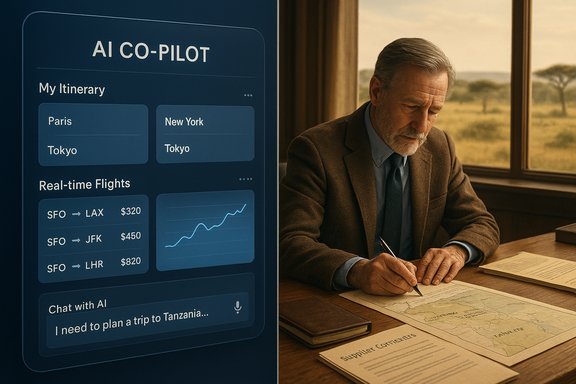 Background / Overview
The last 24 months have seen core travel players embed generative AI into mainstream flows rather than treat it as novelty. Booking.com expanded its AI Trip Planner from a U.S. beta into multiple markets and languages, integrating conversational discovery and itinerary drafts directly into its app. Expedia rolled out an alpha of “Romie,” an AI travel buddy that plans trips, helps book, and can act as a virtual concierge when things go wrong. Meanwhile, travel‑tech incumbents and GDS‑adjacent vendors are rebuilding back‑end engines and revenue systems around machine learning, and platform partners are enabling AI assistants to complete tasks on users’ behalf. This convergence — consumer-facing copilots + supply-side AI + action-capable agents — is what industry leaders call the agent era. The defining questions for advisors are no longer “will AI replace me?” but “how will I use AI to compress the technical, repetitive work so I can focus on value that only people can deliver?”What’s actually new: the product and platform picture
Booking sites and OTAs: built-in copilots and conversational discovery
Large OTAs have moved from simple chat widgets to full conversational trip planners that surface inventory, draft day‑by‑day itineraries, and link directly into bookings. Booking.com’s AI Trip Planner, first piloted in the U.S., was extended to markets including the U.K., Australia, New Zealand and Singapore, with local language rollouts planned — a sign that conversational discovery is now product‑grade, not experimental.- What this means for users: faster ideation, single‑threaded discovery (chat → results → booking), and itinerary drafts that previously required hours of manual research.
- What it means for advisors: commoditized entry tasks (lists, simple itineraries, first drafts) are now lower‑value; bespoke judgment remains premium.
OTA copilots and “travel buddies”: planning + in‑trip concierge
Expedia’s Romie is explicit about the scope shift: it can join group chats, parse intent, build or summarize itineraries, and propose reactive options (alternative hotels or airport hotels when flights are disrupted). Romie is being tested in EG Labs and is already integrated with smart search and cross‑channel flows — a textbook example of an AI system that blends planning and operational aids.Supply-side reinvention: pricing, revenue engines and decisioning
The distribution and airline revenue stacks are being retooled. Vendors are moving beyond rule‑based fare classes toward continuous, ML‑driven offer optimization and classless pricing in pilot deployments. Recent vendor product launches and announcements show that revenue engines and pricing systems are being built as AI‑native modules rather than layered bolt‑ons. These supply‑side changes matter because they change the constraints within which advisors and retailers operate (availability, dynamic bundles, micro‑targeted offers).Ecosystem integrations: agents that act
Platform-level assistants are getting the ability to act on behalf of users. Microsoft’s Copilot “Actions” feature — launched with partners that include Booking.com and Expedia among others — demonstrates early, broad production examples where an AI can perform web tasks for users (booking reservations, selecting flights, initiating purchases) with partner integrations. This is the bridge between suggestion and execution.Are travelers actually using AI? The adoption picture
Adoption is real and accelerating, particularly among younger cohorts. Surveys and analytics show a fast climb in AI‑assisted planning and AI‑driven referral traffic:- Consumer surveys show double‑digit adoption for travel planning — Matador’s sampling surfaced strong year‑over‑year growth in people using AI tools for trip planning, while Adobe analytics report that generative‑AI referral traffic to travel sites jumped dramatically and that a significant share of consumers have used generative AI for travel tasks.
- Industry polling of travel tech leaders places generative AI as a top priority for companies planning investments, with Amadeus’ sector report showing nearly half of travel tech leaders calling gen‑AI a top priority for the coming year. That mirrors vendor roadmaps that put AI at the center of product strategy.
What AI does best (today)
AI is already effective at several parts of the travel workflow:- Rapid ideation & narrowing choices. Natural language prompts collapse hours of browsing into concise, themed option lists.
- Micro‑planning at scale. Drafting day‑by‑day frames, mapping transit times, and surfacing policy/fee gotchas can be automated across many prospects simultaneously.
- Real‑time disruption handling. Agents can detect delays, surface rebooking options, and push itineraries or local alternatives faster than manual contact centers in some cases.
- Content, personalization and marketing at scale. Dynamic ad copy, localized content snippets, and personalized landing pages are low‑friction wins.
What human advisors do best — and will keep doing
There are domains where human skills remain decisive:- Contextual judgment. Humans read intangible trade‑offs — a client’s unsaid tolerance for long travel days, health and mobility constraints, or subtle cultural preferences — far better than an algorithm that lacks lived experience.
- Complex supplier choreography. Multi‑supplier journeys (private charters, timed park permits, migration‑sensitive safaris) require sequencing that tolerates zero‑margin for error. One missed connection can ruin a trip’s narrative arc.
- Accountability, advocacy and escalation. When rules and exceptions collide — refunds, medical incidents, or complex cancellations — clients want a named human champion who can call the operator, escalate, and follow through.
- Curated access and negotiation. Longstanding supplier relationships, insider room allocations, and negotiated inclusions remain differentiators for specialist advisors.
The Tanzania safari litmus test: a practical example
Ask an AI to draft a honeymoon safari timing Serengeti river crossings, securing a crater‑rim room with a genuine view, minimizing long transfer times in heat, and ending on a tide‑aware Zanzibar beach. The result will be a solid first draft — but a polished, specialist itinerary requires human nuance:- Align travel dates with the Serengeti’s regional micro‑patterns (river crossings migrate by corridor and year), not the coarse "July–September" window an AI might offer.
- Select lodges whose guiding philosophy, vehicle:guest ratios, and photographic access match the couple’s priorities for golden‑hour wildlife viewing.
- Balance Tarangire vs. Manyara for elephant density and biodiveristy without imposing punishing drive times for spa‑focused downtime.
- Handle the operational minutiae: bush‑flight baggage limits, visa windows, vaccine requirements, local flight schedules and contingency routing when weather or logistics intervene.
How top advisors are evolving — a pragmatic playbook
- Co‑pilot your pipeline: Use AI to pre‑qualify leads, segment by trip archetype, and draft tiered proposals; spend human time where it moves the needle.
- Operationalize disruption: Tie AI concierges to PNRs (passenger name records) to anticipate irregular operations and push curated options before the client calls.
- Own personalization: Combine CRM signals with AI to remember textures (sleep habits, scent sensitivities, mobility quirks) that transform “a trip” into “their trip.”
- Be the editor‑in‑chief: Let AI draft, but you curate, fact‑check, and elevate using lived expertise and supplier relationships.
- Productize expertise: Convert niche mastery (e.g., Great Migration logistics) into signature, marketable packages, then use AI to scale marketing, split‑testing, and personalization.
Risks, reality checks and governance
- Hallucinations & stale data. Generative models can produce confident but false facts. Always verify visa rules, local timetables, and safety material against primary sources; RAG (retrieval‑augmented generation) and provenance display help but are not foolproof.
- Over‑automation & experience erosion. Over‑reliance on AI can create soulless, frictionless trips that reduce referrals. Keep human touchpoints at moments that matter (proposal review, pre‑departure briefing, emergency escalation).
- Data governance & client privacy. Be explicit about what client data is used to personalize outputs and whether it trains third‑party models. Enterprise vendors increasingly publish non‑training clauses, but the ultimate accountability for client data use rests with you.
- Liability & consumer protection. As agents begin taking actions (bookings, payments) on users’ behalf, the legal and regulatory responsibility lines blur. Platforms and advisors must maintain audit trails and clear consent flows.
- Operational coupling risks. If GDS and revenue engines move to classless, AI‑driven pricing, price parity and distribution agreements must be renegotiated to avoid hidden availability or surprise buyer outcomes.
Cross‑checks and evidence (what I verified)
- Expedia’s Romie and its public feature set were announced at the EXPLORE conference and covered across multiple trade outlets; Romie is in alpha through EG Labs and emphasizes planning, group chat integration, and in‑trip support.
- Booking.com publicly documented expanding its AI Trip Planner beyond its initial U.S. beta into additional markets and languages as part of an October 30, 2024 product update.
- Amadeus’ report of October 2024 found generative AI to be a top priority for travel technology leaders, with roughly 46% calling it a top priority in their survey of senior tech decision‑makers. The report also flagged data security, talent shortages, and infrastructure as adoption barriers.
- Platform‑level actionability (Copilot Actions with booking partners) was documented in major tech coverage as Microsoft expanding Copilot’s ability to perform web tasks for users with partner integrations including Booking.com and Expedia.
- Vendor claims about AI‑native revenue engines and continuous pricing are emerging in supplier press — Sabre, for example, has announced AI‑native revenue optimization products and pilot partnerships intended to enable continuous pricing approaches; such claims require case study validation when estimating expected uplift.
- Adoption metrics from Matador and Adobe provide independent signals that consumer use of AI for travel planning is rising; these should be treated as indicative rather than definitive, because survey framing and sample frames vary.
The next 12–24 months: what to expect
- More action‑capable agents. Scoped, permissioned agents that can book, modify, and handle refunds on behalf of users will expand from labs into controlled production. Expect stronger authentication and consent UX around agent permissions.
- Deeper GDS / NDC integration. Distribution rails will be enhanced with ML‑driven offer construction and richer metadata; advisors must understand how offer attributes and ancillary bundling are generated.
- Ubiquitous embedding. AI will be in the UI everywhere — not labelled “AI” by users. Travelers will expect frictionless answers and instant alternatives; they’ll not ask “does it use AI?” — they’ll ask “does it just work?”
- Operational transparency pressure. Regulators and partners will demand provenance, audit trails, and remediation processes as more consumer transactions are initiated by agentic systems.
Practical checklist for advisors (immediately actionable)
- Require verification: never publish AI outputs to clients without a human sign‑off for anything that affects safety, compliance, or money.
- Build non‑training clauses into supplier contracts if using third‑party models with client PII.
- Instrument monitoring: measure AI‑drafted quote accept rate, error corrections, and client satisfaction separately to validate ROI.
- Preserve ritual touchpoints: keep a human check at the proposal review, pre‑departure briefing, and crisis handover.
Verdict: replace—or reshape?
AI is the industry’s autopilot, not the pilot. It compresses the “how” and exposes the “why” as the scarce part of travel advising. For complex, story‑driven journeys — the Tanzanian safari that times migration corridors, secures the right rooms and choreography, and finishes on a tide‑sensitive Zanzibar beach — the best outcome is an expert advisor paired with a capable AI co‑pilot: less friction, faster iteration, and more time spent obsessing over texture and timing.Those who win will pair machine speed with human nuance: using AI to automate the repetitive and amplify the personal, while retaining accountability and the craft that makes travel unforgettable.
If you want, next steps can include a practical vendor map for advisors (which OTA copilots to pilot, how to map PNR hooks to concierge flows, and a starter RAG architecture checklist), or a one‑page checklist to vet AI features before integrating them into an agency’s workflow.
Source: The AI Journal Is AI Replacing Travel Agents—or Reshaping Them? | The AI Journal
