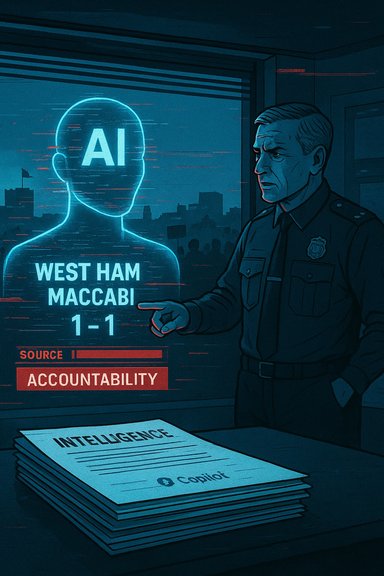
The West Midlands Police decision to advise Birmingham’s Safety Advisory Group (SAG) to ban Maccabi Tel Aviv supporters from attending a Europa League fixture at Villa Park has landed as a defining embarrassment for modern policing: a public-safety judgement built on weak, poorly documented intelligence and then amplified by a demonstrable artificial‑intelligence error. The Home Secretary has told Parliament she no longer has confidence in Chief Constable Craig Guildford after an inspectorate report found “a failure of leadership” and confirmation bias in how evidence was gathered and presented — including a fabricated reference to a non‑existent West Ham–Maccabi match that was later traced to Microsoft Copilot. This single episode has produced a cascade of consequences: reputational damage to West Midlands Police (WMP), questions about the governance of AI in public services, accusations of political and community partiality, and renewed debate about how police forces document and validate intelligence used to curtail civic freedoms.
Public bodies must therefore treat AI as a tool that changes epistemic workflows, not just a productivity boost. That requires investment in governance, training, auditing capabilities, and cultural change to recognise AI outputs as provisional unless independently verified.
The operational lesson is straightforward: do not let convenience become the mother of error. The political lesson is similarly stark: when policing touches identity‑charged international politics, transparency and robust engagement with affected communities are non‑negotiable. And the technological lesson is urgent: design and procurement must assume the worst‑case consequence of hallucination and build controls accordingly.
Source: The Week Who is to blame for Maccabi Tel Aviv fan-ban blunder?
 Background
What happened, in brief
In the autumn of 2025, Birmingham’s Safety Advisory Group — a multi‑agency body that includes policing representatives — classified the Europa League fixture between Aston Villa and Maccabi Tel Aviv as “high risk.” On that basis, it advised that away supporters should not be permitted to travel to Villa Park on 6 November. The decision was presented as a public‑safety measure driven by intelligence about potential violent clashes and disorder; it was controversial from the outset, prompting immediate political criticism and community concern. On the night of the match, policing operations proceeded without travelling Maccabi fans present; arrests and protests nonetheless occurred outside the ground.How the controversy escalated
What transformed a contested risk assessment into a political crisis was the discovery, during follow‑up scrutiny, that part of the intelligence dossier used to justify the ban included a reference to a Maccabi fixture against West Ham that had never taken place. That invented item became a focal point: press and parliamentary questioning revealed that the fictitious match had been included in police briefings and summaries, and the provenance of that error became central to inquiries. Initial testimony by senior WMP officers to MPs stated the false reference arose from an ordinary web search. That was later corrected: the erroneous claim was produced by an AI assistant — Microsoft Copilot — and had been incorporated into briefing material used to advise the SAG. Chief Constable Guildford apologised for the mistake in a letter to the Home Affairs Committee and accepted the role of AI in producing the error.The chronology: key moments
- October 2025: WMP presents its risk assessment to Birmingham SAG, which recommends barring Maccabi supporters from Villa Park.
- 6 November 2025: Aston Villa hosts Maccabi Tel Aviv; Maccabi fans do not travel; protests and arrests occur outside the ground despite a substantial policing presence.
- December 2025 – January 2026: Media reporting and parliamentary scrutiny uncover inconsistencies in the intelligence dossier, including the fabricated West Ham match. Initial denials that AI had been used are followed by Guildford’s apology admitting an officer used Microsoft Copilot.
- 14 January 2026: The Home Secretary tells the Commons she no longer has confidence in the chief constable after receiving a watchdog report highlighting leadership failures and poor intelligence validation.
How an AI “hallucination” entered a policing dossier
What we mean by hallucination
In the context of large language models and generative assistants, a hallucination is an output that is plausible‑sounding but factually incorrect or fabricated. These systems are statistical pattern matchers: they produce coherent prose by predicting the next token based on training and context, which can result in invented facts, spurious citations, or misplaced timelines if prompts or ground‑truthing are insufficient. When such output is not treated as provisional, it can be mistaken for verified intelligence.How Copilot’s output became operational
According to WMP’s later admission, an officer used Microsoft Copilot as part of open‑source research on social media and past incidents involving Maccabi fans. The tool generated a reference to a West Ham fixture that did not occur. That item was not caught in subsequent checks and migrated into the intelligence product used to advise Birmingham SAG. Chief Constable Guildford initially told MPs that no AI was used and that the error had been a Google search; he has since apologised, saying his earlier understanding was honestly held but incorrect. This sequence — AI output, human failure to verify, inclusion in an operational briefing, and public reliance on the briefing — highlights a governance gap: the force lacked mandatory verification steps for AI‑derived findings in high‑impact decisions.Who is to blame?
Assigning blame requires separating proximate causes from systemic failures. In this case there are multiple, overlapping responsibilities.1) Operational responsibility: West Midlands Police officers and analysts
The immediate error — an AI‑generated falsehood entering an intelligence dossier — rests with the personnel who conducted the research, packaged the briefing, and failed to verify it. Organisationally, that points to analysts and line managers who should have checked primary sources, traced claims to original material, and documented provenance. The inspectorate report cited an “absence of intelligence” in crucial areas; intelligence claims that cannot be traced to primary evidence should never drive restrictions on civil liberties. The force’s failure to follow established verification procedures — or the absence of such procedures for AI‑assisted work — is a direct operational failure.2) Leadership failure: senior officers and decision makers
Senior leaders — including the chief constable and assistant chief constable — bear responsibility for the systems and culture that allowed an unchecked AI output to be treated as intelligence. Leadership must set standards for documentation, verification, and risk‑based decision making. The Home Office inspectorate found “a failure of leadership” and confirmation bias in the force’s approach: rather than seeking out robust evidence, the force reportedly privileged items that supported a predetermined position to recommend a ban. That selection bias is a leadership and governance issue.3) Governance gaps: Safety Advisory Group and partners
Birmingham’s SAG — a multi‑agency forum that included WMP representatives — ratified a recommendation rooted in the police’s assessment. SAG members, including local authority officials and other stakeholders, share a duty to demand evidential transparency for decisions that curtail rights or movement. The SAG’s acceptance of the assessment without independent scrutiny of its provenance is a procedural weakness. Critics argue the SAG did not adequately test or seek primary documentation before issuing a decision affecting fans’ attendance.4) Technology and vendor role: Microsoft Copilot and product design
There is a layered responsibility for vendors of generative AI. Tools that produce assertive factual statements without source tags or provenance metadata create risks for operational use in the public sector. Microsoft’s Copilot integrates generative assistive features into widely used workflows; when those outputs are used in high‑stakes decisions, vendors must ensure mechanisms for provenance, confidence scoring, and guarded outputs that clearly flag speculative content. That said, operational deployments must pair vendor features with internal human‑in‑the‑loop controls — responsibility is shared, not shifted entirely to the company.5) Political and community context
Some critiques emphasize the broader political context: the decision occurred against a backdrop of tensions over Israel/Palestine, vigorous local campaigning, and contested community narratives. Media and commentators have argued that pressure from certain community groups, or fear of confrontations with pro‑Palestine demonstrators, influenced risk assessments. Whether those pressures equate to culpability is a complex judgment; what is clear is that policing in such charged contexts requires even higher standards of impartial evidence and community engagement to avoid perceptions of bias. The inspectorate found limited engagement with Birmingham’s Jewish community before the SAG decision, which is itself a failing.Evidence failures: what the watchdog found and what remains uncertain
The independent inspection that precipitated the Home Secretary’s loss of confidence highlighted several problems: confirmation bias, weak documentation, insufficient community engagement, and the insertion of at least one AI‑generated error into the intelligence narrative. Those are serious failings when a policing product is used to recommend restricting the right of a large group to travel to a sporting event. The inspectorate’s critique focused less on motive than on process: the wrong answer emerged from weak process, not demonstrable malicious intent. That said, some contested points remain politically charged and, in places, contested by different parties. For example, WMP originally said Dutch police had identified Maccabi fans as instigators in Amsterdam; Dutch authorities’ accounts and other documentation suggest the reality of those clashes was more complex and that many injured were Maccabi supporters themselves. Where foreign police accounts were used as supporting evidence, the subsequent erosion of that narrative undermined confidence in the force’s judgement. These layers of contestation are now being evaluated by continuing inquiries and media scrutiny.Accountability and the politics of dismissal
The Home Secretary said she no longer has confidence in Chief Constable Guildford, but she does not have the administrative power to sack him; that authority sits with the Police and Crime Commissioner (PCC), who appointed Guildford. The PCC — and political actors across the spectrum — are now under pressure to act. Guildford has said he will seek due process and has “lawyered up,” signalling he intends to contest any attempt to remove him. The tension between political accountability, operational independence of policing, and public expectations of leadership is now in full view. This episode also feeds a larger debate about whether ministers should have clearer powers to intervene in chief constable appointments and removals — a constitutional and political question with substantial implications for policing independence.Practical lessons: fixing the mechanics of intelligence in a generative‑AI era
This debacle spotlights operational controls that public bodies must adopt immediately to prevent recurrence. The technical and procedural recommendations are not exotic; they are practical fixes that align governance with emerging technology risks.- Establish a mandatory AI‑use policy: forces must explicitly identify permitted tools and ban ad hoc consumer‑grade assistants for intelligence production unless logged, approved and auditable.
- Require provenance and evidence trails: any factual claim used to limit rights must be traceable to primary sources with documented links, screenshots or authenticated reports.
- Human‑in‑the‑loop verification: institute a two‑person verification rule for high‑impact decisions, where a separate analyst must independently confirm relevant claims.
- Audit logs for tools and prompts: record the prompts, model version, user ID and timestamp for any AI query that contributes to public reports. This creates an auditable chain of custody.
- Red team review: before recommending civil‑liberty curtailments, run adversarial tests seeking evidence that contradicts the risk assessment to minimise confirmation bias.
The vendor angle: what responsibility do AI companies bear?
Generative AI vendors must design for use cases that include safety‑critical public sector workflows. That implies:- Visible provenance: models used in operational settings should provide explicit citations and linkable sources rather than plausible, unattributed narrative.
- Confidence indicators: systems should flag outputs that are low‑confidence or speculative.
- Enterprise controls: administrative features to block or tag outputs intended for external reporting.
Political and community consequences
Beyond immediate personnel consequences, the incident has lasting consequences for the relationship between police and the communities they serve. Jewish groups complained of inadequate engagement before the ban; other community actors argued that local safety concerns were being downplayed. The perception that the force’s judgement was shaped, even subconsciously, by fears of confronting pro‑Palestine demonstrators has fuelled accusations that the ban reflected political reticence rather than impartial risk assessment. Rebuilding trust will require transparent remedial steps, independent oversight, and substantive engagement with affected communities.Broader implications for public services
This episode is an early cautionary tale about the interplay of generative AI and public‑sector decision making. When AI encounters high‑stakes contexts — policing, courts, immigration, health — the cost of a fabricated assertion can be large: reputational damage, restriction of civil liberties, and erosion of public trust.Public bodies must therefore treat AI as a tool that changes epistemic workflows, not just a productivity boost. That requires investment in governance, training, auditing capabilities, and cultural change to recognise AI outputs as provisional unless independently verified.
Balancing accountability: scapegoat vs systemic reform
There is a natural appetite for a single villain in crises: the officer who failed to check, the chief who misled Parliament, the AI that hallucinated. But the more important question is structural: why did a generated error pass through multiple layers without detection? Single dismissals can satisfy immediate accountability demands, but they do not rewrite the protocols, toolsets and cultures that allowed the failure. A credible reform program must combine individual accountability where warranted with institutional fixes — stronger policies, audit trails, improved training, and procurement standards for AI tools used in closed operational workflows.Immediate next steps and likely outcomes
- Internal reforms inside West Midlands Police: expect explicit AI‑use policies, new verification protocols and personnel changes at middle management levels.
- PCC and political scrutiny: the Police and Crime Commissioner will face pressure to act on the chief constable’s future; the Home Secretary’s loss of confidence increases political heat.
- Wider regulatory attention: Parliament and inspectorates will likely push for sector‑wide guidance on generative AI in public services, including mandatory auditability and provenance in intelligence workflows.
Final analysis: what this episode reveals about modern policing
This affair exposes an uncomfortable truth: policing increasingly depends on rapid, digitally mediated information flows in contexts of political intensity. That places a premium on epistemic discipline. AI can help analysts find patterns and summarise vast troves of open‑source material, but it cannot substitute for primary evidence or the ethical obligation to protect civil liberties.The operational lesson is straightforward: do not let convenience become the mother of error. The political lesson is similarly stark: when policing touches identity‑charged international politics, transparency and robust engagement with affected communities are non‑negotiable. And the technological lesson is urgent: design and procurement must assume the worst‑case consequence of hallucination and build controls accordingly.
Conclusion
Blame in the Maccabi Tel Aviv fan‑ban blunder is shared: an AI tool produced a fabricated assertion, officers and analysts failed to verify it, senior leaders did not ensure sufficient evidential rigour, and a multi‑agency advisory group accepted a recommendation without the necessary provenance. But focusing solely on a single point of failure misses the structural lesson: the combination of high‑stakes decision making, weak documentation standards, limited community engagement, and the operational adoption of generative AI without governance creates systemic fragility. Correcting that fragility requires policy change, technological guardrails, and cultural reform inside policing and across public services. Only by treating AI outputs as provisional and insisting on auditable, source‑level verification for any claim that restricts rights can institutions avoid letting a single hallucination metastasise into a national scandal.Source: The Week Who is to blame for Maccabi Tel Aviv fan-ban blunder?