

Every time a company announces a new data center or a chat window suggests “Draft with Copilot,” an invisible ledger updates: more compute, more cooling, more capital — and, increasingly, higher costs passed beyond the hyperscalers to ordinary electricity customers and hardware buyers. The argument that “if you don’t like AI, just don’t use it” has become hollow for many consumers who never clicked an AI prompt but are still seeing the ripple effects in their bills and on store shelves. That’s the core grievance that Windows Central raised — and the data backing it up is now hard to ignore. Why the “AI tax” argument has traction
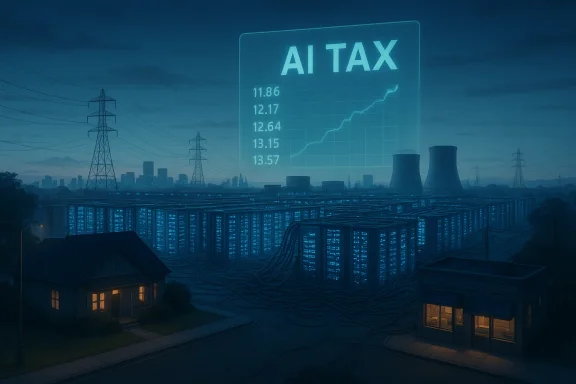
The debate over whether everyone is effectively paying an “AI tax” crystallized after a high-profile research brief and follow-up coverage showing that AI-driven data-center buildouts are already shaping electricity markets and consumer costs. A widely reported Goldman Sachs note, summarized by the Financial Times and other outlets, found that electricity prices rose roughly 6.9% year‑over‑year through December 2025 — well above headline inflation — and attributed a meaningful share of that rise to the surge in data-center demand driven by generative AI workloads. The report models scenarios where part of the incremental infrastructure and operating cost for data centers ends up being borne by non‑AI customers; in some plausible cases, electricity inflation could be considerably higher.
At the same time, chipmakers and component suppliers are reorienting capacity toward high‑bandwidth memory (HBM) and accelerators that feed AI training and inference pipelines, tightening supplies for the DRAM and NAND used in consumer devices. That squeeze has sparked warnings from major corporations and prompted inventory and pricing moves that ripple through PC makers, console manufacturers, phone vendors, and small businesses. Independent reporting and industry commentary have started to label the phenomenon “RAMmageddon.”
Put simply: AI is not just a software feature in the cloud. It’s a capital‑intensive industrial buildout that consumes land, chips, and electricity at scales that can affect markets for ordinary people.
These are not apocalyptic numbers in macro terms, but they are meaningful for households and small businesses already stretched by broader cost pressures. And as Goldman points out, the regional distribution of these costs matters — communities that house dense clusters of hyperscaler datacenters will feel a proportionally larger local impact.
That raises political and ethical questions: should society underwrite private compute-intensive experimentation? If private companies gain commercial value from services that require large public‑good inputs (grid capacity, transmission corridors), what obligations should they accept in return?
Public policy must catch up with the scale of private ambition. Utilities and regulators need to redesign rate frameworks, fast‑track grid upgrades, and require enforceable community benefits so that the cost of private compute does not become a regressive tax on households and small businesses. Hyperscalers and chipmakers should step beyond PR pledges and into verifiable commitments — backed by contracts, third‑party audits and public filings — that align private returns with public costs.
If AI will demand tens of gigawatts of power and reshape our economies over the coming decade, we have two options. We can let the market allocate costs haphazardly, producing concentrated private gains and dispersed public pain. Or we can design rules, contracts and investments so that the benefits are shared and the burdens are borne by those who profit most. The industry and policymakers should pursue the latter; anything less would be a quiet extraction of value from the many to concentrate it in the few — and that is precisely what critics mean when they say they’re tired of being told they can “just not use AI.”
Source: Windows Central https://www.windowscentral.com/soft...s-ai-im-already-paying-for-it-and-so-are-you/
The debate over whether everyone is effectively paying an “AI tax” crystallized after a high-profile research brief and follow-up coverage showing that AI-driven data-center buildouts are already shaping electricity markets and consumer costs. A widely reported Goldman Sachs note, summarized by the Financial Times and other outlets, found that electricity prices rose roughly 6.9% year‑over‑year through December 2025 — well above headline inflation — and attributed a meaningful share of that rise to the surge in data-center demand driven by generative AI workloads. The report models scenarios where part of the incremental infrastructure and operating cost for data centers ends up being borne by non‑AI customers; in some plausible cases, electricity inflation could be considerably higher.
At the same time, chipmakers and component suppliers are reorienting capacity toward high‑bandwidth memory (HBM) and accelerators that feed AI training and inference pipelines, tightening supplies for the DRAM and NAND used in consumer devices. That squeeze has sparked warnings from major corporations and prompted inventory and pricing moves that ripple through PC makers, console manufacturers, phone vendors, and small businesses. Independent reporting and industry commentary have started to label the phenomenon “RAMmageddon.”
Put simply: AI is not just a software feature in the cloud. It’s a capital‑intensive industrial buildout that consumes land, chips, and electricity at scales that can affect markets for ordinary people.
 Overview: What the numbers say
Electricity inflation and macro spillovers
Goldman Sachs’ research — as reported by the Financial Times and Fortune — found that electricity prices increased by about 6.9% year‑over‑year through December 2025, compared with a 2.9% PCE inflation rate over the same period. Their modeling estimates that, in a baseline scenario where hyperscalers cover about two‑thirds of incremental datacenter-related capex and other customers bear the rest, electricity inflation would remain elevated (roughly 6% in 2026–2027). If regulators or market structures shift more capex burden onto non‑AI customers, electricity inflation could climb toward 8% for a time. Goldman’s economists also quantify knock-on effects: reduced disposable income, a 0.2 percentage‑point drag to consumer spending growth in 2026–2027, and roughly a 0.1 percentage‑point drag to GDP growth in the same window.These are not apocalyptic numbers in macro terms, but they are meaningful for households and small businesses already stretched by broader cost pressures. And as Goldman points out, the regional distribution of these costs matters — communities that house dense clusters of hyperscaler datacenters will feel a proportionally larger local impact.
Compute, density and “10 gigawatts” ambition
The scale of compute being discussed is now measured in gigawatts for the industry’s most ambitious plans. OpenAI CEO Sam Altman publicly framed one extreme: the idea that with “10 gigawatts of compute” AI might unlock societal breakthroughs like curing cancer or delivering universal tailored tutoring. That ambition is not just rhetorical: it signals an intent to build data‑center campuses and interconnects at city‑scale power footprints, which necessarily implicates electric utilities, transmission bottlenecks and permitting regimes. Multiple outlets have reported on Altman’s “10‑gigawatt” framing as a real planning target for future AI infrastructure.The supply‑side story: memory, GPUs and the consumer tech squeeze
Memory demand is the new bottleneck
Several industry sources and investigative reports show vendors pivoting wafer capacity toward HBM (the specialized stacked DRAM used by AI accelerators) while reducing the proportion of capacity for commodity DRAM and NAND. The result: consumer‑grade memory and storage availability is tightening, and prices have spiked. Analysts and manufacturers describe an imbalance so severe that Apple, Tesla and others publicly warned of constrained production lines and squeezed margins. Bloomberg and other reporting — summarized in international press outlets — indicate DRAM prices surged late 2025 into 2026, with HBM demand crowding out legacy DRAM for phones and PCs. That’s the technical mechanism behind the everyday impact users see (higher laptop prices, intermittent availability of devices like Valve’s Steam Deck, and potential console timing changes).GPUs, cloud capacity and reallocation
The hyperscalers and AI labs buy high‑end accelerators in massive quantities — often custom rack systems packed with HBM and tens of GPUs per rack. While companies like NVIDIA have clarified they manage supply carefully, the effective reallocation of wafer and packaging capacity to data‑center grade accelerators reduces the availability of components for consumer GPUs and drives up retail prices. Industry reporting shows downstream effects: PC OEMs stockpiling memory, Valve warning of intermittent Steam Deck supply, and console makers reconsidering launch windows or price points for next‑generation hardware. These aren’t hypothetical impacts; they’re already being observed in inventory signals and vendor statements.Corporate responses and the politics of “not my bill”
Microsoft’s “Community‑First” pledge
Microsoft’s January 2026 "Community‑First AI Infrastructure" initiative explicitly attempts to square the circle: it promises to “pay our way to ensure our datacenters don’t increase your electricity prices,” pledge water neutrality, create local jobs, and pay full local taxes. Microsoft framed the plan as a set of five commitments aimed at avoiding the public bearing the costs of AI infrastructure. That statement was widely covered and has become the template many expect other hyperscalers to mirror — or be judged against. But promises and enforcement are different things; the plan’s credibility depends on regulatory behavior, utility rate design and contract transparency.PR pledges vs. market incentives
A single company’s promises can be meaningful locally — a hyperscaler committing to pay higher rates and full taxes can blunt political opposition in a host county. But the broader problem is systemic: utilities, regulators and market rules currently allocate costs and risks in ways that can leave residential and small‑business customers exposed if incumbents successfully seek cross‑subsidized rates, or if grid upgrades and generation investments are financed via general rate base increases. Microsoft can choose to pay more, but the incentives to secure cheaper power or tax concessions remain powerful across the industry, and not every player will make the same public commitment. Reporters and policy analysts have already flagged this tension.How this matters to everyday people
Direct channels: your electricity bill and local services
Higher electricity prices show up a few ways:- As a larger line item on the household utility bill when overall wholesale and retail electricity prices rise.
- As higher operating costs for local businesses (bakeries, laundromats, clinics), which are often passed onto consumers through price increases.
- As a drag on disposable income, particularly for low‑income households for whom energy is a greater share of monthly spending. Goldman Sachs’ models make this explicit: the aggregate impact on consumer spending is modest in macro terms but concentrated and regressive in distribution.
Indirect channels: hardware, services and opportunity cost
When DRAM and NAND availability is constrained, manufacturers stockpile or reprice. The effects include:- Higher laptop and smartphone prices because the bill‑of‑materials has become more expensive.
- Longer lead times or intermittent stock for gaming consoles and handhelds (Steam Deck, some PS/Xbox supply variants).
- Deferred innovation cycles when OEMs push product launches to avoid selling at unprofitable prices or to wait for cheaper components.
Risks, trade‑offs and ethical questions
Environmental and grid‑resilience risk
AI datacenters are energy‑intensive, and concentrated clusters can stress local transmission and distribution systems. That raises two worries:- Short‑term stress from capacity constraints and peak loads, which can increase outage risk and force utilities to use higher‑emitting marginal generation.
- Long‑term allocation decisions: if the buildout accelerates faster than transmission upgrades, communities may face protracted service reliability and environmental tradeoffs.
The inequality of benefits and costs
The benefits of AI (efficiency gains, productivity, potential medical breakthroughs) are real but concentrated in a handful of mega‑cap firms and industrial buyers. The costs — higher electricity bills, pricier gadgets, and dislocated local infrastructure — are diffuse and disproportionately borne by consumers, small businesses and communities hosting datacenters.That raises political and ethical questions: should society underwrite private compute-intensive experimentation? If private companies gain commercial value from services that require large public‑good inputs (grid capacity, transmission corridors), what obligations should they accept in return?
Security, misuse and governance
Beyond economic externalities, AI also introduces non‑economic risks: disinformation, poisoned datasets, security vulnerabilities, and privacy erosion. Those harms, combined with the material costs, strengthen the case for governance mechanisms that go beyond voluntary corporate commitments. As Microsoft itself conceded in its blog and elsewhere, AI systems have failure modes and externalities that require oversight and technical controls.What can — and should — be done
Practical policy and market levers
Governments, regulators and utilities have tools to realign incentives so the burden isn’t unfairly shouldered by households:- Utility rate design and “very large customer” tariffs: regulators can require hyperscalers to take discrete tariff classes that reflect their unique demand profiles and network impact, rather than allowing costs to be pooled into general retail rates. Microsoft signaled it will ask utilities to set such rates; regulators can make that mandatory rather than voluntary.
- Conditional approvals and community benefit agreements: local permitting can require developers to sign enforceable commitments (e.g., local tax floors, workforce investments, community energy funds) as a condition of siting approvals.
- Targeted relief for low‑income households: if electricity prices rise, direct subsidies (lifeline rates, bill credits) can protect the most vulnerable while the system transitions.
- Fast‑track grid investment and transmission planning: the slow pace of permitting is a structural mismatch with AI’s pace of growth. Dedicated federal and state programs to speed interconnection and transmission would reduce localized price shocks.
Corporate accountability and technical fixes
Hyperscalers and chipmakers can also act:- Contract discipline: explicit long‑term power purchase agreements (PPAs) tied to new generation can avoid short‑run price shocks.
- Efficiency investments: designing datacenters with higher PUE (power usage effectiveness), liquid cooling and AI‑driven thermal management reduces marginal energy needs per unit of compute.
- Supply‑chain investment in HBM/DRAM/NAND capacity: chipmakers and industrial policy can accelerate fab builds and packaging capacity to relieve consumer pain faster.
- Transparent reporting: public disclosure of expected power demand, water use and tax contributions would make promises verifiable and accountable. Microsoft’s blog calls for transparency; independent reporting and regulatory filings should follow.
What consumers can do (short of stopping AI overnight)
Realistically, the era of large-scale AI infrastructure is underway. For consumers worried about immediate effects:- Budget for energy: where possible, reduce discretionary electricity use during peak periods and switch to time‑of‑use plans if they provide savings.
- Prioritize purchases: if memory and storage prices are rising, buy devices when sales or stable inventory appear rather than chasing speculative low prices.
- Engage locally: community forums and local regulators are where datacenter approvals are decided; citizen input can shape community benefit conditions.
- Advocate for policy: support regulatory reforms that require transparency and protect residential ratepayers from bearing disproportionate costs.
What’s speculative and what’s verified
- Verified or strongly supported claims:
- Electricity inflation of roughly 6.9% year‑over‑year through December 2025 was reported by Financial Times summarizing Goldman Sachs analysis; Goldman projects notable macro spillovers.
- Microsoft publicly committed to a “Community‑First AI Infrastructure” plan promising not to raise local household electricity bills via its datacenter activities. That pledge was made in a Microsoft blog post and covered widely.
- Industry reporting and vendor notices confirm memory (DRAM/HBM) pressure and component allocation shifts toward AI accelerators, producing higher prices and intermittent availability of some consumer devices. Multiple outlets characterize this as a structural shortage driven in part by hyperscaler demand.
- Sam Altman’s “10 gigawatts” framing for compute ambition is a public statement in OpenAI commentary and covered in multiple outlets.
- Claims that require caution or remain partially unverifiable:
- Specific product‑launch delays (e.g., PlayStation 6 definitively moving to 2029) are based on reporting from suppliers and unnamed sources; Sony’s internal calendar can change and the company has not publicly confirmed final dates. Treat such timeline reports as plausible but fluid.
- Attributing a fixed percentage of electricity inflation solely to AI is challenging; Goldman Sachs provides modeling assumptions and scenarios, but disentangling AI from other drivers (fuel prices, weather, transmission constraints) requires careful econometric attribution. Goldman’s scenarios are the best available large‑scale estimate but still depend on key assumptions.
Conclusion — A fair bill for a shared future
The debate is often framed as values vs. convenience: AI’s promise to accelerate medicine, education and productivity on one side, and the nuisance of unwanted assistant popups and subscription fees on the other. But framing it as an individual choice (“don’t use AI if you don’t want to pay”) misses the structural reality: AI’s buildout imposes externalities that are shared across society. That means the answers can’t be only technological or only individualistic; they must be systemic.Public policy must catch up with the scale of private ambition. Utilities and regulators need to redesign rate frameworks, fast‑track grid upgrades, and require enforceable community benefits so that the cost of private compute does not become a regressive tax on households and small businesses. Hyperscalers and chipmakers should step beyond PR pledges and into verifiable commitments — backed by contracts, third‑party audits and public filings — that align private returns with public costs.
If AI will demand tens of gigawatts of power and reshape our economies over the coming decade, we have two options. We can let the market allocate costs haphazardly, producing concentrated private gains and dispersed public pain. Or we can design rules, contracts and investments so that the benefits are shared and the burdens are borne by those who profit most. The industry and policymakers should pursue the latter; anything less would be a quiet extraction of value from the many to concentrate it in the few — and that is precisely what critics mean when they say they’re tired of being told they can “just not use AI.”
Source: Windows Central https://www.windowscentral.com/soft...s-ai-im-already-paying-for-it-and-so-are-you/
