

Artificial intelligence is no longer a novelty for technophiles — in 2026 it has woven itself into the daily routines of children, working adults, caregivers, and seniors, quietly automating chores, personalizing learning and health support, and turning complex tasks into simple conversations with a device or application.
Across homes, schools, factories, and care facilities, AI assistants and copilots have gone from experimental tools to everyday helpers. These systems—ranging from voice agents that manage smart homes to domain-specific copilots that draft lesson plans or diagnose machine faults—are redefining productivity and accessibility for people of all ages. Many of these improvements are visible through Microsoft-centered deployments (Windows and Azure ecosystems), industry partnerships, and research projects aimed at narrowing digital divides. The result is a landscape where people spend less time wrestling with repetitive tasks and more time on creativity, relationships, and high-value work. ps://www.microsoft.com/en-us/research/blog/teachers-in-india-help-microsoft-research-design-ai-tool-for-creating-great-classroom-content/)
This feature examines how AI is easing daily life in 2026, the technologies powering those changes, real-world examples, measured benefits, and the risks every user and organization must manage.
Two practical shifts stand out:
Enterprise examples show measurable gains: companies that automate proposal generation, customer support triage, or routine maintenance planning see significant time savings and faster respoent from task assistance to workflow orchestration is what separates novelty features from systemic productivity gains.
Why it matters:
Measured benefits include:
These enablers together explain why people now trust AI to handle routine tasks: the systems are both smarter and more controllable than previous generations.
Practical mitigations:
Key principles for equitable deployment:
But the story is not one of unalloyed triumph. Hallucinations, privacy gaps, and unequal access remain real problems that require technical fixes, policy guardrails, and ongoing human oversight. The sensible path forward is pragmatic: adopt AI thoughtfully, measure outcomes, and keep people—not just automation—at the center of design.
In short: AI in 2026 is powerful, useful, and imperfect. Used responsibly, it makes daily routines easier for people of all ages; neglected, it creates new risks that are avoidable with careful stewardship.
Source: Mix Vale Artificial intelligence makes daily routine easier for people of all ages in 2026
 Overview
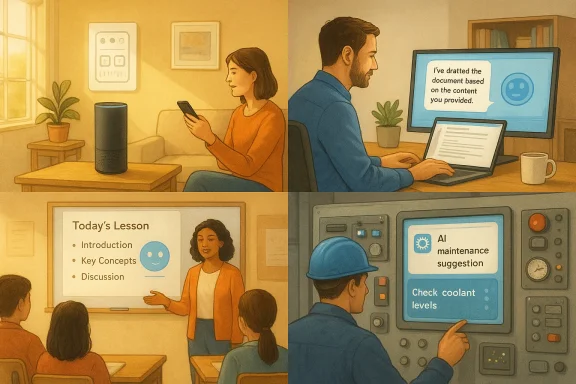
Across homes, schools, factories, and care facilities, AI assistants and copilots have gone from experimental tools to everyday helpers. These systems—ranging from voice agents that manage smart homes to domain-specific copilots that draft lesson plans or diagnose machine faults—are redefining productivity and accessibility for people of all ages. Many of these improvements are visible through Microsoft-centered deployments (Windows and Azure ecosystems), industry partnerships, and research projects aimed at narrowing digital divides. The result is a landscape where people spend less time wrestling with repetitive tasks and more time on creativity, relationships, and high-value work. ps://www.microsoft.com/en-us/research/blog/teachers-in-india-help-microsoft-research-design-ai-tool-for-creating-great-classroom-content/)This feature examines how AI is easing daily life in 2026, the technologies powering those changes, real-world examples, measured benefits, and the risks every user and organization must manage.
Background: why 2026 feels different
The last few years accelerated three converging forces: vastly improved language models and specialized AI agents, enterprise-ready cloud platforms with integrated safety controls, and broad user adoption driven by simpler, conversational interfaces. Those elements have produced tools that feel natural to ryone — from a teenager composing a video script to a factory technician debugging a PLC program in plain language.Two practical shifts stand out:
- The move from single-purpose bots to multi-step, context-aware agents (so-called AI agents or copilots) that can plan, act, and coordinate across apps.
- The maturation of grounding techniques like Retrieval-Augmented Generation (RAG) and domain-adapted models that reduce factual errors by connecting generative outputs to verified source data.
How AI is simplifying daily routines — by context
At home: voice-first, hands-free convenience
For many households, a voice assistant no longer just plays music or sets timers. Integration between smart-home devices, calendars, and health reminders allows seniors and busy families to manage environments and routines through natural speech. AI automations configure home lighting, heating, and reminders based on daily patterns, while linked services handle grocery lists, recipe planning, and even simple household finances.- Hands-free controls reduce physical strain and fall risk for people with mobility issues.
- Conversational AI helps users who struggle with complex menus or smaller screens.
- Smart reminders and connected pill dispensers address medication adherence.
Work and productivity: copilots that finish the boring parts
At work, AI copilots are embedded into office suites, messaging platforms, and industry-specific apps to automate repetitive tasks: summarizing long email threads, drafting presentations, extracting insights from spreadsheets, and generating boilerplate documents. For Windows users, this is especially tangible; AI features are being integrated into familiar workflows so that users don’ools to benefit. These copilots act as first-draft generators that save time and reduce friction while leaving final edits to human judgment.Enterprise examples show measurable gains: companies that automate proposal generation, customer support triage, or routine maintenance planning see significant time savings and faster respoent from task assistance to workflow orchestration is what separates novelty features from systemic productivity gains.
Education: lesson plans, differentiated instruction, and faster grading
AI copilots tailored for education can produce age-appropriate lesson plans, generate quizzes, and suggest learning activities aligned with local curricula. Project deployments in 2024–2025 demonstrated dramatic time savings for teachers, reducing lesson-prep time from hours to minutes while helping create richer, multimedia learning experiences. These tools are purpose-built to interpret curriculum structure and adapt resources to classroom languages and contexts, tackling a chronic bottleneck in under-resourced schools.Health & caregiving: reminders, monitoring, and cognitive support
AI-powered monitoring systems and conversational companions support caregivers and people living with chronic conditions. From smart pill dispensers that prompt patients to take medicines to ambient systems that detect unusual motion patterns, AI reduces the cognitive and administrative load on family caregivers. Cognitive-stimulation apps and companion platforms also offer socially assistive experiences that can help reduce loneliness and support mental well-being in older adults. Research and pilot deployments show growing evidence that these technologies improve engagement and safety when thoughtfully deployed.Industry and infrastructure: copilots for complex, technical work
Generative AI copilots are now used to generate and debug industrial control code, to summarize long technical manuals, and to surface maintenance plans from historical logs and sensor data. Partnerships between major cloud providers and industrial OEMs have produced domain-specific copilots that reduce troubleshooting times from days to minutes, helping address labor shortages and speeding design cycles. Siemens’ Industrial Copilot, built in partnership with cloud providers, is an example of how AI is being engineered for safety, data control, and real-world industrial value.Case studies: real deployments, real impact
Shiksha Copilot — teachers in India save hours a week
Microsoft Research’s Project VeLLM produced Shiksha Copilot, designed to help government schoolteachers generate curriculum-aligned lesson plans in regional languages. Field pilots in Karnataka reported large reductions in preparation time and heightened classroom engagement, with teachers using the tool to produce activities, multimedia links, and assessment items quickly. The tool is built on cloud AI services and curriculum ingestion, demonstrating how domain-specific copilots can be localized and effective.Why it matters:
- Time savings: teachers report lesson planning that once took an hour now takes minutes.
- Localized content: the copilot aligns with local syllabi and languages, an essential factor for adoption.
Siemens Industrial Copilot — engineering at industrial scale
Siemens’ copilot ecosystem uses adapted language models and knowledge extracted from engineering platforms to help engineers generate, optimize, and debug automation code. The copilot reduces previously weeks-long tasks to minutes and supports maintenance staff with step-by-step repair guidance generated from equipment manuals and sensor data. This is an instance where AI shifts from assistant to accelerator in complex technical domains.Measured benefits include:
- Faster design iterations and reduced simulation time.
- Reduced mean time to repair (MTTR) through improved maintenance guidance.
Agriculture, public services, and “AI for good” pilots
Across the globe, pilots address problems as varied as aquaculture optimization and citizen services. Azure-powered copilots help Indonesian fish farmers optimize feeding schedules and environmental management to improve yields. Other local projects use AI agents to streamline university enrollment and reduce administrative backlogs, delivering measurable efficiency improvements for public services. These projects illustrate AI’s practical benefits when domain knowledge and data access align.The technology powering everyday AI in 2026
Model adaptation and grounding
To be useful beyond generic chat, copilots are adapted with domain-specific knowledge and pipelines that ground outputs in company documents, manuals, or curated data sources. Techniques like Retrieval-Augmented Generation (RAG) and fine-tuning on proprietary data reduce hallucinations and improve factuality. Enterprises increasingly use dedicated model layers and “knowledge validation” checks to prevent confident-but-wrong answers.Agent orchestration and multi-step workflows
Modern agents can plor example, collate meeting notes, extract action items, schedule follow-ups, and update a CRM automatically). This orchestration capability is the difference between a single-turn assistant and a productivity copilot that actually completes workflows.Cloud platforms, privacy controls, and edge capabilities
Cloud AI services provide scalable compute and governance. Many deployments allow customers to retain control over their data, run inference in private networks, or deploy lightweight models at the edge for latency-sensitive tasks and privacy-preserving local processing.These enablers together explain why people now trust AI to handle routine tasks: the systems are both smarter and more controllable than previous generations.
Risks, trade-offs, and the persistent problem of hallucinations
No technology is risk-free. As AI becomes more integrated into daily life, three categories of risk matter most: factual errors (hallucinations), privacy/data governance, and socio-economic impacts.Hallucinations — when fluency outruns truth
AI-generated outputs can sound authoritative while being incorrect. Academic studies and cross-model audits continue to show that hallucination rates vary by model, prompt, and domain; in sensitive domains like healthcare, even occasional falsehoods can be dangerous. Research in medical and clinical settings demonstrates that models remain vulnerable to adversarial prompts and can produce fabricated or unsafe recommendations if not properly constrained. This is why industry best practices emphasize grounding, abstention mechanisms (the model says “I don’t know”), and human review for high-stakes decisions.Practical mitigations:
- Use RAG and knowledge graphs to anchor answers in verifiable data.
- Introduce abstention and confidence reporting for uncertain queries.
- Keep humans in the loop for regulated workflows (medicine, law, finance).
Privacy and data governance
Embedding personal workflows into AI systems often requires that those systems access calendars, emails, sensor strea. Without robust governance, sensitive data can be exposed, misused, or leveraged to train models beyond intended scopes. Enterprises and platform providers are increasingly publishing compliance controls and data residency options, but implementation gaps and misconfigurations remain a concrete risk for families and institutions alike.Economic and labor considerations
Automation of routine work creates efficiency but also requires reskilling. Organizations must plan not simply for automation ROI but for workforce transitions: task redesign, upskilling, and new supervisory roles that oversee AI agents. Successful adopters treat copilots as augmenters, not replacements, and invest in retraining programs to maintain morale and safeguard institutional knowledge.Ethical and accessibility considerations
AI has strong potential to broaden access — for people with disabilities, for students in under-resourced schools, and for remote communities. Scholarly reviews and conferences in 2024–2025 emphasized both the promise and the digital divide: accessibility requires deliberate design, localization, and affordability. When those elements are present, AI-based assistive technologies produce meaningful improvements in independence and inclusion. But without careful policy and community involvement, gains will be uneven.Key principles for equitable deployment:
- Design with target users (co-creation with teachers, caregivers, or people with disabilities).
- Prioritize low-bandwidth and low-cost deployment paths.
- Maintain explainability and transparency about what the agent can and cannot do.
Best-practice playbook: how individuals and organizations should use AI in daily routines
For individuals- Treat AI outputs as drafts, not final authority. Verify facts for important decisions.
- Use privacy settings and prefer tools that offer on-device or private-instance options for sensitive data.
- Learn to craft effective prompts — a small investment in prompt literacy yields large productivity gains.
- Start with a clear pain point: automate concrete, repeatable tasks before trying to “AI-enable everything.”
- Implement grounding and verification layers for factual outputs.
- Train staff on oversight roles and create a review loop that measures error rates and user satisfaction.
- Ensure data governance policies align with regulatory requirements and user expectations.
- Promote AI literacy and critical evaluation skills in school curricula.
- Fund accessible pilot programs that prioritize underserved communities.
- Update consumer privacy protections and sectoral regulations for AI-driven services.
What to watch next: trends shaping the near future
- Domain-specific copilots will proliferate across more industries, from small-business accounting to municipal services.
- More robust model assurance frameworks will become mainstream, combining retrieval, verification, and human oversight to reduce hallucinations in practice.
- Edge and hybrid deployments will increase to satisfy privacy and latency needs in healthcare and home settings.
- Public policy will shift from rea governments recognize AI’s societal impacts on employment, privacy, and safety.
Critical assessment: strengths, weaknesses, and honest caution
Strengths- Productivity gains are real and measurable in multiple sectors: education, manufacturing, and public services show clear time and cost savings.
- Accessibility improvements are significant when AI is deliberately designed for local needs and languages.
- Seamless integration into familiar platforms (Windows, Office, cloud son barriers for older adults and non-technical users.
- Hallucinations remain a fundamental limitation of generative systems; mitigation is improving but incomplete, especially in high-stakes domains.
- Privacy and governance gaps can turn helpful assistants into vectors for unintended data exposure.
- Uneven access and local-language support risk leaving vulnerable populations behind unless explicit efforts address affordability and localization.
Practical checklist: adopting AI assistants responsibly (for families, teachers, and small businesses)
- Define the specific task you want to automate.
- Choose a tool with clear privacy controls and an option for local data retention.
- Runasure: time saved, error rates, user satisfaction.
- Train users on prompt best practices and verification steps.
- Establish a human review threshold for any outcome with safety, legal, or financial implications.
- Reassess monthly and ensure updates to the tool don’t introduce new data exposures.
Conclusion
By 2026, artificial intelligence has become a practical helper in daily life — folding itself into homes, classrooms, workplaces, and factories in ways that save time and expand capabilities. The difference from earlier waves of technology is that modern AI can be both conversational and contextual: it understands a user’s goals, connects to domain data, and executes multi-step workflows that used to require repetitive human labor. When implemented with attention to grounding, governance, and inclusion, these systems deliver tangible benefits for people of all ages: teachers who regain planning time, seniors who gain safer independence, and workers who offload tedious tasks to focus on higher-value work.But the story is not one of unalloyed triumph. Hallucinations, privacy gaps, and unequal access remain real problems that require technical fixes, policy guardrails, and ongoing human oversight. The sensible path forward is pragmatic: adopt AI thoughtfully, measure outcomes, and keep people—not just automation—at the center of design.
In short: AI in 2026 is powerful, useful, and imperfect. Used responsibly, it makes daily routines easier for people of all ages; neglected, it creates new risks that are avoidable with careful stewardship.
Source: Mix Vale Artificial intelligence makes daily routine easier for people of all ages in 2026
