

The gaming industry’s simmering debate about generative AI erupted into public view this month when an awards season juggernaut — a critically celebrated indie RPG — triggered a chain of denunciations, a rescinded prize from a niche awards body, and renewed calls for disclosure and limits on AI-assisted creation; the noise matters because it exposes a disconnect between how games are actually made today and the moral narratives some critics want to impose.
Indie auteurism and platform distribution collided at scale in 2025. A small French studio produced a tightly focused, story-first RPG that dominated year-end awards and quickly became the cultural shorthand for what a polished indie release can still achieve in a subscription era. That success amplified a second story: public reporting that the studio had used generative AI tools in parts of its workflow, and an awards organization that subsequently stated it would not tolerate AI use in submissions. The result was a social-media firestorm that drew platform operators, publishers, and leading developers into the argument.
Those two facts — indie breakthrough through subscription-driven reach, and evidence of AI in production — are both true and consequential. The former changed the playing field for discoverability; the latter changed expectations about provenance and authorship. Together they created a lightning rod that forced the industry to confront not whether AI will be used, but how transparently and fairly that use should be governed.
Two pragmatic consequences follow:
The lesson is not deterministic progress: CGI didn’t kill craft — it redefined and expanded it. Similarly, generative AI so far appears most powerful when it augments human craft (rapid concepting, iteration) rather than when it attempts to replace core artistic vision without governance. That history cautions against treating ICs (instrumental computing) as moral failings and instead encourages governance, attribution, and craft preservation.
At the same time, a vocal segment of the audience demands transparency and authenticity; platforms that provide labeling and provenance support help these players make informed choices and preserve trust. The market will likely segment between titles that wear their AI provenance transparently and titles that brand themselves as artisanal human-crafted experiences. Both will have customers.
The controversy that ignited headlines is useful because it forced those conversations into public view. The next task — for studios, platforms, and festivals alike — is to convert the debate into reproducible, auditable practices that protect creators, empower players, and let games continue to evolve as both technology and art.
Source: kmjournal.net Are AI-Made Games Off Limits? Inside a Debate the Industry Has Already Moved Past - KMJ
 Background: why the controversy landed so loudly
Indie auteurism and platform distribution collided at scale in 2025. A small French studio produced a tightly focused, story-first RPG that dominated year-end awards and quickly became the cultural shorthand for what a polished indie release can still achieve in a subscription era. That success amplified a second story: public reporting that the studio had used generative AI tools in parts of its workflow, and an awards organization that subsequently stated it would not tolerate AI use in submissions. The result was a social-media firestorm that drew platform operators, publishers, and leading developers into the argument.Those two facts — indie breakthrough through subscription-driven reach, and evidence of AI in production — are both true and consequential. The former changed the playing field for discoverability; the latter changed expectations about provenance and authorship. Together they created a lightning rod that forced the industry to confront not whether AI will be used, but how transparently and fairly that use should be governed.
Overview: the practical state of AI in game development
The industry is past the “experiment” phase. Multiple surveys and trade coverage show that AI has moved from isolated demos into day-to-day workflows: studios use large language models and image/texture generators for prototyping, localization drafts, QA triage, code assistance, and iteration on concept art. For many mid-size and indie teams, that adoption is pragmatic: AI accelerates routine work, lowers the cost of iteration, and lets small teams punch above their technical weight.- Common early/adoption uses:
- Code and productivity assistance (copilots, codebase Q&A) to reduce onboarding friction and speed refactors.
- Concept art and texturing for rapid ideation and first-pass art variants that artists then curate.
- Localization and QA support, where models produce drafts or triage bug reports.
The award revocation and the culture-war flashpoint
The awards controversy that ignited the wider debate was not just about a single trophy. It became a test-case for how the industry defines authorship and eligibility in an era when tools that assist creation have blurred authorship lines.- The indie title’s awards sweep prompted intense scrutiny about the creation pipeline and public statements by the studio’s team that generative AI had been used in parts of development. Media and fan outlets amplified those disclosures, sparking community calls for labeling and boycotts.
- Platforms and festivals responded by revisiting rules and disclosure requirements, arguing they needed to preserve “indie integrity” and avoid incentivizing undisclosed automation. Other platform operators and industry leaders countered that rigid bans would be out of step with reality, given wide adoption of AI tools for productivity.
Where the line actually is — and why it’s slippery
The debate founders on definitions. Practical questions that produced the most heat include:- Does an AI-assisted texture counted as an AI-made asset if an artist heavily retouches it?
- When an AI colors a human sketch, who is the author?
- If a studio uses AI for QA triage or to generate placeholder art that’s replaced later, does that count as AI production?
Two pragmatic consequences follow:
- Absolute prohibitions are brittle and enforceability is weak without deep, intrusive audits.
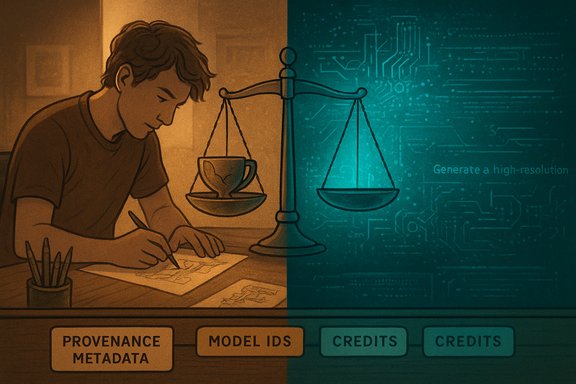
- Transparency policies — metadata, provenance tags, and clear credits — are more operationally feasible and less likely to punish legitimate, human-led craft.
Lessons from film: the CGI parallel
Film offers a useful historically grounded analogy: when computer-generated imagery (CGI) first appeared, critics argued it was not “real” art and it shouldn’t be treated the same as traditional effects. Within a generation, CGI became a fundamental tool of cinematic storytelling rather than an existential threat to human artistry.The lesson is not deterministic progress: CGI didn’t kill craft — it redefined and expanded it. Similarly, generative AI so far appears most powerful when it augments human craft (rapid concepting, iteration) rather than when it attempts to replace core artistic vision without governance. That history cautions against treating ICs (instrumental computing) as moral failings and instead encourages governance, attribution, and craft preservation.
Strengths and real opportunities
Generative AI offers measurable wins when used with clear guardrails:- Speed and iteration: assets, text, and code scaffolds appear faster, letting teams iterate on design problems without long lead times.
- Lowered entry barriers: small studios and solo creators can prototype more ambitious ideas quickly, democratizing certain aspects of development.
- New gameplay possibilities: procedural, player-personalized content and adaptive NPCs become feasible at scales previously unaffordable.
Risks and the legal/ethical problem set
Adopting generative tools at scale brings hard, solvable but serious risks:- IP and training-data exposure: models trained on broad internet corpora can reproduce copyrighted elements; studios must decide whether to rely on vendor models or curate licensed datasets.
- Workforce impacts: automation of low-level tasks like repetitive QA could shrink entry-level ladders into the industry unless studios invest in retraining and role evolution.
- Quality and hallucination risk: generative systems can produce confident yet incorrect outputs; left unchecked, those outputs can leak into shipped content.
- Concentration and vendor lock-in: a small set of model providers and clouds could capture the tooling stack, increasing strategic dependency for studios.
Platform policies and the disclosure imperative
Storefronts and platform holders are moving toward transparency measures rather than blanket bans. Recent policy shifts show a trend:- Platforms increasingly require developer disclosures about where and how AI was used in production pipelines, especially for author-facing assets.
- Some publishers and labels have taken opposite editorial stances — rebranding as AI-first or human-first to signal their values to creators and players. These choices reflect different business models and brand strategies.
A pragmatic playbook for studios and festivals
To navigate the muddied waters, studios and award bodies should adopt a shared, concrete governance approach:- Define what matters for your title (narrative beats, signature art, core mechanics) and reserve those areas for human authorship or designated leads.
- Require provenance metadata for every asset submitted to awards or storefronts (tool used, prompt templates, and human curatorial notes).
- Use curated, licensed datasets for model fine-tuning when assets will be shipped; avoid black-box third-party models for final deliverables without contract clarity.
- Implement a human-in-the-loop policy: every AI-produced asset must be reviewed, edited, and approved by a credited human.
- Invest in retraining and role evolution programs so automation becomes augmentation, not replacement.
The player perspective: what actually matters to consumers
For most players, the decisive factors are fun, polish, and memorable design — not the precise toolchain used to ship a sprite. Historically, players reward good experiences irrespective of the toolset. That reality complicates purity narratives: a well-curated, AI-accelerated game can deliver emotional and mechanical quality that players will embrace.At the same time, a vocal segment of the audience demands transparency and authenticity; platforms that provide labeling and provenance support help these players make informed choices and preserve trust. The market will likely segment between titles that wear their AI provenance transparently and titles that brand themselves as artisanal human-crafted experiences. Both will have customers.
What regulators and legal systems should be watching
Policymakers and legal teams need to prioritize three items:- Training-data clarity: require disclosures about whether public or licensed copyrighted works were used to train models that produced shipped assets.
- Attribution frameworks: develop standards for how AI-assisted work is credited so authorship and contractual rights remain legible.
- Consumer protections: mandate clear marketplace labeling so buyers understand whether material was AI-assisted, and in what capacity.
Conclusion: the debate industry leaders already moved past
The headline tension — “are AI-made games off limits?” — masks a simpler truth: the industry has largely moved past the binary question. AI is already embedded in workflows at scale; the practical questions now are about governance, disclosure, and fairness. The productive route is neither techno-phobia nor uncritical embrace. It is a disciplined integration that:- preserves human authorship where it matters most,
- requires transparent provenance and credits,
- invests in worker transition and retraining,
- and places human review and editorial judgement at the end of any automated pipeline.
The controversy that ignited headlines is useful because it forced those conversations into public view. The next task — for studios, platforms, and festivals alike — is to convert the debate into reproducible, auditable practices that protect creators, empower players, and let games continue to evolve as both technology and art.
Source: kmjournal.net Are AI-Made Games Off Limits? Inside a Debate the Industry Has Already Moved Past - KMJ
