

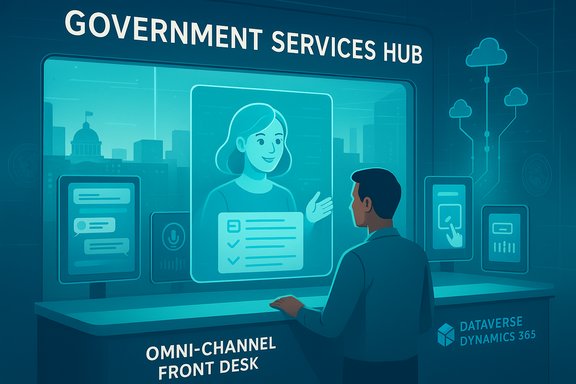
Microsoft’s public pitch for “AI in Government” is straightforward: use omni‑channel citizen engagement and AI‑powered virtual agents to let residents connect when, how and where they want, and to give social‑services staff fast, contextual access to the records and guidance they need to act. The vendor frames this as an end‑to‑end stack — from Microsoft 365 Copilot and Copilot Studio to Microsoft Foundry, Azure OpenAI Service and the Power Platform — that can deliver conversational front doors, guided form completion, multilingual access and back‑office automation while preserving enterprise controls and compliance.
Governments are increasingly pressured to reduce friction for citizens while containing the cost of service delivery. Conversational AI and retrieval‑augmented systems promise faster first‑contact resolution for straightforward inquiries, and the ability to pre‑screen or pre‑fill complex applications so fewer people drop out mid‑process. Microsoft’s use‑case materials explicitly position these capabilities as especially relevant to Directors of Social Services and Social Services Program Managers who must balance access, fairness and auditability in welfare, benefits and casework programs. At the same time, public‑sector programs face heightened legal and reputational risk when automation touches benefits, eligibility determinations or case outcomes. That tension — promise versus risk — is the central fact of deploying AI in government today. Independent frameworks such as the NIST AI Risk Management Framework (AI RMF) have become a practical baseline for governments to structure governance, testing and human oversight before scaling production systems.
However, the technology is not a magic bullet. The difference between a safe, effective deployment and a damaging one lies in governance and engineering discipline: retrieval quality, auditable provenance, fairness testing, data residency, explicit contractual controls and human oversight are not optional — they are the operational preconditions for trustworthy AI in government. Agencies that skip these steps risk hallucinations, biased outcomes, data misuse, security incidents and long‑term vendor entanglement.
The responsible path forward is therefore one of pragmatic optimism conditioned on governance: pilot small, measure outcomes, demand independent audits, codify human accountability for consequential decisions, and make contractual and technical choices that preserve sovereignty, portability and citizen trust. Governments that follow that path can materially improve access to information and services; those that shortcut the guardrails risk reproducing the very inequities and harms they intend to solve.
Appendix: Quick reference phrases (SEO friendly)
Source: Microsoft AI in Government: Enabling Access to Information
 Background / Overview
Governments are increasingly pressured to reduce friction for citizens while containing the cost of service delivery. Conversational AI and retrieval‑augmented systems promise faster first‑contact resolution for straightforward inquiries, and the ability to pre‑screen or pre‑fill complex applications so fewer people drop out mid‑process. Microsoft’s use‑case materials explicitly position these capabilities as especially relevant to Directors of Social Services and Social Services Program Managers who must balance access, fairness and auditability in welfare, benefits and casework programs. At the same time, public‑sector programs face heightened legal and reputational risk when automation touches benefits, eligibility determinations or case outcomes. That tension — promise versus risk — is the central fact of deploying AI in government today. Independent frameworks such as the NIST AI Risk Management Framework (AI RMF) have become a practical baseline for governments to structure governance, testing and human oversight before scaling production systems. What Microsoft is selling to government: stack and capabilities
The core components
Microsoft’s messaging for public‑sector citizen engagement typically groups the following building blocks:- Front-end conversational channels: web chat, voice/phone, messaging and kiosk interfaces that act as a conversational “front desk.”
- Agent runtimes and orchestration: Microsoft Foundry (Foundry Agent Service) and Copilot Studio to build, host and orchestrate multi‑agent workflows with observability, identity and governance controls.
- Knowledge grounding & search: retrieval‑augmented generation (RAG) patterns that connect LLMs to authoritative knowledge bases, policy documents, Dataverse and Dynamics 365 records.
- Workflows/automation: Power Platform (Power Pages, Power Automate, Dataverse) and Dynamics 365 for pre‑fill, case creation, escalation and deterministic business logic.
- Compliance & hosting: Azure and Azure Government with region‑ and compliance‑specific options (FedRAMP, sovereign cloud choices), plus encryption, private network connectivity and admin controls.
How the architecture typically works
A typical production pattern seen in vendor materials and recent deployments follows this sequence:- User interacts via chat, voice or messaging.
- The conversational front end issues a retrieval query against an index of authoritative documents and tenant records (RAG).
- An LLM composes a response that references or attaches provenance metadata from retrieved sources.
- If a transaction is required, the system pre‑fills forms and triggers a Power Automate flow or creates a Dynamics 365 case for human review.
- Telemetry, audit logs and human‑in‑the‑loop gates capture decisions and provide traceability for later review.
Early production examples and what they show
India: e‑Shram and National Career Service (NCS)
Microsoft has publicly announced integrations with India’s e‑Shram registry and the National Career Service (NCS) to add AI‑assisted features such as multilingual chatbots, résumé creation, job matching and skills gap analytics. Vendor statements and multiple press reports say those integrations are powered by Azure and Azure OpenAI Service, and aim to reach hundreds of millions of informal workers. These projects underscore how cloud scale, localized language support and partner networks can enable population‑scale digital public infrastructure — but they also surface procurement and data‑governance questions that require contractual clarity. Note that some scale numbers (for example, coverage claims or peak transaction figures) appear in vendor material and press accounts; where a figure matters operationally it should be validated in contractual SOWs and third‑party audits.Bolzano (South Tyrol), Italy: myCIVIS and EMMA
Bolzano’s myCIVIS portal is a municipal/regional example that Microsoft has featured: a consolidated citizen portal with a multilingual AI companion called EMMA that helps residents find services, pre‑fill forms and trigger governed back‑office workflows. The program emphasizes opt‑in consent, multilingual support (German, Italian, Ladin), and a hybrid design that ties conversational outputs directly to Dataverse and Dynamics 365 records with human checkpoints for legally consequential tasks. This case demonstrates the practical value of coupling low‑code Power Platform components to a managed agent runtime and a governance perimeter — but it’s also a reminder that local privacy design and opt‑in models are operational prerequisites for trust.Other governments and initiatives
There are multiple municipal and national programs — from northern Canada’s language access pilots to ministry consolidation projects in the Middle East — that mirror the same architecture and promise. These cases provide early validation that the pattern can work, but the evidence is mixed on long‑term outcomes because rigorous independent outcome evaluations are often absent from vendor case pages. Governments should demand independent audits and outcome reporting as part of procurement.Benefits that make these programs attractive
- Lower friction and higher take‑up: conversational guides and pre‑fill features can meaningfully reduce application abandonment for complex benefit forms.
- Language and accessibility reach: integrated translation and localized language models extend access to non‑English speakers.
- Faster front‑line response: caseworkers receive contextual retrieval of policy and client records, reducing time‑to‑decision.
- Scalability and 24/7 availability: cloud hosting allows agencies to offer persistent virtual assistance without linear staffing increases.
- Data for policy: aggregated, de‑identified interaction data can feed evidence‑based outreach and program redesign when legally and ethically handled.
The risks: where experiments become exposure
No vendor or platform removes the operational responsibilities that governments face when automation touches people’s lives. The principal risk vectors are well established:1. Hallucinations and factual errors
Large language models can generate plausible but incorrect statements. Even with RAG grounding, hallucinations persist unless retrieval quality, provenance tagging, and post‑generation verification are systematically enforced. In welfare contexts, an incorrect answer about eligibility or benefit amounts can cause material harm. Agencies must deploy multi‑stage checks and human‑in‑the‑loop controls for any outcome that affects entitlements.2. Algorithmic bias and unfairness
Models or matching algorithms tuned on historical administrative data can replicate and amplify inequities. Public programs must require demographic disaggregation of outcomes, fairness testing prior to production, and public reporting on impact metrics so bias is discovered and mitigated.3. Data protection and sovereignty
Cross‑system data flows and central registries increase attack surface. For U.S. federal deployments, FedRAMP and Azure Government provide hardened options; for other nations, sovereign cloud and regional data residency controls matter. Contracts must explicitly prohibit unapproved secondary uses of PII and clarify whether vendor models may be trained on program data.4. Vendor lock‑in and portability
Relying on a single vendor for models, hosting, identity and workflow tooling creates strategic and operational dependence. Procurement should insist on portable data formats, exportable indices, and open APIs to preserve future portability and competitive re‑procurement.5. Novel security vectors introduced by agentic AI
Agentic systems — software agents that act across tools and services — introduce new attack surfaces such as prompt injection and cross‑prompt attacks. Microsoft, other platforms and independent researchers have warned that agents require strong isolation, least privilege and red‑team testing before broad enablement. These are not theoretical concerns: they have concrete exploit modes and mitigation practices.6. The digital divide and unequal benefits
Conversational AI improves access for digitally connected users but risks leaving offline, low‑literacy, or low‑bandwidth populations behind unless deployments explicitly fund mediated channels (call centres, community kiosks, assisted registration) and outreach programs. Pilots must measure who benefits and who is excluded.Operational checklist: how to pilot responsibly
For Directors of Social Services and Program Managers considering a pilot, the following sequential steps create a defensible path from concept to controlled rollout:- Define a single, high‑value user journey (for example, benefit pre‑screen + pre‑fill) and set clear success metrics: completion rate lift, reduction in drop‑offs, staff time saved, and error rate.
- Map data flows and classify data sensitivity. Choose hosting that meets regulatory requirements (Azure Government / sovereign cloud if required) and demand contractual non‑reuse clauses for sensitive registries.
- Require an AI RMF / TEVV mapping and independent third‑party evaluation before production (bias audits, security red‑team, performance testing).
- Build RAG with provenance: ensure retrieval sources are authoritative, versioned, and surfaced with metadata; add verifier models or deterministic checks for outcomes that affect benefits.
- Deploy human‑in‑the‑loop gates for all legally consequential decisions; instrument audits, logs and explainability artifacts that tie responses back to sources and decision owners.
- Budget for skilling and mediation: invest in staff training, community mediators and low‑tech access channels to avoid worsening the digital divide.
What to require from vendors and contracts
When negotiating with cloud vendors or system integrators, procurement teams should insist on:- Explicit data residency and non‑reuse clauses preventing the vendor from training models on sensitive registries without consent.
- Exportable indices and APIs for portability and exit planning.
- Independent audit rights, third‑party bias testing and published impact summaries.
- Service level agreements that include measurable availability, latency (for voice/phone channels), and model‑related error rates or rollback procedures.
- Security commitments covering prompt‑injection mitigations, agent isolation, logging and red‑team results.
Technical maturity and open standards: where the market is heading
Microsoft and other hyperscalers are investing in agent runtimes, orchestration protocols and open agent standards (for example, the Agent2Agent / A2A proposals) intended to let agents interoperate across clouds and toolchains. These moves are strategically significant: interoperability and open protocols could reduce lock‑in and enable multi‑cloud resilience — but they are still early. Agencies should watch these standards, demand open interfaces, and avoid designs that hard‑bind operations to a single proprietary runtime until interop proves robust.Realistic verdict: pragmatic optimism with guardrails
The combination of omni‑channel citizen engagement, RAG grounding, and agent orchestration offers genuine operational value: faster, more inclusive citizen access, reduced form drop‑offs, and improved staff productivity. There are credible early success stories from municipal and national programs that show the architectural pattern can work in practice.However, the technology is not a magic bullet. The difference between a safe, effective deployment and a damaging one lies in governance and engineering discipline: retrieval quality, auditable provenance, fairness testing, data residency, explicit contractual controls and human oversight are not optional — they are the operational preconditions for trustworthy AI in government. Agencies that skip these steps risk hallucinations, biased outcomes, data misuse, security incidents and long‑term vendor entanglement.
Practical recommendations for next 90 days (for social‑services leaders)
- Commission a targeted pilot that focuses on a single user journey and pre‑registers measurement and audit plans. 1. Define KPIs; 2. Select a low‑risk service; 3. Require independent evaluation.
- Insist on a system‑level AI RMF mapping and a TEVV (Test, Evaluate, Verify, Validate) plan before any production rollout.
- Negotiate contractual guarantees: data non‑reuse, local hosting (if required), audit rights and portability commitments.
- Build humane fallback channels: staffed phone lines, community kiosks and paper alternatives to ensure inclusion.
- Fund staff skilling and an internal “AI operations” role to monitor telemetry, fairness metrics and security anomalies.
Closing analysis — strengths, caveats, and the path forward
Microsoft’s commercial stack for AI in government bundles powerful advantages: an integrated ecosystem that shortens time‑to‑value, enterprise governance features (identity, RBAC, compliance), and the tooling to connect generative models to authoritative records and deterministic workflows. For governments already invested in Microsoft technologies, these advantages reduce integration risk and accelerate pilots. Yet the same consolidation that speeds delivery also concentrates risk. Vendor‑controlled agent runtimes, proprietary connectors and model hosting decisions can create long‑term strategic exposure if procurement and architecture do not mandate portability and independent verification. Technical mitigations for hallucination and agentic attack vectors exist, but they require disciplined engineering and continuous testing — not only at launch, but as models, data and attack techniques evolve.The responsible path forward is therefore one of pragmatic optimism conditioned on governance: pilot small, measure outcomes, demand independent audits, codify human accountability for consequential decisions, and make contractual and technical choices that preserve sovereignty, portability and citizen trust. Governments that follow that path can materially improve access to information and services; those that shortcut the guardrails risk reproducing the very inequities and harms they intend to solve.
Appendix: Quick reference phrases (SEO friendly)
- AI in government, omni‑channel citizen engagement, AI‑powered virtual agents, Microsoft Foundry, Copilot Studio, Azure OpenAI Service, Power Platform, retrieval‑augmented generation (RAG), human‑in‑the‑loop, NIST AI RMF, FedRAMP, data sovereignty, agentic AI, TEVV.
Source: Microsoft AI in Government: Enabling Access to Information
