

The Welsh Government is not, in any literal sense, handing over redundancy decisions to a machine. But it is increasingly clear that AI systems are moving into the spaces where public bodies make sensitive judgments about workers, performance, and management, and that shift demands far more scrutiny than the usual hype cycle allows. Wales has already built a public-sector framework around human oversight, social partnership, and the idea that technology must not become a covert replacement for management accountability. That makes the current debate about AI in hiring and firing less about one dramatic tool and more about a bigger question: how far can algorithmic systems shape employment decisions before the “human in command” becomes a slogan rather than a safeguard?
Wales has spent the last two years trying to position itself as a place where AI adoption is deliberate rather than reckless. In December 2024, Wales’ Workforce Partnership Council published guidance on the ethical and responsible use of AI across public-sector workplaces, framing adoption around three core ideas: checks and balances, responsible implementation, and post-adoption evaluation. The same guidance stressed that AI should be transparent and underpinned by human oversight, reflecting the Welsh “social partnership” model that has become central to public-sector policy in the country.
That matters because the Welsh debate is not taking place in a vacuum. The Workforce Partnership Council’s earlier work on algorithmic management systems was even more explicit: there must be human oversight of all strategic decisions about such systems, and human interaction should remain part of day-to-day decision-making too. In other words, Wales is not simply asking whether AI can be useful; it is asking whether the state can deploy it without weakening responsibility, worker voice, and trust.
By March 2025, the issue had moved from principle to process. Welsh Government materials show active discussion of AI and the workplace inside the Social Partnership Council, including the possibility of further work on workforce AI skills and capability. That is important because it shows ministers and partners were already treating AI as a practical employment issue, not just a futuristic one. The policy language is cautious, but the direction of travel is clear: AI is becoming normalised in Welsh public administration, with guardrails rather than blanket bans.
The government’s broader AI strategy also reinforces that direction. The Welsh Government published an AI plan for Wales in late 2025, and in September 2025 it said it would establish an Office for Artificial Intelligence to strengthen internal capability and support informed policymaking. Around the same time, it described AI projects aimed at streamlining back-office functions, suggesting that officials see automation as a way to improve service delivery and free up staff time. That is perfectly understandable. But once “productivity” becomes the argument, the next question is always whether productivity gains are being achieved by augmenting judgment or by reshaping it in ways people barely notice.
There is a second layer here too: employment policy itself. Welsh Government recruitment guidance published in late 2025 explicitly references the use of AI, indicating that the institution is now thinking about AI not as an external novelty but as something that touches real hiring processes. That is exactly where risk rises. Hiring, promotion, performance evaluation, disciplinary support, and redundancy planning are all areas where algorithmic recommendations can feel efficient while quietly introducing bias, opacity, or over-reliance. If Wales wants to stay ahead of that problem, it will need to keep its policy culture as strong as its innovation rhetoric.
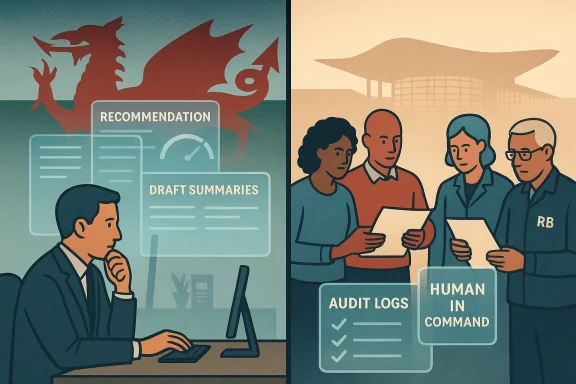
This is where the difference between “decision support” and “decision-making” starts to blur. A manager might believe they are making the final call, but if a system has already sorted candidates, highlighted “high-risk” employees, or generated a near-complete narrative about performance, the human often becomes a rubber stamp. In public-sector employment, that is exactly the kind of drift Welsh policy tries to prevent. The language of “human in command” and “human in the loop” is not decorative; it is there because once the machine’s recommendation becomes the default, accountability becomes diluted.
A sensible public body therefore needs to ask several separate questions:
That distinction matters because public debate often collapses several separate risks into one sensational story. There is the use of AI for administrative support, the use of AI for workforce management, and the use of AI for employment decisions. These are not the same thing. A tool that helps summarise consultation notes is not the same as one that flags employees for dismissal risk. The Welsh framework is designed to keep those categories separate, even if the technology market tries to fuse them together.
That sounds obvious, but it is easy to weaken in practice. Once a manager begins to trust an AI dashboard, the tool can become a silent authority. If the system is wrong, the manager may not notice. If the system is biased, the manager may never test it. If the system is opaque, the manager may not even know what to challenge. The Welsh emphasis on human oversight is therefore less about symbolism and more about avoiding accountability outsourcing.
The approach also aligns with recent Welsh health guidance on AI, where the government said systems should not be used autonomously and must operate under strict human supervision. That is in clinical settings, but the principle travels well. When decisions affect people’s jobs, livelihood, or career progression, the case for strict supervision is at least as strong.
AI systems also tend to be trained on historical data, and historical data in employment is rarely neutral. Past promotion patterns, disciplinary outcomes, sickness trends, or productivity records may all reflect existing bias, uneven management practice, or structural inequality. If a model learns from those patterns, it can reproduce them at scale. That is precisely the kind of outcome Welsh guidance warns against when it discusses fairness, checks and balances, and ethical implementation.
This is where human reviewers matter. A model may flag one worker as “high risk” because of a pattern that looks suspicious to software but is entirely explainable to a person who knows the case. If managers are not trained to interrogate the output, they may treat algorithmic scores as objective truth. That would be a mistake. In employment, the burden should always be on the system to prove it is helpful, not on the worker to prove the machine wrong. That inversion is one of the greatest risks in algorithmic management.
There is also a trust issue. Even a fair system can become controversial if employees do not understand how it works. That is why transparency matters. Welsh guidance places heavy emphasis on collaboration and post-adoption evaluation because a secretive system, however efficient, will be seen as hostile. In a workplace context, perception can become reality very quickly.
At the same time, the Welsh Government is under pressure to modernise. Like every administration, it faces tight budgets, complex demand, and the temptation to use AI as a shortcut. The problem is that shortcuts in employment are rarely free. They often move costs from visible admin time to invisible legitimacy problems. A tool that saves minutes today can create grievances, disputes, and mistrust tomorrow.
The public will still worry, and fairly so. If a government says AI is helping make decisions about the workforce, many people will assume it is being used to quietly push people out. The only real answer is to publish clear rules, enforce them consistently, and make sure unions, staff, and managers understand what the systems can and cannot do. Opacity is the oxygen of suspicion.
For opposition politicians, the issue is easy to weaponise because the phrase “AI decides who gets sacked” lands hard. But for governments, that is precisely why they need to be more precise than the attack line. If the real use is administrative support, they should say so. If there are systems that influence management choices, they should explain the safeguards. Ambiguity helps no one except campaigners.
The government’s “Managing technology that manages people” framework also provides a useful vocabulary for control. It distinguishes between strategic oversight and day-to-day use, and it places responsibility on management rather than pretending the machine can be self-governing. That matters because in the real world, the biggest failures often occur when everyone assumes someone else is checking the output.
There is a useful lesson here from Wales’ own health guidance on AI scribes. Even in a domain where automation can save enormous time, the government still insists on human-in-command use. If that is the standard for clinical support, it should be no less demanding for employment decisions. A job is not just an administrative status; it is a person’s livelihood.
That is why procurement matters so much. Welsh guidance repeatedly points toward responsibility, evaluation, and human oversight, but the real test happens in contracts and configuration. If a system can infer risk scores from performance data, the question is not just whether it can. The question is whether the public body has the right to switch it off, audit it, and explain it.
This is also where workforce concerns become concrete. A system used for recruitment or dismissal support may be embedded in a larger HR suite, making it hard for staff to separate the “AI part” from the rest of the platform. That opacity creates a governance gap. If officials cannot explain how the tool works, they cannot credibly say it is safe. Simplicity in the user interface often hides complexity in the decision chain.
The same principle applies to redundancy planning. AI can assist with document analysis, cost projections, or scenario modelling. But if those outputs feed directly into decisions about who stays and who goes, the need for oversight becomes much stronger. The more consequential the task, the more the system should be treated as advisory only.
There is also a broader strategic question. Wales wants to be seen as a leader in responsible AI, and that is a credible ambition only if it proves its institutions can handle the difficult cases, not just the easy ones. Drafting and summarisation are the low-hanging fruit. Hiring, performance management, and dismissal support are where the reputation test really begins. That is the difference between adopting AI and governing it.
What to watch next:
Source: The Will Hayward Newsletter The Welsh Gov uses AI to help decide whether to sack people
 Background
Wales has spent the last two years trying to position itself as a place where AI adoption is deliberate rather than reckless. In December 2024, Wales’ Workforce Partnership Council published guidance on the ethical and responsible use of AI across public-sector workplaces, framing adoption around three core ideas: checks and balances, responsible implementation, and post-adoption evaluation. The same guidance stressed that AI should be transparent and underpinned by human oversight, reflecting the Welsh “social partnership” model that has become central to public-sector policy in the country.That matters because the Welsh debate is not taking place in a vacuum. The Workforce Partnership Council’s earlier work on algorithmic management systems was even more explicit: there must be human oversight of all strategic decisions about such systems, and human interaction should remain part of day-to-day decision-making too. In other words, Wales is not simply asking whether AI can be useful; it is asking whether the state can deploy it without weakening responsibility, worker voice, and trust.
By March 2025, the issue had moved from principle to process. Welsh Government materials show active discussion of AI and the workplace inside the Social Partnership Council, including the possibility of further work on workforce AI skills and capability. That is important because it shows ministers and partners were already treating AI as a practical employment issue, not just a futuristic one. The policy language is cautious, but the direction of travel is clear: AI is becoming normalised in Welsh public administration, with guardrails rather than blanket bans.
The government’s broader AI strategy also reinforces that direction. The Welsh Government published an AI plan for Wales in late 2025, and in September 2025 it said it would establish an Office for Artificial Intelligence to strengthen internal capability and support informed policymaking. Around the same time, it described AI projects aimed at streamlining back-office functions, suggesting that officials see automation as a way to improve service delivery and free up staff time. That is perfectly understandable. But once “productivity” becomes the argument, the next question is always whether productivity gains are being achieved by augmenting judgment or by reshaping it in ways people barely notice.
There is a second layer here too: employment policy itself. Welsh Government recruitment guidance published in late 2025 explicitly references the use of AI, indicating that the institution is now thinking about AI not as an external novelty but as something that touches real hiring processes. That is exactly where risk rises. Hiring, promotion, performance evaluation, disciplinary support, and redundancy planning are all areas where algorithmic recommendations can feel efficient while quietly introducing bias, opacity, or over-reliance. If Wales wants to stay ahead of that problem, it will need to keep its policy culture as strong as its innovation rhetoric.
What “AI in hiring and firing” usually means
When people hear that AI is being used to decide whether to sack people, they often picture a fully automated robot manager. That is usually not how the systems work. More often, AI appears as a recommendation engine, a screening layer, a monitoring dashboard, or a drafting assistant that helps managers summarise cases, rank risks, or prepare documentation. The danger is that these tools can look advisory while still exerting heavy practical influence over the outcome.This is where the difference between “decision support” and “decision-making” starts to blur. A manager might believe they are making the final call, but if a system has already sorted candidates, highlighted “high-risk” employees, or generated a near-complete narrative about performance, the human often becomes a rubber stamp. In public-sector employment, that is exactly the kind of drift Welsh policy tries to prevent. The language of “human in command” and “human in the loop” is not decorative; it is there because once the machine’s recommendation becomes the default, accountability becomes diluted.
The practical forms AI can take
AI is rarely one thing. In employment settings, it can be used to draft letters, summarise meeting notes, analyse trends in attendance or workload, or support recruitment administration. Those functions may all be benign in isolation, but together they can create a more automated management culture. That is the real policy challenge: not one dramatic algorithmic firing button, but a series of small efficiency choices that gradually shape outcomes.A sensible public body therefore needs to ask several separate questions:
- Is the tool merely drafting, or is it ranking people?
- Is it helping a manager review evidence, or is it steering the conclusion?
- Is it looking at non-sensitive management data, or is it ingesting personal information?
- Is there a genuine human review, or just a signature after the fact?
- Can staff and unions understand and challenge how the tool works?
Wales’ policy framework is more cautious than the headlines
The headline claim that Wales uses AI to decide whether to sack people is a politically explosive one. But the official Welsh Government position, as far as the public documents show, is more measured. The guidance around algorithmic management stresses human oversight, clear lines of responsibility, and social partnership. The government’s own public-sector AI messaging has repeatedly framed adoption as ethical, transparent, and workforce-aware, not as a route to replacing managers with software.That distinction matters because public debate often collapses several separate risks into one sensational story. There is the use of AI for administrative support, the use of AI for workforce management, and the use of AI for employment decisions. These are not the same thing. A tool that helps summarise consultation notes is not the same as one that flags employees for dismissal risk. The Welsh framework is designed to keep those categories separate, even if the technology market tries to fuse them together.
Human oversight is the key control
The most important control in the Welsh model is not a technical one. It is the insistence that a human must remain responsible for strategic decisions. That is a classic public-sector safeguard because it preserves a chain of accountability. If someone is dismissed, promoted, or formally managed out, the decision must be traceable to a responsible person who can explain the evidence, context, and reasoning.That sounds obvious, but it is easy to weaken in practice. Once a manager begins to trust an AI dashboard, the tool can become a silent authority. If the system is wrong, the manager may not notice. If the system is biased, the manager may never test it. If the system is opaque, the manager may not even know what to challenge. The Welsh emphasis on human oversight is therefore less about symbolism and more about avoiding accountability outsourcing.
The approach also aligns with recent Welsh health guidance on AI, where the government said systems should not be used autonomously and must operate under strict human supervision. That is in clinical settings, but the principle travels well. When decisions affect people’s jobs, livelihood, or career progression, the case for strict supervision is at least as strong.
Why employment decisions are especially risky
Employment is one of the hardest areas for AI because it combines subjective judgment, legal risk, and human dignity. A bad recommendation in an internal workflow is annoying. A bad recommendation in hiring or dismissal can be life-changing. That is why public bodies generally need a higher standard of caution than private firms, even if the private sector may be the first to experiment.AI systems also tend to be trained on historical data, and historical data in employment is rarely neutral. Past promotion patterns, disciplinary outcomes, sickness trends, or productivity records may all reflect existing bias, uneven management practice, or structural inequality. If a model learns from those patterns, it can reproduce them at scale. That is precisely the kind of outcome Welsh guidance warns against when it discusses fairness, checks and balances, and ethical implementation.
Bias is not always obvious
Bias in employment AI does not have to be overt to be harmful. It can appear in the weights a model assigns to attendance, time-to-response, case closure rates, or language use in written reports. It can also emerge when the tool performs differently for people with different communication styles, job histories, or protected characteristics. The danger is not only discriminatory intent; it is discriminatory effect.This is where human reviewers matter. A model may flag one worker as “high risk” because of a pattern that looks suspicious to software but is entirely explainable to a person who knows the case. If managers are not trained to interrogate the output, they may treat algorithmic scores as objective truth. That would be a mistake. In employment, the burden should always be on the system to prove it is helpful, not on the worker to prove the machine wrong. That inversion is one of the greatest risks in algorithmic management.
There is also a trust issue. Even a fair system can become controversial if employees do not understand how it works. That is why transparency matters. Welsh guidance places heavy emphasis on collaboration and post-adoption evaluation because a secretive system, however efficient, will be seen as hostile. In a workplace context, perception can become reality very quickly.
The political stakes in Wales
This debate is not just technical. It sits inside a Welsh political culture that has made a virtue of worker voice, social partnership, and public-sector restraint. That means AI adoption will be judged not only on speed and efficiency, but on whether it respects the Welsh model of governance. A system that feels like covert deskilling or surveillance would collide head-on with that culture.At the same time, the Welsh Government is under pressure to modernise. Like every administration, it faces tight budgets, complex demand, and the temptation to use AI as a shortcut. The problem is that shortcuts in employment are rarely free. They often move costs from visible admin time to invisible legitimacy problems. A tool that saves minutes today can create grievances, disputes, and mistrust tomorrow.
The risk of narrative drift
Once a government begins talking about AI as a productivity engine, the narrative can drift toward automation-first thinking. That is when phrases like “augmenting staff” start to sound like “reducing headcount” even if no one says it directly. The Welsh policy language has so far resisted that drift by repeatedly centring fairness, job security, and workforce development. That is not accidental; it is a political choice.The public will still worry, and fairly so. If a government says AI is helping make decisions about the workforce, many people will assume it is being used to quietly push people out. The only real answer is to publish clear rules, enforce them consistently, and make sure unions, staff, and managers understand what the systems can and cannot do. Opacity is the oxygen of suspicion.
For opposition politicians, the issue is easy to weaponise because the phrase “AI decides who gets sacked” lands hard. But for governments, that is precisely why they need to be more precise than the attack line. If the real use is administrative support, they should say so. If there are systems that influence management choices, they should explain the safeguards. Ambiguity helps no one except campaigners.
How Welsh public-sector guidance tries to manage the risk
Wales’ guidance structure is worth paying attention to because it blends policy principle with operational discipline. The Workforce Partnership Council guidance describes a framework built around checks and balances, responsible implementation, and evaluation after adoption. That is a good model because it recognises that AI policy cannot be static. The technology changes too fast, and so do the ways people use it.The government’s “Managing technology that manages people” framework also provides a useful vocabulary for control. It distinguishes between strategic oversight and day-to-day use, and it places responsibility on management rather than pretending the machine can be self-governing. That matters because in the real world, the biggest failures often occur when everyone assumes someone else is checking the output.
What this means in practice
If these frameworks are applied seriously, a Welsh public body should be able to do several things:- Define exactly what the AI is allowed to do.
- Prohibit the use of the system as an autonomous decision-maker.
- Keep a named human responsible for the outcome.
- Test for bias, error, and unintended effects.
- Review the system after deployment, not just before launch.
There is a useful lesson here from Wales’ own health guidance on AI scribes. Even in a domain where automation can save enormous time, the government still insists on human-in-command use. If that is the standard for clinical support, it should be no less demanding for employment decisions. A job is not just an administrative status; it is a person’s livelihood.
Enterprise technology, not science fiction
A lot of the public debate imagines AI as a consumer chatbot. In practice, the systems that matter most in government are usually enterprise products buried inside HR platforms, workflow tools, analytics dashboards, and document suites. That makes the risk more subtle, because employees may not even realise they are using AI at all. The problem is not always a dramatic AI rollout. Sometimes it is a vendor quietly switching on a feature in an update.That is why procurement matters so much. Welsh guidance repeatedly points toward responsibility, evaluation, and human oversight, but the real test happens in contracts and configuration. If a system can infer risk scores from performance data, the question is not just whether it can. The question is whether the public body has the right to switch it off, audit it, and explain it.
Procurement is governance
In 2026, good AI governance is increasingly product governance. Public bodies need to know where the data goes, who can see it, whether the model is trained on it, how outputs are logged, and what happens if the vendor changes behaviour. Those are boring questions, but they are the ones that determine whether AI remains a tool or becomes an authority.This is also where workforce concerns become concrete. A system used for recruitment or dismissal support may be embedded in a larger HR suite, making it hard for staff to separate the “AI part” from the rest of the platform. That opacity creates a governance gap. If officials cannot explain how the tool works, they cannot credibly say it is safe. Simplicity in the user interface often hides complexity in the decision chain.
The same principle applies to redundancy planning. AI can assist with document analysis, cost projections, or scenario modelling. But if those outputs feed directly into decisions about who stays and who goes, the need for oversight becomes much stronger. The more consequential the task, the more the system should be treated as advisory only.
Strengths and Opportunities
Wales has a real opportunity here. If it keeps AI tied to transparent governance, strong worker protections, and clear human accountability, it can show that public-sector digital transformation does not have to mean surrendering judgment to software. The policy architecture already points in that direction, and the challenge now is making the rules real in day-to-day management.- Human oversight remains central, which is the right starting point for employment-related AI.
- The Welsh model emphasises social partnership, giving workers and employers a structured way to challenge misuse.
- AI can still be used for low-risk tasks like drafting, summarising, and workflow support without touching final decisions.
- Stronger governance may improve procurement discipline across the public sector.
- Clear rules can reduce the risk of shadow AI use and inconsistent local practices.
- Wales can position itself as a credible case study for responsible AI adoption rather than hype-driven experimentation.
- If managed well, AI could free staff from repetitive admin and let them focus on higher-value work.
Risks and Concerns
The biggest danger is not that a robot manager suddenly starts firing people by itself. The real risk is more gradual: AI quietly reshapes decisions, managers become over-reliant, and accountability becomes harder to locate when something goes wrong. That is exactly why the Welsh framework keeps returning to human oversight, because the collapse usually happens in the grey zone between recommendation and decision.- Bias can be replicated from historic employment data and scaled by software.
- AI outputs may be persuasive even when they are wrong, creating false confidence.
- Workers may not know when AI is being used, undermining trust and consent.
- Vendors can embed AI features in broader software packages, making oversight difficult.
- Poor procurement could lock public bodies into systems they cannot effectively audit or exit.
- The language of “productivity” can mask stealthier forms of workforce reduction.
- If the public believes AI is deciding people’s futures, legitimacy can erode quickly, even if the formal process remains human-led.
Looking Ahead
The next stage is not about whether Wales likes or dislikes AI. It is about whether the government, councils, and public bodies can turn the existing principles into auditable practice. That means training managers, involving unions, scrutinising vendor contracts, and publishing enough detail for people to understand what the systems are actually doing. The policy foundation is already there. The hard part is consistency.There is also a broader strategic question. Wales wants to be seen as a leader in responsible AI, and that is a credible ambition only if it proves its institutions can handle the difficult cases, not just the easy ones. Drafting and summarisation are the low-hanging fruit. Hiring, performance management, and dismissal support are where the reputation test really begins. That is the difference between adopting AI and governing it.
What to watch next:
- Further Welsh Government detail on employment-related AI use in public bodies.
- Any sector-specific guidance for recruitment, performance management, or redundancy support.
- Updates from the Workforce Partnership Council on algorithmic management.
- Evidence of how councils and devolved bodies are actually configuring their AI tools.
- Public debate over whether “human oversight” is being enforced or merely claimed.
Source: The Will Hayward Newsletter The Welsh Gov uses AI to help decide whether to sack people
