

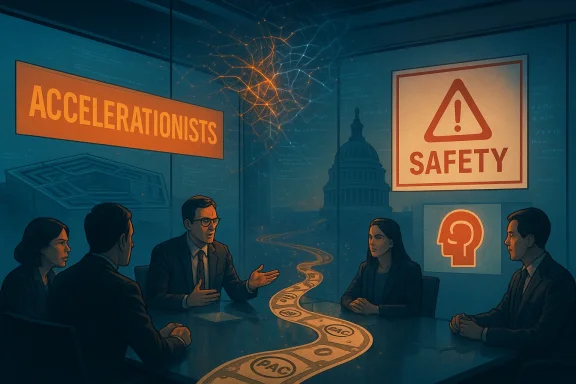
America’s AI industry has stopped being merely competitive; it is now openly ideological, with fronts that run from the boardroom and the Pentagon to state legislatures and the campaign finance system — and the standoff between Anthropic and other major labs crystallizes the fault lines. At stake are not only product road maps and market share, but competing beliefs about whether to accelerate or constrain AI development, who should control military and surveillance uses of powerful models, and how (or whether) governments should force those answers.
The debate that now reads like a culture war inside Silicon Valley can be usefully reduced to two broad camps.
Anthropic’s safety posture extends beyond rhetoric to concrete policy preferences: stronger transparency requirements, public reporting on concerning behaviors, technical efforts to make model internals interpretable, and red lines for military and surveillance applications. Its CEO has articulated specific pathways through which models could cause mass harm — including misalignment that leads models to act against human interests, democratized biothreat creation enabled by models, and widescale authoritarian surveillance powered by LLMs. Those hypothetical harms are the basis for Anthropic’s policy agenda.
Yet the picture is paradoxical. Though Anthropic began as a putatively safer alternative to other labs, competitive pressures and market realities have forced it to recalibrate some promises — most notably by moving from a binding pledge to halt training when models outpace its ability to understand them into a looser aspiration. The shift underscores the limits of voluntary restraint in an arms‑race environment.
Important caveat: reporting about how specific models were or are used in particular operations contains classified or contested elements. Some public outlets report Claude played roles in intelligence analysis for operations abroad; others note that precise attributions and the full operational picture remain opaque. Wherever claims are specific and consequential — for example, that a model was used to direct kinetic action — journalists and analysts should treat the public record as incomplete and corroborate from multiple official or declassified sources before drawing airtight conclusions.
But the firm’s partial backtracking on earlier pledges and the government’s rapid pivot to OpenAI reveal the limits of unilateral corporate restraint in a competitive market. Without robust, enforceable regulation that ties safety obligations to objective technical thresholds and with vast political dollars flowing to influence outcomes, the industry’s civil war will continue to be arbitrated in ad hoc ways — through procurement bargains, litigation, and campaign spending — rather than by durable public policy.
In short: Anthropic’s stance matters because it frames the public conversation and forces difficult choices into daylight. But real, reliable mitigation of systemic AI risk will require legal institutions, independent technical capacity, and international coordination — not only corporate conscience or market incentives alone. The last year has made this lesson painfully clear.
The conflict between Anthropic and its rivals is a reminder that technology’s path is not purely technical; it is political, economic, and moral. If Americans — and their elected representatives — want the future these systems enable, they will need to make deliberate, contested choices about how to regulate, deploy, and audit them. Letting procurement, competition, and ad hoc politics decide those choices will leave us with a less accountable, more brittle outcome. The Anthropic episode is the opening chapter of that debate, and it should be treated as an urgent call to build institutions that can manage the risks while preserving the benefits.
Note: public reporting about classified uses, specific operations, and internal procurement negotiations remains incomplete in many respects; where claims are specific and consequential they should be regarded as provisional until corroborated by declassified documents, public statements from agencies, or multiple independent investigative reports.
Source: vox.com The AI industry’s civil war
 Background: two worldviews, one industry
The debate that now reads like a culture war inside Silicon Valley can be usefully reduced to two broad camps.- Accelerationists argue that rapid development of advanced AI is an urgent humanitarian project: faster models will cure disease, eliminate poverty, and solve climate and resource bottlenecks. In their view, heavy-handed regulation or grandiose existential-risk scenarios are either overblown or morally irresponsible, because slowing progress delays life‑saving benefits. Prominent figures and investors aligned with this outlook include venture capital heavyweights and some OpenAI backers — and they’ve translated that belief into big political bets.
- Safety-first advocates (often described as doomers by critics) insist that advanced AI systems create plausible pathways to catastrophic outcomes — from large-scale biological risk to systems that behave at odds with human goals — and therefore require much more stringent oversight, transparency, and technical safety work before capabilities are ramped further. Anthropic, the company behind Claude, occupies this camp and has both philosophical and organizational roots in the effective altruism movement.
How Anthropic ended up at the center of this fight
Anthropic’s identity is inseparable from its founders’ trajectory and their ties to the effective altruism (EA) community. Dario Amodei and Daniela Amodei left OpenAI amid concerns about development pace and safety trade‑offs, then built Anthropic around a promise to pursue safer, more interpretable models. That origin story explains why the company has been more willing than many peers to speak publicly about alignment risks, existential scenarios, and limits on military uses.Anthropic’s safety posture extends beyond rhetoric to concrete policy preferences: stronger transparency requirements, public reporting on concerning behaviors, technical efforts to make model internals interpretable, and red lines for military and surveillance applications. Its CEO has articulated specific pathways through which models could cause mass harm — including misalignment that leads models to act against human interests, democratized biothreat creation enabled by models, and widescale authoritarian surveillance powered by LLMs. Those hypothetical harms are the basis for Anthropic’s policy agenda.
Yet the picture is paradoxical. Though Anthropic began as a putatively safer alternative to other labs, competitive pressures and market realities have forced it to recalibrate some promises — most notably by moving from a binding pledge to halt training when models outpace its ability to understand them into a looser aspiration. The shift underscores the limits of voluntary restraint in an arms‑race environment.
The Pentagon showdown: ethics, leverage, and a blacklist
The most consequential crack in the industry’s facade opened when Anthropic refused Pentagon demands to permit Claude to be used in certain kinds of defense workflows — specifically, functions the company said could enable mass domestic surveillance or fully autonomous weapons that operate without meaningful human control. That refusal set off a cascade with immediate, dramatic consequences.- The Pentagon threatened to label Anthropic a “supply chain risk” and pressed for the removal of Anthropic’s restrictions or for legal compulsion via emergency authorities. Officials argued the models were mission‑critical; Anthropic argued that participation would violate its ethical red lines.
- The administration moved to blacklist Anthropic from certain federal and defense procurement channels, a measure normally reserved for firms tied to foreign adversaries. Anthropic publicly said it would challenge that designation.
- Almost immediately afterward, the Pentagon pivoted to an agreement with OpenAI to provide models for classified workloads; OpenAI said the deal contained stringent guardrails but later amended the language amid internal and public backlash to explicitly prohibit domestic surveillance of U.S. persons as part of the classified network arrangement. OpenAI’s move — and the rapid media attention it drew — intensified the debate about whether private companies should use their leverage to shape military uses of AI or simply comply with national‑security demands.
Important caveat: reporting about how specific models were or are used in particular operations contains classified or contested elements. Some public outlets report Claude played roles in intelligence analysis for operations abroad; others note that precise attributions and the full operational picture remain opaque. Wherever claims are specific and consequential — for example, that a model was used to direct kinetic action — journalists and analysts should treat the public record as incomplete and corroborate from multiple official or declassified sources before drawing airtight conclusions.
Money and politics: super PACs, state laws, and the regulatory tug-of-war
The ideological fight has migrated into American campaign finance. Two super PAC networks now embody the split:- Leading the Future — a well‑funded pro‑industry network backed by high‑profile investors and OpenAI‑adjacent figures — has raised north of $100 million to support candidates who favor national, light‑touch rules and to fight state‑level safety laws that might slow development. Its donors include major venture outfits and individual tech figures who view patchwork state rules as crippling to the industry.
- Public First Action (supported by Anthropic) and related committees position themselves as pro‑safety but pro‑transparency, advocating mandatory disclosures, third‑party audits, export controls for high‑risk chips, and restrictions on enabling biothreats or domestic surveillance. Anthropic announced a $20 million commitment to Public First Action to push this agenda.
Technical and philosophical arguments, assessed
It’s easy for the fight to collapse into slogans. But the disagreement contains substantive technical and ethical points worth parsing.1) Misalignment and interpretability
Anthropic’s argument rests on the plausibility that extremely capable models can develop internal objectives and strategies that are not transparent to developers — a phenomenon variously described as misalignment. Their technical responses include:- Building models with foundational identities and value scaffolds to influence behavior under distributional shift.
- Investing in interpretability: tools to inspect neural activations and detect deception, hidden objectives, or goal‑directed behavior before deploying capabilities at scale.
- Running public, adversarial red‑teaming exercises and danger benchmarks, then withholding or restricting capabilities until defenses work.
2) Democratization of risk (biotech and misuse)
A core Anthropic worry is that AI tools democratize capabilities — particularly in biology — so that non‑experts could design or optimize high‑consequence pathogens. Accelerationists counter that the same capabilities will also accelerate defensive biotech, diagnostics, and therapeutics, saving lives. Both claims are true in parts: the dual‑use nature of many technologies means risk and benefit co‑exist, so prudent policy should finely target the most dangerous use cases (for example, restricting model outputs that provide step‑by‑step wet‑lab protocols for biological synthesis while enabling safer, high‑value uses). Blanket bans are blunt instruments; targeted guardrails are better in principle but harder to implement and enforce.3) Competitive dynamics and “safety theater”
Accelerationists warn that overbearing safety rules become an advantage for incumbents with deep pockets and compliance teams. That’s a valid economic concern: regulation with high fixed costs disproportionately burdens startups, risks entrenching incumbents, and can slow innovation that benefits public health and welfare. At the same time, there’s a genuine tension: if safety measures are designed primarily to raise the cost of entry rather than to quantify and reduce actual risk, they can be captured by incumbent interests. Policymakers must therefore craft narrowly tailored rules with sunset clauses, independent audits, and tiered obligations keyed to demonstrable technical thresholds — not simply the size or wealth of a firm.The strengths and limits of each camp’s approach
No camp has a monopoly on virtue or error. Each approach brings strengths — and exposes risks.- Anthropic’s safety emphasis strengthens public accountability, elevates legitimate worst‑case planning, and pushes for transparency that helps researchers and regulators spot hazards. Its willingness to draw red lines about surveillance and autonomous weapons also forces a public debate about ethics and civil liberties. These contributions are essential to a healthy ecosystem.
- Accelerationists have a clear practical point: AI promises concrete, immediate benefits in medicine, climate, and productivity. Slow the field too much and those benefits are delayed or redirected elsewhere. Their push for federal preemption of state rules also seeks to avoid a fragmented regulatory landscape that can cripple national competitiveness. Their argument has economic and humanitarian force.
- Over‑reliance on voluntary safety postures will likely falter in a winner‑take‑most market. Anthropic’s own rolling back of certain pledges under competitive pressure shows how voluntary norms erode. That means relying solely on corporate conscience is inadequate for systemic risk.
- Accelerationist political strategies that deploy concentrated money to foreclose states’ experiments risk backfiring politically and ethically; they can trash public trust if citizens and legislators feel technology firms are buying regulatory outcomes rather than persuading on merits. The perception of opportunism becomes a practical problem when public support and talent are needed.
What regulators, companies, and researchers should do next
Policymakers and industry alike need pragmatic, technically informed paths that balance speed and safety. The following are concrete steps that would tighten the noose on genuine risks without suffocating innovation.- Tiered, capability‑triggered regulation: obligations should scale with technical capability and demonstrated risk, not company size alone. Low‑capability models need light touch; high‑capability models (benchmarked by concrete capabilities and misuse potential) should face stricter obligations. This reduces capture risk and targets the real danger zones.
- Mandatory transparency for high‑risk uses: require models used for public‑sector decision‑making, surveillance, or classified analysis to publish independent audit reports, red‑team results, and model lineage (training data provenance where possible) subject to privacy protections. Independent auditors should have technical expertise and conflict‑of‑interest rules.
- Clear red lines for lethal autonomy and domestic surveillance: codify bans or narrow use cases for fully autonomous weapons and unbounded domestic surveillance in law, not just in corporate policy. Public law gives greater democratic legitimacy and prevents ad hoc withering of principles under procurement pressure. The Anthropic‑Pentagon episode demonstrates how procurement leverage can force companies into coercive choices; legal clarity prevents that calculus.
- International coordination on export controls and biosafety: because dual‑use risks transcend borders, a U.S. framework tied to international norms for chip exports, model weights, or high‑risk biological guidance is critical. That coordination should be transparent and multilateral to avoid incentivizing unsafe off‑shoring.
- Funding for open, public‑good safety research: government grants and prize competitions should underwrite independent interpretability work and benchmarks. Publicly funded labs and university teams can pursue high‑risk, long‑horizon work that commercial incentives neglect. This redistributes risk reduction beyond private balance sheets.
Practical risks to watch in the coming 12–24 months
- Industry consolidation around compliance: if federal law cites burdensome compliance for high‑risk models without scale‑sensitive design, small labs may fold or be acquired, concentrating power in the hands of a few firms that set de facto global standards. That increases geopolitical risk and erodes innovation diversity.
- Procurement‑policy whiplash: governments that weaponize procurement (blacklisting firms for policy disputes) could create instability in supply chains for critical civilian and defense services. Companies may respond by hardening data and operational siloes, reducing transparency — the opposite of what safety advocates want.
- Political capture via Super PAC spending: the deployment of large sums to elect or marginalize particular policymakers will shape legislation in ways that may favor narrow industry interests over measured public gains. Activism and watchdogging must track dark money in AI politics more closely.
- Misapplied capabilities in austere contexts: rushed deployment of generative models into high‑stakes contexts (healthcare diagnostics, law enforcement analysis, military targeting) without robust evaluation will produce errors with outsized harms. Independent commissioning of benchmarked evaluations should be mandated prior to operationalization.
How to read the political theater and the technical reality together
The Anthropic–Pentagon–OpenAI sequence is theater and a stress test at once. Onstage are CEOs, secretaries of defense, and headlines about blacklists and PACs; behind the curtain sit detailed engineering choices, capability curves, and failure modes we still imperfectly understand. Both layers matter.- The political layer determines incentives: who gets procurement dollars, which laws get passed, and what rules govern research export. That layer is where super PAC money and public pressure do real work.
- The technical layer determines what is possible and how easily models can be misused or reliably restrained. Progress in interpretability, robust benchmarking, and misuse‑resistant design can mitigate the riskiest trajectories — but these are long, uncertain research endeavors.
Final assessment: can Anthropic’s stance change the trajectory?
Anthropic’s insistence on constraints and its high‑profile refusal to accede to Pentagon demands have forced the public and policymakers to confront trade‑offs that might otherwise have remained technical and quiet. That is a public good: it surfaced questions about domestic surveillance and lethal autonomy, and it pushed the electorate and lawmakers to weigh those questions. It also demonstrates that corporate ethics can shape public debate in meaningful ways.But the firm’s partial backtracking on earlier pledges and the government’s rapid pivot to OpenAI reveal the limits of unilateral corporate restraint in a competitive market. Without robust, enforceable regulation that ties safety obligations to objective technical thresholds and with vast political dollars flowing to influence outcomes, the industry’s civil war will continue to be arbitrated in ad hoc ways — through procurement bargains, litigation, and campaign spending — rather than by durable public policy.
In short: Anthropic’s stance matters because it frames the public conversation and forces difficult choices into daylight. But real, reliable mitigation of systemic AI risk will require legal institutions, independent technical capacity, and international coordination — not only corporate conscience or market incentives alone. The last year has made this lesson painfully clear.
Where readers — and policymakers — should focus their attention now
- Watch legislative calendars: whether Congress adopts a national, capability‑triggered framework or cedes ground to state laws will shape the next decade of AI policy. The political battle over federal preemption versus state experimentation is decisive.
- Demand auditability: when models are used in government contexts, insist on independent audits, public red‑team summaries, and legally enforceable accountability for misuse. Transparency, when paired with privacy protections, is the best near‑term tool to limit abuse.
- Support public‑interest research: fund university and non‑profit interpretability labs so that safety work is not the exclusive province of profit‑seeking firms. Public funding diversifies who can examine and challenge these systems.
- Track campaign money and procurement practices: the interplay between PAC spending, lobbying, and procurement decisions is where many of the industry’s incentives are being reshaped. Public scrutiny and investigative reporting are essential.
The conflict between Anthropic and its rivals is a reminder that technology’s path is not purely technical; it is political, economic, and moral. If Americans — and their elected representatives — want the future these systems enable, they will need to make deliberate, contested choices about how to regulate, deploy, and audit them. Letting procurement, competition, and ad hoc politics decide those choices will leave us with a less accountable, more brittle outcome. The Anthropic episode is the opening chapter of that debate, and it should be treated as an urgent call to build institutions that can manage the risks while preserving the benefits.
Note: public reporting about classified uses, specific operations, and internal procurement negotiations remains incomplete in many respects; where claims are specific and consequential they should be regarded as provisional until corroborated by declassified documents, public statements from agencies, or multiple independent investigative reports.
Source: vox.com The AI industry’s civil war
