

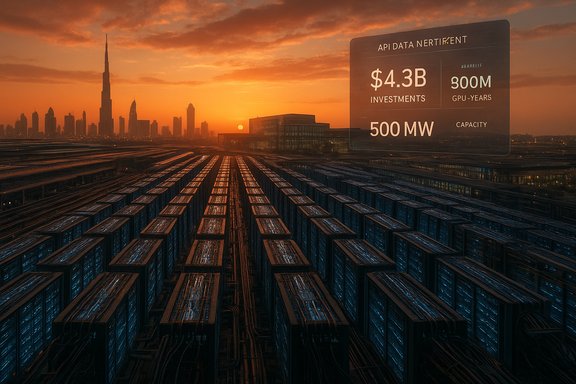
Microsoft and Alphabet have doubled down on an AI arms race this week, with Microsoft unveiling multi‑billion‑dollar infrastructure commitments in the United Arab Emirates and a headline GPU services contract in Texas, while Alphabet returned to the European debt market to raise billions for continued AI and cloud expansion — a flurry of deals that underscores both the scale of hyperscaler spending on AI infrastructure and the strategic, financial and geopolitical tensions it raises.
The last 18 months have seen hyperscalers shift from exploratory AI pilots to full‑scale infrastructure builds. Where 2023 and 2024 were about experimentation and early model purchases, 2025 has become a year of heavy capital allocation: large cloud providers are buying next‑generation GPUs, striking long‑term capacity agreements with data‑center operators, and tapping debt markets to fund the buildouts. This movement has transformed procurement and financing dynamics across the industry, from chip manufacturers and system integrators to power planners and municipal authorities hosting large campuses.
At the same time, analysts warn the market may be entering a period of financial realism — where enterprise and vendor expectations must align with demonstrable return on investment — even as hyperscalers and their partners pour cash into compute, power and real estate. Forrester’s headline prediction that enterprises may defer a quarter of planned AI spending into 2027 has given investors and procurement teams pause.
At the same time, U.S. and European hyperscalers building major campuses in Texas and other power‑rich regions maintain a different model: scale, cost efficiency and regulatory predictability. The market will watch how these models coexist and whether one approach wins on cost, security and performance.
The next 12–24 months will reveal whether this period of heavy spending yields sustained platform advantages and profitable monetization, or whether a mismatch between capacity and enterprise adoption forces a period of price adjustments, consolidation and more cautious capital allocation. For IT leaders, the takeaway is practical: demand evidence of value, contract for flexibility, and treat the new compute commitments as long‑term strategic bets that must be actively managed.
Source: theregister.com Microsoft, Alphabet throw more cash on AI bonfire
 Background
The last 18 months have seen hyperscalers shift from exploratory AI pilots to full‑scale infrastructure builds. Where 2023 and 2024 were about experimentation and early model purchases, 2025 has become a year of heavy capital allocation: large cloud providers are buying next‑generation GPUs, striking long‑term capacity agreements with data‑center operators, and tapping debt markets to fund the buildouts. This movement has transformed procurement and financing dynamics across the industry, from chip manufacturers and system integrators to power planners and municipal authorities hosting large campuses.At the same time, analysts warn the market may be entering a period of financial realism — where enterprise and vendor expectations must align with demonstrable return on investment — even as hyperscalers and their partners pour cash into compute, power and real estate. Forrester’s headline prediction that enterprises may defer a quarter of planned AI spending into 2027 has given investors and procurement teams pause.
What happened: the headlines and the numbers
Microsoft’s UAE expansion and GPU export approvals
Microsoft announced a major expansion in the United Arab Emirates that, when combined with its past and forward commitments, represents more than $15 billion of investment through the end of 2029. Specifically, Microsoft said it will have invested roughly $7.3 billion in the UAE between 2023 and the end of this year, and it has earmarked an additional $7.9 billion for the period from 2026 to 2029 focused on AI and cloud infrastructure. Microsoft executives framed this as a strategic commitment to Abu Dhabi and the UAE’s ambitions to be an AI hub. Key operational and regulatory notes:- Microsoft says the planned capital expense portion includes roughly $5.5 billion for direct AI and cloud infrastructure expansion and $2.4 billion in planned local operating expenses.
- U.S. export approvals now permit shipments of advanced GPU systems — including Nvidia’s newer GB300 class — to Microsoft‑managed installations in the UAE, a move that Reuters and other outlets reported came after Commerce Department approvals were issued in September. Microsoft has described the September authorization as equivalent to 60,400 Nvidia A100 GPUs in aggregate capability.
The IREN‑Microsoft GPU services deal (Childress, Texas)
Alongside the UAE news, Microsoft announced a five‑year GPU services arrangement with IREN Limited that IREN says has a total contract value (TCV) of approximately $9.7 billion, including a 20% prepayment. The contract centers on access to NVIDIA GB300 GPUs to be deployed at IREN’s Childress, Texas campus and to be phased in through 2026 alongside delivery of liquid‑cooled data centers supporting about 200 MW of IT load in the initial horizons. IREN has also indicated a related agreement with Dell Technologies to procure hardware and ancillary equipment in the order of roughly $5.8 billion. What this does operationally:- Locks a major hyperscaler to a third‑party campus operator with secured power and liquid cooling capabilities.
- Transfers a portion of capex timing and supply‑chain risk via customer prepayments.
- Significantly validates the “neocloud” or vertically integrated campus model as an alternative to building hyperscale owned capacity on every site.
Alphabet’s bond sales to fund AI and cloud capex
Alphabet marketed a multi‑tranche euro bond offering expected to raise at least €3 billion and was reported to be simultaneously preparing US dollar tranches that could total up to $15 billion in a broader debt program. This represents Alphabet’s second euro market outing this year after an earlier multi‑tranche €6.75 billion sale, and the proceeds are widely reported to be earmarked for record capital expenditures on AI and cloud infrastructure. Major banks were listed among the bookrunners.Meta’s $30 billion bond program and the debt trend
Meta’s much‑publicized bond float — up to $30 billion — is the clearest sign that the industry is increasingly comfortable leveraging public debt markets to finance AI infrastructure builds. Meta positioned the sale as support for a massive buildout of data‑center capacity and related AI compute plans. Investors have taken note, and the move underlines a broader pattern: investments in AI infrastructure are becoming core, multi‑year capital programs for the largest tech platforms.Why the scale matters: compute, power, cooling, and capital
The announcements reveal several interlocking truths about AI infrastructure economics.- GPU scale is the new currency. Deals are written in GPU‑years, GPU SKUs and “equivalent A100” metrics rather than rack counts. Microsoft’s reference to GB300 exports equivalent to tens of thousands of A100s is shorthand for the raw compute capacity necessary to host recent large generative models and to serve high‑volume inference workloads.
- Power and cooling are the constraint, not just chip supply. The IREN deal’s focus on liquid‑cooled halls and 200 MW of IT load underscores how modern AI compute demands require purpose‑built facilities, high‑density power delivery, and industry‑grade cooling solutions. These are long‑lead, asset‑heavy projects that involve grid agreements, substation work and sometimes municipal land deals.
- Financing is being industrialized. Alphabet, Meta and other major players are using bond markets and other capital solutions (prepayments, private credit, partnerships) to smooth the capex curve. Taking buildings and compute off the balance sheet, layering long‑term offtake contracts, or issuing debt at scale changes the competitive landscape by lowering the near‑term liquidity burden for hyperscalers — but it also concentrates risk in long‑dated obligations.
Strategic and geopolitical implications
Export controls, national policy and the new geography of compute
The Commerce Department export decisions referenced in Microsoft’s announcements are not just logistics; they are geopolitical signals. Export approvals for higher‑end GPUs to the UAE represent a calibrated policy choice: enabling strong partners to host advanced compute while attempting to manage proliferation risks to adversaries. That calculus will be continually tested as chips and systems flow to multiple jurisdictions. Regulatory risk will remain an operational input for hyperscalers and their partners.Regional AI hubs and the competition for talent and capital
The UAE — and broader Gulf states — have aggressively pursued AI hub positioning through sovereign investments, tax incentives, and high‑visibility partnerships. That strategy gives companies like Microsoft quick access to committed power and capital, but it also embeds private tech players into state economic plans, raising questions about governance, sovereignty and long‑term data handling norms.At the same time, U.S. and European hyperscalers building major campuses in Texas and other power‑rich regions maintain a different model: scale, cost efficiency and regulatory predictability. The market will watch how these models coexist and whether one approach wins on cost, security and performance.
Financial analysis: returns, risks and investor reactions
The upside: economies of scale and differentiated services
Investing billions in GPUs and associated infrastructure can yield three major advantages for hyperscalers:- Lower cost per useful inference via amortized capex and optimized facility PUE (power usage effectiveness).
- Product differentiation by offering higher‑performance models, lower latency and sovereign or region‑specific hosting options for enterprise customers.
- Capturing early market share in enterprise AI hosting as legacy enterprise customers seek scalable, compliant solutions.
The downside: utilization risk, stranded assets, and capex overhang
However, the downside risks are material and multi‑dimensional:- Utilization risk: large GPU fleets are valuable only if they are used. Forrester warns that a widening gap between vendor promises and enterprise outcomes could lead to deferred enterprise spending and lower utilization rates. That scenario pushes providers into aggressive pricing, large commitments, or markdowns that compress margins.
- Stranded asset risk: GPUs, power infrastructure and liquid‑cooling systems are specialized assets. If model architectures change materially or demand shifts, portions of these investments could be difficult to repurpose.
- Debt and covenant risk: massive bond issuances create long‑term fixed obligations. Even for well‑rated issuers, higher interest rates or weaker cash flow can make aggressive capital plans expensive and politically fraught among shareholders.
Market responses so far
Investors have reacted variably. Meta’s debt program drew intense market attention and trading volatility as analysts re‑priced the company’s capital intensity. Alphabet’s euro and dollar tranches were widely reported to be multiple billions in size, and the move was interpreted as prudent diversification of funding sources during a record capex phase. The market’s reaction will hinge on near‑term execution, clear ROI metrics and whether enterprise customers accelerate or defer their own deployments.Operational realities: deployment, supply chains and timelines
Chip deliveries, logistics and system integration
The announcements presume timely deliveries of GB300 and other Blackwell‑class GPUs. Supply chain timing has improved compared with the early pandemic years, but manufacturing yields, component supply for racks and server OEM lead times remain non‑trivial. Microsoft and IREN’s phase‑delivery plans through 2026 effectively spread risk, but they still depend on GPU availability and coordinated systems integration.Power contracts, grid resilience and environmental optics
Large AI campuses require high amounts of grid‑connected power and often negotiation of long‑term energy contracts. That creates exposure to local utility policy, rising energy prices, and community permitting. On the flip side, it offers opportunities to negotiate renewable PPAs and to present AI campuses as anchor consumers for new grid investments — if operators can commit to clean energy and resilient design.Talent and operations
Running liquid‑cooled, high‑density GPU clusters at hyperscale requires specialized operations teams: liquid‑cooling engineers, GPU cluster schedulers, and distributed operations staff. Talent competition will be intense in regional hotspots, and operators may need to absorb higher labor and training costs. IREN’s ability to run a vertically integrated platform is part of the contract’s justification; it positions the company as a turnkey provider to hyperscalers that want to avoid owning every element of the stack.What this means for enterprise customers and the broader ecosystem
- Enterprises that need high‑performance, compliant AI hosting now have more choices: hyperscaler‑owned regions, sovereign cloud options in the Gulf, and third‑party campus providers that can supply dedicated GPU clusters.
- Pricing dynamics will become more complex as hyperscalers aim to monetize idle compute, offer reserved capacity, and apply differentiated pricing for tenancy, latency and compliance.
- Smaller cloud and managed‑service providers may find opportunity in serving niche compliance, vertical or geographic needs, but they will also struggle against the vertically integrated scale and capital advantages of the largest players.
Critical evaluation: strengths, blind spots, and cautionary signals
Notable strengths
- Speed to capacity: Prepaid, multi‑year deals and public debt issuance accelerate availability of compute for model training and inference.
- Operational validation of new suppliers: Deals with companies like IREN validate the neocloud and campus operator model and expand the ecosystem of specialized suppliers (liquid cooling OEMs, power contractors, systems integrators).
- Global reach: Export approvals paired with regional investments let hyperscalers serve customers with local‑jurisdiction data residency and compliance requirements.
Potential risks and blind spots
- Overbuilding and the utilization cliff: If enterprise demand does not materialize at forecasted levels, capacity could sit idle and providers will turn to price‑based “fill rate” tactics that erode returns.
- Regulatory unpredictability: Export controls, sanctions, and shifting national AI strategies can quickly alter where advanced compute can be deployed and who can access it.
- Concentration risk: Large payments and prepayments to a small number of campus operators create counterparty concentration that could create systemic shocks if one operator fails to deliver to schedule.
- Environmental and community pushback: Massive campuses can trigger local backlash over water usage, visual impact, and tax incentives if the public perceives uneven benefits.
Unverifiable or early claims to flag
Some numerical equivalences and long‑term revenue projections embedded in announcements — such as “equivalent to 60,400 A100 chips” or multi‑billion TCVs — are meaningful shorthand but depend on variable assumptions about SKU performance, utilization, and contract accounting. Where companies present TCVs and “equivalents,” those figures should be treated as directional until backed by delivery schedules, device‑level inventories, and concrete revenue recognition outcomes.Practical takeaways for IT leaders and procurement teams
- Revisit capacity planning: Prioritize measurable ROI metrics for AI pilots before signing long multi‑year commitments.
- Negotiate utilization‑linked terms: Seek performance SLAs, flexibility clauses and exit triggers to guard against stranded capacity.
- Factor geography into compliance: Use regional offers and sovereign cloud options where data residency and export rules matter.
- Model energy and operational costs: Don’t assume cloud price parity; include PUE, power contracts and cooling OPEX in total cost of ownership.
- Monitor vendor roadmaps: Ask for SKU‑level transparency and delivery timelines to avoid surprises during ramp phases.
Conclusion
The latest wave of announcements from Microsoft, IREN, Alphabet and Meta shows an unmistakable pivot: AI is no longer an experimental add‑on — it is a capital‑intensive, strategic core of modern cloud providers’ roadmaps. Billions of dollars of investment, complex export approvals and large bond offerings are the manifest signs of this shift. Still, the market is no longer a one‑way bet: Forrester’s prediction that enterprises will defer a significant portion of planned AI spending into 2027 flags a sober counterweight to the froth. Hyperscalers and their partners can create real value from these investments, but success will require disciplined execution, transparent ROI, regulatory agility and a close eye on utilization.The next 12–24 months will reveal whether this period of heavy spending yields sustained platform advantages and profitable monetization, or whether a mismatch between capacity and enterprise adoption forces a period of price adjustments, consolidation and more cautious capital allocation. For IT leaders, the takeaway is practical: demand evidence of value, contract for flexibility, and treat the new compute commitments as long‑term strategic bets that must be actively managed.
Source: theregister.com Microsoft, Alphabet throw more cash on AI bonfire
