

From Microsoft’s newly sharpened Copilot disclaimers to OpenAI’s latest revenue revelations and Meta’s fresh push into frontier models, this past week in AI offered another reminder that the industry is maturing even as it remains profoundly unstable. The story is no longer just about bigger models or flashier demos; it is about responsibility, infrastructure, enterprise monetization, and the geopolitical weight of the systems being built. What looked like an era of boundless experimentation is increasingly colliding with legal language, capital intensity, and national-security realities.
AI news has been moving fast for so long that it is easy to miss the bigger pattern. But the pattern is now unmistakable: the companies leading the race are trying to turn speculative enthusiasm into durable business models while simultaneously insulating themselves from risk. Microsoft’s Copilot disclaimer, OpenAI’s revenue disclosures, and the latest infrastructure and model launches all sit inside that same transition. The industry is still promising transformation, but it is also writing far more defensive fine print.
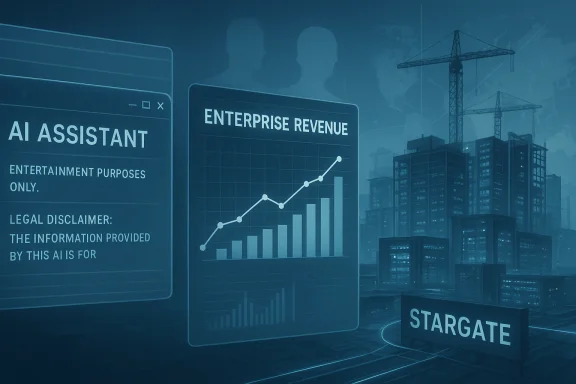
The most striking theme is the growing gap between marketing and legal reality. Microsoft’s Copilot still gets sold as a productivity and workplace companion, yet its terms now make clear that it is for entertainment purposes only and should not be relied on for important advice. That same tension exists across the sector. AI companies want users to treat these tools as essential infrastructure, but they want the liability to stop with the user when things go wrong.
At the same time, OpenAI’s financial picture has become much clearer, and that matters more than many casual observers may realize. Revenue growth at this scale suggests AI is not merely a hype cycle driven by consumer novelty; it is becoming a business with real commercial gravity. That does not prove profitability, sustainability, or inevitability, but it does make the market harder to dismiss as a purely speculative bubble. The money is real, even if the long-term economics remain unsettled.
Then there is the physical layer. Stargate, the sprawling data-center and compute initiative associated with OpenAI and partners, reflects the reality that AI is no longer just software. It is power, land, chips, cooling, grid access, and political stability. Once AI infrastructure becomes a strategic asset, it also becomes a strategic target. That is why headlines about geopolitical threats to data centers are not merely dramatic; they are a preview of the pressures that accompany a compute-hungry industry.
A final theme is competition. Meta’s latest model push and Anthropic’s continued experimentation underscore that the frontier model race is not over, even if the narrative has shifted from pure benchmark bragging to product fit, safety tradeoffs, and enterprise trust. Each company is now trying to define what kind of AI layer it wants to own. Some are building assistants. Others are building platforms. A few are trying to become the operating system underneath work itself.
The reason this matters is simple: AI companies want adoption without accountability. They want businesses to integrate their systems into daily operations, but they are increasingly careful to frame outputs as uncertain, provisional, and ultimately user-responsible. That move is not unique to Microsoft. It reflects a broader industry consensus that the models are useful, but the output is never quite binding enough to create clear vendor liability.
There is also a practical reason for the caution. AI systems can hallucinate, misread context, and confidently produce plausible nonsense. That makes them dangerous in exactly the environments where Microsoft wants them to thrive: finance, legal, HR, operations, and executive decision-making. The legal disclaimer is Microsoft’s way of saying that the company is happy to provide the engine, but not the steering wheel.
That shift is important because the consumer side of AI, while culturally visible, is often economically noisy. Millions of people may experiment with chatbots, image tools, and assistants, but business customers tend to drive steadier recurring revenue and stronger willingness to pay. If OpenAI is moving toward enterprise parity, it is effectively saying that the AI market is graduating from novelty to procurement. That is a much more serious phase of the cycle.
The strategic implication is that OpenAI can no longer be treated as a laboratory with a chat interface. It is becoming a platform company with enterprise ambitions, API economics, and infrastructure obligations. That changes how investors, competitors, and customers should think about it. This is no longer just a research story; it is a balance-sheet story.
That matters because it reframes the AI race. Companies are not merely competing on model quality; they are competing on access to chips, electricity, grid interconnects, and the ability to keep those systems running in politically stable environments. The same infrastructure that powers the next model generation can also become a bottleneck, a negotiation point, or a strategic vulnerability.
That does not mean every threatened facility becomes a live target, but it does mean the industry has crossed into a new risk category. AI firms now need to think like utilities, defense contractors, and cloud providers at the same time. That is not a role most of them imagined for themselves when the current boom began.
What makes Muse Spark notable is not just the model itself but the organizational signal behind it. Meta appears to be reworking its AI structure around a more ambitious “superintelligence” narrative while trying to convert research into product. That is a familiar move in Silicon Valley, but the stakes are higher now because the companies involved are no longer just trying to impress technologists. They are trying to capture user attention, developer loyalty, and long-term ecosystem power.
There is also a broader market signal here. When companies like Meta release a new model, they are not only talking to users. They are talking to talent, investors, and rivals. A credible model launch says the company is still in the game, still capable of shipping at the frontier, and still willing to spend heavily to stay relevant. In AI, perception is not everything — but it is close.
That is why Anthropic’s recent approach matters. The company has increasingly treated model release as a governance decision rather than a pure product decision. That does not make it conservative in the ordinary sense. It makes it strategic. In a market where some competitors chase speed, Anthropic is trying to claim seriousness, especially in enterprise and security-sensitive contexts.
That could prove valuable. As AI moves deeper into regulated industries, the ability to explain why access is restricted may matter more than raw benchmark leadership. Buyers do not only want the most powerful model. They want the model that is easiest to defend internally. Safety is becoming a sales feature, not just a research ethic.
These are not just different styles. They are different theories of where value will accrue. One theory says the winner will own the most flexible assistant layer. Another says the winner will own enterprise workflows. Another says the winner will own the infrastructure stack. Another says distribution is destiny. None of them can be ruled out yet, which is part of what makes the current phase so unstable.
This matters to users because the business model influences the product. If consumer growth slows, users may see more paywalls, tighter caps, or more aggressive upsell paths. If enterprise demand rises, they may see stronger admin controls and more compliance features. If infrastructure remains tight, access may become more expensive even when the software looks free.
For enterprises, the stakes are much higher. Businesses want AI that saves time, lowers labor burden, and integrates into workflows without creating legal exposure. They also want stable pricing and predictable behavior. That is a tall order, and it explains why the industry is leaning so hard into enterprise contracts, admin features, and managed deployments.
It also creates a feedback loop. Enterprise demand finances the infrastructure that keeps consumer tools improving, while consumer usage creates the brand and distribution that enterprise sales teams can point to. The market is becoming a two-way engine, not a one-way funnel. That is good for revenue, but it also makes the whole ecosystem more fragile.
Watch for a few specific developments over the next several weeks. The first is whether OpenAI continues to lean harder into enterprise and workflow integration. The second is whether Microsoft’s Copilot messaging becomes even more explicit about user responsibility and limited guarantees. The third is whether Meta can turn Muse Spark into a product story with staying power rather than a one-off launch cycle. And the fourth is whether infrastructure risk starts to shape public AI strategy more visibly than model benchmarks do.
Source: TechRadar https://www.techradar.com/ai-platfo...d-7-other-ai-stories-you-need-to-catch-up-on/
 Overview
AI news has been moving fast for so long that it is easy to miss the bigger pattern. But the pattern is now unmistakable: the companies leading the race are trying to turn speculative enthusiasm into durable business models while simultaneously insulating themselves from risk. Microsoft’s Copilot disclaimer, OpenAI’s revenue disclosures, and the latest infrastructure and model launches all sit inside that same transition. The industry is still promising transformation, but it is also writing far more defensive fine print.The most striking theme is the growing gap between marketing and legal reality. Microsoft’s Copilot still gets sold as a productivity and workplace companion, yet its terms now make clear that it is for entertainment purposes only and should not be relied on for important advice. That same tension exists across the sector. AI companies want users to treat these tools as essential infrastructure, but they want the liability to stop with the user when things go wrong.
At the same time, OpenAI’s financial picture has become much clearer, and that matters more than many casual observers may realize. Revenue growth at this scale suggests AI is not merely a hype cycle driven by consumer novelty; it is becoming a business with real commercial gravity. That does not prove profitability, sustainability, or inevitability, but it does make the market harder to dismiss as a purely speculative bubble. The money is real, even if the long-term economics remain unsettled.
Then there is the physical layer. Stargate, the sprawling data-center and compute initiative associated with OpenAI and partners, reflects the reality that AI is no longer just software. It is power, land, chips, cooling, grid access, and political stability. Once AI infrastructure becomes a strategic asset, it also becomes a strategic target. That is why headlines about geopolitical threats to data centers are not merely dramatic; they are a preview of the pressures that accompany a compute-hungry industry.
A final theme is competition. Meta’s latest model push and Anthropic’s continued experimentation underscore that the frontier model race is not over, even if the narrative has shifted from pure benchmark bragging to product fit, safety tradeoffs, and enterprise trust. Each company is now trying to define what kind of AI layer it wants to own. Some are building assistants. Others are building platforms. A few are trying to become the operating system underneath work itself.
Microsoft’s Copilot disclaimer and the liability pivot
Microsoft’s Copilot disclaimer is one of those details that sounds trivial until you look at what it implies. The company has spent years positioning Copilot as a central productivity layer across Windows, Microsoft 365, and enterprise workflows, but its terms now emphasize that the service is not to be treated as dependable advice or a guaranteed work tool. That is not a cosmetic change. It is a legal and strategic boundary.The reason this matters is simple: AI companies want adoption without accountability. They want businesses to integrate their systems into daily operations, but they are increasingly careful to frame outputs as uncertain, provisional, and ultimately user-responsible. That move is not unique to Microsoft. It reflects a broader industry consensus that the models are useful, but the output is never quite binding enough to create clear vendor liability.
Why the wording matters
The phrase for entertainment purposes only is especially jarring because it clashes with the way Copilot is marketed. This is not a toy in the promotional sense. It is embedded in office software, enterprise licensing, and workplace automation. When the legal framing sounds closer to a game than a business platform, users should pay attention.There is also a practical reason for the caution. AI systems can hallucinate, misread context, and confidently produce plausible nonsense. That makes them dangerous in exactly the environments where Microsoft wants them to thrive: finance, legal, HR, operations, and executive decision-making. The legal disclaimer is Microsoft’s way of saying that the company is happy to provide the engine, but not the steering wheel.
- Productivity positioning and legal disclaimers are now pulling in opposite directions.
- Enterprise trust depends on accuracy, but the model cannot guarantee it.
- User responsibility is becoming the industry’s default liability strategy.
- AI governance is shifting from promise to paperwork.
OpenAI’s revenue and the commercialization of AI
OpenAI’s latest revenue disclosures are among the most consequential developments in the current AI market because they offer a glimpse into the economics underneath the hype. The company said enterprise now makes up more than 40% of revenue and is on track to reach parity with consumer by the end of 2026. That is a major signal. It suggests the business is evolving from consumer obsession to a more balanced, and perhaps more durable, commercial model.That shift is important because the consumer side of AI, while culturally visible, is often economically noisy. Millions of people may experiment with chatbots, image tools, and assistants, but business customers tend to drive steadier recurring revenue and stronger willingness to pay. If OpenAI is moving toward enterprise parity, it is effectively saying that the AI market is graduating from novelty to procurement. That is a much more serious phase of the cycle.
What the numbers suggest
OpenAI’s claim that its enterprise segment now accounts for more than 40% of revenue aligns with broader reporting that the company’s annualized revenue has climbed sharply over the past year. Reuters-linked reporting earlier this year said OpenAI topped $25 billion in annualized revenue, and separate reporting indicated the company was already above $20 billion in annualized revenue in January. Those figures are not the same as profit, but they do establish momentum.The strategic implication is that OpenAI can no longer be treated as a laboratory with a chat interface. It is becoming a platform company with enterprise ambitions, API economics, and infrastructure obligations. That changes how investors, competitors, and customers should think about it. This is no longer just a research story; it is a balance-sheet story.
- Enterprise demand is now a central growth engine.
- Consumer scale still matters, but it is no longer the whole business.
- Revenue growth strengthens the case that AI is not a passing fad.
- Compute costs remain the key offsetting risk.
Stargate and the infrastructure reality of AI
If the software layer of AI is about models and prompts, the physical layer is about power and geopolitics. Stargate has become one of the clearest symbols of that shift, because it represents AI as a sprawling industrial project rather than a purely digital service. OpenAI’s own announcements describe Stargate as a multi-gigawatt infrastructure effort designed to support frontier-scale compute across multiple sites, including U.S. capacity and the international Stargate UAE deployment.That matters because it reframes the AI race. Companies are not merely competing on model quality; they are competing on access to chips, electricity, grid interconnects, and the ability to keep those systems running in politically stable environments. The same infrastructure that powers the next model generation can also become a bottleneck, a negotiation point, or a strategic vulnerability.
Why geopolitics matters here
Reports that Iranian officials could view major AI infrastructure as a potential target underscore a simple reality: compute is now part of the global strategic landscape. A data center is no longer just a building full of servers. It is a concentration of national and corporate ambition, and that makes it symbolically and practically significant.That does not mean every threatened facility becomes a live target, but it does mean the industry has crossed into a new risk category. AI firms now need to think like utilities, defense contractors, and cloud providers at the same time. That is not a role most of them imagined for themselves when the current boom began.
- Compute concentration increases operational risk.
- International sites add regulatory and geopolitical complexity.
- Energy dependence can slow deployment and raise costs.
- Physical security is now part of AI strategy.
Meta’s Muse Spark and the renewed frontier race
Meta’s new Muse Spark model is a reminder that the frontier race is still alive, even if the market has become less naïve about it. Meta says the model is natively multimodal, supports tool use and multi-agent orchestration, and is available through Meta AI products. That makes it more than a research artifact; it is part of a broader attempt to reassert Meta’s relevance in the next generation of AI platforms.What makes Muse Spark notable is not just the model itself but the organizational signal behind it. Meta appears to be reworking its AI structure around a more ambitious “superintelligence” narrative while trying to convert research into product. That is a familiar move in Silicon Valley, but the stakes are higher now because the companies involved are no longer just trying to impress technologists. They are trying to capture user attention, developer loyalty, and long-term ecosystem power.
What Meta is really trying to prove
Meta has always had an advantage in distribution. Billions of users touch Facebook, Instagram, WhatsApp, and related products. But distribution does not guarantee AI leadership. The company needs models that feel differentiated enough to justify integration and usage. Muse Spark appears intended to show that Meta is not content to be a fast follower.There is also a broader market signal here. When companies like Meta release a new model, they are not only talking to users. They are talking to talent, investors, and rivals. A credible model launch says the company is still in the game, still capable of shipping at the frontier, and still willing to spend heavily to stay relevant. In AI, perception is not everything — but it is close.
- Multimodal capability is now table stakes for serious frontier models.
- Orchestration features show the shift toward agentic workflows.
- Distribution advantages matter, but only if the model earns user trust.
- Productization is the real test of frontier credibility.
Anthropic, safety, and the limits of “capability”
Anthropic’s latest model news has drawn attention because it highlights a paradox at the center of frontier AI: the most capable models are also the ones most likely to raise the sharpest safety questions. Even when a model performs well on benchmarks, the critical issue is not simply whether it can do more. It is whether it can do more in ways that are socially, legally, and operationally acceptable.That is why Anthropic’s recent approach matters. The company has increasingly treated model release as a governance decision rather than a pure product decision. That does not make it conservative in the ordinary sense. It makes it strategic. In a market where some competitors chase speed, Anthropic is trying to claim seriousness, especially in enterprise and security-sensitive contexts.
The safety tradeoff
The tension is that capability and caution often pull in opposite directions. A model that is too aggressively gated may frustrate users and slow adoption. A model that is too open may generate security, misuse, or trust problems. The interesting part is not that Anthropic understands this tension. It is that the company seems willing to make it central to its branding.That could prove valuable. As AI moves deeper into regulated industries, the ability to explain why access is restricted may matter more than raw benchmark leadership. Buyers do not only want the most powerful model. They want the model that is easiest to defend internally. Safety is becoming a sales feature, not just a research ethic.
- Benchmark strength is no longer enough on its own.
- Controlled release can signal seriousness to enterprise buyers.
- Security use cases are becoming a major battleground.
- Reputation management is part of model strategy now.
The business model war beneath the model war
A lot of AI coverage still treats the race as if it is mainly about who has the smartest model. That is increasingly outdated. The deeper battle is about monetization architecture. OpenAI is leaning into enterprise and compute-backed scale. Microsoft is protecting itself with disclaimers and diversified model access. Meta is trying to build productized AI into its consumer ecosystem. Anthropic is focusing on trust, safety, and serious workflows.These are not just different styles. They are different theories of where value will accrue. One theory says the winner will own the most flexible assistant layer. Another says the winner will own enterprise workflows. Another says the winner will own the infrastructure stack. Another says distribution is destiny. None of them can be ruled out yet, which is part of what makes the current phase so unstable.
Who wins what?
The answer may be that no single company wins everything. Consumer adoption, enterprise revenue, developer APIs, and infrastructure control may each favor different players. That would create a market that looks more like cloud computing than like the original chatbot moment: a few dominant layers, lots of specialized partners, and a continued scramble for differentiation.This matters to users because the business model influences the product. If consumer growth slows, users may see more paywalls, tighter caps, or more aggressive upsell paths. If enterprise demand rises, they may see stronger admin controls and more compliance features. If infrastructure remains tight, access may become more expensive even when the software looks free.
- Pricing pressure may rise as compute costs stay high.
- Feature gating may increase as companies seek higher-margin customers.
- Model diversity may improve as platforms support multiple vendors.
- Vendor lock-in remains a real concern for businesses.
Consumer impact versus enterprise impact
For consumers, the biggest change is psychological. AI tools are becoming less magical and more regulated, which is probably healthy. Copilot’s disclaimer, in particular, is a reminder that these systems are not truth machines. They can help, but they should not be treated as authoritative. That may disappoint users who want a frictionless digital assistant, but it should also reduce overreliance.For enterprises, the stakes are much higher. Businesses want AI that saves time, lowers labor burden, and integrates into workflows without creating legal exposure. They also want stable pricing and predictable behavior. That is a tall order, and it explains why the industry is leaning so hard into enterprise contracts, admin features, and managed deployments.
Why the split matters
Consumer users can tolerate novelty and occasional failure more easily than enterprises can. A bad recommendation in a personal chatbot is annoying. A bad recommendation in a procurement workflow, customer-support system, or compliance process can become expensive. That distinction is pushing vendors to add guardrails, auditability, and contractual protections.It also creates a feedback loop. Enterprise demand finances the infrastructure that keeps consumer tools improving, while consumer usage creates the brand and distribution that enterprise sales teams can point to. The market is becoming a two-way engine, not a one-way funnel. That is good for revenue, but it also makes the whole ecosystem more fragile.
- Consumers get convenience, but also more caveats.
- Enterprises get power, but also more responsibility.
- Vendors get recurring revenue, but also higher expectations.
- Regulators get more reasons to pay attention.
Strengths and Opportunities
The AI sector still has enormous upside, and this week’s developments show why investors and strategists remain interested despite all the caveats. The combination of real revenue, growing enterprise adoption, and frontier model development suggests the industry is still expanding its addressable market rather than merely recycling hype. The strongest opportunity is not any single feature but the convergence of models, products, and infrastructure into something operationally useful.- Enterprise monetization is proving more durable than consumer novelty.
- Infrastructure buildout creates a moat for the best-capitalized players.
- Multimodal models can support richer workflows and new products.
- Safety and compliance tooling may become a differentiator.
- Multiple model ecosystems could improve customer choice.
- Consumer distribution remains a powerful on-ramp to broader adoption.
- New use cases in coding, support, search, and productivity are still emerging.
Risks and Concerns
The risks are just as real as the opportunities. AI remains capital-intensive, legally ambiguous, and operationally dependent on infrastructure that can be stressed by power constraints or geopolitical shocks. The more AI becomes embedded in critical workflows, the more expensive mistakes become. That means the industry’s growth may be accompanied by a rising cost of failure.- Hallucinations and incorrect outputs remain unavoidable.
- Legal exposure is being pushed onto users and customers.
- Compute scarcity can raise costs and slow deployment.
- Geopolitical instability can threaten physical infrastructure.
- Vendor concentration may create systemic dependence.
- Consumer confusion may increase as marketing outpaces reliability.
- Regulatory scrutiny is likely to intensify as adoption deepens.
Looking Ahead
The next phase of AI will probably be defined less by surprise and more by normalization. That may sound less exciting, but it is actually the sign of a mature market. Once AI becomes ordinary in office suites, enterprise workflows, and consumer apps, the winners will be the companies that can make it reliable, affordable, and defensible. The flashy demo era is giving way to the operational era.Watch for a few specific developments over the next several weeks. The first is whether OpenAI continues to lean harder into enterprise and workflow integration. The second is whether Microsoft’s Copilot messaging becomes even more explicit about user responsibility and limited guarantees. The third is whether Meta can turn Muse Spark into a product story with staying power rather than a one-off launch cycle. And the fourth is whether infrastructure risk starts to shape public AI strategy more visibly than model benchmarks do.
- Further enterprise pricing and packaging changes across major AI platforms.
- More model launches that emphasize multimodality and agentic workflows.
- Additional legal and regulatory language limiting vendor liability.
- Greater attention to data center capacity, energy, and security.
- More competition around trustworthy AI for business use.
Source: TechRadar https://www.techradar.com/ai-platfo...d-7-other-ai-stories-you-need-to-catch-up-on/
