• Thread Author
A new University of Sydney study warns that AI-driven news summaries are quietly reshaping how Australians encounter current affairs — and not in ways that favour local journalism. The paper, led by Dr Timothy Koskie of the Centre for AI, Trust and Governance, finds that Microsoft’s Copilot routinely prioritises US and European outlets over Australian reporting, links to Australian media in only about one in five sampled replies, and frequently strips out bylines and local context — changes that could accelerate declines in regional coverage and weaken the economic foundations of independent newsrooms. more than a decade, search engines and social platforms have been reshaping referral traffic to publishers; generative AI assistants are now the next structural force doing the same. These assistants combine a retrieval layer (which sources candidate documents), a generative model (which composes summaries), and a presentation layer (which surfaces links and attribution to users). When any of those layers preferentially surfaces globally dominant outlets — because of training data prevalence, SEO signals, or product design choices — local and regional publishers can be bypassed entirely. The University of Sydney analysis interrogates that pipeline specifically in the context of Microsoft Copilot configured for an Australian user.
The research sample consisted of 4ummaries created by Copilot over a month, using seven news-focused prompts that Copilot itself recommended. Prompts included globally framed queries such as “what are the top global news stories today?” and “what are the major health or medical news updates for this week.” The results showed a systematic geographic skew: roughly 20% of Copilot responses contained links to Australian media, while U.S. and European sites dominated the remainder. In three of the seven prompt categories, the study found no Australian sources at all.

A laptop screen shows 'AI NEWS SUMMARY' with a world map and a bold 'PROVENANCE' label in a dim office.What the study actually measured — and what it dimethods​

  • Sample size: 434 Copilot responses generated over a 31-day window.
  • Platform: Microsoft Copilot running on Windows systems set to an Australian location, using pe assistant.
  • Focus: provenance (which outlets were linked), visibility of journalists (are bylines named?), and **local s and communities referenced?).

Important exclusions and caveats​

  • The study did not evaluate factual accuracy, hallucinations, or disinformation in the summariestion of whose voice is amplified versus erased.
  • The analysis examined Copilot only; although Koskie reported preliminary, informal checks suggesting similar trends across other LLMs, those platforms were *nl dataset. Microsoft did not respond to requests for comment prior to publication of the study. These are important limits to keep in mind when generalising the findings.

Key findings — what the numbers show​

  • Only about one in five Copilot news summaries linked to Australian media. This pattern held across multiple globally framed promptropean outlets** were cited far more frequently; more than half of the most-referenced sites in the sample were U.S.-based.
  • Where Australian outlets appeared, links tended to concent of dominant national players** (for example, major commercial publishers and the national broadcaster), rather than a diverse cross-section oonal newsrooms.
  • Bylines and journalist names were nearly invisible. Summaries frequently referred to “researchers” or “experts” instead of naming the reporter and newsroom that produced the original reporting. This erasure weakens both recognition for jouhe user’s ability to judge provenance.
These patterns are not abstract: they translate into fewer referral clicks, reduced subscription conversions and advertising opportunities, and thus fewer resources to sustain local beats that cover courts, councils, schools and regional emergencies. In short, the refs that once propped up niche and local reporting can be undermined by opaque summarisation layers.

Why Copilot (and similar assistants) favour big international outlets​

Several interacting technical and commercial dynamics explain the skew:
  • Training and indexing density: Large international publishers produce huge volumes of content and enjoy high crawl/index coverage anetrieval systems and training corpora therefore contain disproportionately more signals from these domains. That data density biases retrieval toward big players.
  • SEO and backlink concentration: Retrieval algorithms and relevance heuristics often use signals correlated with global reach (backlinks, domain authority). Smaller or paywalled local outlets typically lack that global footprint.
  • Prompt framing and UX design: If the assistant’s suggested prompts anemphasise global briefs (for example, “top global news”), user behaviour and system outputs will both bias toward globally syndicated stories. Default UIs that encourage broad queries multiply this effect.
  • Platform aggregation and es: Integrations with platform-owned news portals (for Microsoft, the MSN/aggregator ecosystem) and in-house summarisation features change the incentives: the platform’s product strategy can favour internal or high-reach partners over routing users to smaller third-party sites. Koskie points out that Cch installed the assistant on Windows and promoted news prompts to users — is itself a product-level driver of how news is surfaced.
Taken together, these mechanics create a feedback loop: models and retrieval indices privilege globally visible sources, which then generate summaries that deprioritise local reporting — decreasing clicks back to smaller outlets and further reducing their web presence and link signals.

The broader integrity problem: accuracy and sourcing in AI assistants​

Koskie’s ph and provenance, but it sits alongside independent evidence that AI assistants also present real accuracy and sourcing issues when they attempt to summarise news.
A large international study coordinated by the European Broadcasting Union and led by the BBC evaluated more than 3,000 responses from ChatGPT, Copilot, Google Gemini, and Perplexity across 14 languages and 18 countries. Professional journalists judged that 45% of AI answers contained at least one significant issue; 31% of responses had
serious sourcing problems* (missing, misleading or incorrect attributions); and 20% contained major accuracy problems such as fabricated or outdated facts. The EBU now publishes a "News Integrity in AI Assistants" toolkit aimed at improving evaluation and best practice. These results highlight systemic reliability problems that compound the distributional issues Koskie documents.
Taken together, the two sets of findings raise twin concerns for publishers and regulators: AI assistants both distort where readers go for news and too often present news summaries that misrepresent original reporting or fail to attribute it correctly.

Why this matters for Australian democracy and local communities​

Local journalism is civic infrastructure: it holds councils, courts and utilities to account; it reports on emergency warnings, planning decisions and local service delivery; and it is often the most trusted information source on community matters. When algorithmic systems deprioritise local outlets and remove reporter bylines:
  • Communities risk losing timely, locally tailored information about issues that directly affect them.
  • Newsrooms lose referral traffic that converts casual readers into subscribers or provides ad impressions — both vital revenue streams, especially for small and regional publishers.
  • The invisible labour of journalists becomes harder to recognise and reward, undermining accountability and professional credit for reportinghe consequences starkly: without interventions that account for AI-mediated news discovery, Australia faces disappearing local news, fewer independent voices, and a weakened democratic drengths of the research — what it contributes
  • Clear, measurable lens on provenance. By isolating which sources were surfaced by Copilot, tncrete metric (share of Australian-linked responses) that is directly meaningful to publishers and policymakers.
  • Product-aware critique. The paper inspects not just the model but the full product pipeline — p presentation — which is essential when engaging with real-world platform effects.
  • Policy relevance. The findings directly intersect with existing Australian policy instruments — specifically the News Media Bargaining Incentive and related bargaining codes — by identifying a policy gapn sits outside current regulatory frameworks.
  • Actionable recommendations. Koskie does not merely diagnose; he proposes concrete levers: adjusting retrieval weighting for geographic relevance, improviovenance defaults, extending bargaining frameworks or incentives to AI experiences, and mandating auditing or transparency obligations.

Risks, unknowns and areas needing further verification​

  • Generalisability across models and prompts. The study focuses on Copiloeven prompts. Koskie’s informal checks suggested similar trends across other LLMs, but those were not part of the formal dataset. Broader audits across different assistants, languages and a wider set of query types are needed before concluding the skew is universal. Caution is warranted when extrapolating beyond Copice.
  • Causality vs. correlation. The study documents distributional outcomes but cannot fully disentangle the precise causal mechanism for each instance (e.g., was a U.S. outlet cited because the retrieval index prioritized it, or because it published the most recent relevant reporting?). Technical audits that trace retrieval scores, grounding documents and ranking heuristics would strengthen causal claims.
  • Opaque commercial relationships. Platform licensing deals, syndication arrangements aval indices are often opaque. The economic incentives that shape which outlets are surfaced — whether marketplace agreements or preferential API access — are not always publicly visible, which complicates regulatory responses. Koskie notes this opacity as a constraint on full public auditing.
  • Microsoft’s platform choices. The study highlights Microsoft-specific integrations (e.g., MSN content and the alout) as structural contributors, but Microsoft’s design rationale and any internal geographic-weighting logic were not made public during the study. The company’s lack of pre-publication comment leaves some assertions unverified from a vendor perspective.

Practical steps publishers, platforms and policymakers should consider​

The study’s recommendations can be grouped into product, publisher, a

Product and platform changes (what Microsoft and other AI vendors could do)​

  • Embed geographic weighting into retrieval indices so that local outlets are surfaced for users in that jurisdiction.
  • Default to link-first provenance in presentation: always show the original byline, outlet and a clickable link before the summarised copy.
  • Expose an “expand / read original” aers toward the source article, preserving referral opportunities.
  • Publish periodic transparency reports and make retrieval signals auditable to independent researchers.

Publisher tactics (what newsrooms can adopt)​

  • Improve technical discoverability: make sitemaps, structured metadata, and canonical tags robust so retrieval layers can index local reporting more effectively.
  • Experiment with microformats or schema designed for grounding in summarisation services (e.g., explicit author metadata fields).
  • Build membership and direct-payment flows that are less dependent on single pageviews to reduce vulnerability to referral changes.

Regulatory and policy options (what governments can do)​

  • Expand the remit of the News Media Bargainin frameworks to explicitly include AI-assisted news experiences, defining what constitutes “use” and compensation when AI summaries incorporate or are grounded in news content.
  • Mandate provenance and attribution standards for AI news responses — explicit byline display, source linking, and versioned corrections when the model’s output deviates from the source.
  • Require independent auditing of AI assistants’ news outputs and public reporting on the incidence ofal sourcing.

How readers and civic actors should respond right now​

  • Treat AI summaries as starting points, not definitive reporting. Always click through to the original article on the publisher’s site before acting on consequential claims.
  • Support local journalism directly via subscriptionstions; that direct revenue is the most resilient buffer against referral erosion.
  • Demand transparency from AI vendors about how retrieval and grounding are implemented, and support journalistic audits that publicly measure geographic representation.

Final analysis — a pragmatic prognosis​

AI assistants deliver meaningful readability, triage, and accessibility. Yet the University of Sydney’s findings underscore that product convenience can carry concentrated downstream harms for media pluralism when the architecture of retrieval and presentation favours gls authorial provenance. Those harms are not strictly technical; they are economic, civic and democratic.
The EBU/BBC evidence that assistants misrepresent newthe time compounds the problem. When the gateway into the news ecosystem is both distributionally biased and prone to sourcing errors, the combined effect is to centralise antability, and accelerate the long-term attrition of local reporting capacity.
This is not a call to freeze innovation. It is a call to realign incentives and product defaults so that AI systems can deliver concision and accessibility without hollowing out the institutions that produce high-value local reporting. Realistic reform will be mixed: technical product changes that preserve provenance, publisher investments in discoverability and payment models, and policy adjustments that bring AI-mediated news experiences within the regulatory perimeter. Without that hybrid response, the "invisibility" of Australian journalists may become an entrenched effect of the next generation of information infrastructure.

Quick reference — what to read next (research and toolkits to consult)​

  • University of Sydney press brief and research summary by Dr Timothy Koskie on Copilot and Australian media provenance.
  • European Broadcasting Union’s “News Integrity in AI Assistants” report and toolkit, coordinated with the BBC, documenting broad reliability and sourcing issues across major assistants.
Conclusion: AI is remaking the fionversation; whether it strengthens or weakens democratic information ecosystems will depend on choices we make now about product defaults, liability, and how platform economics interact with the fragile business models of local journalism. If policymakers, platforms and publishers do not act in concert, the result will be an automated amplifier for global outlets and an accelerating retreat of the local watchdogs that keep communities informed and accountable.

Source: Information Age | ACS How AI is reshaping Australian news
 

Microsoft’s AI business is no longer a promise on a slide deck — it’s a measurable revenue engine that is reshaping how the company allocates capital, how analysts value the stock, and how enterprise customers buy cloud services. The Intellectia piece you provided captures that shift: Microsoft reported materially stronger AI-driven consumption and disclosed an AI annualized revenue run rate that management and most observers now treat as a concrete growth vector rather than a speculative long‑term upside. view
Microsoft’s recent quarterly reporting and investor commentary made two things unmistakably clear: AI is already a major commercial product for Microsoft, and management is deliberately accepting short‑term capital and margin pressure to build the infrastructure that will support AI at scale. The company’s official investor materials and mainstream reporting show that the Azure and Microsoft Cloud franchises are growing fast, while the productization of generative‑AI features — primarily through the Copilot family and Azure AI services — is shifting consumption patterns and pricing models.
Across multiple earnings summaries, the same headline numbers recur:
  • Quarterly revenue well above consensus (the October–December quarter was reported at roughly $81.3 billion).
  • Azure and Intelligent Cloud growth in the high‑30s percent range, driven substantially by AI workloads.
  • Management‑disclosed AI annualized revenue run rates that industry analysts have repeatedly cited as north of $10 billion (with specific statements noting about a $13 billion run‑rate in earlier quarters).
These raw numbers are the scaffolding for the bullish case that investors and enterprise customers have been discussing: Microsoft has a unique combination of a hyperscale cloud, productized seat‑based AI in Microsoft 365, privileged model access through the OpenAI relationship, and a sales organization that reliably converts pilots into enterprise contracts.

IT professionals monitor cloud storage and analytics in a futuristic data center.What the Intellectia Piece Says — A Cleared‑Up Summary​

The Intellectia article (the document you shared) frames Microsoft’s AI story in financial and analyst terms: it highlights the company’s reported AI growth, repeats the headline analyst price targets and theirs that while AI momentum is lifting Azure, there are new dynamics to watch — especially how Microsoft is allocating new capacity to first‑partyilot rather than selling that capacity solely as third‑party Azure consumption. That, the article notes, is part of why some analysts lowered price targets even after stro
Key takeaways Intellectia emphasizes:
  • Microsoft’s AI business is growing quickly and already contributes materially to Azure momentum.
  • Some sell‑side analysts trimmed price targets aft capacity allocation and Azure growth that came in slightly shy of the highest expectations.
  • The company’s capital expenditure program and the way it uses newly‑installed capacity (for in‑house Copilot usage vs. third‑party hosting) are central to near‑term upside and risk dynamics.
I verify and expand on those points below with additional context from Microsoft’s investor disclosures and independent reporting.

Financials and Key Metrics — What’s Verifiable​

When translating “AI momentum” into numbers, investors need a handful of anchors. Here are the most load‑bearing, verifiable facts and their meanings:
  • Revenue and EPS: Microsoft reported approximately $81.3 billion in revenue for the October–December quarter, materially beating consensus and lifting GAAP and adjusted EPS. This confirms the company’s ability to continue growing at scale across its portfolio.
  • Azure / Intelligent Cloud growth: Azure and cloud services grew in the high‑30s percent range year‑over‑year, supporting the assertion that cloud plus AI remain the principal engines of growth. Different outlets reported Azure growth figures in the 38–39% neighborhood for the quarter.
  • AI annualized run rate: Microsoft publicly stated an AI annualized revenue run rate that management has characterized as in the low‑double‑digit billions — a commonly quoted anchor in investor notes is about $13 billion (reported in prior quarters by management). That figure is a durable, company‑level signal that AI has moved from a development expense to a monetizable product set.
  • Capital expenditures: Microsoft signaled extremely high capex levels tied to AI infrastructure (quarterly capex in the tens of billions, and multi‑year commitments to expand GPU and data‑center capacity). The company’s disclosures and financial reporting show capex markedly higher than in pre‑AI years, with the most recently reported quarter carrying a material capex load. This is the key trade‑off: higher growth today, but with near‑term free‑cash‑flow pressure.
These are the concrete anchors analysts and investors use when they model gross margin trajectory, incremental revenue from Copilot seat conversions, and Azure consumption growth.

How Microsoft Is Monetizing AI: Copilot, Azure AI, and Pricing​

Microsoft has formalized two complementary monetization paths for AI:
  • Seat‑based monetization: Microsoft 365 Copilot is priced and sold as an add‑on for commercial customers. Microsoft announced a commercial price‑anchor at roughly $30 per user per month for enterprise customers when Copilot first launched, although Microsoft has subsequently adjusted business offerings and SMB pricing in response to feedback and segmentation. That seat pricing gives analysts an ARPU (average revenue per user) figure to model adoption and expansion into existing Microsoft 365 customers.
  • Usage / consumption monetization: Azure charges for inference and other AI workloads. Customers (including large commercial partners) consume GPU hours, managed services, and platform features — generating variable revenue that scales with usage and produced by Azure’s hyperscale infrastructure. Microsoft’s financials show commercial bookings and remaining performance obligations growing in a way consistent with higher recurring and multi‑year Azure commitments.
Why both paths matter:
  • Seat pricing converts AI features into recurring, predictable revenue and creates an upsell path inside Microsoft’s installed base.
  • Consumption monetization powers outsized revenue when customers scale AI workloads, which can be very high margin once the capacity is paid off and utilization is optimized.
Microsoft’s product pages and investor commentary make the seat price and consumption model explicit — and both are already showing up in results and commercial bookings.

The OpenAI Arrangement: Opportunity and Concentration​

One of the most consequential events of the last 12 months was OpenAI’s restructuring and the new commercial terms reached with Microsoft. Under the revised arrangement, Microsoft gained a significant equity position in the new OpenAI Group and secured long‑term commercialization rights. Public reporting and Microsoft’s own blog confirm the terms: Microsoft has a roughly 27% stake in the restructured OpenAI for‑profit entity, and OpenAI committed to purchasing large volumes of Azure services (commonly reported in the industry as an incremental $250 billion of Azure consumption over time in the revised agreement). Those facts materially change Microsoft’s revenue visibility and the economics of running an enterprise‑grade model provider on Azure.
Implications:
  • Positive: The arrangement gives Microsoft privileged model access and a long‑term revenue backstop from OpenAI usage, while also expanding the company’s ability to commercialize cutting‑edge AI in its product stack.
  • Cautionary: Concentration risk increases — a large portion of the AI narrative depends on the OpenAI relationship and how those commercial terms translate into actual Azure consumption and cash flows. Also, public commitments of this magnitude are subject to timing, implementation, and potential renegotiation complexities.

Analyst Reaction and Valuation — Why Some Targets Came Down​

The paradox of Microsoft’s recent quarters is straightforward: the company is growing and producing significant AI revenue, but the stock has faced downward pressure because analysts and investors are re‑pricing growth against much larger near‑term capital commitments.
What happened:
  • Several sell‑side firms lowered price targets after the quarter even while maintaining positive ratings. The common thread cited by analysts is capacity allocation (Microsoft increasingly uses new capacity for first‑party Copilot/Office deployments and product teams) and the fact that Azure’s headline growth, while strong, came in slightly below the loftiest Street expectations. Published analyst notes and market summaries document multiple price‑target trims in late January as the market digested capex and guidance.
Why this matters for investors:
  • Price‑target changes are backward‑looking and often reflect updated margin and capital intensity expectations rather than the underlying market opportunity.
  • The market must reconcile a durable long‑term AI revenue opportunity with short‑term free‑cash‑flow drag from the largest capex efforts Microsoft has made in decades. That trade‑off is central to both bullish and cautious scenarios.

Strategic Strengths That Favor Microsoft​

Microsoft’s AI thesis rests on several durable competitive advantages that are worth articulating clearly:
  • Hyperscale infrastructure with enterprise reach: Azure combines global data‑center scale with enterprise integrations (Active Directory, Microsoft 365 identity and management), making it straightforward for enterprises to adopt AI‑based features into existing environments. This reduces friction and shortens sales cycles.
  • Commercialized seat pricing: Converting Copilot into a priced, seat‑based SKU means Microsoft can capture value via subscription economics inside existing Microsoft 365 contracts.
  • Privileged model access and partner leverage: The strategic arrangements with OpenAI (and subsequent partnerships with other model provid partners) create differentiated product capabilities that Microsoft can embed across the Office stack, Teams, Windows, and vertical applications.
  • Large installed base and field organization: Microsoft’s enterprise sales channels and multi‑year contractual relationships (including large commercial bookings and remaining performance obligations) provide a clear path to scale Copilot adoption across customers who already pay for Microsoft 365 and Azure.

Execution Risks and Why Skepticism Is Reasonable​

No strategic advantage removes execution risk. The leading risks that could materially alter Microsoft’s AI outcomes are:
  • Capital intensity and utilization timing: Massive GPU investments and data‑center builds are front‑loaded costs. If utilization ramps slower than expected, margins and free cash flow will be impaired for longer. The market is already pricing this risk into valuations.
  • Capacity allocation trade‑offs: Microsoft’s decision to use new capacity preferentially for first‑party applications (Copilot, Windows features) could reduce short‑term Azure third‑party revenue upside. That’s a product‑strategy choice that trades near‑term topline for strategic product differentiation. Intellectia and several analysts flagged this dynamic.
  • Concentration on OpenAI and partner dependency: While the earlier OpenAI deal provides upside and visibility, it also concentrates a portion of Microsoft’s AI narrative in a single partner relationship. Any changes to those dynamics — competitive model offerings, regulatory intervention, or changes in OpenAI’s go‑to‑market — would influence Microsoft’s AI consumption path.
  • Competition and pricing pressure: AWS, Google Cloud, and other platform vendors are aggressively pursuing enterprise AI workloads. Open weight releases, multi‑cloud model providers, or new verticalized offerings from competitors could increase price competition in both seat and consumption markets.
  • Regulatory scrutiny: Given Microsoft’s scale, the intensifying regulatory focus on major AI players — covering issues such as data privacy, AI safety, and potential antitrust concerns — is a non‑trivial risk that could complicate product rollouts or require costly compliance measures.

What This Means for Windows Users, IT Admins, and Developers​

For the Windows community and IT professionals, Microsoft’s AI pivot has immediate, practical consequences:
  • Expect deeper AI integration into productivity workflows. Copilot features in Word, Excel, Teams, and Outlook are being pushed toward mainstream commercial adoption — meaning new training, governance, and change‑management needs for enterprises.
  • Admins will need to manage seat licensing and governance. The seat‑based monetization model places procurement and governance decisions squarely in IT’s remit — particularly as Copilot expands into frontline and small‑business user tiers with adjusted pricing.
  • Hybrid and edge scenarios will remain important. Microsoft’s investment in on‑prem/hybrid tooling and Azure Arc plays into how enterprises deploy inference at the edge, which affects Windows Server and enterprise device strategies.
  • Expect an acceleration of “AI as a feature” embedded into Windows and Surface experiences over time. That’s why capacity allocation toward first‑party features is considered a strategic bet: it makes Windows and Microsoft 365 stickier and opens up opportunities for device and OS monetization strategies.

Likely Outcomes — Bull, Base, and Bear Scenarios​

  • Bull case (execution + adoption): Microsoft converts a large share of its installed base to Copilot seats, consumption ramps quickly, GPU utilization reaches efficient levels, and infrastructure investments pay off through sustained high‑margin usage revenue and re‑rating of multiples. In this view, the market’s near‑term capex concerns are a temporary drag on FCF that gives way to durable, higher growth and improved long‑term margins.
  • Base case (moderate execution): Copilot and Azure AI grow materially, but capex and capacity allocation temper near‑term free cash flow. Azure continues to grow but with variability quarter‑to‑quarter; analysts keep price targets in a band while allowing for multiple compressions relative to historic peaks. This is the scenario most sell‑side notes currently model.
  • Bear case (execution issues or regulatory shock): Capacity underutilization, heightened competition, or regulatory constraints materially slow seat conversions and third‑party Azure consumption. Under this scenario, the valuation multiple compresses and the balance between investment and monetization becomes negative for shareholders for a prolonged period.

What Investors and Practitioners Should Watch Next​

  • Quarterly capex and GPU utilization trenllar amount and commentary on how much capacity is being used internally versus sold to external customers. This is the single most consequential near‑term metric.
  • Copilot seat growth and ARPU — Microsoft’s disclosure of seat adds, penetration rates in large accounts, and any change to minimum seat rules for SMBs will affect revenue modeling. Microsoft’s initial $30 pricing has already evolved in the SMB channel, demonstrating the importance of segmentation.
  • Azure commercial bookings and remaining performance obligations — these metrics indicate contracted future revenue and will show whether enterprise customers are committing long‑term to Microsoft's AI stack.
  • OpenAI execution and multi‑cloud dynamics — track how OpenAI’s model distribution and third‑party partnerships evolve, and whether the promised Azure purchases materialize on the cadence expected by Microsoft. Public commitments are meaningful but require real execution to underpin valuation assumptions.

Final Assessment — Strengths, Risks, and a Balanced View​

Microsoft’s AI monetization story has graduated from promise to practice. That’s the fundamental positive takeaway: AI now contributes material, recurring revenue, and Microsoft has a realistic pathway to scale that revenue through both seat pricing and usage consumption. This reality is a core reason many analysts remain bullish on Microsoft’s multi‑year prospects.
At the same time, the valuation question has become more nuanced and time‑dependent. Analysts lowering price targets while keeping constructive ratings reflect a market that wants to see conversion of infrastructure investments into sustained, higher‑margin revenue before assigning a multiple premium. The primary dangers are execution timing (how fast that infrastructure is used) and concentration around partner‑dependent model sources — both entirely real and plausibly significant.
For enterprise IT leaders and Windows users, the short‑term impact is straightforward: prepare to manage Copilot adoption, licensing, and governance; evaluate the ROI of AI automation projects carefully; and factor AI‑enabled features into desktop, server, and cloud roadmaps.
Ultimately, Microsoft is placing a high‑stakes bet on being the platform of record for enterprise AI. The numbers show that the bet is working in revenue terms today, but the larger question is whether the company will realize margin and cash‑flow superiority at scale. That calculus will determine whether investors reward Microsoft with a higher valuation or whether the market will insist on more evidence that the long‑term payoff justifies the near‑term investment.

Source: Intellectia AI https://intellectia.ai/news/stock/microsofts-ai-business-shows-significant-growth/
 

AI-driven answers are now being flagged for citing a very narrow set of headline news sources — a trend that threatens local journalism, distorts public debate, and concentrates editorial power in the hands of a few highly visible outlets.

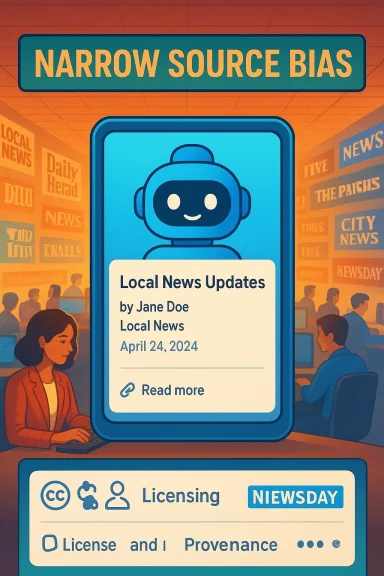
Poster about narrow source bias in local news, showing a blue robot delivering updates.Background / Overview​

The recent debate began to crystallise after a series of audits and think‑tank analyses showed that mainstream AI assistants tend to draw on a small subset of well‑known publishers when answering news queries. A BBC‑led audit coordinated with the European Broadcasting Union found widespread problems in AI news summaries — including high rates of factual errors, sourcing failures and editorialisation — when assistants were tested against real newsroom questions. Reviewers judged roughly half of assistant nificant issues*.
Independent analysis by the Institute for Public Policy Research (IPPR) layered onto that editorial concern with a distributional claim: some AI tools repeatedly surface the same handful of outlets, with certain publishers appearing far more often than others in generated answers. That concentration, IPPR argues, can be traced to licensing arrangements, indexing density and platform retrieval heuristics that privilege high‑visibility domains.
At the same time, academic and field studies have shown product‑level effects: a University of Sydney audit of Microsoft Copilot coalian locale found Copilot’s news briefs heavily favoured large national and international outlets over regional and local publishers — a pattern that risks reducing referral traffic to smaller newsrooms and eroding byline visibility.
This article summarises the key findings, explains the technical and commercial mechanisms behind them, weighs the benefits and risks for readers and publishers, and offers a practical set of mitigations that vendors, regulators and newsrooms should adopt now.

What the audits actually found​

High error rates on newsroom tasks​

Journalist‑led evaluations framed the central problem precisely: when asked to summarise or explain current events, assistants produced outputs that failed newsroom standards for accuracy and sourcing often enough to be alarming. In the BBC/EBU review, professional journalists scored thousands of assistant replies across languages and markets and found that roughly 45–51% of repliene significant problem (for example, a factual error, misattribution, or a fabricated quote). When minor defects were included, the share of replies with any problem rose to around 80–90%.

Narrow source panels and brand concentration​

Separate provenance‑focused audits—like the IPPR analysis and national studies such as the University of Sydney’s Copilot review—show that assistants often draw upon a small, repeat list of high‑reach outlets. IPPR’s analysis reported that some tools disproportionately cither major English‑language publishers, while other assistants leaned more heavily on the BBC or Reuters depending on licensing and indexing. The practical effect is a narrowing of the visible news ecosystem inside the assistant’s answer box.

Geographic and local under‑representation​

The University of Sydney study quantified the local imin five Copilot responses linked to Australian media in a sample of hundreds of news replies, and many prompts returned zero local sources. When domestic outlets appeared they commonly clustered around big national players rather than regional or independent newsrooms. That pattern matters because referral traffic and byline recognition are economically meaningful for small publishers.

Why AI answers end up citing the same outlets​

Understanding the mechanisms helps explain why the results are systemic, not acex and training density
Large publishers produce huge archives and accumulate backlinks; crawlers and indexers therefore capture far more content and authority signals from them. Retrieval layers and training corpora built on web snapshots are, by design, denser for these domains — making them statistically more likely to be chosen as sources for generated answers.

2) Licensing and deliberate access controls​

Some publishers have explicit licensing arrangements with AI vendors; others have attempted to block scraping or to pursue legal action. Where a vendor has a licensing deal (or where content is technically accessible), that outlet becomes an easier and safer provenance to cite. Conversely, the absence of a licence or active blocking can result in an outlet being under‑represented or omitted entirely from a given tool. The IPPR analysis highlights how these contractual and legal differences produce observable sourcing skews.

3) Retrieval heuristics and SEO signals​

Ranking signals used by retrieval systems (backlinks, domain authority, canonical tags) correlate with global visibility. Retrieval‑augmented generation systuthority signals will surface the same few domains more often, even where local reporting is stronger or more appropriate for the query.

4) UI design and default prompts​

Products often promote global or “top headlines” starters, nudging users away from explicitly local searches. Default prompt lists and in‑product discovery flows condition both users and the model toward broad, internationally framed answers — a design choice with dists.

5) Post‑hoc citation generation and provenance mismatch​

Some assistants generate citations after composing an answer rather than directly surfacing the retrieved evidence that informed the text. This post‑hoc reconstruction can create mismatches — a claimed source may not actually support the claim — and encourage reuse of high‑visibility outlets as a provenance shortcut. The BBC audit described these attribution problems in detail.

What’s at stake: strengths and immediate harms​

Benefits AI brings (but which create new responsibilities)​

  • Faster, conversational access to news summaries can help busy readers orient themselves quickly.
  • Multilingual summarisation and cross‑source synthesis can surface perspectives a reader might otherwise miss.
  • For accessibility and assistive technologies, conversational interfaces can make news content more reachable.
These are real gaiwhy AI assistants are being embedded across browsers, operating systems and productivity suites. But the benefits depend crucially on trustworthy provenance and editorial fidelity — which current evidence shows is uneven.

Immediate harms and systemic risks​

  • Shrinking referral flows: When answers summarise reporting without clear bylines or links, publishers lose click‑throughs and subscription opportunities — a direct economic hit, especially for smaller outlets.
  • Concentration of narrative power: If a handful of global outlets dominate AI answers, editorial frames produced by those organisations can disproportionately shape public debate in other countries and contexts.
  • Misleading or erroneous synthesis: Journalists’ audits showed frequent factual errors, hallucinated quotes or misdated events — problems that can misinform readers and produce reputational damage for original reporting mistakenly seen as incorrect.
  • Local democracy risk: Loss of visibility for local reporting threatens coverage of councils, courts, and community emergencies. The practical result is a weaker civic safety net.

Critical analysis: where existing reporting is strong — and where it is thin​

Strengths of the current research and reporting​

  • Journalist‑led audits criteria. Studies led by the BBC/EBU use experienced reporters to judge outputs on accuracy, sourcing and context — an operationally relevant method that maps directly to newsroom responsibilities.
  • Cross‑market and language breadth. Large audits tested multiple assistants across languages the problem is not isolated to English or a single vendor.
  • Provenance‑focused studies reveal distributional harms. Analyses such as the University of Sydney sample quantify the local‑news under‑representation problem with concrete referral metrics, not just anecdotes.

Limits and cautions in the evidence​

  • **Snapshot timingAssistants update frequently; tests are snapshots. A vendor may patch a sourcing bug or change a retrieval index soon after a study is published, which complicates long‑term claims. Studies are valuable but time‑bound.
  • Prompt and usage selection bias. Some audits used globally framed prompts or newsroom‑oriented question sets that stress time‑sensitive and contentious topicsst cases for LLMs. Results therefore reflect real risks, but percentages should not be read as uniform failure rates across all assistant use‑cases.
  • Proprietary system opacity. Vendors rarely disclose detailed retrieval logs or training mixes, which makes it hard to attribute a single root cause (e.g., licensing vs. index bias) without access to internal telemetry. Where possible, external audits should be paired w under nondisclosure terms. This remains, for now, a barrier to perfect verification.
Where claims are hard to verify (for example, the exact percentage share of a single outlet across all queries over a long period), they should be treated with caution. But the convergent pattern across independent studies and geographic contexts strongly supports the core diagnosis: systems often concentrate on a small set of high‑reach publishers and make noticeable editorial mistakes on news tasks.

Practical mitigations — what vendors, publishers and regulators should do now​

Below are concrete, operational steps that would materially reduce the risk of concentration and mis‑reporting. They are ordered roughly from engineering and product defaults (fast wins) to policy and industry actions (structural fixes).

Product and engineering fixes (vendors)​

  • Require every news answer showing: author, outlet, publication date and a clickable link to at least one primary source. Make provenance the default UI, not opt‑in.
  • Stop post‑hoc citation stitching: surface the actual retrieved documents that informed the answer and allow verifiers to inspect retrieval traces.
  • Add conservative refusal heuristics for time‑sensitive or high‑risk news topics (health, legal, breaking events), and require human review for distributionuce geographic weighting options so users can switch to “local” mode; expose region sensitivity to retrieval so local outlets surface correctly.

Publisher actions​

  • Publish machine‑readable metadata (bylineal timestamps) in structured schema so retrieval systems can identify local articles reliably.
  • Negotiate collective licensing or data‑sharing agreements that ensure fair compensation and branded integration in assistant interfaces.
  • Experiment with content forms that resist easy summarisation (investigations, data visualisations, local multimedia) to preserve unique value.

Regulatory and industry measures​

  • Mandate perts of AI news outputs (geographic diversity, byline preservation, referral impact) and require transparency reporting from major vendors.
  • Consider “nutrition label” requirements for AI‑generated news that disclose the editorial provenance, licence status and confidence level of statements. The IPPR has advocated exactly this as a consumer‑facing disclosure model.
  • Explore remuneration or bargaining frameworks that include AI re‑use of journalistic content so smaller publishers are not economicaltomated summarisation.

Short checklist for Windows users, IT teams and newsroom managers​

  • Check the provenance: insist on assistants that show where they derived key facts and quotes. If an answer lacks a clear byline and link, treat it as a starting point, not a definitive source.
  • Prefer “local” queries: add explicit geographic context to prompts (e.g., “local news [city]”) when you want local reporting. This can sometimes surface regional outlets that global prompts miss.
  • Monitor referral analytics: publishers should look for sudden shifts in search or direct referrals after AI assistant rollouts and raise these with vendors and policymakers.
  • Educate readers: newsrooms should publish short explainers about how AI summaries work and urge readers to click through for full context and corrections.

Final assessment and caveatsgenuinely useful shortcuts for readers, but the current generation of products treats summarisation as a finished product instead of a gateway to primary reporting. The result is two linked problems: (1) concentration of source visibility — a narrow range of high‑reach outlets repeatedly cited in answers — and (2) editorial brittleness — significant accuracy and sourcing failures on news tasks that matter for civic life. These problems compound: a misattributed or erroneous summary that comes from a single be more visible and more consequential than the same error in a fragmented news ecosystem.​

Remedies are both technical and institutional. Engineers must bake provenance, conservative refusal, and geographic sensitivity into product defaults. Publishers must adopt machine‑readable metadata and consider collective bargaining. Regulators and standard‑setting bodies should require audits and consumer‑facing disclosure of provenance and licensing. The alternative is a gradual re‑routing of audience attention away from the diverse networks of journalism that underpin local accountability and civic resilience.
The evidence from multiple, independent audits and analyses is consistent enough to treat the problem as urgent — not hypothetical. At the same time, product updates and licensing negotiations can change the trajectory quickly; the policy task is to ensure that when vendors do improve, they do it in ways that restore plurality, preserve bylines and compensate the journalism ecosystem that underpins public knowledge.

Source: Press Gazette AI answers cite 'narrow range' of top newsbrands led by BBC and Guardian
 

Back
Top