

The March 20 “Rundown AI Office Hours” discussion lands at a moment when AI in office software has moved from novelty to platform strategy, and that shift matters far beyond productivity demos. What began as a race to bolt chatbots onto documents and spreadsheets is now turning into a contest over enterprise workflows, pricing power, security, and distribution. The real story is not just that Microsoft, Google, and a wave of startups are adding generative AI to familiar apps; it is that they are trying to redefine how knowledge work is bought, measured, and monetized.
The modern AI office stack did not appear overnight. It emerged from two converging pressures: the post-pandemic normalization of remote and hybrid work, and the rapid maturity of large language models capable of writing, summarizing, and reasoning over everyday business content. By March 2023, the productivity market was primed for disruption, with workers drowning in email, meetings, chat threads, and fragmented files, while executives searched for measurable efficiency gains.
Microsoft’s Copilot for Microsoft 365 became the defining product of that wave. On March 16, 2023, Microsoft introduced the assistant as a layer across Word, Excel, PowerPoint, Outlook, and Teams, positioning it as a way to draft, analyze, summarize, and create using business context and enterprise data. Microsoft later emphasized that it could help unlock productivity and creativity across those core apps, while also building a broader “Copilot” ecosystem around work, security, and business processes. (microsoft.com)
Google responded quickly with its own generative AI push in Workspace. On March 14, 2023, Google announced new generative AI experiences for Docs, Gmail, and other Workspace tools, signaling that productivity software had become a frontline battleground for generative AI. Google described the rollout as a staged release to trusted testers before public availability, which reflects how cautious vendors were being while still racing to claim mindshare. (workspace.google.com)
The commercial opportunity is obvious because the software category is enormous and sticky. Microsoft has since priced Microsoft 365 Copilot as a premium add-on, with current business pricing starting at a monthly per-user fee and separate licensing requirements for qualifying plans, underscoring that AI is not just a feature but a monetization layer. That pricing model reflects a broader market conviction that enterprises will pay for time savings, reduced toil, and better decision support if the return is clear enough.
At the same time, the market has matured beyond simple “chat in the sidebar” demos. Gartner said in 2023 that by 2026, more than 80 percent of enterprises would have used generative AI APIs or deployed GenAI-enabled applications in production, up from less than 5 percent in 2023. Gartner also warned that hallucinations and inaccuracy remained obstacles, a reminder that usefulness does not eliminate risk. (gartner.com)
The early marketing emphasized dramatic time savings and a fluid handoff between natural language and business tasks. Microsoft described Copilot as able to find information in files, connect context across content, and assist across apps, all while understanding a user’s job and organization. That pitch matters because it moves AI from generic generation toward contextual execution, which is far more valuable to businesses trying to standardize workflows. (microsoft.com)
Microsoft also leaned into enterprise readiness by pairing Copilot with security and data architecture messaging. It highlighted a Semantic Index for Copilot that maps user and company data so prompts can be interpreted in business context rather than by keyword matching alone. That is important because enterprise search and retrieval are often the bottlenecks that determine whether AI feels magical or merely probabilistic. (blogs.microsoft.com)
That matters because Google’s strengths are different from Microsoft’s. Google has deep expertise in search, cloud infrastructure, and collaborative web-native products, while Microsoft controls the desktop office stack and enterprise identity layer. In practice, that means the two companies are optimizing for the same user outcomes with different assets, and the competition is likely to stay intense.
The rollout approach was also notable. Google said the new experiences would be delivered to trusted testers on a rolling basis before broader release. That is a prudent move in a category where the reputational risk of hallucination, incorrect output, or sensitive-data mishandling could be costly. It also shows how vendors are balancing velocity with caution in the enterprise market. (workspace.google.com)
Microsoft also said early customers viewed Copilot as transformative for meetings and creation workflows, based on testing with enterprise accounts such as Chevron, Goodyear, General Motors, and Dow. That is significant because it indicates the value proposition extends beyond clerical work into higher-order knowledge tasks where management cares about speed and consistency. (blogs.microsoft.com)
The market backdrop suggests buyers are already moving in that direction. Gartner projected a steep rise in enterprise adoption of generative AI applications by 2026, and it specifically pointed to workforce productivity, customer experience, and product creation as the big enterprise payoff areas. In other words, the procurement conversation has shifted from if to where first. (gartner.com)
One useful way to think about the economics is in layers:
For small businesses, the upside is real but practical. These teams often lack dedicated analysts, executive assistants, or formal research staff, so an AI assistant that can generate documents, summarize calls, or help manage customer communication can have outsized value. Microsoft has explicitly positioned Copilot for small and medium-sized businesses as a way to ease administrative load and recover time for core growth work.
Still, the economics are not trivial. Per-user pricing can add up quickly, and the return depends on whether owners and staff actually change behavior. A tool that is technically impressive but culturally underused becomes another line item rather than a productivity lever.
That plumbing is what enterprise buyers care about. A model that can write a persuasive email is useful; a model that can do so while respecting permissions, data boundaries, and organizational context is much more valuable. Microsoft’s focus on semantic indexing was an early sign that retrieval quality would be just as important as raw model capability. (blogs.microsoft.com)
This also explains why AI in office software is not interchangeable across providers. Microsoft can leverage Microsoft 365 data, Teams metadata, and Azure security. Google can leverage Workspace collaboration patterns and Google Cloud infrastructure. Each vendor’s differentiator is partly technical and partly architectural, and those strengths shape how quickly they can improve product quality.
Another important technical distinction is the shift from simple text generation to workflow orchestration. The next frontier is not just “write this for me,” but “collect the inputs, draft the output, route it for review, and update the system of record.” That moves AI from assistant to agent, which is far more ambitious and far more disruptive.
Microsoft emphasized enterprise readiness through its broader security and identity ecosystem, while also surfacing capabilities like semantic indexing and role-aware context. That is meant to reassure buyers that Copilot is operating inside governed boundaries rather than scrubbing random data from the tenant. The distinction sounds subtle, but in enterprise procurement it is decisive.
The user-facing challenge is training. Employees need to understand what kinds of prompts are appropriate, what content is sensitive, and how to verify output before using it in downstream decisions. Without that behavioral layer, even a strong security stack can be undermined by careless usage.
Microsoft’s pricing strategy shows how this works. By attaching Copilot to qualifying Microsoft 365 plans, the company turns AI into an incremental revenue engine rather than a replacement for the suite. That also gives Microsoft leverage over procurement, because customers can choose between basic productivity software and a more expensive AI-enhanced workflow.
The broader market opportunity is also substantial. PwC’s widely cited analysis has long argued that AI could contribute massively to global economic output by 2030, and more recent PwC materials continue to frame AI as a central driver of reinvention and growth. Even though estimates vary by methodology and year, the consistent message is that AI is expected to create value at a scale large enough to justify intense enterprise investment.
Microsoft’s advantage is distribution and enterprise gravity. Google’s advantage is cloud-native collaboration and a strong AI research legacy. Startups can still win by specializing in narrow workflows, but they face the challenge of integrating deeply enough to become mission critical. The moat is not merely AI quality; it is workflow ownership.
Another competitive factor is ecosystem trust. Buyers already have procurement relationships, compliance expectations, and support contracts with large vendors. That gives Microsoft and Google a substantial head start, but it also raises the bar: if they stumble on quality or governance, competitors can attack from below with focused, easier-to-deploy alternatives.
The winners will probably be the companies that combine model quality, workflow integration, security, and clear ROI metrics. They will also need to persuade CFOs and CIOs that the costs are manageable, the risks are controlled, and the productivity gains are real. In that sense, the AI office market is no longer just a technology story; it is a management story.
Source: blockchain.news The Rundown AI Office Hours March 20: Latest AI Trends and Business Opportunities Analysis | AI News Detail
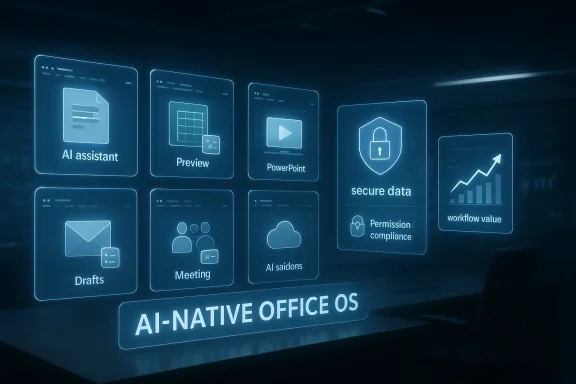 Overview
The modern AI office stack did not appear overnight. It emerged from two converging pressures: the post-pandemic normalization of remote and hybrid work, and the rapid maturity of large language models capable of writing, summarizing, and reasoning over everyday business content. By March 2023, the productivity market was primed for disruption, with workers drowning in email, meetings, chat threads, and fragmented files, while executives searched for measurable efficiency gains.Microsoft’s Copilot for Microsoft 365 became the defining product of that wave. On March 16, 2023, Microsoft introduced the assistant as a layer across Word, Excel, PowerPoint, Outlook, and Teams, positioning it as a way to draft, analyze, summarize, and create using business context and enterprise data. Microsoft later emphasized that it could help unlock productivity and creativity across those core apps, while also building a broader “Copilot” ecosystem around work, security, and business processes. (microsoft.com)
Google responded quickly with its own generative AI push in Workspace. On March 14, 2023, Google announced new generative AI experiences for Docs, Gmail, and other Workspace tools, signaling that productivity software had become a frontline battleground for generative AI. Google described the rollout as a staged release to trusted testers before public availability, which reflects how cautious vendors were being while still racing to claim mindshare. (workspace.google.com)
The commercial opportunity is obvious because the software category is enormous and sticky. Microsoft has since priced Microsoft 365 Copilot as a premium add-on, with current business pricing starting at a monthly per-user fee and separate licensing requirements for qualifying plans, underscoring that AI is not just a feature but a monetization layer. That pricing model reflects a broader market conviction that enterprises will pay for time savings, reduced toil, and better decision support if the return is clear enough.
At the same time, the market has matured beyond simple “chat in the sidebar” demos. Gartner said in 2023 that by 2026, more than 80 percent of enterprises would have used generative AI APIs or deployed GenAI-enabled applications in production, up from less than 5 percent in 2023. Gartner also warned that hallucinations and inaccuracy remained obstacles, a reminder that usefulness does not eliminate risk. (gartner.com)
The Copilot Pivot
Microsoft’s Copilot launch was not just a product announcement; it was a signal that the company intended to turn Microsoft 365 into an AI distribution engine. Rather than asking users to visit a separate chatbot, Microsoft embedded the assistant into the tools people already use to produce work, which is strategically important because habits are difficult to change in enterprise environments. That is the difference between a feature and a platform.The early marketing emphasized dramatic time savings and a fluid handoff between natural language and business tasks. Microsoft described Copilot as able to find information in files, connect context across content, and assist across apps, all while understanding a user’s job and organization. That pitch matters because it moves AI from generic generation toward contextual execution, which is far more valuable to businesses trying to standardize workflows. (microsoft.com)
Why integration matters
Integration is the real moat. A standalone chatbot can answer questions, but an embedded assistant can draft a document, revise a spreadsheet, or summarize a meeting inside the place where the work already lives. That reduces friction, increases usage, and gives the vendor a better shot at recurring revenue.Microsoft also leaned into enterprise readiness by pairing Copilot with security and data architecture messaging. It highlighted a Semantic Index for Copilot that maps user and company data so prompts can be interpreted in business context rather than by keyword matching alone. That is important because enterprise search and retrieval are often the bottlenecks that determine whether AI feels magical or merely probabilistic. (blogs.microsoft.com)
- Embedding beats launching a separate app.
- Context beats raw generation in business settings.
- Enterprise data access is the source of most product value.
- Security controls determine whether procurement says yes.
Google Workspace Joins the Race
Google’s March 14, 2023 announcement showed that the productivity war would not be one-sided. Workspace got its own generative AI layer for Docs and Gmail, with Google promising features that help users write and communicate more effectively. The move positioned Google not as a follower, but as a parallel architect of the AI-native office suite. (workspace.google.com)That matters because Google’s strengths are different from Microsoft’s. Google has deep expertise in search, cloud infrastructure, and collaborative web-native products, while Microsoft controls the desktop office stack and enterprise identity layer. In practice, that means the two companies are optimizing for the same user outcomes with different assets, and the competition is likely to stay intense.
Collaboration as a differentiator
Google Workspace has always leaned toward real-time collaboration, lightweight editing, and cloud-first workflows. Generative AI fits naturally into that model because it can lower the effort required to start drafts, refine communications, and summarize content. If Microsoft is using AI to enrich a dominant suite, Google is using it to strengthen a more cloud-native work style.The rollout approach was also notable. Google said the new experiences would be delivered to trusted testers on a rolling basis before broader release. That is a prudent move in a category where the reputational risk of hallucination, incorrect output, or sensitive-data mishandling could be costly. It also shows how vendors are balancing velocity with caution in the enterprise market. (workspace.google.com)
- Google’s edge is cloud-native collaboration.
- Microsoft’s edge is office-suite ubiquity.
- Both vendors are trying to own the prompt-to-output workflow.
- Caution in rollout reflects enterprise trust concerns.
Why Enterprises Will Pay
The strongest business case for office AI is not novelty; it is labor reallocation. If a tool can shave minutes from repetitive drafting, reduce search time, accelerate meeting follow-up, and speed up analysis, then the compound effect across thousands of workers can be meaningful. Microsoft has repeatedly framed Copilot around exactly that logic: reclaim time, reduce drudgery, and make knowledge workers more productive. (microsoft.com)Microsoft also said early customers viewed Copilot as transformative for meetings and creation workflows, based on testing with enterprise accounts such as Chevron, Goodyear, General Motors, and Dow. That is significant because it indicates the value proposition extends beyond clerical work into higher-order knowledge tasks where management cares about speed and consistency. (blogs.microsoft.com)
The ROI question
For enterprises, the key question is not whether AI works in a demo. It is whether the assistant improves throughput enough to justify the license cost, the security review, and the training overhead. That is why premium pricing can still be rational if the tool saves enough time across enough users.The market backdrop suggests buyers are already moving in that direction. Gartner projected a steep rise in enterprise adoption of generative AI applications by 2026, and it specifically pointed to workforce productivity, customer experience, and product creation as the big enterprise payoff areas. In other words, the procurement conversation has shifted from if to where first. (gartner.com)
One useful way to think about the economics is in layers:
- Task acceleration reduces time spent on first drafts and summaries.
- Workflow compression shortens the path from input to decision.
- Decision support improves confidence in routine business analysis.
- Platform stickiness increases the likelihood of suite renewal.
Consumer and Small Business Impact
The consumer and small business story is more nuanced. For individuals, AI productivity tools can feel like a productivity upgrade, but consumer willingness to pay is usually lower than enterprise willingness to pay. Microsoft’s own pricing structure reflects that reality: the high-value commercial offer is clearly the center of gravity, while consumer offerings are framed differently and often bundled into broader subscriptions.For small businesses, the upside is real but practical. These teams often lack dedicated analysts, executive assistants, or formal research staff, so an AI assistant that can generate documents, summarize calls, or help manage customer communication can have outsized value. Microsoft has explicitly positioned Copilot for small and medium-sized businesses as a way to ease administrative load and recover time for core growth work.
Where SMBs benefit most
Small businesses typically gain the most from AI in tasks that are common, repetitive, and time-sensitive. That includes email drafting, meeting recaps, proposal creation, first-pass budgeting, and internal knowledge lookup. The more standardized the task, the easier it is to translate AI assistance into immediate value.Still, the economics are not trivial. Per-user pricing can add up quickly, and the return depends on whether owners and staff actually change behavior. A tool that is technically impressive but culturally underused becomes another line item rather than a productivity lever.
- SMBs need speed more than sophistication.
- Consumers value convenience but resist high recurring fees.
- Bundling matters because it reduces buying friction.
- Adoption depends on habit change, not just feature quality.
The Technical Foundation
Under the hood, the office AI wave depends on large language models, retrieval systems, identity controls, and integration layers. Microsoft’s early Copilot messaging described a customized experience built on OpenAI’s GPT-4, fine-tuned and wrapped in Microsoft’s productivity stack. In practical terms, the value is not only in model intelligence but in the plumbing that lets the model see the right context at the right time. (microsoft.com)That plumbing is what enterprise buyers care about. A model that can write a persuasive email is useful; a model that can do so while respecting permissions, data boundaries, and organizational context is much more valuable. Microsoft’s focus on semantic indexing was an early sign that retrieval quality would be just as important as raw model capability. (blogs.microsoft.com)
Context is the product
In enterprise AI, context is the product. The same model output can be brilliant or useless depending on whether it has access to the right files, the right meeting notes, and the right organizational hierarchy. That is why vendors invest so heavily in identity, search, and permission-aware retrieval.This also explains why AI in office software is not interchangeable across providers. Microsoft can leverage Microsoft 365 data, Teams metadata, and Azure security. Google can leverage Workspace collaboration patterns and Google Cloud infrastructure. Each vendor’s differentiator is partly technical and partly architectural, and those strengths shape how quickly they can improve product quality.
Another important technical distinction is the shift from simple text generation to workflow orchestration. The next frontier is not just “write this for me,” but “collect the inputs, draft the output, route it for review, and update the system of record.” That moves AI from assistant to agent, which is far more ambitious and far more disruptive.
Security, Privacy, and Compliance
Security is where enthusiasm meets procurement reality. Enterprise AI that touches emails, files, calendars, and meetings inevitably raises questions about data access, retention, and misuse. Microsoft and Google both framed their rollouts carefully, and that caution is not accidental; it is a recognition that trust is a feature, not a footnote. (microsoft.com)Microsoft emphasized enterprise readiness through its broader security and identity ecosystem, while also surfacing capabilities like semantic indexing and role-aware context. That is meant to reassure buyers that Copilot is operating inside governed boundaries rather than scrubbing random data from the tenant. The distinction sounds subtle, but in enterprise procurement it is decisive.
Privacy is a workflow problem
Privacy is not just a legal issue; it is a workflow issue. If employees paste sensitive information into the wrong place, or if AI tools expose content beyond intended permissions, the resulting risk can be reputational, contractual, or regulatory. That means the quality of defaults matters as much as the quality of the model.The user-facing challenge is training. Employees need to understand what kinds of prompts are appropriate, what content is sensitive, and how to verify output before using it in downstream decisions. Without that behavioral layer, even a strong security stack can be undermined by careless usage.
- Permission boundaries must be enforced consistently.
- Data handling rules need to be visible to users.
- Employee training is part of the security model.
- Auditability will matter more over time.
- Trust failures could slow adoption materially.
Monetization and Market Structure
The monetization story is one of the most important parts of this trend. AI inside office software is not a standalone category; it is a premium layer on top of existing recurring revenue. That makes it attractive to incumbents because they can upsell a massive installed base instead of building demand from scratch.Microsoft’s pricing strategy shows how this works. By attaching Copilot to qualifying Microsoft 365 plans, the company turns AI into an incremental revenue engine rather than a replacement for the suite. That also gives Microsoft leverage over procurement, because customers can choose between basic productivity software and a more expensive AI-enhanced workflow.
The platform advantage
The platform advantage is powerful because distribution is already there. Microsoft and Google do not need to convince users to install an entirely new category of software; they only need to convince them to pay more for a better version of software they already use. That lowers adoption friction and increases the odds of long-term retention.The broader market opportunity is also substantial. PwC’s widely cited analysis has long argued that AI could contribute massively to global economic output by 2030, and more recent PwC materials continue to frame AI as a central driver of reinvention and growth. Even though estimates vary by methodology and year, the consistent message is that AI is expected to create value at a scale large enough to justify intense enterprise investment.
- Upsell economics favor incumbents.
- Seat-based pricing scales with enterprise size.
- Workflow value supports premium positioning.
- AI is becoming a bundle differentiator.
Competitive Landscape
The competitive landscape is broader than Microsoft versus Google. It includes startups like Notion, specialized workflow vendors, collaboration platforms, and future agentic tools that may bypass traditional office suites entirely. That means the current wave is both a product race and a positioning race, with each vendor trying to define the next default interface for work.Microsoft’s advantage is distribution and enterprise gravity. Google’s advantage is cloud-native collaboration and a strong AI research legacy. Startups can still win by specializing in narrow workflows, but they face the challenge of integrating deeply enough to become mission critical. The moat is not merely AI quality; it is workflow ownership.
What rivals need to prove
Rivals will need to show more than a clever prompt box. They must prove they can reduce time-to-completion, handle sensitive data responsibly, and fit into existing enterprise environments without forcing a rip-and-replace strategy. The strongest products will be the ones that remove friction from common work patterns, not the ones that merely showcase model intelligence.Another competitive factor is ecosystem trust. Buyers already have procurement relationships, compliance expectations, and support contracts with large vendors. That gives Microsoft and Google a substantial head start, but it also raises the bar: if they stumble on quality or governance, competitors can attack from below with focused, easier-to-deploy alternatives.
- Incumbents own distribution.
- Startups own niche innovation.
- Ecosystem trust can outweigh raw capability.
- Integration depth is often decisive.
- Switching costs favor the big platforms.
Strengths and Opportunities
The strongest argument for AI office tools is that they sit exactly where work already happens. That gives them a natural distribution channel, a clear productivity story, and an easy way to become habitual. It also creates a large surface area for incremental improvement, because even small gains across emails, meetings, documents, and spreadsheets can add up quickly.- Time savings on repetitive work.
- Better first drafts for common business content.
- Faster meeting follow-up and note synthesis.
- Stronger enterprise search and knowledge retrieval.
- Upsell potential for suite vendors.
- Cross-functional use cases across finance, sales, HR, and operations.
- Room for agents that can take on multi-step workflows.
Risks and Concerns
The biggest risk is that businesses will overestimate the reliability of generative AI. Even strong models can hallucinate, misread context, or produce persuasive but incorrect output. In a productivity setting, that can quietly create errors in reports, communications, and decisions, which is especially dangerous when users assume the tool is authoritative.- Hallucinations can distort business content.
- Data leakage remains a serious concern.
- User overreliance can weaken judgment.
- High licensing costs may slow adoption.
- Training gaps can reduce real-world ROI.
- Compliance complexity can delay deployment.
- Feature parity may erode differentiation over time.
Looking Ahead
The next phase of office AI is likely to be less about drafting and more about execution. As models improve and vendor ecosystems mature, the competitive question will shift toward whether AI can manage multi-step work across systems with minimal supervision. That is where the real enterprise prize sits, because it moves beyond assistance into delegation.The winners will probably be the companies that combine model quality, workflow integration, security, and clear ROI metrics. They will also need to persuade CFOs and CIOs that the costs are manageable, the risks are controlled, and the productivity gains are real. In that sense, the AI office market is no longer just a technology story; it is a management story.
- Watch for agentic workflow features that go beyond drafting.
- Monitor enterprise pricing pressure as competition increases.
- Track governance and audit tools as adoption widens.
- Look for deeper integrations across email, meetings, and CRM.
- Expect more verticalized AI offerings for regulated industries.
Source: blockchain.news The Rundown AI Office Hours March 20: Latest AI Trends and Business Opportunities Analysis | AI News Detail
