

Microsoft’s bet that a new generation of “AI PCs” would re-ignite Windows laptop sales has hit a reality check: the silicon is arriving, but buyers aren’t convinced. OEMs are quietly shifting away from AI-first marketing, channel partners are rewriting pitch decks to emphasize battery life and thermals, and enterprises are piloting cautiously while procurement teams ask for hard ROI and clearer privacy guardrails. The hardware story — powerful NPUs and Copilot‑certified SKUs — looks strong on paper, but the software, scenarios, and trust that would turn those specs into mass upgrades are not yet delivering for most shoppers.
The past year has seen an industry-wide drive to label newer notebooks “AI PCs”: systems that pair CPU and GPU compute with an on‑device neural processing unit (NPU) capable of running smaller models locally for lower latency, privacy-sensitive features, and offline modes. Microsoft’s Copilot branding and a loosely defined Copilot+ hardware bar (commonly reported as a 40+ TOPS NPU threshold plus RAM/storage minima) set expectations for what an AI PC should deliver. Analysts, OEMs, and chipmakers rushed to productize that idea: Qualcomm’s Snapdragon X family, Intel’s Core Ultra series, and AMD’s Ryzen AI lines all now advertise on‑device inference capabilities. At the same time, Microsoft’s Copilot rollout in Windows has been uneven: high‑visibility bugs and a privacy backlash over the Recall screenshotting experiment dented confidence in agentic features and showed how quickly trust can erode. That combination — compelling silicon with fragile software narratives — explains why OEMs are softening their AI pitch in stores and why businesses are choosing to pilot rather than buy at scale.
For now, the race to define what an AI PC truly earns its place in a buyer’s hand is less about peak TOPS numbers and more about consistent, understandable, privacy‑respecting wins that change day‑to‑day work. Until those wins are obvious and repeatable, OEMs will sell new Windows PCs the way they always have — by making life faster, quieter, cleaner, and cheaper for the tasks people actually do every day.
Source: findarticles.com AI PC Demand Stalls While Microsoft Partners Scramble
 Background
The past year has seen an industry-wide drive to label newer notebooks “AI PCs”: systems that pair CPU and GPU compute with an on‑device neural processing unit (NPU) capable of running smaller models locally for lower latency, privacy-sensitive features, and offline modes. Microsoft’s Copilot branding and a loosely defined Copilot+ hardware bar (commonly reported as a 40+ TOPS NPU threshold plus RAM/storage minima) set expectations for what an AI PC should deliver. Analysts, OEMs, and chipmakers rushed to productize that idea: Qualcomm’s Snapdragon X family, Intel’s Core Ultra series, and AMD’s Ryzen AI lines all now advertise on‑device inference capabilities. At the same time, Microsoft’s Copilot rollout in Windows has been uneven: high‑visibility bugs and a privacy backlash over the Recall screenshotting experiment dented confidence in agentic features and showed how quickly trust can erode. That combination — compelling silicon with fragile software narratives — explains why OEMs are softening their AI pitch in stores and why businesses are choosing to pilot rather than buy at scale. OEMs pull back: from “AI, AI, AI” to outcomes shoppers notice
A tactical marketing shift
At CES and in private channel briefings, senior OEM executives admitted there’s a gap between AI hype and buyer behavior. Dell explicitly dialed down AI‑first messaging and urged sales teams to lead with observable upgrades — battery life, display quality, keyboard and thermals — instead of feature lists centered on NPU TOPS. That admission reflects a broader retail reality: consumers and retail sales reps want clear, relatable claims that translate to everyday benefits, not abstract acceleration numbers. Product teams at HP, Lenovo, and others are quietly retooling collateral and point‑of‑sale demos. In practice that means:- Shifting demo scripts away from generative chat and toward improved webcam/video experiences, faster wake-from-sleep, and longer battery life.
- Bundling on‑device AI features that work out of the box (noise cancellation, background blur, real‑time captions) as part of a broader user benefit narrative.
- Positioning NPUs and Copilot certification as a “future‑proof” checkbox rather than the sole upgrade reason.
Why “40 TOPS” doesn’t sell — but matters to engineers
A recurring theme in store feedback is that spec sheets showing “40 TOPS NPU” or “45 TOPS Hexagon NPU” rarely connect with retail buyers. Most people don’t know (and don’t want to know) what TOPS measures; they want to know the experience difference. Meanwhile, Microsoft and chip partners use TOPS as an engineering threshold for local model inference and Copilot‑branded feature parity, making it a technical rather than commercial storytelling device. The result is a product/marketing mismatch: engineering progress is real; consumer narratives are lagging.The software and trust gap: Copilot, Recall, and the pilot‑to‑scale problem
Copilot in Windows: powerful but unfinished
Microsoft has invested heavily to make Copilot a system-level AI assistant across Windows and its 365 ecosystem. Commercial pricing for Microsoft 365 Copilot (commonly cited at $30 per user per month for commercial tiers) and the promise of Copilot‑enhanced workflows elevated expectations for AI‑ready devices. Yet enterprise buyers routinely ask for demonstrated productivity improvements and predictable TCO before deploying at scale. For many, Copilot remains a feature in progress rather than a proven productivity multiplier. Enterprise hurdles include:- Integration complexity — connecting Copilot to CRM/ERP/custom apps reliably is non‑trivial.
- Billing and consumption opacity — inference costs and metered agent workloads complicate budgeting.
- Compliance and auditability — enterprises demand clear lineage of data, where inference occurs, and governance controls.
Recall: political cost of a bad demo
Recall — a Windows feature that periodically snapshots the screen and makes it searchable via on‑device AI — became a lightning rod. Early previews were criticized as a “privacy nightmare,” prompting Microsoft to pause broad rollouts, rework the feature to be opt‑in, and harden protections (local encrypted storage, Windows Hello gating, exclusions for private modes). That episode amplified skepticism: if an on‑device AI feature is perceived as invasive or buggy, it can undo trust for a much larger set of AI features. The Recall saga shows how sensitive privacy and default settings are when AI is embedded at the OS level.Enterprise adoption: cautious pilots, not wholesale refresh
CIOs want metrics, not demos
Enterprises are not rejecting AI; they’re asking for evidence. Line‑of‑business leaders pilot Copilot in coding, meeting summarization, and transcription scenarios with measured outcomes, but scaling requires:- Deterministic behavior from agents.
- Transparent cost models and FinOps tooling to manage inference spend.
- Strong audit trails and data governance that meet regulatory regimes.
Pricing friction: Microsoft 365 Copilot and seat economics
Microsoft’s commercial Copilot pricing (widely published at roughly $30/user/month for select enterprise plans) is a straightforward headline, but on the ground procurement teams demand pilots and outcome-based justifications before accepting subscription add‑ons at scale. For organizations with thousands of seats, the arithmetic matters and pilots must prove per-user productivity gains that outweigh the recurring cost.The hardware truth: silicon is moving fast — software is not keeping pace
What the chips deliver today
Chipmakers have shipped NPU-capable platforms that meet or exceed the 40 TOPS threshold Microsoft associated with Copilot+ PCs:- Qualcomm’s Snapdragon X Elite/X Plus series advertise Hexagon NPU performance in the mid‑40 TOPS range and system-level figures that OEMs cite during Copilot+ certification. Qualcomm’s X family has been positioned as an early on‑device leader for Windows on Arm.
- Intel’s Core Ultra (Lunar Lake and successor lines) increased on‑chip NPU performance, with some mobile parts quoted at NPU figures in the 40–48 TOPS class depending on SKU and measurement methodology. Intel frames AI PC capability as NPU + GPU + CPU orchestration.
- AMD’s Ryzen AI series (Zen 5 / XDNA) announced NPU figures that industry reporting put in the same ballpark (high‑teens to 50 TOPS depending on SKU and combined metrics), enabling AMD‑based Copilot+ SKUs.
The software bottleneck: runtime, drivers, models
A few technical friction points slow practical on‑device AI adoption:- Runtimes and toolchains are still consolidating. Developers face multiple target runtimes (ONNX, DirectML, vendor SDKs), meaning porting and optimization work remains non‑trivial.
- Driver maturity and firmware parity differ across platforms and OEM SKUs, producing inconsistent behavior that complicates enterprise validation.
- Model footprints and quantization strategies must be tuned for each NPU’s ISA and memory hierarchy, a workstream that still requires engineering effort from ISVs.
How vendors are adapting — product and channel tactics
OEM playbook: prove value through defaults and outcomes
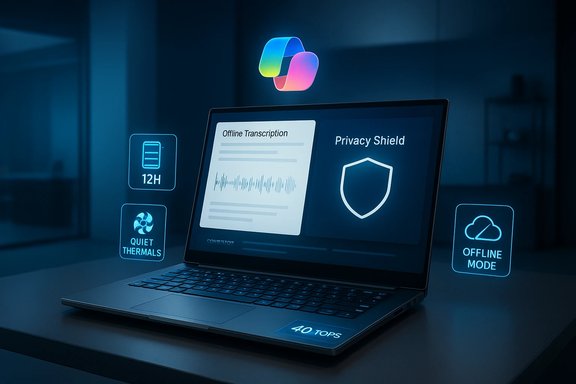
OEMs are adopting a “ship the capability but sell the outcome” strategy:- Pre‑enable simple on‑device experiences that surface the NPU’s value quickly and reliably (noise suppression, local transcription, camera framing).
- Avoid overstating generative claims in retail; instead, lead with everyday benefits that customers recognize — battery, quiet fans, display, and instant wake.
- Offer short software bundles or trial access to higher‑value apps (creative suites, advanced transcription) to reduce subscription friction and illustrate real-case utility.
Microsoft’s path: consistency, clarity, and trust
For the PC AI story to scale, Microsoft must deliver three pragmatic improvements:- Consistency of Copilot behavior across Windows and Office apps so that features feel dependable.
- Clear, machine‑readable “processing receipts” that explain what ran locally versus in the cloud and why — helpful for admins and privacy teams.
- Strong default settings and conservative demos that prioritize reliability over ambition.
Risks and blind spots
Privacy and regulatory exposure
Recall and related features showed that poorly‑communicated defaults and insufficient transparency can spark regulatory attention and public backlash. For enterprise customers, the stakes are higher: misconfigured agentic features could expose regulated data, creating legal and reputational risk. Vendors need tight, auditable controls and strong default opt‑outs in enterprise SKUs.Fragmentation and procurement complexity
Differing NPU capabilities across SKUs, variable driver maturity, and vendor‑specific SDKs risk fragmenting the Windows ecosystem. That fragmentation makes procurement and fleet management harder for IT teams, and it raises lifecycle and support questions (who guarantees NPU firmware updates, for how long, under what SLAs?. Channels and CIOs are already demanding SKU‑level documentation and independent benchmarks.Subscription fatigue and TCO worries
Beyond upfront price premiums for NPU‑equipped devices, subscription services (Copilot licenses, metered agent inference) introduce recurring costs that must be justified with measurable productivity gains. Without clear value, organizations will defer purchases or stick to baseline refresh cycles.Practical guidance for buyers and channel partners
For consumers and prosumers
- Prioritize daily experience: battery life, display quality, keyboard comfort, thermals.
- If on‑device AI matters (transcription, offline privacy), look for Copilot+ certified SKUs and validate the specific features you’ll use.
- Demand clear demos in store that show the feature working on the actual SKU you’re buying — not generic cloud demos.
For IT leaders and procurement
- Inventory and triage endpoints by criticality, compliance risk, and whether on‑device AI materially helps the job function.
- Pilot with defined KPIs — time saved, transcription accuracy, errors avoided — before large rollouts.
- Require SKU‑level documentation for NPUs: TOPS figures, power implications, firmware update promises, and driver support windows.
- Negotiate pilot pricing or outcome guarantees on Copilot licenses to bridge the pilot‑to‑production gap.
The verdict: silicon outpaces services — urgency depends on use cases
The PC industry is at an inflection point where hardware progress (NPUs, heterogeneous SoCs) has outstripped the software and commercial plumbing required to make on‑device AI irresistible to the mainstream. That mismatch means AI PC shipments will continue to grow as a share of shipments — driven by premium devices and targeted enterprise buys — but broad consumer replacement cycles won’t accelerate solely because a laptop is “AI‑branded.” Until Microsoft and partners turn NPUs into visible, repeatable, trustworthy wins for everyday workflows, Windows OEMs will continue to sell machines the old‑fashioned way: performance, battery life, and price.What to watch next (the short list)
- Copilot reliability metrics and enterprise governance features — stronger audit trails and deterministic outputs will unlock scale.
- Third‑party ISV support for on‑device runtimes — if major productivity and communications apps ship certified NPU builds, value will become obvious.
- OEM SKU rationalization — whether OEMs maintain separate “AI” tiers or fold NPUs into mainstream lines will affect pricing and adoption.
- Regulatory signals on privacy and edge AI — enforcement or guidance could shift defaults and influence procurement choices.
Conclusion
The era of AI PCs is not postponed — it’s being reframed. Chipmakers have delivered meaningful NPU performance; Microsoft has stitched Copilot into Windows and commercial plans; OEMs have produced hardware that meets the engineering bar. But the market’s gatekeepers — retail shoppers, enterprise procurement teams, and regulators — are asking for something different than hype: reliable features, demonstrable value, and transparent controls.For now, the race to define what an AI PC truly earns its place in a buyer’s hand is less about peak TOPS numbers and more about consistent, understandable, privacy‑respecting wins that change day‑to‑day work. Until those wins are obvious and repeatable, OEMs will sell new Windows PCs the way they always have — by making life faster, quieter, cleaner, and cheaper for the tasks people actually do every day.
Source: findarticles.com AI PC Demand Stalls While Microsoft Partners Scramble
