

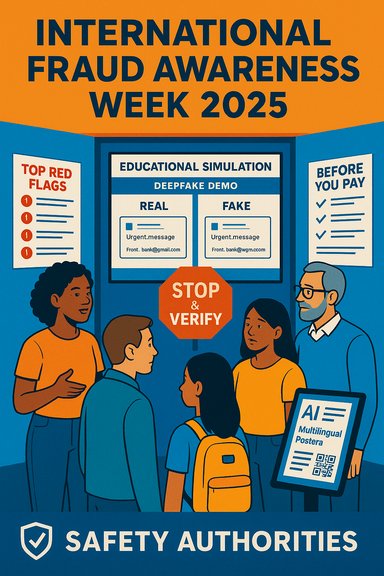
International Fraud Awareness Week 2025 arrives at a critical moment — fraud losses are surging, criminals are using generative AI to scale convincing scams, and organisations from schools to banks are scrambling to translate traditional awareness work into rapid, widely shareable actions. This feature explains how to turn the very tools scammers use — video generators, voice‑cloning, image AIs and chatbots — into practical, ethical campaigns that reach diverse communities at speed. It also verifies the top data points you’ll need to justify budgets and prioritise outreach, highlights technical and legal red flags, and provides ready‑to‑run playbooks for schools, workplaces, creators and community groups during International Fraud Awareness Week and beyond.
Source: swikblog.com International Fraud Awareness Week 2025 AI Tools for Awareness
 Background
Why 2025 is different: scale, sophistication and new ‘weaponised convenience’
Two linked trends make 2025 a turning point in public fraud prevention. First, reported consumer losses spiked sharply in 2024: U.S. consumer reports to the Federal Trade Commission show more than $12.5 billion lost to fraud in 2024 — a 25% jump year‑over‑year — with investment scams and impostor fraud accounting for the largest dollar totals. This recent rise is not just noise in the data; it reflects more costly, higher‑value incidents. Second, generative AI and low‑cost “phishing‑as‑a‑service” toolkits have dramatically lowered the barrier for polished, personalised scams. Reported incidents of voice‑cloning, deepfake impersonations and AI‑assisted social engineering now appear regularly in both press investigations and vendor research. High‑profile business and political attempts have underscored that even corporate leaders and institutions are not immune. These technical developments mean public awareness campaigns must evolve from static posters and one‑off talks into interactive, repeatable, and highly visual learning experiences.Verified figures to ground your campaign
- US consumer fraud losses reported to the FTC in 2024: more than $12.5 billion; investment scams and impostor scams lead losses.
- Public digital‑safety literacy: Microsoft’s 2025 Global Online Safety Survey reports 51% of people had used AI tools and 73% said spotting AI‑generated images is hard; only 38% of test images were correctly identified. These figures justify visual, demo‑led education.
- Regional vulnerability example (useful when pitching local outreach): Trend Micro’s August–November 2025 research found 53% of surveyed people in Singapore reported being targeted by job scams, showing how economic pressure and local behaviours shape scam exposure. Use regional statistics like this when tailoring campaigns.
Overview: How AI helps — and what to watch for
AI tools speed content production, lower creative costs, and enable personalised learning paths — but they also introduce new hazards: hallucinated facts in automated copy, privacy exposure when uploading sensitive case files to cloud models, and the legal risks of generating likenesses of real people without consent. A responsible campaign uses AI for production efficiency while embedding human review, provenance labels, and explicit ethical guardrails.Quick wins AI makes possible
- Rapid production of short vertical videos and social clips for Reels/Shorts/TikTok that explain one scam playbook in 30–60 seconds.
- Interactive chatbots that simulate SMS/email lures and let learners practise safe replies in a controlled sandbox.
- Multilingual translations and regionally localised posters generated and refined in minutes, increasing reach into migrant and multilingual communities.
The most important guardrails
- Always label simulations clearly: every deepfake demo, avatar clip, or cloned‑voice example must be presented as educational and fictional. Unlabelled demos risk legal and reputational harm.
- Keep sensitive data off public cloud models unless you have an enterprise agreement with a non‑training/data‑use guarantee. Test outputs and verify facts in every AI‑generated statement.
- Use native speaker review for translations before publication to avoid dangerous mistranslations in scams and safety instructions.
Practical playbooks: ten ways to use AI for Fraud Awareness Week
1) Turn scam scenarios into short AI videos
Short vertical videos are the single most reusable asset across feeds and stories. Plan a week of 8–12 micro‑clips (30–60s) that focus on a single lesson each.- Ideas:
- Deepfake call demo — a labelled reenactment where a cloned voice pretends to be a family member asking for emergency money; finish with Stop & Verify actions.
- Phishing in 5 seconds — split screen: real bank email vs fake, with callouts highlighting URL, sender address, and attachments.
- Romance scam timeline — fast montage showing grooming, requests for secrecy, and an ask for money.
- Tools and tips:
- Use modern text‑to‑video or image‑to‑video models (e.g., Google Gemini Veo 3 for 8‑second clips, or other short‑clip generators) and combine with simple on‑device editing for captions and disclaimers. Veo models now support 8‑second 720p outputs that are ideal for previews and social clips.
- Always include a clear, visible label: “Simulated for education — not real.” Add a short URL to your verified reporting or help page.
2) Demonstrate deepfakes with AI avatars and voice cloning — ethically
Showing how convincing a deepfake can be is powerful, but do it responsibly.- Best practices:
- Fictional characters only. Never recreate a real person’s voice or likeness without express consent. Use clearly invented names and faces.
- Add provenance overlays (text banners, timestamp, and “educational simulation”) and keep the clip short.
- Accompany with verification steps: how to check a sender, who to call at the bank, how to report.
- Why: realistic demos increase recognition and behavioural uptake — Microsoft’s research shows people struggle to spot AI content, so seeing a labelled demo helps cement the warning.
3) Build a simple AI chatbot that simulates scam messages
Interactive practice beats passive reading. A chatbot that plays the aggressor lets learners practise refusal and verification steps in a safe environment.- Example flows to implement:
- “Delivery customs fee” SMS with choices: ignore, verify with official courier site, or click link (explain consequences).
- “Bank login alert” email that asks for OTP — bot explains why banks never ask for full PINs.
- “Too‑good‑to‑be‑true job” with an ask for upfront fee or identity docs.
- Where to host:
- School LMS, company intranet, or an accessible microsite. Export CSVs of aggregate choices to measure behaviour changes.
- Toolset:
- Use a lightweight LLM (hosted with an enterprise contract if you’ll ingest real complaint text) and set safety rules: never request personally identifying information.
4) Produce AI‑designed infographics and fraud flowcharts
People avoid long reports; eye‑catching one‑pag ers work.- Visual suggestions:
- Anatomy of a Scam: path from first contact to money transfer with red flags at each node.
- Top 5 Red Flags: urgency, secrecy, off‑platform payments (gift cards, crypto), refusal to verify, and pressure to bypass employer or bank policy.
- Fraud losses by month: highlight spikes during holidays or tax season to justify targeted timing.
- Production:
- Use AI design tools (image generators, auto‑layout engines) to create several variants; pick clear typography and keep text minimal.
5) Design AI‑generated posters, banners and social cards
AI art engines are great for original editorial imagery but avoid using real people’s faces.- Use cases:
- Digital signage in banks and schools.
- Instagram Stories and LinkedIn cards.
- Print posters for community noticeboards.
- Tip: Generate multiple sizes in one pass (square, vertical, wide) and include a scannable QR to your scam reporting resources.
6) Launch an AI‑powered fraud awareness quiz
Quizzes engage and create shareable badges.- Quiz ideas:
- “Spot the Scam” — 10 messages where users choose real vs fake.
- “Would you click?” — email/ads with subtle red flags.
- “Deepfake or real?” — short clips or quotes with immediate explanation.
- Technical approach:
- Use an LLM to draft scenarios, then human‑review every item. Provide instant feedback and references to reporting channels.
- Distribution:
- Embed on your site, share via newsletters, and encourage social sharing of scores to increase reach.
7) Turn fraud data into clear dashboards
Too many official datasets are dense. Use AI summarisation and charting to make executive and public dashboards.- Suggested charts:
- Age groups vs reported losses.
- Payment methods by loss (bank transfer, crypto, gift card).
- Regional peaks across the calendar year.
- Data sources to verify and combine:
- FTC Consumer Sentinel (US), national anti‑scam centres (country‑level), and vendor surveys (Trend Micro). Cross‑check two independent sources for major claims.
8) Translate fraud alerts into community languages with AI
Multilingual alerts dramatically expand reach, especially into migrant communities that often underreport scams.- Practical steps:
- Generate translations with an LLM.
- Have a native speaker or community leader review before publishing.
- Prioritise the three most common languages in your local catchment.
- Where to share:
- Community WhatsApp/Telegram groups, faith centres, local radio, and school newsletters.
9) Draft weekly fraud‑bulletin emails with AI
Consistency beats drama. An automated weekly digest keeps scams top of mind.- Suggested bulletin structure:
- Headline: “This Week’s Top 3 Scam Alerts”
- One new scam summary with red flags and immediate action
- Anonymised real story (learned lesson)
- Safety habit of the week (e.g., enable MFA)
- Footer with reporting links
- Tip: Use AI to draft then human‑approve. Keep emails short, scannable, and mobile‑friendly.
10) Combine AI content with official fraud guidance
AI is a production engine; trust comes from aligning messages with verified authorities.- Always link to or include guidance from:
- National fraud reporting centres and police cyber units (country‑specific).
- Bank fraud teams and consumer protection agencies.
- Established NGOs and industry groups that handle victim support.
- Why: adding verified signposts increases credibility and search‑engine trust for your content.
Implementation: a ready-to-run timeline for organisations (one‑week sprint)
- Day 0 — Planning: finalise target audiences, languages, and reporting links. Identify a small approvals team (legal, comms, IT).
- Day 1 — Content batch: generate 10 micro video scripts and 5 infographic templates using AI; assign human editors.
- Day 2 — Production: create Veo/short video renders, voice lines (fictional), and graphics; label everything as simulation.
- Day 3 — QA and legal review: fact‑check, verify translations, confirm non‑training data policy for models used.
- Day 4 — Launch internal chatbot sandbox and pilot quiz with a sample group.
- Day 5 — Community drop: publish videos on social platforms, post posters in local physical spaces, and send the first bulletin.
- Day 6–7 — Measure and iterate: collect click‑through metrics, quiz completion rates, and chatbot response patterns; update content accordingly.
Technical, legal and ethical cautions
Hallucination and factual accuracy
LLMs can invent plausible but false details. For any legal, financial, or procedural claim — amounts, phone numbers, regulatory instructions — verify against primary sources before distribution. Log prompts, model versions and human approvals to create an audit trail.Privacy and data handling
Avoid uploading victim case files or identifiable personal data to consumer AI services. If you must use real cases, de‑identify and keep the data processing within enterprise or on‑premise models that guarantee non‑training and proper retention. Require vendor attestations for sensitive use.Likeness and copyright risk
Using a real person’s voice, likeness, or trademarked brand to demonstrate scams legally requires permission. Use fictional avatars, or ensure you have signed releases. Err on the side of caution: it’s legally and ethically safer to simulate than to mimic real people.Accessibility and inclusion
Design visuals with large type and high contrast. Provide transcripts and captions for all audio/video. Prioritise translated short forms for communities with low literacy; voice messages in the native language often work better than text for older audiences.Measuring impact: metrics that matter
- Behavioural tests: proportion of quiz takers who correctly identify scams before vs after the campaign.
- Practice outcomes: reduction in risky actions in the chatbot sandbox (click‑through rate to simulated malicious links).
- Reporting lift: increases in verified scam reports to a bank or national centre (measured in cooperation with partners).
- Reach and frequency: total impressions, but weighted by unique viewers in high‑risk groups (older adults, job seekers).
Example campaigns by audience
Schools (ages 12–18)
- Host a 30‑minute assembly showing a single deepfake demo, then small‑group quizzes and a Minecraft Education module or gamified activity that teaches verification rules. Use teacher scripts and short follow‑up exercises. Microsoft’s educational toolkits and Minecraft “CyberSafe AI” modules are designed for classroom use and illustrate how games can embed digital literacy.
Workplaces (HR & IT)
- Deliver a mandatory 10‑minute micro‑training: a 60‑second phishing video, a 3‑scenario chatbot exercise, and a one‑page checklist pinned in Slack/Teams channels. Run periodic micro‑simulations and ensure managers are trained to respond to staff reports. Pair content with conditional access and MFA rollouts for immediate technical mitigation.
Community groups and banks
- Translate a one‑page “Before you pay” checklist into three local languages and distribute via community radio and WhatsApp groups. Add a hotline and clear steps for freezing transactions. Work with partner banks to create an escalation contact for suspected fraud cases.
Creators and influencers
- Encourage a short‑form challenge: creators post a labelled “simulated deepfake” with a pinned comment listing 3 checks to perform before trusting a message. Offer a badge or verification code creators can add to their posts linking to the official reporting page.
Strengths, risks and the bottom line
Strengths
- Speed and reach: AI tools let small teams produce professional videos, multilingual assets and interactive experiences in days, not weeks.
- Behavioural learning: interactive chatbots and quizzes produce measurable behaviour change compared with passive campaigns.
Risks
- Misuse and legal exposure: poorly labelled simulations or unauthorised use of someone’s likeness can backfire. Always apply strict consent and labelling.
- Overreliance on AI: unchecked AI output risks hallucination and erosion of trust. Human review and source verification remain mandatory.
Quick checklist for a safe AI-driven Fraud Awareness Week
- Choose models and vendors with enterprise non‑training options where sensitive content will be uploaded.
- Pre‑label every simulated audio/video asset as educational.
- Keep a documented verification step for every factual claim; cite official sources for recovery steps and reporting links.
- Use native review for translations.
- Measure outcomes (quiz accuracy, chatbot choices, reporting changes) and publish an anonymised evaluation one month after the campaign.
Source: swikblog.com International Fraud Awareness Week 2025 AI Tools for Awareness
