

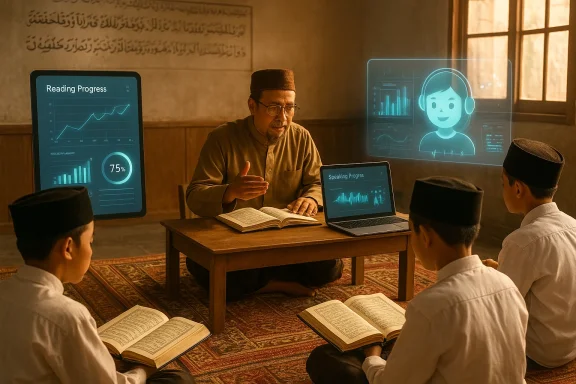
On a warm afternoon in Tasikmalaya Regency, the sound of Qur’an recitation fills a classroom at Pondok Pesantren Cipasung — but the scene is not quite what it once was: students still recite line by line, and teachers still correct tajwīd and pronunciation, yet a new set of tools sits quietly beside the old routines, reshaping how practice, assessment, and teaching time are structured.
In early 2026, Microsoft published a feature highlighting the integration of Microsoft 365 Copilot and Microsoft Teams Learning Accelerators in pesantren (Islamic boarding school) classrooms, using Pondok Pesantren Cipasung and teacher Hasan Basri as a case study. The story described how features such as Reading Progress and Speaking Progress, plus Copilot-powered conversation practice and administrative assistance, were being adopted to supplement traditional tajwīd instruction and expand practice beyond the classroom. The initiative sits within a broader Indonesian training program called AI Teaching Power, delivered under the Microsoft Elevate banner in partnership with local civil society and religious organizations, and supported by the Ministry of Religious Affairs.
These shifts are real, and verifiable through multiple sources: Microsoft’s own product documentation and education announcements describe Reading Progress, Speaking/Speaker Progress, and Learning Accelerators as built-in or integrated features in Microsoft Teams for Education and Microsoft 365 Copilot; the AI Teaching Power program and the elevate platform appear on the Indonesian program pages; local reporting and the Office of the Vice President’s communications confirm that santri (students) at Pondok Pesantren Cipasung demonstrated Copilot-driven demos to national officials in January 2026. At the same time, academic research and recent technical work on automatic speech recognition (ASR) for Qur’anic recitation make it clear that the problem space — automated assessment of tajwīd and recitation — is technically feasible but also has important limitations. This article examines what is changing in pesantren classrooms, how the tools work, the benefits observed so far, and the real risks and policy questions that must be solved if this moment becomes a sustainable transformation rather than a passing experiment.
What teachers at Cipasung and similar institutions report is that tools like Reading Progress and Speaking Progress create a structured, repeatable way to gather student recordings, to annotate where errors occurred, and to return actionable feedback. Rather than replacing the teacher’s ear, these tools serve as an instrument for capturing practice and highlighting trouble spots — allowing the teacher to prioritize which students or which phonemes need immediate human attention.
This human-centered training is crucial. It acknowledges that deploying AI in faith-based education cannot be a purely technical exercise — it must integrate with moral and ethical aims of the institution. The program’s syllabi combine practical tool use with reflective practice, certification, and follow-up workshops, and are designed to be accessible to teachers across formal and non-formal education systems.
At the same time, several non-negotiable responsibilities must accompany adoption. Schools must insist on teacher training, clear data governance, a critical posture toward automated feedback, and investments to bridge the device and connectivity gap. Technical limitations in automated tajwīd assessment mean that human validation remains indispensable; research and localized model adaptation show progress, but they do not yet justify full automation of religious assessment.
If educators, communities, and developers commit to a principled path — one that centers pedagogy, respects privacy and tradition, and invests in equitable infrastructure — pesantren can indeed step “boldly into an inclusive digital era.” The change will not look like a digital takeover; it will look like older rituals refreshed by tools that expand practice, free teacher time, and provide new ways to measure and deepen learning — all under the careful oversight of the teachers and communities who hold spiritual and educational authority.
Source: Microsoft Source Islamic Boarding School Classrooms That Are No Longer the Same - Source Asia
 Background
In early 2026, Microsoft published a feature highlighting the integration of Microsoft 365 Copilot and Microsoft Teams Learning Accelerators in pesantren (Islamic boarding school) classrooms, using Pondok Pesantren Cipasung and teacher Hasan Basri as a case study. The story described how features such as Reading Progress and Speaking Progress, plus Copilot-powered conversation practice and administrative assistance, were being adopted to supplement traditional tajwīd instruction and expand practice beyond the classroom. The initiative sits within a broader Indonesian training program called AI Teaching Power, delivered under the Microsoft Elevate banner in partnership with local civil society and religious organizations, and supported by the Ministry of Religious Affairs.These shifts are real, and verifiable through multiple sources: Microsoft’s own product documentation and education announcements describe Reading Progress, Speaking/Speaker Progress, and Learning Accelerators as built-in or integrated features in Microsoft Teams for Education and Microsoft 365 Copilot; the AI Teaching Power program and the elevate platform appear on the Indonesian program pages; local reporting and the Office of the Vice President’s communications confirm that santri (students) at Pondok Pesantren Cipasung demonstrated Copilot-driven demos to national officials in January 2026. At the same time, academic research and recent technical work on automatic speech recognition (ASR) for Qur’anic recitation make it clear that the problem space — automated assessment of tajwīd and recitation — is technically feasible but also has important limitations. This article examines what is changing in pesantren classrooms, how the tools work, the benefits observed so far, and the real risks and policy questions that must be solved if this moment becomes a sustainable transformation rather than a passing experiment.
Classrooms are beginning to adjust: what’s changing on the ground
A familiar ritual, sharpened by data
In traditional pesantren instruction, the teacher listens closely to each recitation, correcting errors in tajwīd, articulation points, and prosody. That process is intensely time-consuming: the teacher must attend to dozens of students every session, detect subtle pronunciation errors, and provide corrective drill work.What teachers at Cipasung and similar institutions report is that tools like Reading Progress and Speaking Progress create a structured, repeatable way to gather student recordings, to annotate where errors occurred, and to return actionable feedback. Rather than replacing the teacher’s ear, these tools serve as an instrument for capturing practice and highlighting trouble spots — allowing the teacher to prioritize which students or which phonemes need immediate human attention.
Practice outside the classroom
Perhaps the most visible change is that practice that used to be limited to face‑to‑face sessions can now happen anytime students have a device and a connection. Students record reading assignments, receive automated markers and coach-like feedback, and teachers later review the submissions. The distribution of practice across time and space — particularly useful during Ramadan or when travel interrupts in-person instruction — is one of the immediate pedagogical wins educators describe.Administrative time reclaimed
Teachers like Hasan also report large non-teaching benefits. Copilot’s content generation and admin supports — from drafting lesson plans to generating rubrics and quizzes — are freeing hours that previously went to paperwork. That reclaimed time is being redirected toward character education and individualized mentoring, a core value in pesantren pedagogy.The technology stack explained
Microsoft Teams Learning Accelerators: Reading Progress and Speaking Progress
- Reading Progress is a Teams for Education feature designed to support reading fluency. Students record readings, submit them as assignments, and the system aggregates data for teachers to review. The tool is explicitly presented as a way to save time on routine assessments while giving educators insight into accuracy and fluency.
- Speaking / Speaker Progress (sometimes called Speaker Progress in Microsoft documentation) extends that model to presentations and speaking skills, offering rehearsal coaching and class‑level insights about pacing, filler words, and other presentation metrics.
Microsoft 365 Copilot and AI Conversation Practice
- Copilot for Education provides guided content generation (lesson plans, rubrics, quizzes), and — crucially for language learning — AI conversation practice. Copilot can simulate low‑pressure conversation partners, adjust difficulty, and provide corrective feedback. This is particularly valuable for language rehearsal when native speakers or tutors are not available.
- Copilot’s “Teach” module and teacher-oriented features explicitly target administrative efficiency: aligning lessons to standards, generating assessments, and drafting feedback suggestions that teachers can review and edit.
How these tools are used together
Teachers can assign a Reading Progress task in Teams, have students record at home or in school, and then use Copilot to:- Generate follow-up exercises and differentiated practice materials that address observed weaknesses.
- Draft feedback comments or rubrics based on typical errors observed across the class.
- Create conversational scenarios for students to rehearse speaking skills using Copilot’s conversational agents.
Training, ecosystems, and the human-centered approach
AI Teaching Power: skills, values, and local partnerships
The rollout in Indonesia is not just product deployment; it comes with a training ecosystem. AI Teaching Power, a collaboration between Microsoft Elevate and local partners, aims to teach both the technical use of tools and values-centered approaches: modules include AI for Educators, agent building, 21st‑century pedagogy, and importantly, spiritual intelligence—emphasizing purpose, empathy, and humility in technology use.This human-centered training is crucial. It acknowledges that deploying AI in faith-based education cannot be a purely technical exercise — it must integrate with moral and ethical aims of the institution. The program’s syllabi combine practical tool use with reflective practice, certification, and follow-up workshops, and are designed to be accessible to teachers across formal and non-formal education systems.
Local validation and momentum
The initiative has visible local momentum: pesantren and madrasah have been enrolling teachers in batches, with governmental support through the Ministry of Religious Affairs. Pondok Pesantren Cipasung’s public demonstrations in January 2026 — including presentations to national offices — show that the narrative of “AI supporting heritage education” is resonating. These demonstrations have an important signaling effect; they encourage other faith-based institutions to consider pilot programs, funding, and formal partnerships.Benefits observed and plausible learning gains
1. More practice, more measurable progress
The combination of recording, automated marking, and teacher review creates an evidence trail. Teachers can track who practices, how fluently they read, and which tajwīd rules are recurrently misapplied. This turns an often qualitative process — recitation assessment — into a trackable dataset that can guide remediation.2. Time savings and pedagogical reorientation
Copilot’s content generation features reduce time spent on:- Drafting lesson plans and presentations,
- Creating assessments and rubrics,
- Generating learning materials in multiple forms and reading levels.
3. Student confidence and lower affective barriers
AI conversation practice provides a low-pressure environment for students to rehearse spoken Arabic. For many learners, the absence of immediate human judgment reduces anxiety and increases speaking practice frequency — a recognized driver of oral language acquisition.4. Continuity of learning during disruptions
When teachers or students are physically absent, recorded assignments and practice agents keep learning going. For boarding schools with rotating schedules, seasonal travel, or public‑health disruptions, this continuity is valuable.Limits, risks, and unresolved technical issues
While the early returns are promising, the transition is not without important caveats. These are practical, technical, ethical, and cultural risks that educators and policymakers must actively manage.1. Accuracy limits in automated tajwīd and recitation feedback
Automated speech analysis for Qur’anic recitation is a technically complex problem. The Qur’anic recitation register differs from everyday Modern Standard Arabic: it has distinct phonetic detail, prosodic conventions, and strict tajwīd rules. Academic reviews and recent technical work show both progress and persistent challenges:- Researchers have documented that Automatic Speech Recognition (ASR) systems trained on modern speech perform poorly on Qur’anic recitation without domain adaptation.
- Recent studies show that fine‑tuning models (for example, adapting LLM/ASR models to recitation datasets) can dramatically reduce error rates, but these models require robust annotated datasets and careful evaluation against tajwīd rules.
2. Risk of overreliance and teacher deskilling
If teachers begin to rely uncritically on AI-generated feedback or administrative automation, there’s a risk that core teaching skills — especially the fine-grained ear for pronunciation and the capacity to mentor moral and spiritual development — could atrophy. The correct approach is augmentation: AI should extend teacher capacity, not substitute for professional judgment.3. Data privacy, protection, and consent
Collecting student voice recordings, assignment logs, and activity metrics raises non-trivial privacy questions. Any deployment must address:- Who controls the recordings and processed data (school, cloud vendor, or third party)?
- How long are recordings retained, and for what purposes are they used?
- Are there clear consent protocols for minors, including parental permission where applicable?
- Are data residency and local regulatory requirements (for example, national data protection laws) observed?
4. The digital divide and infrastructural equity
Tools work only when devices and connectivity exist. In many pesantren, there is a mix of personal laptops, shared campus computers, and limited bandwidth. Without targeted investment in devices, bandwidth, and reliable power, adoption will be uneven — risking a two-tier system where better-resourced pesantren accelerate while others are left behind.5. Cultural and theological sensitivities
Religious education has norms and sensitivities that require careful alignment with technology. For example:- Automated feedback must respect the sanctity of recited material and not present corrections in an insensitive manner.
- Community leaders and scholars should be involved in the design and validation of learning materials generated by Copilot or other AI tools.
Practical recommendations for pesantren, policymakers, and developers
To move from promising pilots to responsible, sustainable practice, the following actions are recommended.For pesantren leaders and teachers
- Adopt AI as augmentation: use Copilot and Learning Accelerators to free teacher time and expand practice, but keep teachers as the final authority for corrected recitations and moral instruction.
- Establish clear consent and privacy practices: inform students and parents about recordings, retention, and how data will be used. Implement retention policies aligned with national regulations.
- Prioritize teacher training: participate in structured programs that cover not only tool use but also pedagogy, data literacy, and ethical reflection.
- Pilot with measurement: run short-term pilots with clear learning outcomes and evaluation plans to see whether the tools improve fluency, comprehension, and student confidence.
- Maintain community engagement: involve religious scholars and parents to ensure cultural fit and acceptability.
For education authorities and policymakers
- Provide funding for devices and connectivity targeted to under-resourced pesantren to avoid deepening inequities.
- Develop guidelines for voice data in education that set minimum standards for consent, retention, and data residency.
- Support open datasets and research for tajwīd‑oriented speech recognition, enabling local researchers and vendors to build responsibly adapted models.
- Encourage interoperability and local control: specify procurement conditions that allow schools to export or archive data and avoid vendor lock-in.
For technology providers
- Be transparent about model limitations: provide clear documentation on cases where automated feedback may be unreliable and recommend human validation routines.
- Provide teacher-centric workflows: ensure that AI feedback is draftable, editable, and reviewable by teachers before students see it.
- Prioritize privacy-by-design: default minimal retention, strong access controls, and local data processing options where possible.
- Invest in local language and domain adaptation: partner with local institutions to curate tajwīd-tagged datasets and co‑design evaluation metrics.
How to evaluate success: simple metrics and a roadmap
Measuring whether AI tools genuinely improve pesantren learning outcomes requires both quantitative and qualitative indicators:- Quantitative:
- Change in reading fluency scores (pre/post) as measured by teacher‑validated rubrics.
- Frequency of at‑home practice attempts per student per week.
- Time teachers save on administrative work (self-reported minutes/week).
- Device and access metrics (percentage of students with reliable device and connection).
- Qualitative:
- Teacher and student perceptions of confidence and learning agency.
- Case studies of remediation: did AI flags help teachers identify persistent tajwīd mistakes sooner?
- Community acceptance and theological review outcomes.
- Short pilot (3 months) with 1–2 classes to validate workflow.
- Evaluation and teacher feedback loop; iterate on prompts and assignment design.
- Scale within the school for a full academic term with infrastructure support.
- Cross-institutional sharing of lessons and technical artifacts (e.g., anonymized practice templates).
Conclusion: widening the practice space while centering the human teacher
The experience at Pondok Pesantren Cipasung is a practical demonstration of a broader truth: AI can widen the practice space, making learning more flexible and measurable, but it does not replace the pedagogical and moral roles that teachers — especially in faith-based contexts — perform. The real promise of Copilot, Reading Progress, and Learning Accelerators lies in thoughtful augmentation: freeing teachers from repetitive administration, enabling more distributed practice, and supplying data that helps teachers focus scarce human attention where it matters most.At the same time, several non-negotiable responsibilities must accompany adoption. Schools must insist on teacher training, clear data governance, a critical posture toward automated feedback, and investments to bridge the device and connectivity gap. Technical limitations in automated tajwīd assessment mean that human validation remains indispensable; research and localized model adaptation show progress, but they do not yet justify full automation of religious assessment.
If educators, communities, and developers commit to a principled path — one that centers pedagogy, respects privacy and tradition, and invests in equitable infrastructure — pesantren can indeed step “boldly into an inclusive digital era.” The change will not look like a digital takeover; it will look like older rituals refreshed by tools that expand practice, free teacher time, and provide new ways to measure and deepen learning — all under the careful oversight of the teachers and communities who hold spiritual and educational authority.
Source: Microsoft Source Islamic Boarding School Classrooms That Are No Longer the Same - Source Asia
