

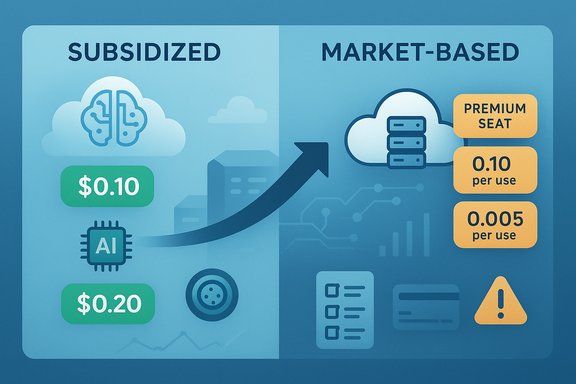
The tech industry is sounding a clear alarm: the long era of cheap, always‑on generative AI is giving way to a new commercial reality that looks a lot like Uber’s pivot from subsidized rides to market‑priced fares — and for many companies that means a genuine risk of “sticker shock” in 2026.
Background
The analogy to Uber captures a familiar arc: early adopters enjoy heavily subsidized or promotional pricing while vendors race to build scale; once the infrastructure and product reach maturity, vendors pivot to sustainable unit economics and monetization. That transition in AI is already visible across major vendors — Microsoft, Google, Adobe, OpenAI and Anthropic — as they fold generative features into core suites, create premium lanes for heavy users, and adopt metered or credit‑based billing for expensive inference workloads.Those moves have two immediate implications for IT and procurement teams. First, even modest per‑user or per‑seat uplifts compound rapidly at scale. Second, metered models and per‑action pricing introduce cost variability that must be modeled and governed, or organizations risk unplanned invoices and budget surprises.
Why AI pricing is shifting now
The economics: compute, capex and the cost of scale
The raw costs of running high‑performance LLMs are not trivial. While per‑token inference costs have declined due to model and inference engineering, overall spend rises dramatically when organizations replace human tasks with automated workflows, run many agents, or generate large volumes of media. Meanwhile, major cloud and AI companies are committing tens of billions to data centers and accelerator fleets — capital investments that must be amortized over time. Those two dynamics (volume elasticity + heavy capex) are the fundamental drivers pushing vendors toward sustainable pricing that recovers infrastructure, R&D and enterprise security costs.Microsoft’s own public reporting shows the scale of capital commitments behind this shift: the company has reported capex quarters measured in tens of billions, which executives attribute in large part to cloud and AI capacity expansion.
Bottlenecks and feature costs
Not all AI features cost the same. Large multimodal models, real‑time audio/video inference, and agent orchestration demand the newest accelerators and tighter networking — all of which carry premium costs compared with lower‑latency text tasks. Vendors now directly reflect these differences through model tiering, premium-seat SKUs, and consumption credits that make higher fidelity services materially more expensive. OpenAI, for example, lists model pricing that ranges dramatically by model and capability class.How major vendors are packaging AI — a vendor‑by‑vendor snapshot
Microsoft: Copilot, premium bundles and credits
Microsoft’s strategy has migrated from optional add‑ons to closer integration: Copilot features are being embedded into higher‑tier Microsoft 365 plans while pay‑as‑you‑go and “Pro” lanes remain available for heavy users. For consumers, Microsoft consolidated Copilot Pro-style functionality into the Microsoft 365 Premium bundle (a consumer price point often reported at $19.99/month), and commercial bundles have similarly incorporated AI capabilities with attachable credit models for agent runs and heavy inference. These choices simplify packaging for many customers but also lock AI costs into baseline SKUs and introduce metered unpredictability for high‑consumption users. Strengths and tradeoffs:- Integrated security and admin controls reduce third‑party sprawl.
- Predictable baseline features for most users.
- Small per‑user uplifts scale into large aggregate line items.
- Metered credits and overage risks add unpredictability without strict governance.
Google: Gemini becomes core to Workspace
Google moved Gemini features into core Workspace plans rather than as a $20/seat add‑on, raising base prices modestly to include AI across Gmail, Docs, Sheets and Meet. The net effect: easy access to AI for most users, but a baseline price reset that spreads AI cost across all seats rather than charging only adopters. Google’s product and blog posts confirm the change and the modest per‑user increases that accompanied it.Adobe: Creative Cloud rebranded around generative AI
Adobe rebranded its All Apps plan to Creative Cloud Pro and increased list prices (North America reported at $69.99/month for the annual, billed‑monthly plan) while adding expanded generative capabilities and credit allotments for premium generations. Adobe also introduced a lower‑cost “Standard” tier for users who don’t require broad AI primitives — a clear example of vendors splitting the market into classic and AI‑first tiers. Adobe’s product blog and independent reporting confirm the pricing and the feature sets.OpenAI and Anthropic: model tiering and price per fidelity
Model providers are explicit about price bands. OpenAI’s public API pricing shows substantial gaps between flagship models and the “mini” variants, enabling cheaper throughput for simple tasks while charging premium rates for high‑context, multimodal inference. Anthropic’s Claude family follows a similar multi‑model approach, and recent partnerships (notably Anthropic’s integration with major cloud partners) emphasize both choice and premium lanes for enterprise workloads. These model tiers give customers choice, but they also expose them to variable charges as workloads shift toward higher‑fidelity models.What “sticker shock” looks like — practical scenarios
Small per‑user uplifts and metered credits are easy to dismiss on a per‑seat basis. At scale, they are not.- A conservative baseline uplift of $2–$5 per user per month becomes material: a 1,000‑seat deployment at $3/user/month adds $36,000 annually to the run rate.
- Add metered consumption: agent runs, large‑scale document synthesis, or media generation can quickly multiply charges. A handful of power users on premium seats with heavy inference can convert a modest uplift into six figures of incremental annual spend.
- Consumption variability: without per‑action caps, automated agents or high‑volume media jobs can spike month‑to‑month costs, creating governance headaches and threatening project budgets.
Strengths of the new commercial model
- Predictable revenue funds ongoing model improvement, compliance, and enterprise controls. Vendors argue this is necessary to keep delivering and securing AI at scale.
- Bundling reduces vendor sprawl and simplifies identity and lifecycle management for customers deeply invested in a given ecosystem.
- Tiered pricing creates clearer performance‑cost tradeoffs, enabling organizations to match fidelity to use cases rather than paying a one‑size‑fits‑all premium.
Risks and governance alarms
- Bill shock and opaque metering: Token or credit models can produce runaway costs if usage is not instrumented, capped, and chargebacked. Procurement must insist on telemetry, usage alerts and contractual protections.
- Vendor lock‑in: Deep embedding of AI into tenant data, identity and workflows raises switching costs. Buyers should demand portability clauses and clear exit terms.
- Regressive impact on smaller organizations: Modest per‑user increases hurt SMBs and teams with large frontline populations disproportionately; channel partners and CSPs will be critical mediators.
- Environmental and regulatory exposure: Large model training and inference incur significant energy use; policymakers and procurement rules could impose new costs or reporting requirements.
Practical steps for IT, procurement and finance — a vendor‑agnostic checklist
- Map every renewal and contract window that touches AI features; flag renewals that fall in 2026 and engage vendors early to preserve price protection or grandfathered terms.
- Run a license and usage audit: identify who needs premium AI seats vs. who can remain on classic SKUs and collect real token/credit consumption metrics.
- Pilot with measurable KPIs: design pilots that measure time saved, error reduction, or revenue uplift and pre‑define pass/fail thresholds before committing to broad rollouts.
- Negotiate protections: seek price caps, consumption buckets, blended discounts, and opt‑out/downgrade paths for seats that deliver no measurable value.
- Build governance controls: implement per‑user and per‑agent caps, alerts for anomalous consumption, and transparent chargeback models to allocate AI spend to business units.
Architectural strategies to reduce TCO
- Adopt hybrid inference: run low‑sensitivity, high‑frequency tasks on smaller local models or edge inference and reserve cloud models for heavy‑lift operations.
- Use purpose‑built models where feasible: many tasks don’t need flagship multimodal models; smaller variants often provide excellent cost‑performance tradeoffs.
- Consider private instances or reserved hardware for predictable, heavy workloads: at scale, self‑managed clusters can beat cloud metering, provided capital and ops are available.
What to watch in 2026 — forward indicators
- Will vendors maintain “classic” opt‑out tiers or sunset them? The existence (or removal) of non‑AI legacy SKUs will show how much price sensitivity vendors tolerate.
- The proliferation of outcome‑pricing pilots: per‑resolution or per‑outcome contracts would materially align vendor revenue with customer value and could cap runaway consumption.
- Regulatory pressure for machine‑readable pricing and data‑use disclosures: expect governments to demand clearer metering disclosures and data residency metadata for enterprise customers.
- Growth of open models and multi‑vendor orchestration: credible OSS models and third‑party orchestration tools will be the most powerful counterweight to entrenched bundles.
Critical assessment: strengths vs. systemic risks
There is a defensible case for the observed pricing evolution. Vendors must sustain enormous infrastructure, pay for ongoing model improvement, and provide enterprise‑grade security and compliance. Those investments have real costs that cannot remain permanently subsidized. Bundling AI into core suites can reduce tool sprawl and simplify management for customers already invested in an ecosystem.But the commercial logic collides with procurement realities:
- Many AI benefits are hard to quantify precisely. Marketing claims of “30–50% time saved” require context and reproducible measurement before they justify recurring per‑seat uplifts.
- Bundling increases switching friction, reinforcing vendor power and making future renegotiations harder.
- Metered and per‑action pricing exposes teams to volatile bills unless governance and telemetry are implemented up front.
Cross‑checks and verification of major claims
- Adobe’s shift to Creative Cloud Pro at $69.99/month (North America) is documented on Adobe’s own product blog and has been corroborated by independent reporting.
- Google’s decision to integrate Gemini into core Workspace plans (raising base prices modestly rather than continuing a $20 add‑on) is confirmed by Google’s Workspace updates and reporting from Ars Technica and TechCrunch.
- Microsoft’s consumer and commercial bundle changes, and its materially increased capex disclosures tied to AI and datacenter expansion, have been reported in company statements and industry coverage. The company reported capex quarters in the tens of billions and explicit AI buildout plans.
- OpenAI and other model vendors publicly list tiered pricing across model families, demonstrating explicit per‑1M‑token economics that vary widely by model fidelity; independent rate‑card comparison tools reflect this price dispersion.
Conclusion
The industry’s “Uber moment” for AI is not a metaphor for sudden irrelevance — it’s a practical signpost: the market is moving from loss‑leading experimentation to price‑driven sustainability. For tech leaders, its lesson is operational: treat AI as a material cost center, instrument usage like cloud spend, and demand measurable outcomes before you scale.The coming months will separate two kinds of organizations: those that plan and govern AI consumption with the same rigor they apply to cloud, procurement, and security — and those that discover the cost of convenience when renewal seasons in 2026 arrive. The former will be able to capture AI’s productivity upside while limiting surprise bills; the latter may face genuine sticker shock and, in some cases, painful renegotiations.
The practical hedge is straightforward: audit renewals, pilot with hard KPIs, insist on telemetry and contractual caps, and architect for optionality. That is the most reliable defense against the sticker shock the industry is warning companies to expect.
Source: The Business Journals AI tools are nearing their 'Uber' moment. It may mean sticker shock for businesses in 2026. - Triad Business Journal
