

Advertising is moving into the very place users now expect authoritative, conversational answers: AI-driven search and chat interfaces are becoming ad surfaces, and that shift rewrites measurement, creative, privacy and publisher economics at once.
The rise of AI search engines — conversational assistants and generative “answer engines” that synthesize web content into a single response — has created a new discovery layer between users and the open web. Where traditional search returned lists of links and clear sponsored slots, AI answers aim to deliver a short, contextual conclusion that often ends the user’s journey. That same moment of decision is now being monetized: major platforms are piloting clearly labeled ad placements and sponsored content inside chat-style answers and AI overviews.
This article synthesizes the practical guidance and industry framing that have appeared in recent coverage, evaluates the commercial and technical implications, and gives advertisers and publishers an actionable playbook for navigating the next 12–24 months of AI search engine advertising. My analysis draws on a range of contemporary reporting and industry posts that document pilots, product launches, and evolving ad formats across multiple platforms.
Source: AOL.com Everything you need to know about advertising on AI search engines
Source: The Ponte Vedra Recorder https://www.pontevedrarecorder.com/...bout-advertising-on-ai-search-engines,167787/
 Background / Overview
The rise of AI search engines — conversational assistants and generative “answer engines” that synthesize web content into a single response — has created a new discovery layer between users and the open web. Where traditional search returned lists of links and clear sponsored slots, AI answers aim to deliver a short, contextual conclusion that often ends the user’s journey. That same moment of decision is now being monetized: major platforms are piloting clearly labeled ad placements and sponsored content inside chat-style answers and AI overviews.This article synthesizes the practical guidance and industry framing that have appeared in recent coverage, evaluates the commercial and technical implications, and gives advertisers and publishers an actionable playbook for navigating the next 12–24 months of AI search engine advertising. My analysis draws on a range of contemporary reporting and industry posts that document pilots, product launches, and evolving ad formats across multiple platforms.
Why ads are moving into AI search now
AI answers change the unit of intent. A typed or spoken chat request encodes more context — constraints, preferences, budgets — than a single query string, and that richer signal is extremely valuable to advertisers. Platforms see three immediate incentives:- Scale access without charging every user directly, by monetizing attention in the chat surface.
- Capture purchase intent at the decision moment: conversational answers are usually closer to a conversion trigger than a ten‑link SERP.
- Extend programmatic ad stacks into new creative formats (cards, interactive units, in‑chat checkouts) that promise higher engagement or measurement control.
How AI search engine advertising works (basics)
The ad insertion moment
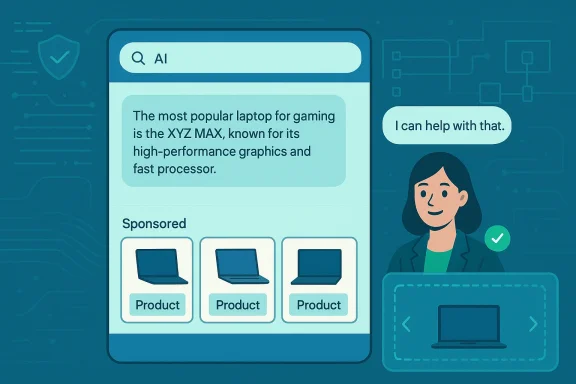
Traditional search ads appear alongside or above organic links. In AI search, ads can appear:- Directly beneath a generated answer as a labeled sponsored card.
- As suggested next steps inside a conversation (e.g., “If you want to buy, consider X”).
- In the assistant’s interface as interactive showrooms, product carousels, or “brand agents” that continue the conversation with a single merchant’s inventory.
Targeting and measurement
AI assistants can combine intent signals from the immediate conversation with broader profile or session signals to create highly contextual targeting. That includes:- Conversation-level intent (products, prices, timeframes).
- Session history and prior interactions.
- Potentially, cross-device or logged-in account signals — if the user has consented.
Ad formats: what advertisers will see
AI search placements are not one-size-fits-all. Expect several families of formats:- Sponsored answer cards — short, labeled recommendations that sit beneath the AI response.
- Interactive showrooms — richer, filterable displays that let users refine options without leaving the assistant.
- Brand Agents and checkout integrations — single-brand conversational experiences that can accept payments inside the chat flow.
- Sponsored follow-ups or prompts — injected suggestions that steer the next user action (e.g., “Would you like to compare prices?”).
The advertiser playbook: adapting to AI search engine advertising
Advertisers that approach AI search ads as a simple extension of search will underperform. The following prioritized checklist gives a practical roadmap.1. Treat conversational signals as first‑class intent
AI answers encode constraint-rich signals. Design campaigns that accept contextual attributes (budget range, timeline, style preferences) and map them to dynamic creatives.- Build entity-rich product feeds (titles, specs, structured features).
- Create short-form ad copy and micro‑assets tailored to in‑chat cards.
- Use automation for bid adjustments based on conversational context.
2. Invest in creative for the answer moment
Short, helpful, trust-forward messaging wins. Ads that read like disembodied sales copy will be downranked or ignored by users and, increasingly, by platform policies.- Prioritize clarity and utility in first-line messaging.
- Provide supporting proof (ratings, short specs) in the card metadata.
- Test human‑readable labels that clarify sponsored status.
3. Prepare data plumbing for in‑chat checkout and measurement
If the platform supports in-chat checkout or Brand Agents, take the integration seriously:- Ensure your product catalog maps to the assistant’s schema.
- Implement server-to-server order confirmations and tokenized payments where required.
- Be ready to reconcile in‑assistant conversions with your analytics stack.
4. Expect higher scrutiny and plan for transparency
Because these ads appear next to authoritative answers, platforms are testing stronger labeling, limits around sensitive topics, and opt-outs for minors. Budget for creative review cycles and compliance checks.Publisher and open web implications
AI answer engines compress discovery away from the link list and toward synthesized outputs. That has blunt consequences for publishers:- Referral traffic from explicit clicks can decline if the assistant summarizes and answers without sending the user to the original page.
- Publishers may need to negotiate new revenue models (licensing content to assistive platforms or participating in publisher revenue shares).
- Smaller sites risk being excluded from shortlists if their machine‑readable facts or review signals are not properly surfaced.
Risks: privacy, trust, and regulatory friction
While the commercial upside for platforms and advertisers is clear, the risk profile is high.Privacy and data scope
AI assistants can combine short-term conversation signals with stored account data. That raises obvious concerns:- How much personal data is used to personalize ads?
- Is signal processing kept on-device or sent to servers?
- Are minors or sensitive topics excluded from ad eligibility?
Trust erosion
When an assistant’s answer is followed immediately by a paid card — even if labeled — users may find it harder to distinguish independent information from commercial placement. Design and labeling choices will materially affect user trust metrics; missteps could drive users to ad-free competitors.Market concentration and competition concerns
If a small number of large platforms control the dominant AI assistants, they will also control seller access to discovery. That can concentrate pricing power and limit market access for smaller advertisers and independent publishers. Competition regulators and publisher coalitions are likely to push back.Technical and operational challenges for ad platforms
Building a robust ad stack inside an AI assistant is non‑trivial. Platforms must solve:- Real-time ranking of ads against generative answers without harming latency.
- Clear provenance and citation systems that let users verify where facts came from.
- Payment tokenization and fraud prevention for in‑chat checkout flows.
- Measurement attribution that reconciles conversational interactions with downstream conversions.
Regulatory and policy pressures to watch
Several regulatory fronts will shape how quickly and in what form AI search advertising scales:- Consumer protection and truth-in-advertising enforcement may require stricter labeling and disclosure.
- Data protection regimes will constrain personalized targeting when sensitive categories are involved.
- Competition and antitrust scrutiny may focus on whether assistants unfairly favor their own marketplace offerings or gatekeeper partners.
Practical recommendations for marketers, publishers and product teams
For marketers
- Reallocate part of test budgets to conversational formats now. Treat experiments as discovery purchases, not scale buys.
- Build short, verifiable creatives and structured feeds that map to assistant UIs.
- Prioritize privacy-first measurement options and server-side integrations.
For publishers
- Publish machine-readable facts and add clear canonical metadata to high-value pages.
- Monitor referral traffic and negotiate licensing or revenue-sharing where possible.
- Diversify monetization — memberships and first-party commerce will be more defensible if AI answers reduce referral volume.
For product and engineering teams
- Instrument detailed logs that can map conversational context to downstream activity.
- Design transparent labeling and provenance surfaces that allow users to trace assistant answers to sources.
- Build lightweight SDKs for merchants to integrate with in-chat purchases securely.
Strengths of the new ad model
- Higher-intent placement: Ads in conversational surfaces sit closer to the decision moment than many display or discovery buys, which can increase conversion efficiency.
- New creative opportunities: Interactive showrooms and brand agents offer ways to present products without the friction of page loads and complex funnels.
- Potential for better measurement: If platforms standardize provenance and conversion attribution, advertisers could gain cleaner signals about what content, formats and messages actually closed deals.
Notable weaknesses and open questions
- Trust vs. monetization: The most valuable asset for an assistant is user trust; aggressive monetization risks degrading the product’s core promise.
- Measurement immaturity: Conversion and viewability definitions inside assistants are not yet standardized, making cross-platform comparisons difficult.
- Publisher displacement: If assistants routinely answer questions without linking, the open web’s referral economy will be strained, and smaller publishers are vulnerable.
A short roadmap: what to expect next
- Near term (3–6 months): Pilots expand, platforms refine labeling and begin rolling out limited in-chat ad units. Early industry winners will be advertisers with clean product feeds and fast integrations.
- Medium term (6–18 months): Measurement and checkout integrations improve; publishers and platforms begin experimenting with revenue share or licensing deals. Regulatory attention intensifies.
- Longer term (18+ months): The market splits between ad‑supported assistants and subscription/enterprise models. Standards for provenance and conversational attribution begin to emerge — or fragmentation makes cross-platform attribution a persistent headache.
How to run a responsible test campaign (step-by-step)
- Identify a narrow category where conversation-to-purchase latency is short (e.g., consumer electronics accessories, local services).
- Prepare a structured product feed with concise attributes and high-quality micro‑images.
- Create two creative sets: utility-first cards (facts, specs, ratings) and promotional cards (offers, discounts).
- Launch with a small budget and server-side conversion tracking.
- Measure: conversation-engagement rate, click-throughs from the assistant, click-to-conversion, and assisted conversions.
- Iterate on labeling, copy length, and the amount of context you pass to the assistant. Adjust bids to favor high-conversion conversational contexts.
Caveats and verification
Much of the public reporting about AI search engine advertising is early-stage and based on platform pilots and company blog posts. While this article synthesizes those signals and outlines practical responses, specific product details (exact placement rules, pricing models and revenue-sharing terms) vary by platform and are subject to change as experiments conclude. Readers should treat current product behaviors as experimental and verify exact placement policies directly with platform advertising teams before committing large budgets.Conclusion
AI search engines create a game-changing advertising surface: the answer itself is now a place where brands can appear, recommend, and — increasingly — transact. That opportunity is powerful, but it carries proportional risks to user trust, publisher economics and privacy. Advertisers that prepare — by building structured feeds, testing short-form creatives, and engineering privacy-compliant measurement — will have an early advantage. Publishers that prioritize machine‑readable facts and diversify revenue will be better positioned to withstand discovery compression. And everyone will need to watch policy and regulatory developments closely as the industry searches for a sustainable balance between usefulness and commerce.Source: AOL.com Everything you need to know about advertising on AI search engines
Source: The Ponte Vedra Recorder https://www.pontevedrarecorder.com/...bout-advertising-on-ai-search-engines,167787/
