

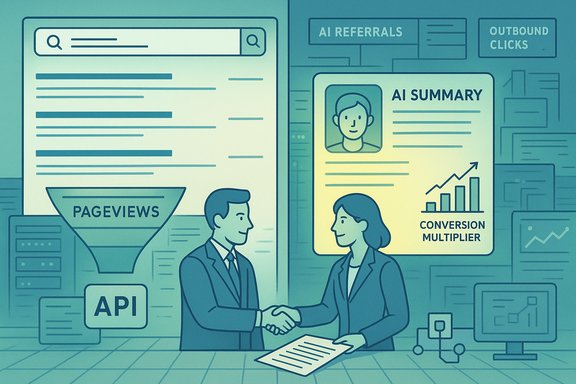
Microsoft and Google have publicly mounted a coordinated PR defense this week, arguing that the shift to AI-driven search is not a publisher-ending “traffic collapse” but a change in the web’s currency — fewer clicks, they say, but higher-value clicks that convert at multiples of legacy search traffic.
Background / Overview
The debate centers on an uncomfortable trade-off: large language model (LLM) assistants and AI-powered answer panels are increasingly satisfying users on the results page — reducing outbound clicks — while platform owners insist that the quality of the clicks that do happen is rising sharply. Microsoft’s internal analytics (via Microsoft Clarity) recently reported dramatic percentage growth in AI referrals and conversion multiples that grabbed headlines; independent researchers and publishers counter that aggregate evidence shows substantial declines in link-driven traffic and only marginal or inconsistent conversion advantages for those referrals. This is not merely a measurement spat. For advertising-supported journalism and many independent publishers, raw pageviews have been the lifeblood of the business model. A structural change that systematically reduces pageviews — even if the remaining visits are richer — threatens the economics of the open web and raises questions about attribution, transparency, and the terms under which platforms reuse third‑party content.Microsoft and Google’s “Quality over Quantity” Argument
What the platforms are saying
Microsoft’s outreach frames the shift as a redefinition of value: visibility inside an AI summary becomes a form of currency because it shapes user preference before any click occurs. Microsoft Clarity’s analysis, cited by company spokespeople, reports that AI referrals across a sample of publisher and news domains grew roughly 155% over eight months and — while still representing under 1% of visits in the dataset — converted at as much as three times the rate of traditional channels such as search and social. Copilot referrals were singled out for especially high multipliers in Clarity’s provider breakdown.Google has pushed a parallel narrative. Its Head of Search has argued that while query volumes and click patterns are changing, the clicks that do arrive are “higher value” because they represent deeper intent — users “click to dive deeper,” the company says, and those subsequent sessions are more commercially meaningful. Google is also rolling agentic capabilities into Search (e.g., its Gemini/Project Mariner efforts) that aim to complete tasks without requiring traditional browsing, which further reframes how success is measured in search flows.
Strengths in the platforms’ case
- Platforms control massive volumes of interaction data and can measure downstream events (form fills, purchases, subscriptions) across integrated surfaces, giving them visibility into outcomes that legacy analytics may miss.
- For publishers with subscription or direct-response funnels, a small number of high-intent referrals can be disproportionately valuable compared with high-volume, low-intent visits. That structural fact underpins the argument that conversion rate matters more than raw sessions.
Independent Data: A Far Less Rosy Picture
Pew Research: AI Overviews depress clicks
The Pew Research Center study is the clearest independent datapoint showing that AI summaries reduce outbound click behavior: in a large sample of Google searches, pages that included an AI Overview produced clicks to external sites only about 8% of the time — versus roughly 15% when no AI summary appeared — and users clicked the citations inside AI Overviews at vanishingly small rates (about 1%). The presence of an AI summary also increased the likelihood that a user would end the browsing session without a subsequent click. These are headline findings with immediate implications for publishers that rely on search‑driven traffic.Amsive: conversion lifts are tiny and inconsistent
Amsive, a marketing and analytics agency, ran a site-level analysis across dozens of domains and found only a marginal average advantage for LLM-driven sessions versus organic search (4.87% vs 4.60% conversion rate). Once the analysis controlled for site-level variability — using paired statistical tests — the difference lost statistical significance. Amsive’s conclusion: organic search still dominates in both traffic share and total conversion contribution, and LLM referral performance is highly site‑ and vertical‑dependent. That undermines a blanket claim that AI referrals will broadly replace lost pageviews with financially equivalent, fewer-but-better visits.Multiple independent indicators align
Third‑party analytics vendors and researcher groups (SimilarWeb, Adobe Digital Insights, several ad-tech observers) have reported both: (a) a growing incidence of zero-click searches or search sessions that end on the results page, and (b) isolated cases where AI-referred sessions look engaged and convert well. Those two facts can and do coexist — but they deliver very different business implications when you translate them into dollars: a 50% fall in clicks on high-volume informational queries is harder to offset than a small conversion premium on under‑1% of traffic.Measurement, Methodology, and the “Small-Base” Problem
Why the same data can tell two stories
- Small-base mathematics: a 155% increase on a channel that comprises 0.2% of total visits still yields a minuscule absolute volume of sessions. Quoted multipliers (e.g., “3× conversion” or “17× Copilot vs direct”) are extremely sensitive to the baseline chosen and to the measurement window. Microsoft acknowledges the <1% share in its Clarity measures; that fact makes headline multipliers fragile without confidence intervals or sample sizes.
- Attribution gaps and “dark AI”: many assistant interactions happen in closed UIs or produce context but no clickable link; users copy text or copy links into a new tab; sessions are misclassified as direct or lateral traffic. These behaviors hide the true scale and influence of assistants from conventional analytics, complicating cross-source comparisons.
- Endpoint heterogeneity: publishers vary in how they measure conversions (sign-ups, paywalls, advertising impressions, lead quality). A “conversion” for a news site (email newsletter signup) is very different from an e-commerce purchase margin. That means aggregated conversion comparisons must be interpreted with vertical granularity, not broad claims.
What solid measurement would look like
- Standardized channel definitions for “AI referrals” across analytics platforms, including hostnames, UTM patterns, and a consistent event taxonomy.
- Confidence intervals, sample sizes, and per‑provider breakdowns reported with any multiplier claims.
- Longitudinal attribution models that account for multi-touch, cross-device paths (AI exposure → later organic click → conversion).
- Independent third‑party audits that reconcile platform-logged events with publisher server-side receipts.
The Publisher Reality: Volume Remains Survival
For ad-supported publishers, the headline problem is scale. A modest conversion uplift on under-1% of traffic cannot replace the bulk revenue tied to pageviews, programmatic display, and scale-based CPMs. Multiple publishers and trade groups report sharp traffic declines and deteriorating ad yields in categories that historically depended on informational queries. Several operators — especially local and mid-sized publishers — have publicly reported declines in organic referrals measured in the tens of percentage points, which directly translates to lost ad impressions and weaker inventory prices. Industry associations and executives have framed this as more than a technical disruption: they call it a unilateral re-engineering of the web’s economic contract. Statements from publisher groups and CEOs capture the sector’s concern that platforms are extracting value without fairly sharing the proceeds or establishing clear licensing terms for content reuse. That has pushed publishers from explanation to litigation, regulatory complaints, and demands for compensation or binding transparency — responses that will shape the ecosystem’s next phase.Legal and Regulatory Pressure
Where the fight is happening
- Antitrust and regulatory scrutiny in the United States and Europe is intensifying. In a prominent U.S. court filing, Google’s legal team warned that the “open web is already in rapid decline,” language that has been leveraged by both sides in public debate and litigation. That same case — and related European inquiries — focus on whether dominant platforms are mediating discovery in a way that disadvantages third‑party publishers.
- Publisher coalitions in Europe and elsewhere have escalated demands, including high‑value compensation claims from certain media groups that say the platforms’ AI summaries use journalistic content without a fair return. These commercial and legal pressures are likely to trigger regulatory remedies, transparency requirements, or mandated licensing discussions in many jurisdictions.
Why regulation matters
If regulators require clearer provenance, compensation schemes, or limits on how models surface third‑party content, the commercial calculus of AI search could change rapidly. Conversely, if platforms are allowed to continue to integrate and monetize content without structural constraints, publishers will face a hard choice: aggressively gate content, seek partnerships, or reinvent revenue models.Tactical Playbook: How Publishers Should Respond Right Now
Short-term: measurement, protection, and experiments
- Tighten measurement: implement server-side event logging, robust UTM tagging, and custom channel detection for known assistant referrers. Run holdout experiments to quantify incremental value from AI‑referenced traffic.
- Harden the funnel: optimize the top of article pages for conversion with clear, converter-focused CTAs and concise summaries that match what AI assistants extract. Use schema markup and structured data to ensure assistants have an accurate canonical summary to cite.
- Consider crawler and bot policy: selectively limit access to crawlers where appropriate while balancing reach and discoverability. This is a blunt instrument and comes with trade-offs; approach with legal counsel and technical controls.
Medium-term: commercial and product strategies
- Negotiate with platforms: explore licensing, revenue-share, or referral-payment arrangements for content surfaced inside AI assistants. Publishers that can demonstrate measurable conversion value have leverage.
- Diversify revenue: accelerate membership, first-party data, and commerce initiatives to reduce reliance on raw ad impressions. Publishers with direct monetization channels are less vulnerable to referral volatility.
- Productize content for agents: create machine-friendly endpoints, concise canonical abstracts, and APIs that make it straightforward (and contractually clear) how assistants can reuse material — potentially unlocking new licensing revenues.
Risks and Strengths — A Balanced Assessment
Notable strengths of the platform thesis
- Platforms have richer cross-product telemetry and can legitimately measure conversion events tied to their integrated interfaces, which legacy analytics may not capture. That gives them a defensible argument that their referrals can be more efficient.
- For certain verticals and transaction types (travel, niche ecommerce, subscription media), AI-driven referrals may indeed produce outsized conversion efficiency if the assistant routes users to the exact page that completes a purchase or signup.
Substantial risks and open questions
- Small-sample fallacy: headline multipliers can be driven by tiny cell sizes. Platforms must publish sample sizes and confidence bounds before their multipliers can be taken at face value.
- Ecosystem concentration risk: if a small number of platforms mediate discovery and elect what content counts, diversity and independence of sources will shrink, potentially biasing information flows and training datasets. That has downstream reputational and regulatory costs.
- Monetization mismatch: conversions (subscriptions and purchases) monetize differently than ad impressions; even high conversion rates won’t automatically replace lost programmatic revenue for publishers that lack direct-payment models.
What the Next 12–18 Months Will Likely Deliver
- Measurement harmonization attempts: expect industry groups and analytics vendors to propose standardized definitions for “AI‑referred” traffic and for referenceable metrics to be published.
- Negotiation and licensing: commercial conversations between major publishers and platform owners will escalate, leading to selective deals and pilot revenue‑share models.
- Regulatory action: Europe and the U.S. will increase oversight, probing whether assistant architectures and indexing practices create anti‑competitive or unfair outcomes for content producers.
- Product responses: publishers will experiment with clearer canonical abstracts, paywall strategies targeted at AI surfaces, and API offerings tailored to agent discovery.
Conclusion
The platforms’ claim — that AI-driven referrals convert at multiples of traditional search and therefore replace lost pageviews with higher-quality interaction — is a defensible hypothesis, supported by internal telemetry and plausible mechanism. Microsoft’s Clarity data and related vendor case studies show a consistent pattern: AI referrals are rising from a small base and, where tracked, often look more intentful. However, the broader evidence counsels caution. Independent studies (notably Pew Research and Amsive) demonstrate that AI summaries materially reduce outbound clicks at scale and that conversion advantages for LLM‑referred traffic are modest, inconsistent, and highly dependent on vertical and measurement choices. Those two truths are not contradictory; they are complementary and paint a nuanced picture: AI is changing the plumbing of discovery, and that change benefits some actors while threatening others. For publishers, the practical imperative is immediate: fix measurement, protect the funnel, experiment with new commercial terms, and diversify revenue. For platforms and policymakers, the task is structural: design transparent, auditable metrics and clear commercial frameworks so the open web’s creators — who still supply the information that powers AI — can sustain their work. The question is not whether AI is transformative; it is whether that transformation will be managed in a way that preserves a plural, remunerative open web or whether it accelerates a consolidation that leaves publishers asking how to survive.Source: WinBuzzer Microsoft Claims AI Search Traffic Converts at 3x Rate, Defying Publisher 'Collapse' Narrative - WinBuzzer
