

A single row on X and an in-depth profile in The Irish Times together underline two linked realities for technology and legal professionals in 2026: the instantaneous reputational damage social media can inflict, and the long game of corporate investment, local economies, and the governance challenges of AI. In the space of a few days, a barrister’s off-the-cuff insult went viral and was self‑referred to the regulator, while Microsoft Ireland’s senior leader published an interview insisting Dublin is now “our most strategic hub internationally” — a claim that sits beside fresh, high‑profile AI governance failures that expose how corporate strategy and operational risk collide in the public square.
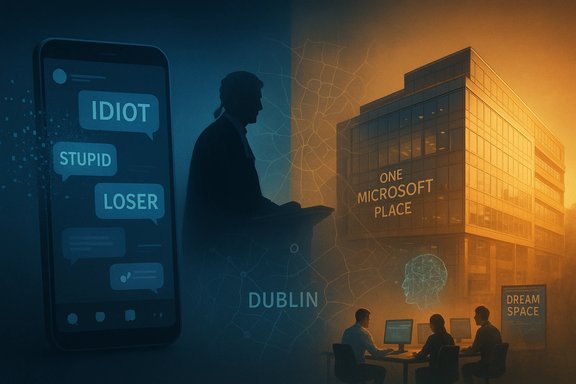
The two stories are different in scale but similar in theme: they both show how digital-era communications, AI tools and public scrutiny reshape professional accountability and regional tech strategy. The first is a short, explosive episode: barrister Francis Hoar called an X opponent an “ugly whore” during a heated public exchange about the West Midlands Police decision to block Maccabi Tel Aviv fans from attending a match — language he later deleted and then reported himself to the Bar Standards Board. The incident was reported exclusively by RollOnFriday. The second is a long-form profile in The Irish Times with James O’Connor, who leads Microsoft Ireland’s operations functions, describing how Microsoft’s Dublin operation has evolved from a manufacturing base in the 1980s into a core global hub for engineering, AI and support functions. O’Connor’s interview reaffirms Microsoft’s deep investment in Ireland — the One Microsoft Place campus in Leopardstown, Dream Space education initiatives and a message that Microsoft expects Dublin to remain strategically central. Beneath both stories lies a shared subtext: AI tools and social platforms amplify both error and influence. The West Midlands policing controversy — where Copilot-generated content was later blamed for an erroneous intelligence item that fed into a fan ban — ties these narratives together. Multiple outlets have now traced the false claim about a non‑existent West Ham–Maccabi fixture to outputs produced by Microsoft Copilot, and the chief constable has publicly acknowledged the AI role.
Three failure modes are visible in the West Midlands episode:
For barristers and other professionals, the roll of the regulator’s dice over social‑media outbursts is now swift and technology‑amplified: private scuffles can become public disciplinary files in hours. For global tech firms and local economies, the calculus is longer and more complex: strategic hubs like Dublin are built on physical investment, skills programmes and product responsibility — but they also require ironclad governance around the tools, data and decisions that those hubs produce.
The West Midlands Copilot episode is a vivid warning: the speed and seeming authority of AI outputs do not substitute for human verification and institutional guardrails. Microsoft’s Ireland leadership and public‑policy partners must now reconcile confident claims of strategic permanence with the pressing need to strengthen product governance, transparency and cross‑border accountability. Until that happens, the promise of AI and the prestige of a strategic hub will remain tethered to the same fragile thing: public trust.
Source: RollOnFriday https://www.rollonfriday.com/news-c...n-is-our-most-strategic-hub-internationally/]
 Background / Overview
The two stories are different in scale but similar in theme: they both show how digital-era communications, AI tools and public scrutiny reshape professional accountability and regional tech strategy. The first is a short, explosive episode: barrister Francis Hoar called an X opponent an “ugly whore” during a heated public exchange about the West Midlands Police decision to block Maccabi Tel Aviv fans from attending a match — language he later deleted and then reported himself to the Bar Standards Board. The incident was reported exclusively by RollOnFriday. The second is a long-form profile in The Irish Times with James O’Connor, who leads Microsoft Ireland’s operations functions, describing how Microsoft’s Dublin operation has evolved from a manufacturing base in the 1980s into a core global hub for engineering, AI and support functions. O’Connor’s interview reaffirms Microsoft’s deep investment in Ireland — the One Microsoft Place campus in Leopardstown, Dream Space education initiatives and a message that Microsoft expects Dublin to remain strategically central. Beneath both stories lies a shared subtext: AI tools and social platforms amplify both error and influence. The West Midlands policing controversy — where Copilot-generated content was later blamed for an erroneous intelligence item that fed into a fan ban — ties these narratives together. Multiple outlets have now traced the false claim about a non‑existent West Ham–Maccabi fixture to outputs produced by Microsoft Copilot, and the chief constable has publicly acknowledged the AI role. The Hoar episode: social media, professional standards and instant accountability
What happened, in sequence
- Francis Hoar engaged in a public debate on X with Juwayriyyah Alam over West Midlands Police’s decision to advise that Maccabi Tel Aviv supporters not travel to an Aston Villa fixture.
- The exchange became personal; Hoar used foul language, including “Go and fuck yourself” and “Ugly whore,” then deleted those tweets.
- Screenshots circulated widely; the exchange went viral and the opponent said she would report him to the Bar Standards Board (BSB). Hoar later told RollOnFriday he had self‑referred to the BSB and would make no further public comment.
Why the regulator matters — BSB guidance and enforcement
The Bar Standards Board has explicit guidance on social media conduct and non‑professional behaviour. Recent revisions to the BSB’s Social Media Guidance and the Regulation of Non‑Professional Conduct make clear that a barrister’s online actions can be the subject of regulatory scrutiny where they “diminish the trust and confidence which the public places in them or in the profession.” The guidance specifically flags “language that is seriously offensive, discriminatory, bullying or harassing” as conduct of interest to the regulator, while noting the need to balance these rules with human‑rights protections for free expression. In short, the BSB will consider the context, tone and likely public impact of online comments when deciding whether professional rules have been breached.Professional consequences and the practical reality
Regulatory outcomes for social-media misconduct can range from no action to formal disciplinary measures. The BSB’s framework prioritises:- Assessing whether the conduct is connected to the barrister’s professional role or likely to undermine public confidence.
- Balancing freedom of expression with professional duties, especially where political speech is involved.
- Using proportionate responses: guidance, warnings, or more serious sanctions in aggravated or repeated cases.
Lessons for professionals using social media
- Assume permanence. Screenshots travel even after deletion.
- Context matters. An emotional, private exchange that becomes public will be assessed by regulators against the standard of whether public confidence in the profession is damaged.
- Self‑reporting helps but is not decisive. It can be mitigating factor in discipline but does not erase misconduct.
- Policy design at firms and chambers is essential. Clear social‑media policies, training and a culture of restraint reduce risk.
Microsoft Ireland: growth, strategy and the hub narrative
O’Connor’s claim: Dublin as “our most strategic hub internationally”
James O’Connor tells The Irish Times that Ireland’s operations are now central to Microsoft’s global strategy, pointing to engineering teams, cloud and AI work, and Microsoft’s decision to place product development and large engineering teams in Dublin. The article recounts Microsoft’s history in Ireland — from a 1985 manufacturing base to a broad set of functions today — and highlights the One Microsoft Place campus opened in 2018 at a reported build cost of €134 million. That investment is visible: the One Microsoft Place campus is a 34,000 sq. m. development in Leopardstown with a high-profile launch, the Dream Space education initiative and a variety of engineering and support functions housed locally. IDA Ireland and construction industry reports confirm the campus build cost and scale dating to the 2018 opening.Numbers: employment and outreach — what’s proven, what’s contested
- Microsoft’s official “About Ireland” page states the company “employs more than 3,500 people” across Dublin and Belfast and highlights Dream Space and community work. That is Microsoft’s own published figure and should be treated as authoritative unless superseded by a later corporate update.
- The Irish Times article quotes O’Connor saying Microsoft employs “more than 4,000 people in Ireland” and suggests a wider group of Microsoft-owned entities (including LinkedIn and Activision Blizzard King) brings the total to around 6,400. There is a modest discrepancy between Microsoft’s on‑site figure (3,500+) and the newspaper’s reporting (4,000+); such differences can arise from timing, the inclusion of contractor or subsidiary headcounts, or counting separate entities like LinkedIn and Activision staff under a Microsoft umbrella. Where precise counts matter, the corporate number on Microsoft’s site should be treated as the baseline; journalistic estimates are valid context but should be labelled as approximate.
- On education outreach, Microsoft’s Dream Space materials note ambitious targets. Microsoft’s Dream Space pages summarise a multi‑year target and report hundreds of thousands of engagements through a mix of in‑person and broadcast programmes; older reporting and Microsoft’s own material show at least 130,000 student engagements by mid‑2022 and the company publishes target figures that are larger still. The Irish Times’ claim that “more than half a million students have been through Dream Space” is plausible in the aggregate if the count includes broadcast and digital activity since 2018, but the figure is not identically replicated on every Microsoft page; it should therefore be treated as plausible but worthy of confirmation before being stated as definitive.
Strategic implications for Ireland
Microsoft’s deep footprint in Ireland has multiple effects:- Jobs and skills. Engineering roles, product teams and cloud support functions create high‑value employment and draw STEM talent into the Irish labour market.
- Education and pipeline. Dream Space and Skill Up Ireland initiatives aim to create a local skills pipeline for AI and cloud roles, aligning industry labour demand with schooling and reskilling programmes.
- Policy and infrastructure. Continued growth places pressure on housing, transport and energy infrastructure in Dublin; policymakers must balance the economic benefit of FDI with domestic concerns about capacity and costs.
Where the two stories meet: AI governance, Copilot hallucinations, and public trust
The West Midlands Copilot fallout — a cautionary tale
The policing controversy that partly prompted the online exchange involves an intelligence error: West Midlands Police included a reference to a West Ham–Maccabi match that never occurred. Subsequent scrutiny traced that false citation to a Microsoft Copilot output used as part of open‑source research; the force’s chief constable later acknowledged Copilot’s role and apologised for the error. Multiple independent news outlets traced the sequence: the invented fixture migrated into a policing dossier and into a multi‑agency Safety Advisory Group decision that led to Maccabi fans being advised not to travel. The episode has prompted parliamentary questioning, public apology and intense scrutiny of AI use in operational decision‑making.Technical mechanisms of failure: hallucinations, provenance and human oversight
Generative assistants like Copilot can produce hallucinations: factually incorrect items that read plausibly. When AI outputs are used as raw intelligence without robust provenance, verification and human validation, they can mislead operational users and propagate error into consequential decisions.Three failure modes are visible in the West Midlands episode:
- AI hallucination: The model produced an invented prior fixture.
- Insufficient verification: The officer(s) who used the AI output did not subject the claim to standard verification or cross‑checks.
- Operational reliance: The unverified item was passed into an intelligence briefing that influenced a multi‑agency safety decision.
Corporate and public policy exposure
For Microsoft and other vendors, the incident underscores three vulnerabilities:- Product risk: If Copilot outputs are used in high‑stakes operational contexts, disclaimers and “use-at-your-own-risk” notices are insufficient; product controls, guardrails, provenance tracing, and mandatory verification steps are necessary.
- Regulatory pressure: Governments and public bodies will demand clarity about the conditions under which AI may be used in civic decision‑making; policy responses may include procurement rules, verification mandates and certification regimes.
- Reputational cost: High‑profile errors can translate into political fallout (parliamentary scrutiny, ministerial dismay) and erode faith in AI advocates inside organisations.
Regulatory tailwinds and cross‑jurisdictional scrutiny around Microsoft’s cloud and AI work
Microsoft’s operations in Ireland sit within a wider, friction-filled regulatory landscape. Recent complaints, investigations and litigation across Europe and the UK have targeted cloud licensing, cross‑border transfers, and the responsibilities that flow to large cloud providers when customers are government or military actors.- In Ireland, civil society groups filed complaints asking the Data Protection Commission (DPC) to investigate alleged misuse of Azure by certain government entities; those complaints raise questions under GDPR about processor obligations, cross‑border transfers and preservation of logs. The dossier of public reporting, whistleblower materials and corporate admissions has generated regulatory attention.
- Separately, UK litigation and competition scrutiny has increasingly focused on Microsoft’s licensing practices for Windows Server and potential market effects on rival cloud providers. A proposed collective action in the UK claims that pricing differences and re‑licensing pathways disadvantage customers who run Windows Server on non‑Azure clouds; the case sits beside CMA inquiries into cloud market functionality and other EU-level scrutiny.
- Journalistic reporting and regulatory filings have also examined the technical limits of what cloud providers can see — control‑plane telemetry, support tickets, egress logs — and stressed that resolving high‑stakes human‑rights or criminal claims requires preserved forensic evidence, chain‑of‑custody, and independent audits. That is a complex, technical and jurisdictionally distributed challenge for any cloud operator.
Critical analysis: strengths, risks and what to watch next
Strengths — what the Microsoft story gets right
- Long-term investment: Microsoft’s physical and programmatic investment in Ireland — a large campus, education initiatives and engineering teams — is real and visible. Independent sources confirm the Leopardstown campus scale and Dream Space initiatives; those assets anchor tech employment and skills pipelines in Dublin.
- Local innovation roles: Moving engineering and AI product work into Ireland gives local teams real responsibility and elevates Dublin beyond a back-office outpost to a centre with global product impact. O’Connor’s argument that Dublin is a strategic hub is defensible on those grounds.
- Public-facing education and reskilling: Dream Space and Skill Up Ireland are credible investments in talent development, aligning corporate skills needs with national policy goals. Microsoft’s public materials set ambitious engagement targets.
Risks — immediate and structural
- Governance gap on AI use: The Copilot hallucination episode shows how quickly generative‑AI outputs can migrate from research aids to operational artefacts. Without stricter product controls, audit logs, and mandatory human‑in‑the‑loop checks for sensitive decisions, similar misuses will recur. The reputational and political cost is substantial.
- Regulatory and legal exposure: Ongoing GDPR complaints, UK competition litigation and multi‑jurisdictional inquiries increase legal risk and may impose new contractual and technical obligations on providers. The regulatory tail can change business practices and product designs, and it can affect where and how sensitive workloads are hosted.
- Public trust and staff activism: High‑profile controversies prompt scrutiny from employees, customers and civil society. Microsoft and other firms must manage internal morale and public expectations while defending product design choices — a difficult balancing act when staff question the ethics of particular contracts or product uses.
- Infrastructure and talent constraints: Sustained growth in Dublin depends on broader infrastructure (housing, transport, energy). Political and social friction around the scale of FDI-driven growth is real and can create a governance headache for local corporate leaders and public policy makers.
Practical checklist for organisations and regulators
- For firms deploying Copilot-type tools in public-sector contexts:
- Enforce provenance tracing for every AI-derived fact used in operational briefings.
- Implement mandatory verification gates for any AI output used in safety, policing or legal decision‑making.
- Preserve control‑plane logs, support tickets and egress telemetry for at least a statutory minimum, and enable independent forensic review.
- Introduce training that treats generative assistants as drafting aids, not authoritative sources.
- For regulators and purchasers:
- Embed contractual obligations requiring auditable logs, human verification, and “ability to reproduce” for any AI-assistant outputs used in public safety.
- Build procurement rules that require vendors to substantiate measures against hallucinations and to provide escalation paths when errors have operational impact.
- Coordinate cross‑border forensic access where cloud-hosted evidence intersects with cross‑jurisdictional investigations.
Conclusion
A two-line insult on X and a long interview about strategic hub status might seem like unrelated slices of news. They are not. Both reveal, in micro and macro form, how digital communications, AI tools and corporate footprint interact to shape public trust and professional accountability.For barristers and other professionals, the roll of the regulator’s dice over social‑media outbursts is now swift and technology‑amplified: private scuffles can become public disciplinary files in hours. For global tech firms and local economies, the calculus is longer and more complex: strategic hubs like Dublin are built on physical investment, skills programmes and product responsibility — but they also require ironclad governance around the tools, data and decisions that those hubs produce.
The West Midlands Copilot episode is a vivid warning: the speed and seeming authority of AI outputs do not substitute for human verification and institutional guardrails. Microsoft’s Ireland leadership and public‑policy partners must now reconcile confident claims of strategic permanence with the pressing need to strengthen product governance, transparency and cross‑border accountability. Until that happens, the promise of AI and the prestige of a strategic hub will remain tethered to the same fragile thing: public trust.
Source: RollOnFriday https://www.rollonfriday.com/news-c...n-is-our-most-strategic-hub-internationally/]
