

AI-assisted translations of Guernésiais — Guernsey’s traditional Norman variety — are already appearing in public spaces and online, but experts warn those outputs may be wrong, and the risks are concrete: when a language has only a few hundred fluent speakers, widespread use of automated translation can amplify errors, fossilize bad forms, and subtly reshape how the language is used and remembered.
Guernésiais (also written Guernesiais) is a Norman variety long spoken on the island of Guernsey in the Channel Islands. Once widely used in family and community life, it has been in steep decline for decades; the most recent formal counts and linguistic surveys put fluent speakers in the low hundreds, with the majority elderly and few under 60. Community-led revitalisation work — classes, listening-post audio installations, and new teaching materials — is under way, but the language lacks a single widely accepted orthography and has a small digital footprint.
At the same time, mainstream AI assistants and large language models (LLMs) — from ChatGPT-style systems to product-embedded assistants such as Microsoft Copilot — have become a first stop for many users who want a quick translation. Recent local reporting and interviews with Guernésiais teachers and commission members highlight a growing mismatch: people increasingly rely on instant AI outputs while the on-island human expertise that could check and correct those outputs is scarce. That combination is what the teacher and language advocate Yan Marquis succinctly described as “AI is fantastic … but incorrect translations will not be noticed” when the community of fluent speakers shrinks.
Two practical consequences follow:
If AI is to help save and not distort small languages, product teams must be transparent about uncertainty, communities must prioritize curated resources, and end users should treat machine translations as helpful drafts rather than definitive authorities. The technical fixes exist, and promising projects have expanded coverage dramatically, but the final arbiter of a language’s health is its speakers — and for Guernésiais, those speakers must remain central to any technological intervention.
Source: BBC Guernésiais translations generated by AI 'could be wrong'
 Background
Guernésiais (also written Guernesiais) is a Norman variety long spoken on the island of Guernsey in the Channel Islands. Once widely used in family and community life, it has been in steep decline for decades; the most recent formal counts and linguistic surveys put fluent speakers in the low hundreds, with the majority elderly and few under 60. Community-led revitalisation work — classes, listening-post audio installations, and new teaching materials — is under way, but the language lacks a single widely accepted orthography and has a small digital footprint.At the same time, mainstream AI assistants and large language models (LLMs) — from ChatGPT-style systems to product-embedded assistants such as Microsoft Copilot — have become a first stop for many users who want a quick translation. Recent local reporting and interviews with Guernésiais teachers and commission members highlight a growing mismatch: people increasingly rely on instant AI outputs while the on-island human expertise that could check and correct those outputs is scarce. That combination is what the teacher and language advocate Yan Marquis succinctly described as “AI is fantastic … but incorrect translations will not be noticed” when the community of fluent speakers shrinks.
Why AI gets small languages wrong: the technical picture
1. Data scarcity and skewed training sets
Modern translation systems are statistical — they learn to map patterns between source and target texts by ingesting large volumes of parallel data (aligned sentences in both languages). For many minority or regional languages, few or no parallel corpora exist, and what does exist is scattered, inconsistent, or domain-limited (songs, place names, museum captions). That means models either learn from noisy, non-representative samples or are forced to transfer knowledge from related languages — which can help, but also introduces systematic errors when the language has unique vocabulary, morphology, or idioms. This is the canonical low-resource problem in machine translation research.2. Lack of standard orthography and annotated corpora
Guernésiais has never had a fully standardised spelling system; community texts and recordings use multiple conventions. For neural models, inconsistent orthography behaves like different dialects mixed together, reducing the signal-to-noise ratio and increasing the chance of mistranslation. Where orthography varies, statistical mappings from characters and subwords to meanings become unreliable unless linguistically curated datasets exist. Field linguists and revitalisation programs routinely emphasise that writing consistency multiplies the value of any small corpus — a lesson often missed in large-scale, data-hungry ML pipelines.3. Hallucination and overconfident wrong outputs
LLMs and sequence-to-sequence translation models can produce fluent, plausible-looking text that is not grounded in the source input — a phenomenon labelled hallucination. For closed-domain translation tasks this is less common than for open generation, but it still occurs, particularly when models extrapolate from insufficient or noisy data. Research shows hallucinations can be detected and mitigated with model introspection and post-hoc detectors, but those tools are not universally deployed in consumer-facing assistants. That leaves end‑users exposed to confidently wrong translations.4. Over-reliance on pivoting and related-language shortcuts
To overcome corpus gaps, many systems pivot via a related high-resource language (for example: Guernésiais → French → English). Pivoting can speed development and broaden coverage but also compounds error: nuances lost in the first mapping are unlikely to be recovered in the second, and cultural or idiomatic meanings may be flattened. When a minority language subtly differs from the regional prestige language, pivot-based systems produce plausible but inaccurate renderings.The Guernésiais case: what local experts report
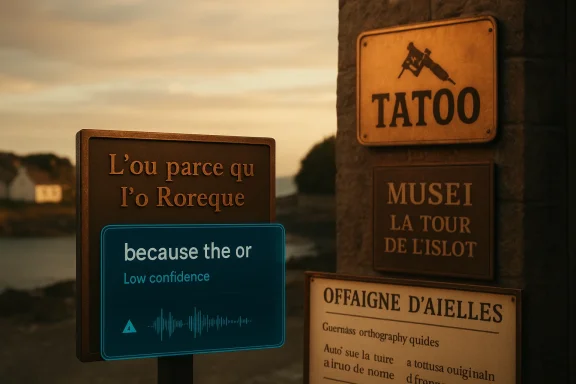
Guernsey’s language activists and teachers are already seeing the effect. Yan Marquis, a long-time teacher and translator, told reporters he has seen requests for translations for tattoos, signs and cards — the exact situations where a wrong phrase becomes visible and permanent. He notes that AI outputs can sometimes be very impressive, but because the language community is small, mistakes go unchecked and can spread (for example, a bad translation shared on social media or printed on a poster). The island’s Language Commission has built resources and a non‑instant translation service that prioritises careful human checking — an option Marquis recommends because it avoids the “instant-but-incorrect” trap.Two practical consequences follow:
- Small‑scale public errors (tattoo slogans, commemorative plaques) can become replicated and normalized.
- Learners who use AI as a primary input risk internalising non‑native forms, which undermines revitalisation pedagogy.
Industry context: progress and limits in low-resource translation
Big-model breakthroughs — and their caveats
Projects such as Meta’s No Language Left Behind (NLLB-200) demonstrate that engineering and careful mining of data can extend translation to hundreds of languages and push quality significantly higher than earlier baselines. NLLB introduced new data-mining practices and a massive evaluation effort (FLORES-200) to measure performance across many directions; results were a meaningful leap. But even NLLB’s authors stress that automatic improvements don't remove the need for community validation, human evaluation, or careful toxicity/safety checks for each language. In short: expanded coverage does not equal perfect accuracy.What the academic literature shows about hallucination and evaluation
Multiple studies and surveys of machine translation in the LLM era underline a consistent point: models produce fluent text but can be unfaithful to the source, and hallucinations are particularly pernicious for languages where reference test sets and reliable evaluators are scarce. Recent research proposes token‑level hallucination detectors and other technical fixes, but these require integration into production systems and, crucially, user-facing confidence signals. Without those, a polished sentence can mask an error.Risks beyond pure mistranslation
Cultural and semantic erosion
When incorrect renderings proliferate, they can nudge everyday usage. For a living but vulnerable language, repeated exposure to a mistaken grammatical form or calqued expression can shift speaker judgments about what counts as “correct,” especially among new learners who lack direct access to fluent speakers.Legal and commercial harms
Mistranslations in legal, medical, or contractual contexts can carry real-world consequences. While Guernésiais may not be used in high-stakes contracts, localized signage, heritage displays, or tourism materials printed with AI outputs could mislead visitors or inadvertently misrepresent legal obligations and place‑names.Reputation and trust
If public-facing institutions begin to rely on instant AI translation without review, the community’s trust in both those institutions and in machine translation could erode — making it harder to promote proper revitalisation pathways that mix technology and human expertise.Concrete mitigation strategies for communities and tech teams
For local language bodies and communities
- Prioritise curated, labelled corpora: even a few thousand high-quality sentence pairs or audio-text alignments can dramatically improve downstream performance when used with transfer learning techniques.
- Establish and maintain an orthography guide: a clear, community-accepted spelling convention turns scattered texts into machine-usable datasets.
- Create a verification workflow: for any public text (plaques, museum captions, tattoos, official signage), require sign-off from a certified speaker or the Language Commission before publication.
- Archive recordings: collect oral history and store aligned transcripts; speech data is increasingly valuable for building bilingual lexicons and pronunciation lexicons that help disambiguate low-resource text.
For technology vendors and platform owners
- Surface confidence scores and provenance: when a model provides a translation for a low-resource language, the interface should flag data sparsity and show the confidence/reliability estimate, encouraging users to seek human validation.
- Implement fallbacks and human-in-the-loop checks for named-entity heavy or culturally sensitive content.
- Offer community tools for dataset contribution: simplified web forms that let speakers submit aligned example sentences and corrections will pay large dividends; programs such as FLORES-200 and NLLB benefited from controlled, curated data contributions.
For Windows users, developers and IT managers
- Treat instant AI outputs as drafts, not final copy: for user-facing features (apps, localised UI, filesystem messages), prioritise vetted translations.
- Where possible, ship language features as optional language packs or downloadable resources that can be community‑validated rather than baked-in by default.
- Use offline or local validation steps for critical text: if an app must offer Guernésiais output, consider bundling a small curated glossary maintained by the Language Commission to post-process or sanity-check model outputs.
Technical fixes researchers use (brief, practical summary)
- Data augmentation and back-translation: generate synthetic parallel examples by back-translating monolingual corpora to improve model robustness.
- Transfer learning from typologically close languages: adapt pre-trained multilingual models using small curated sets; typological similarity improves transfer.
- Confidence and hallucination detectors: use internal model signals and lightweight detectors to flag suspect outputs before delivery.
- Human-in-the-loop correction pipelines: allow community validators to correct and re-ingest outputs into training sets, creating virtuous cycles.
- Orthography normalization tools: pre-process inputs to canonical spellings to increase model stability.
What responsible reporting and public bodies should do now
- Public broadcasters, tourist boards and local governments should avoid publishing machine-only translations for public signage or commemorative text. Where speed is needed, add visible disclaimers and a link to human‑verified translations.
- Language commissions should prioritise creating small, high-quality datasets and make a well-documented API or download available to researchers under clear licensing terms so that models improve in a transparent way.
- Developers of consumer AI assistants should expose provenance and offer one-click routes to request human verification or to flag mistranslations for the community. The BBC/EBU audits and follow-up coverage show that model errors in public-facing contexts are not theoretical; they are happening and need governance.
A realistic roadmap for Guernésiais and similar languages
Short term (0–12 months)
- Publish a community-approved orthography and a small "seed" bilingual glossary (English ↔ Guernésiais) for public use.
- Encourage the Language Commission to accept and curate community contributions (short phrases, place-name corpus, audio snippets) and provide a clear mechanism for researchers to request access.
- Platforms that offer instant translation should add an explicit “Low-resource language — verify with a speaker” banner when presenting Guernésiais outputs.
Medium term (1–3 years)
- Build a validated dataset of a few thousand sentence pairs and aligned audio; use it to fine-tune a compact translation model that can run on-device or on low-cost cloud instances.
- Collaborate with academic and industry partners on a shared evaluation suite so systems are tested against community expectations rather than only automatic metrics.
- Embed a community feedback loop for continuous correction and model improvement.
Long term (3+ years)
- Integrate validated Guernésiais support into mainstream translation projects (with clear quality labels).
- Use multimodal resources (audio + text + images) to provide richer learning signals for models and to create learner-facing apps that emphasise pronunciation and usage, not only literal translation.
- Maintain and expand community education so younger speakers encounter the language in both human and responsibly used technological contexts.
Conclusion: technology as ally, not replacement
AI translation tools can be valuable allies for minority-language communities — they raise visibility, lower barriers for learners, and can be deployed to produce accessible materials. But the Guernésiais case demonstrates a universal lesson: for vulnerable languages, accuracy and cultural fidelity depend on human expertise. Instant, polished outputs from large models may look correct to non‑speakers, and that is precisely what makes unverified AI translations risky.If AI is to help save and not distort small languages, product teams must be transparent about uncertainty, communities must prioritize curated resources, and end users should treat machine translations as helpful drafts rather than definitive authorities. The technical fixes exist, and promising projects have expanded coverage dramatically, but the final arbiter of a language’s health is its speakers — and for Guernésiais, those speakers must remain central to any technological intervention.
Source: BBC Guernésiais translations generated by AI 'could be wrong'
