

Mark Russinovich's thirty‑plus‑year‑old Apple II utility has become an unlikely canary in a rapidly evolving threat: modern large language models can reverse engineer raw machine code and surface latent bugs — even in 6502 binaries typed into a magazine in 1986 — and that capability both helps defenders and lowers the bar for attackers. Anthropic's disclosure around Claude Opus 4.6 and the demonstrations that followed show AI now routinely finds high‑severity bugs in well‑tested, mature codebases; the Apple II example is a human‑scale illustration of a capability with systemic consequences for embedded firmware, industrial controllers, and the vast, lightly governed fleet of legacy devices still running the physical world.
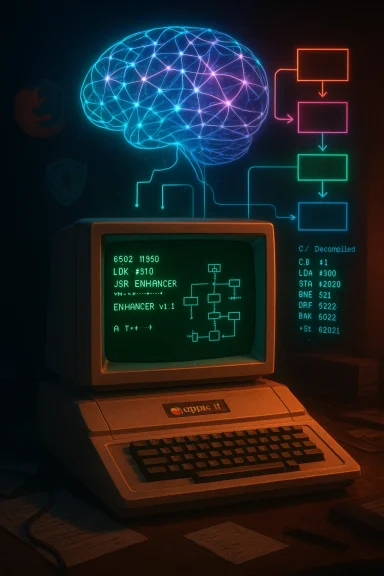
Applesoft BASIC, the standard BASIC interpreter on the Apple II line, lacked the ability to use variables or computed expressions as destinations for GOTO, GOSUB, and RESTORE. In May 1986 Mark Russinovich published a machine‑language utility called Enhancer that extended Applesoft with &GOTO, &GOSUB and &RESTORE — a tiny piece of hand‑entered 6502 code distributed as a type‑in program in Compute! magazine. The Enhancer listing and description remain archived in scans of that issue and show the exact approach: a short machine‑language routine written into a disk file that the BASIC program invoked to alter interpreter behavior at runtime.
Anthropic's recent work with its Opus 4.6 model — and the company's Red Team posts detailing the model's behavior when pointed at large codebases — make two claims of importance. First, Opus 4.6 can automatically decompile, analyze, and reason about compiled or hand‑assembled machine code well enough to locate logic errors and incorrect behavior. Second, when applied at scale to mature projects that have been fuzzed and audited for years, the model still finds previously unknown, high‑severity bugs. Anthropic's team reports hundreds of such discoveries across open‑source components during internal tests. Those are not theoretical results: Anthropic publicly disclosed a cooperation with Mozilla that produced 22 new Firefox vulnerability reports in a short engagement.
This convergence — a model that can meaningfully inspect binary/embedded code plus an installed base of billions of devices with poorly audited firmware — creates a pragmatic security problem that deserves immediate attention.
In short: the low‑level fix that Claude recommended — “check the carry flag and branch to an error handler when a line isn't found” — is sensible and matches 6502 programming patterns. Whether that precisely maps to the original Enhancer binary requires disassembly and rebuild of the listing, which is straightforward for a 77‑byte routine but outside what Anthropic published. We therefore treat the Apple II example as illustrative rather than an exhaustive, independently reproduced test.
Defenders should treat the arrival of AI‑accelerated vulnerability discovery as an urgent operational reality: adopt automated scanning where it helps, but bolt solid human validation and prioritized remediation onto those findings. Vendors and regulators must raise the baseline for firmware supply‑chain security. And the security community must be realistic: AI is not a panacea for decades of legacy technical debt, but it is a new vector that accelerates both discovery and exploitation. The practical difference between those two outcomes will be how quickly organizations move from surprise to sustained, prioritized hardening.
The Apple II moment is a warning and a gift: the same machinery that uncovers decades‑old logic errors can, if wielded responsibly and quickly, help clean the attic of embedded systems before the window of opportunity for attackers swings shut. The operational challenge is not academic — it is logistical, organizational, and political — and it deserves immediate, prioritized action from every team that runs devices outside their control.
Source: theregister.com Microsoft Azure CTO says Claude found vulns in Apple II code
 Background / Overview
Applesoft BASIC, the standard BASIC interpreter on the Apple II line, lacked the ability to use variables or computed expressions as destinations for GOTO, GOSUB, and RESTORE. In May 1986 Mark Russinovich published a machine‑language utility called Enhancer that extended Applesoft with &GOTO, &GOSUB and &RESTORE — a tiny piece of hand‑entered 6502 code distributed as a type‑in program in Compute! magazine. The Enhancer listing and description remain archived in scans of that issue and show the exact approach: a short machine‑language routine written into a disk file that the BASIC program invoked to alter interpreter behavior at runtime.Anthropic's recent work with its Opus 4.6 model — and the company's Red Team posts detailing the model's behavior when pointed at large codebases — make two claims of importance. First, Opus 4.6 can automatically decompile, analyze, and reason about compiled or hand‑assembled machine code well enough to locate logic errors and incorrect behavior. Second, when applied at scale to mature projects that have been fuzzed and audited for years, the model still finds previously unknown, high‑severity bugs. Anthropic's team reports hundreds of such discoveries across open‑source components during internal tests. Those are not theoretical results: Anthropic publicly disclosed a cooperation with Mozilla that produced 22 new Firefox vulnerability reports in a short engagement.
This convergence — a model that can meaningfully inspect binary/embedded code plus an installed base of billions of devices with poorly audited firmware — creates a pragmatic security problem that deserves immediate attention.
What the Apple II example actually shows
The simple facts
- The Enhancer utility is real and was published in Compute! magazine in May 1986 as a short machine‑language blob that BASIC programs could BSAVE/BRUN to add new syntax semantics.
- Anthropic (and those testing Opus/Claude) claim the model can decompile such machine code and identify logic errors — in Russinovich's case, a subtle incorrect‑behavior case where the code fails to report an error if a target line is absent and instead sets the pointer to the next line or beyond the program end. The suggested remedy was to check the processor's carry flag and branch to an error handler when a search fails.
What is and isn't proven by that single anecdote
The Apple II demo is valuable because it is concrete and familiar: a well‑understood 6502 environment, a short machine‑code routine, and a known author who could confirm the model’s output. But the broader claim — that Claude and models like it will systematically make previously obscure embedded‑firmware bugs easy to find and weaponize — depends on scale and adversary intent.- Proven: A capable LLM can process and reason about low‑level machine code and suggest genuine fixes for logic errors in small, self‑contained routines. That’s demonstrably true in this human‑scale test.
- Plausible but not fully proven in public: That the same technique directly converts into exploit‑grade artifacts for modern embedded products at scale without human refinement. Anthropic’s teams did find impactful bugs in large projects, but exploit development usually requires additional steps, and Anthropic acknowledges Claude converted vulnerabilities into working exploits in only a subset of cases it examined.
- Urgent but dependent on context: The practical risk to any specific embedded device depends on firmware updateability, exposure, and the surrounding system architecture. Billions of devices are reachable targets in principle, but exploitation in practice varies widely.
How Claude can look inside machine code (brief technical primer)
To appreciate the claim, it's helpful to recap what a model must do to find bugs in raw machine code:- Disassemble or decompile the binary blob into a higher‑level representation (assembly or pseudo‑C).
- Identify calling conventions, data structures, and control‑flow idioms in the target architecture.
- Track state and flags across code paths to spot missing checks, off‑by‑one conditions, or undefined behavior.
- Reason about intended semantics (for example, “search for a line number; if not found signal an error”), and compare that to observed behavior in the code path.
In short: the low‑level fix that Claude recommended — “check the carry flag and branch to an error handler when a line isn't found” — is sensible and matches 6502 programming patterns. Whether that precisely maps to the original Enhancer binary requires disassembly and rebuild of the listing, which is straightforward for a 77‑byte routine but outside what Anthropic published. We therefore treat the Apple II example as illustrative rather than an exhaustive, independently reproduced test.
Scale: why ancient machine code matters today
Most readers understand that modern software has bugs. Less visceral is the scale of legacy embedded code still running critical functions:- Estimates of total connected devices run into the tens of billions; even conservative industry figures project device counts in the high tens of billions by the mid‑2020s. A large share of these endpoints embed microcontrollers or SoCs running firmware written decades ago or by small vendors without rigorous auditing.
- Many MCUs use tiny, simple architectures (8 or 16‑bit cores) and have firmware that is not buildable from a canonical upstream repository; often the only artifact available is a ROM or a firmware image. That makes runtime analysis and binary inspection the only practical route for understanding behavior at scale.
Defender benefits — real improvements, fast wins
AI‑accelerated binary auditing offers immediate practical benefits:- Rapid triage of firmware images: automated scanning to find egregious logic holes, missing error checks, or insecure default behaviors.
- Prioritization: models can rank findings by likely impact, enabling scarce engineering teams to focus where fixes matter most.
- Bootstrap analysis of orphaned/closed‑source firmware: even without source code, defenders can reconstruct control‑flow and detect classes of failure like unchecked return values, missing bounds checks, or incorrect state handling.
- Augmented fuzzing: LLMs can generate better harnesses, input mutations, and hypotheses to improve traditional fuzzers' reach.
The threat model — why attackers will benefit too
The same chain of capabilities that helps defenders helps attackers:- Lowered technical bar: attackers no longer need reverse‑engineering experts to surface memory corruption or logic errors in closed firmware — a model can do much of the heavy lifting.
- Speed: an attacker can rapidly scan multiple firmware images, prioritize high‑impact bugs, and attempt exploit development at scale.
- Weaponization: once vulnerabilities are found, weaponizing them still often requires manual steps, but AI can accelerate exploit‑generation and suggest payloads or exploitation chains.
- Supply‑chain amplification: an attacker who compromises a single firmware vendor or build system can scan all generated images for the same artifact class and rapidly identify vulnerable products worldwide.
False positives, noise, and the human workload
One important, underreported problem: AI finds “problems” that are not real or are low value, and maintaining projects can be overwhelmed by the deluge.- LLMs can generate plausible but incorrect decompilations or misinterpret calling conventions and therefore flag false vulnerabilities.
- Open‑source maintainers already struggle with issue triage; an influx of noisy reports from AI scanners will amplify this problem and create a maintenance debt.
- Defenders must therefore invest in validation pipelines: automatic reproducers, unit tests, and quick binary‑level mocks to convert LLM findings into high‑confidence reports before allocating engineering time.
Practical mitigations and a defensible action plan
If you operate or advise organizations that include embedded or legacy systems, here is a prioritized, practical roadmap:- Inventory and prioritize
- Build a hardware/firmware inventory that includes device model, firmware version, update mechanism, and exposure (Internet‑facing vs isolated).
- Rank devices by criticality: safety‑critical, privacy‑sensitive, and externally reachable devices go to the top.
- Scan with caution
- Use AI‑assisted binary analysis to scan internally held firmware and images first; feed the model output into a human verification pipeline to reduce false positives. Anthropic and similar vendors emphasize enabling defenders first — use that workflow.
- Harden update paths
- If a device is updatable, ensure signed firmware updates, rollback protection, and secure update servers are in place. A discovered bug is only dangerous if the attacker can reach a vulnerable device or firmware update channel.
- Apply compensating controls
- Network segmentation, zero‑trust controls for device management, and runtime monitoring can reduce risk while engineering teams produce fixes.
- Invest in long‑term code hygiene
- For new development, prefer memory‑safe languages and secure boot architectures where feasible; the NSA and numerous vendors recommend memory‑safe languages for high‑risk code. While realistic for new projects, retrofitting embedded products is slower and must be risk‑prioritized.
- Coordinate and disclose responsibly
- Work with vendors and upstream maintainers when you find issues. Large cross‑vendor disclosures are messy but necessary; the Mozilla‑Anthropic example shows how collaboration can produce fixes quickly.
Policy, procurement, and vendor expectations
The rise of AI‑driven binary auditing changes procurement and vendor expectations:- Buyers should require firmware provenance, reproducible builds, and a viable update plan as part of any device purchase.
- Government and industry regulators should consider minimum firmware security requirements for critical infrastructure and medical/automotive markets.
- Vendors must plan for AI‑driven scrutiny as a norm: maintaining public bug‑bounty programs, publishing reproducible build artifacts, and offering authenticated firmware retrieval APIs will make it easier to triage and fix issues quickly.
Limits, uncertainties, and where we need more data
A few important caveats:- Public evidence shows LLMs find real bugs in mature code and can decompile and reason about machine code, but the public literature does not yet demonstrate universal, automated exploitation at scale. Anthropic’s reports show successful conversion to exploits in a fraction of cases and a spectrum from benign bugs to true exploit paths. More independent, reproducible tests are needed.
- False positives remain a practical obstacle. Without robust validation pipelines, maintainers may waste resources chasing spurious issues.
- The most devastating real‑world outcomes will depend on attacker access to devices and update channels. Many embedded devices are behind NATs or isolated networks; many are reachable. Risk assessment must therefore be contextual and device‑specific.
A measured conclusion: act like defenders, assume attackers will
The Apple II anecdote is delightful in its novelty: an ancient, hand‑entered 6502 routine flagged by a modern AI. But the punchline is not nostalgia — it's a mirror showing the present: models can read and reason about low‑level code, and when paired with scale (billions of embedded devices, opaque firmware images, and inconsistent update practices), that capability is both a powerful tool and a fundamental risk.Defenders should treat the arrival of AI‑accelerated vulnerability discovery as an urgent operational reality: adopt automated scanning where it helps, but bolt solid human validation and prioritized remediation onto those findings. Vendors and regulators must raise the baseline for firmware supply‑chain security. And the security community must be realistic: AI is not a panacea for decades of legacy technical debt, but it is a new vector that accelerates both discovery and exploitation. The practical difference between those two outcomes will be how quickly organizations move from surprise to sustained, prioritized hardening.
Quick checklist for IT and security teams
- Inventory firmware and device exposure now.
- Run AI‑assisted binary analysis on high‑value firmware images behind a controlled validation pipeline.
- Patch and harden update mechanisms; require signed firmware.
- Add network compensations (segmentation, device policies) for unpatchable endpoints.
- Demand reproducible builds and disclosure from vendors going forward.
The Apple II moment is a warning and a gift: the same machinery that uncovers decades‑old logic errors can, if wielded responsibly and quickly, help clean the attic of embedded systems before the window of opportunity for attackers swings shut. The operational challenge is not academic — it is logistical, organizational, and political — and it deserves immediate, prioritized action from every team that runs devices outside their control.
Source: theregister.com Microsoft Azure CTO says Claude found vulns in Apple II code