

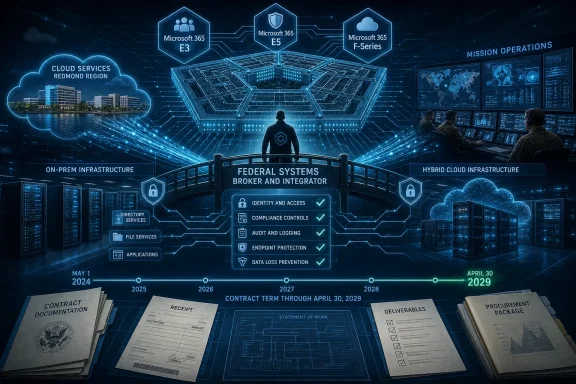
Dell Federal Systems was awarded a $1.44 billion Air Force call order in June 2026 for Microsoft 365 E3, E5, and F-series licenses, software assurance, and subscription services under a blanket purchase agreement running through April 30, 2029. The size is striking, but the real story is not that the Pentagon uses Microsoft. It is that defense IT is being pulled ever more tightly into a small number of enterprise software channels, with Dell sitting in the middle as broker, integrator, and procurement pressure valve.
The Air Force award looks at first like another large line item in the Department of Defense’s weekly contract digest: Dell Federal Systems, Round Rock, Texas; firm-fixed-price; sole-source; Microsoft Enterprise License Agreement renewal; $208.8 million obligated at award. But placed beside the Pentagon’s broader 2026 Microsoft consolidation push, it reads less like a standalone buy and more like a symptom of a larger procurement doctrine.
The Defense Department has already moved toward a massive consolidated Microsoft licensing vehicle, reportedly worth about $9.7 billion over five years, intended to gather scattered software purchases across the military services, intelligence community, and related defense buyers. That agreement was framed by officials as a way to reduce license sprawl, improve visibility, and use the government’s combined buying power to lower costs. The Air Force’s $1.44 billion order now shows how that enterprise logic lands inside a specific service branch.
For WindowsForum readers, this matters because Microsoft 365 at Pentagon scale is not just email, Word, Excel, and Teams with a bigger invoice. It is identity, endpoint management, compliance, conditional access, audit logging, cloud collaboration, records retention, security analytics, and the messy bridge between disconnected environments and hyperscale cloud. When the Air Force renews Microsoft 365 E3/E5 and F-series licenses through Dell, it is renewing much of the operating fabric of modern defense administration.
The contract language is procurement-sober, but the implications are not. Microsoft’s productivity stack has become part of the defense industrial base’s daily nervous system, and Dell has become one of the government’s preferred conduits for turning that dependency into something contracts officers can manage.
That role is less glamorous than cloud architecture, but it is lucrative because it solves a very real federal problem. Large agencies rarely suffer from a shortage of software contracts; they suffer from too many overlapping agreements, too little visibility into actual consumption, too many renewal calendars, and too much local discretion in environments that are supposed to meet enterprise security requirements.
The Dell award is explicitly tied to Microsoft 365 E3/E5 and F-series enterprise software licenses, software assurance, and associated subscription services. In plain English, that covers a tiered workforce: knowledge workers, security-heavy users, and frontline or field personnel who need access without necessarily needing the full desktop-and-office bundle. That segmentation is where enterprise licensing becomes a strategic exercise rather than a clerical one.
For Dell, the win reinforces a familiar federal playbook. The company’s government arm does not need to replace Microsoft to profit from Microsoft’s entrenchment. It needs to make itself indispensable to agencies that want the Microsoft stack but do not want every bureau, command, or field office cutting its own deal.
Sole-source does not automatically mean something improper happened. Federal acquisition law permits it under defined conditions, including situations where only one responsible source can satisfy agency requirements or where continuity and compatibility are decisive. In enterprise software, especially with a preexisting licensing architecture, the practical universe of eligible suppliers can narrow quickly.
But the detail still matters because Microsoft 365 is not a niche tactical radio or a custom aircraft component. It is a mass-market commercial platform being purchased at national-security scale. When the procurement path narrows around a single channel, agencies may gain speed and consistency, but they also trade away some competitive pressure at the point where pricing, service terms, audit rights, and transition flexibility matter most.
That is the central tension of this award. Consolidation can save money compared with chaotic fragmentation, but consolidation can also harden dependency. The Pentagon is trying to escape license sprawl without creating a different kind of sprawl: a sprawl of obligations, integrations, and assumptions that all point back to one commercial ecosystem.
E3 and E5 licenses are bundles of capability. Depending on configuration and entitlement, they can involve desktop Office apps, Exchange Online, SharePoint, OneDrive, Teams, Entra identity services, device management, information protection, eDiscovery, compliance tools, endpoint security, threat analytics, and more. The higher-end E5 tier is particularly important because it folds security and compliance tooling into the same commercial gravity well as productivity.
That bundling is one reason large organizations keep buying Microsoft even when they grumble about cost. The suite promises fewer vendors, tighter integration, unified identity, centralized policy, and a common user experience across hybrid work. For a military service with global personnel and complex security requirements, those are not cosmetic advantages.
Yet the same bundling also makes exit harder. Once identity policies, endpoint controls, records workflows, collaboration spaces, and security dashboards are tied into Microsoft 365, the switching cost becomes organizational rather than merely technical. You do not “replace Teams” in an enterprise like the Air Force; you unwind years of process, training, retention policy, compliance mapping, and user habit.
That is why the Dell order is more consequential than its product description suggests. A Microsoft 365 renewal at this scale is a bet on Microsoft as the control plane for a major slice of defense information work.
Continuity is underrated in consumer tech coverage and paramount in defense IT. The Air Force cannot treat enterprise productivity software as a casual subscription that can be paused while leadership evaluates alternatives. Users need access, compliance regimes need logs, security teams need telemetry, and disconnected or sensitive environments need a licensing model that does not collapse when the network path to the cloud is imperfect.
That helps explain why software assurance and associated subscription services appear in the award language. The value is not only in seats; it is in maintenance rights, version currency, supportability, and the administrative framework that lets the Air Force keep using Microsoft software without renegotiating every operational edge case from scratch.
Still, continuity has a price. The longer an organization depends on a single vendor’s licensing architecture, the more the renewal becomes less a choice than a managed inevitability. The government can negotiate hard, but it is negotiating around a platform that already sits inside workflows, devices, identities, and records systems.
A command buys what it needs. A program office funds a specialized entitlement. A component negotiates a renewal on a different cycle. A contractor support team adds a bundle because the security feature is only available in a higher tier. Five years later, the CIO’s office inherits a license estate that is expensive, partially redundant, and hard to audit.
The Pentagon’s version of that problem is amplified by scale, classification boundaries, mission diversity, and congressional scrutiny. The Department of Defense has to support office workers, engineers, logisticians, field personnel, intelligence users, deployed units, disconnected environments, and joint operations. One-size-fits-all licensing is impossible, but uncoordinated licensing is wasteful.
In that light, Dell’s award is best understood as part of the Pentagon’s attempt to make Microsoft consumption legible. Central buying gives officials a cleaner map of who is entitled to what, which features are being paid for, and where the department can force standardization. It also gives Microsoft and Dell a cleaner path to revenue.
The optimistic version is that the government saves money and reduces administrative waste. The skeptical version is that the government turns a fragmented dependency into a consolidated dependency with better dashboards.
For a defense customer, that argument is powerful. Email remains a primary attack surface. Identity compromise remains one of the most damaging paths into enterprise systems. Endpoint visibility matters at scale. Data loss prevention, retention, auditing, and eDiscovery are not optional for organizations operating under strict legal and security obligations.
But E5 also deepens vendor concentration. If the same vendor provides the operating system, productivity suite, identity layer, collaboration platform, endpoint security, compliance tooling, and cloud hooks, the customer gains integration at the cost of blast-radius anxiety. A licensing decision becomes a security architecture decision.
This is the double edge of Microsoft’s modern enterprise strategy. The more integrated the suite becomes, the more rational it is for a customer like the Air Force to standardize on it. The more rational standardization becomes, the harder it is for alternative vendors to compete on individual merits.
More E3 and E5 standardization can mean broader use of Microsoft-native management and security controls. It can accelerate adoption of Entra ID features, Conditional Access, Microsoft Intune, Defender tooling, Purview compliance features, and stronger integration between Windows endpoints and cloud identity. It can also mean tighter enforcement from above, because centralized licensing makes it easier for leadership to ask why a component is not using the tool it is already paying for.
That can be good news for administrators who have long wanted more consistent baselines. Standardized licensing can reduce the bizarre situation where one office has the security feature needed to comply with policy and another office does not. It can also simplify training, documentation, and support.
The tradeoff is that admins may have less room to choose specialized tools if Microsoft’s bundled equivalent is “good enough” and already funded. In enterprise IT, already-paid-for software has a gravitational pull that feature comparisons rarely overcome. The best tool does not always win; the tool inside the enterprise agreement often does.
In a military context, that category can matter. Not every user is a headquarters knowledge worker with a laptop, multiple monitors, and a full Office workload. Some personnel need secure access to specific workflows, messages, forms, or shared resources from constrained devices or shift-based environments.
Including F-series licenses suggests the Air Force is not merely renewing office software for staff desks. It is accounting for a broader population of users who interact with the enterprise digital environment in uneven ways. That makes the licensing estate more complicated but potentially more accurate.
It also reflects the larger direction of Microsoft 365 as a workforce fabric. The suite increasingly aims to cover everyone from executives to field operators, from analysts to maintenance personnel, from office desktops to mobile access points. In that model, licensing is not just a cost center; it is a map of who the organization believes needs to be digitally reachable.
Hybrid is not a transitional phase that ends neatly for the Pentagon. Some workloads can move into commercial or government cloud environments. Others are constrained by classification, latency, mission assurance, operational security, or disconnected use. The result is a long-running coexistence between cloud-native services, legacy systems, and enclave-specific deployments.
Microsoft has built much of its government strategy around that reality. The company’s value proposition is not simply “move everything to the cloud.” It is “use our identity, productivity, security, management, and cloud services across the messy boundary between cloud and on-premises.” Dell’s role is to make that proposition contractually consumable.
For the Air Force, that means the renewal is not just paying for today’s inboxes and documents. It preserves the licensing runway for more cloud integration, more security telemetry, more identity-centered management, and more Microsoft-native collaboration across environments that will remain uneven for years.
A centralized license agreement can help leadership see what the department owns, what it uses, what it duplicates, and what it can retire. In an era when the Pentagon faces persistent pressure to improve financial accountability, software licensing is not a trivial back-office detail. Every unused seat, redundant tool, and untracked subscription becomes part of a larger story about whether the department can manage its own complexity.
That is where Dell’s intermediary role becomes valuable to the government. A reseller with enterprise-scale reporting can help convert Microsoft’s sprawling catalog into procurement data that budget officials, CIO staff, and auditors can understand. The point is not just to buy licenses, but to impose order on a software estate that has become too large to manage informally.
Of course, auditability depends on execution. A consolidated contract can still be poorly governed. Agencies can still overbuy, underuse, misclassify users, or fail to enforce rational assignment of premium licenses. The contract creates the opportunity for discipline; it does not guarantee discipline.
The procurement logic is not hard to defend. The Defense Department uses Microsoft everywhere. Consolidating licensing can reduce waste. Enterprise agreements can improve security consistency. Dell Federal has experience serving government customers. A firm-fixed-price order gives the government a clearer cost structure than many open-ended arrangements.
But plausible does not mean uncontroversial. The more essential a commercial software ecosystem becomes to national operations, the more public buyers must explain how they are preserving leverage. Competition does not disappear simply because a platform is deeply embedded; it has to be designed into renewals, benchmarks, reporting requirements, and off-ramps.
This is where defense IT procurement often struggles. By the time a system becomes mission-critical, the moment for easy competition has already passed. The government can compete the channel, negotiate the price, and demand terms, but it cannot pretend that switching the underlying stack is a near-term option if the organization has spent years building around it.
The realistic alternatives are narrower. The government can insist on better price transparency. It can demand stronger data portability. It can avoid buying premium licenses for users who do not need them. It can keep specialized security vendors in the mix where they outperform the bundle. It can maintain architectural discipline so that Microsoft integration does not become Microsoft exclusivity by accident.
That distinction matters because otherwise the debate collapses into brand loyalty theater. The question is not whether the Air Force should use Microsoft; it already does, and the operational cost of abrupt displacement would be enormous. The question is whether the government can use Microsoft without surrendering too much pricing power, architectural flexibility, and independent oversight.
The Dell contract is therefore a test of governance more than ideology. If the Air Force uses the agreement to rationalize licensing, improve security baselines, and reduce waste, the consolidation argument gets stronger. If it becomes another expensive renewal machine that quietly expands premium entitlements because they are easier to buy than to justify, the skeptics will have their answer.
That is especially important with E5. Premium licensing can be justified for users who need advanced security, compliance, voice, analytics, or governance features. It is harder to justify when assigned broadly because it simplifies administration or because the organization has not built a disciplined entitlement model.
The inclusion of E3, E5, and F-series licenses gives the Air Force tools to segment its workforce intelligently. But segmentation requires active management. Someone has to define user personas, track consumption, review inactive accounts, measure feature adoption, and challenge the assumption that every user should move upward in the SKU ladder.
That is where many enterprise agreements succeed or fail. The negotiation gets the headline, but the seat-management process determines whether the savings are real.
The government’s desire for integrated security and collaboration only strengthens that moat. Once Microsoft can argue that its tools help with zero trust, endpoint visibility, identity governance, compliance, and AI readiness, it is no longer selling productivity software. It is selling a unified operating model for enterprise IT.
That has consequences for the rest of the market. Smaller vendors may still win where they are technically superior or mission-specific, but they increasingly have to justify themselves against a bundled Microsoft capability that procurement already owns. The competitive bar becomes not “Are you better?” but “Are you better enough to overcome the friction of adding another vendor?”
This is not unique to the Pentagon. It is the logic reshaping enterprise software across industries. But in defense, the stakes are higher because buying decisions ripple through contractors, integrators, compliance frameworks, and the broader technology supply chain.
That makes the licensing foundation important. AI in the enterprise does not begin with a chatbot; it begins with identity, permissions, data governance, retention, labeling, access controls, and audit logs. Microsoft 365 is one of the places where those controls already live.
If the Air Force expands its use of Microsoft-native AI capabilities over the life of this order, the groundwork will have been laid through the same enterprise fabric being renewed now. That does not mean every user gets Copilot tomorrow, or that sensitive data can be casually exposed to generative systems. It means the licensing and governance path is being paved inside the Microsoft ecosystem.
For administrators, that raises familiar questions in sharper form. Who can access AI features? Which data stores are indexed? How are prompts and outputs retained? What happens in classified or disconnected environments? Which controls are available only in higher licensing tiers? The Microsoft 365 renewal does not answer those questions, but it makes them unavoidable.
A user may see more Teams integration, more conditional access prompts, more sensitivity labels, more managed devices, more cloud storage nudges, more Defender alerts, or more restrictions on unsanctioned tools. An administrator may see fewer exceptions tolerated by leadership because the standard toolset is now officially paid for. A security team may see richer telemetry, but also more dependence on Microsoft’s interpretation of what matters.
This is how procurement becomes experience. The contract does not merely authorize spending; it shapes the boundaries of what is easy, supported, approved, and auditable. In government IT, those boundaries are often more powerful than product preference.
The best outcome is a cleaner, more secure, more consistent environment where users get the tools they need and administrators get fewer licensing mysteries. The worst outcome is a bloated entitlement estate where every problem is answered with another Microsoft SKU and every alternative must fight the inertial force of the enterprise agreement.
 The Pentagon Is Buying Fewer Contracts, Not Less Microsoft
The Air Force award looks at first like another large line item in the Department of Defense’s weekly contract digest: Dell Federal Systems, Round Rock, Texas; firm-fixed-price; sole-source; Microsoft Enterprise License Agreement renewal; $208.8 million obligated at award. But placed beside the Pentagon’s broader 2026 Microsoft consolidation push, it reads less like a standalone buy and more like a symptom of a larger procurement doctrine.The Defense Department has already moved toward a massive consolidated Microsoft licensing vehicle, reportedly worth about $9.7 billion over five years, intended to gather scattered software purchases across the military services, intelligence community, and related defense buyers. That agreement was framed by officials as a way to reduce license sprawl, improve visibility, and use the government’s combined buying power to lower costs. The Air Force’s $1.44 billion order now shows how that enterprise logic lands inside a specific service branch.
For WindowsForum readers, this matters because Microsoft 365 at Pentagon scale is not just email, Word, Excel, and Teams with a bigger invoice. It is identity, endpoint management, compliance, conditional access, audit logging, cloud collaboration, records retention, security analytics, and the messy bridge between disconnected environments and hyperscale cloud. When the Air Force renews Microsoft 365 E3/E5 and F-series licenses through Dell, it is renewing much of the operating fabric of modern defense administration.
The contract language is procurement-sober, but the implications are not. Microsoft’s productivity stack has become part of the defense industrial base’s daily nervous system, and Dell has become one of the government’s preferred conduits for turning that dependency into something contracts officers can manage.
Dell Wins by Owning the Middleware Between Redmond and the Mission
Dell is not being paid $1.44 billion because it invented Microsoft 365. It is being paid because government technology buying often depends on the layer between the vendor and the mission owner: the reseller, contract holder, license manager, compliance interface, support coordinator, and billing consolidator.That role is less glamorous than cloud architecture, but it is lucrative because it solves a very real federal problem. Large agencies rarely suffer from a shortage of software contracts; they suffer from too many overlapping agreements, too little visibility into actual consumption, too many renewal calendars, and too much local discretion in environments that are supposed to meet enterprise security requirements.
The Dell award is explicitly tied to Microsoft 365 E3/E5 and F-series enterprise software licenses, software assurance, and associated subscription services. In plain English, that covers a tiered workforce: knowledge workers, security-heavy users, and frontline or field personnel who need access without necessarily needing the full desktop-and-office bundle. That segmentation is where enterprise licensing becomes a strategic exercise rather than a clerical one.
For Dell, the win reinforces a familiar federal playbook. The company’s government arm does not need to replace Microsoft to profit from Microsoft’s entrenchment. It needs to make itself indispensable to agencies that want the Microsoft stack but do not want every bureau, command, or field office cutting its own deal.
The Sole-Source Detail Is the Part Everyone Should Read Twice
The Air Force contract was described as a sole-source acquisition. That phrase tends to trigger predictable reactions: contractors see incumbency; watchdogs see concentration risk; government buyers see continuity; users see none of it until the system changes under them.Sole-source does not automatically mean something improper happened. Federal acquisition law permits it under defined conditions, including situations where only one responsible source can satisfy agency requirements or where continuity and compatibility are decisive. In enterprise software, especially with a preexisting licensing architecture, the practical universe of eligible suppliers can narrow quickly.
But the detail still matters because Microsoft 365 is not a niche tactical radio or a custom aircraft component. It is a mass-market commercial platform being purchased at national-security scale. When the procurement path narrows around a single channel, agencies may gain speed and consistency, but they also trade away some competitive pressure at the point where pricing, service terms, audit rights, and transition flexibility matter most.
That is the central tension of this award. Consolidation can save money compared with chaotic fragmentation, but consolidation can also harden dependency. The Pentagon is trying to escape license sprawl without creating a different kind of sprawl: a sprawl of obligations, integrations, and assumptions that all point back to one commercial ecosystem.
Microsoft 365 Has Become Infrastructure by Another Name
The public still tends to talk about Microsoft 365 as a productivity suite. That framing is increasingly obsolete, especially inside a federal enterprise.E3 and E5 licenses are bundles of capability. Depending on configuration and entitlement, they can involve desktop Office apps, Exchange Online, SharePoint, OneDrive, Teams, Entra identity services, device management, information protection, eDiscovery, compliance tools, endpoint security, threat analytics, and more. The higher-end E5 tier is particularly important because it folds security and compliance tooling into the same commercial gravity well as productivity.
That bundling is one reason large organizations keep buying Microsoft even when they grumble about cost. The suite promises fewer vendors, tighter integration, unified identity, centralized policy, and a common user experience across hybrid work. For a military service with global personnel and complex security requirements, those are not cosmetic advantages.
Yet the same bundling also makes exit harder. Once identity policies, endpoint controls, records workflows, collaboration spaces, and security dashboards are tied into Microsoft 365, the switching cost becomes organizational rather than merely technical. You do not “replace Teams” in an enterprise like the Air Force; you unwind years of process, training, retention policy, compliance mapping, and user habit.
That is why the Dell order is more consequential than its product description suggests. A Microsoft 365 renewal at this scale is a bet on Microsoft as the control plane for a major slice of defense information work.
The Air Force Is Paying for Continuity as Much as Capability
The contract is expected to run through April 30, 2029, with fiscal 2026 operations and maintenance funds of $208.8 million obligated at the time of award. That funding profile tells a familiar federal story: the government is not buying a shiny new system so much as keeping a sprawling operational platform current, licensed, supported, and legally usable.Continuity is underrated in consumer tech coverage and paramount in defense IT. The Air Force cannot treat enterprise productivity software as a casual subscription that can be paused while leadership evaluates alternatives. Users need access, compliance regimes need logs, security teams need telemetry, and disconnected or sensitive environments need a licensing model that does not collapse when the network path to the cloud is imperfect.
That helps explain why software assurance and associated subscription services appear in the award language. The value is not only in seats; it is in maintenance rights, version currency, supportability, and the administrative framework that lets the Air Force keep using Microsoft software without renegotiating every operational edge case from scratch.
Still, continuity has a price. The longer an organization depends on a single vendor’s licensing architecture, the more the renewal becomes less a choice than a managed inevitability. The government can negotiate hard, but it is negotiating around a platform that already sits inside workflows, devices, identities, and records systems.
The Pentagon’s License-Sprawl Problem Was Self-Inflicted, but Real
The broader Pentagon push to consolidate Microsoft licensing has been described as an answer to scattered contracts across services and agencies. That problem is not unique to defense. Any sufficiently large enterprise eventually discovers that local autonomy plus cloud subscriptions equals a maze.A command buys what it needs. A program office funds a specialized entitlement. A component negotiates a renewal on a different cycle. A contractor support team adds a bundle because the security feature is only available in a higher tier. Five years later, the CIO’s office inherits a license estate that is expensive, partially redundant, and hard to audit.
The Pentagon’s version of that problem is amplified by scale, classification boundaries, mission diversity, and congressional scrutiny. The Department of Defense has to support office workers, engineers, logisticians, field personnel, intelligence users, deployed units, disconnected environments, and joint operations. One-size-fits-all licensing is impossible, but uncoordinated licensing is wasteful.
In that light, Dell’s award is best understood as part of the Pentagon’s attempt to make Microsoft consumption legible. Central buying gives officials a cleaner map of who is entitled to what, which features are being paid for, and where the department can force standardization. It also gives Microsoft and Dell a cleaner path to revenue.
The optimistic version is that the government saves money and reduces administrative waste. The skeptical version is that the government turns a fragmented dependency into a consolidated dependency with better dashboards.
E5 Is Where the Security Argument Becomes the Sales Argument
The inclusion of Microsoft 365 E5 matters because E5 is where Microsoft’s pitch to large enterprises becomes inseparable from cybersecurity. The company has spent years turning its productivity footprint into a security platform, using identity, endpoint telemetry, email signals, cloud app behavior, and compliance controls to sell a more complete defensive stack.For a defense customer, that argument is powerful. Email remains a primary attack surface. Identity compromise remains one of the most damaging paths into enterprise systems. Endpoint visibility matters at scale. Data loss prevention, retention, auditing, and eDiscovery are not optional for organizations operating under strict legal and security obligations.
But E5 also deepens vendor concentration. If the same vendor provides the operating system, productivity suite, identity layer, collaboration platform, endpoint security, compliance tooling, and cloud hooks, the customer gains integration at the cost of blast-radius anxiety. A licensing decision becomes a security architecture decision.
This is the double edge of Microsoft’s modern enterprise strategy. The more integrated the suite becomes, the more rational it is for a customer like the Air Force to standardize on it. The more rational standardization becomes, the harder it is for alternative vendors to compete on individual merits.
Windows Administrators Will Feel This in Policy, Not Press Releases
For the sysadmins and endpoint engineers who read WindowsForum, the contract will not show up as a dramatic product launch. It will show up as policy.More E3 and E5 standardization can mean broader use of Microsoft-native management and security controls. It can accelerate adoption of Entra ID features, Conditional Access, Microsoft Intune, Defender tooling, Purview compliance features, and stronger integration between Windows endpoints and cloud identity. It can also mean tighter enforcement from above, because centralized licensing makes it easier for leadership to ask why a component is not using the tool it is already paying for.
That can be good news for administrators who have long wanted more consistent baselines. Standardized licensing can reduce the bizarre situation where one office has the security feature needed to comply with policy and another office does not. It can also simplify training, documentation, and support.
The tradeoff is that admins may have less room to choose specialized tools if Microsoft’s bundled equivalent is “good enough” and already funded. In enterprise IT, already-paid-for software has a gravitational pull that feature comparisons rarely overcome. The best tool does not always win; the tool inside the enterprise agreement often does.
The F-Series Detail Hints at a Broader Workforce Strategy
The F-series licenses in the award are easy to skip, but they are strategically interesting. Microsoft’s frontline worker licensing exists for users who need access to collaboration, communication, scheduling, identity, or limited productivity tools without the full enterprise desktop bundle.In a military context, that category can matter. Not every user is a headquarters knowledge worker with a laptop, multiple monitors, and a full Office workload. Some personnel need secure access to specific workflows, messages, forms, or shared resources from constrained devices or shift-based environments.
Including F-series licenses suggests the Air Force is not merely renewing office software for staff desks. It is accounting for a broader population of users who interact with the enterprise digital environment in uneven ways. That makes the licensing estate more complicated but potentially more accurate.
It also reflects the larger direction of Microsoft 365 as a workforce fabric. The suite increasingly aims to cover everyone from executives to field operators, from analysts to maintenance personnel, from office desktops to mobile access points. In that model, licensing is not just a cost center; it is a map of who the organization believes needs to be digitally reachable.
The Contract Is Also a Cloud Migration Story Hiding in Plain Sight
The Air Force award names Microsoft 365 and subscription services, while the broader Pentagon consolidation has been tied to advanced cloud subscriptions and on-premises licensing. That combination is the tell. Defense IT is not moving from on-premises software to cloud in a clean, theatrical cutover; it is living in the hybrid middle.Hybrid is not a transitional phase that ends neatly for the Pentagon. Some workloads can move into commercial or government cloud environments. Others are constrained by classification, latency, mission assurance, operational security, or disconnected use. The result is a long-running coexistence between cloud-native services, legacy systems, and enclave-specific deployments.
Microsoft has built much of its government strategy around that reality. The company’s value proposition is not simply “move everything to the cloud.” It is “use our identity, productivity, security, management, and cloud services across the messy boundary between cloud and on-premises.” Dell’s role is to make that proposition contractually consumable.
For the Air Force, that means the renewal is not just paying for today’s inboxes and documents. It preserves the licensing runway for more cloud integration, more security telemetry, more identity-centered management, and more Microsoft-native collaboration across environments that will remain uneven for years.
The Audit Trail May Matter as Much as the Discount
Government officials often sell consolidation as a cost-saving measure, and there is reason to believe a single enterprise vehicle can produce better pricing than dozens of disconnected buys. But the more subtle benefit may be auditability.A centralized license agreement can help leadership see what the department owns, what it uses, what it duplicates, and what it can retire. In an era when the Pentagon faces persistent pressure to improve financial accountability, software licensing is not a trivial back-office detail. Every unused seat, redundant tool, and untracked subscription becomes part of a larger story about whether the department can manage its own complexity.
That is where Dell’s intermediary role becomes valuable to the government. A reseller with enterprise-scale reporting can help convert Microsoft’s sprawling catalog into procurement data that budget officials, CIO staff, and auditors can understand. The point is not just to buy licenses, but to impose order on a software estate that has become too large to manage informally.
Of course, auditability depends on execution. A consolidated contract can still be poorly governed. Agencies can still overbuy, underuse, misclassify users, or fail to enforce rational assignment of premium licenses. The contract creates the opportunity for discipline; it does not guarantee discipline.
The Political Optics Are Unavoidable, Even if the Procurement Logic Is Plausible
Large defense contracts always carry political gravity, and this one is no exception. Dell is a major technology company with deep federal relationships, and Microsoft is one of the most entrenched vendors in government computing. A billion-dollar-plus Air Force award and a multibillion-dollar Pentagon-wide licensing consolidation will inevitably draw attention from lawmakers, competitors, and watchdogs.The procurement logic is not hard to defend. The Defense Department uses Microsoft everywhere. Consolidating licensing can reduce waste. Enterprise agreements can improve security consistency. Dell Federal has experience serving government customers. A firm-fixed-price order gives the government a clearer cost structure than many open-ended arrangements.
But plausible does not mean uncontroversial. The more essential a commercial software ecosystem becomes to national operations, the more public buyers must explain how they are preserving leverage. Competition does not disappear simply because a platform is deeply embedded; it has to be designed into renewals, benchmarks, reporting requirements, and off-ramps.
This is where defense IT procurement often struggles. By the time a system becomes mission-critical, the moment for easy competition has already passed. The government can compete the channel, negotiate the price, and demand terms, but it cannot pretend that switching the underlying stack is a near-term option if the organization has spent years building around it.
The Real Alternative Is Not LibreOffice at the Pentagon
Critics of massive Microsoft agreements sometimes drift into fantasy procurement. They imagine that the alternative is simply choosing a different office suite, moving mail elsewhere, or embracing open source at scale. In a defense environment, that is not a serious near-term substitute for what Microsoft 365 has become.The realistic alternatives are narrower. The government can insist on better price transparency. It can demand stronger data portability. It can avoid buying premium licenses for users who do not need them. It can keep specialized security vendors in the mix where they outperform the bundle. It can maintain architectural discipline so that Microsoft integration does not become Microsoft exclusivity by accident.
That distinction matters because otherwise the debate collapses into brand loyalty theater. The question is not whether the Air Force should use Microsoft; it already does, and the operational cost of abrupt displacement would be enormous. The question is whether the government can use Microsoft without surrendering too much pricing power, architectural flexibility, and independent oversight.
The Dell contract is therefore a test of governance more than ideology. If the Air Force uses the agreement to rationalize licensing, improve security baselines, and reduce waste, the consolidation argument gets stronger. If it becomes another expensive renewal machine that quietly expands premium entitlements because they are easier to buy than to justify, the skeptics will have their answer.
The Savings Claim Will Be Judged in Seat Assignments
Enterprise software savings are easy to announce and hard to prove. Discounts look impressive when measured against list prices, but list prices are not what large government buyers should be paying. The more meaningful question is whether the Air Force assigns the right license to the right user and retires what it no longer needs.That is especially important with E5. Premium licensing can be justified for users who need advanced security, compliance, voice, analytics, or governance features. It is harder to justify when assigned broadly because it simplifies administration or because the organization has not built a disciplined entitlement model.
The inclusion of E3, E5, and F-series licenses gives the Air Force tools to segment its workforce intelligently. But segmentation requires active management. Someone has to define user personas, track consumption, review inactive accounts, measure feature adoption, and challenge the assumption that every user should move upward in the SKU ladder.
That is where many enterprise agreements succeed or fail. The negotiation gets the headline, but the seat-management process determines whether the savings are real.
Microsoft’s Federal Moat Gets Wider
For Microsoft, this award reinforces a federal moat that has been expanding for decades. Windows and Office created the original standardization layer. Active Directory and Exchange deepened it. Azure, Entra, Teams, Defender, Intune, Purview, and Microsoft 365 turned that installed base into a cloud-era platform.The government’s desire for integrated security and collaboration only strengthens that moat. Once Microsoft can argue that its tools help with zero trust, endpoint visibility, identity governance, compliance, and AI readiness, it is no longer selling productivity software. It is selling a unified operating model for enterprise IT.
That has consequences for the rest of the market. Smaller vendors may still win where they are technically superior or mission-specific, but they increasingly have to justify themselves against a bundled Microsoft capability that procurement already owns. The competitive bar becomes not “Are you better?” but “Are you better enough to overcome the friction of adding another vendor?”
This is not unique to the Pentagon. It is the logic reshaping enterprise software across industries. But in defense, the stakes are higher because buying decisions ripple through contractors, integrators, compliance frameworks, and the broader technology supply chain.
The AI Layer Is Waiting Behind the Licensing Layer
The award itself is about Microsoft 365 licensing, not a discrete artificial intelligence deployment. But it arrives in a moment when Microsoft is aggressively weaving Copilot-branded AI features into its productivity, security, and cloud platforms, and when defense leaders are openly prioritizing data, automation, and decision advantage.That makes the licensing foundation important. AI in the enterprise does not begin with a chatbot; it begins with identity, permissions, data governance, retention, labeling, access controls, and audit logs. Microsoft 365 is one of the places where those controls already live.
If the Air Force expands its use of Microsoft-native AI capabilities over the life of this order, the groundwork will have been laid through the same enterprise fabric being renewed now. That does not mean every user gets Copilot tomorrow, or that sensitive data can be casually exposed to generative systems. It means the licensing and governance path is being paved inside the Microsoft ecosystem.
For administrators, that raises familiar questions in sharper form. Who can access AI features? Which data stores are indexed? How are prompts and outputs retained? What happens in classified or disconnected environments? Which controls are available only in higher licensing tiers? The Microsoft 365 renewal does not answer those questions, but it makes them unavoidable.
The Air Force Contract Is a Procurement Story With User-Level Consequences
It is tempting to treat a billion-dollar contract as something that happens far above the desktop. But enterprise licensing decisions eventually reach the user through defaults.A user may see more Teams integration, more conditional access prompts, more sensitivity labels, more managed devices, more cloud storage nudges, more Defender alerts, or more restrictions on unsanctioned tools. An administrator may see fewer exceptions tolerated by leadership because the standard toolset is now officially paid for. A security team may see richer telemetry, but also more dependence on Microsoft’s interpretation of what matters.
This is how procurement becomes experience. The contract does not merely authorize spending; it shapes the boundaries of what is easy, supported, approved, and auditable. In government IT, those boundaries are often more powerful than product preference.
The best outcome is a cleaner, more secure, more consistent environment where users get the tools they need and administrators get fewer licensing mysteries. The worst outcome is a bloated entitlement estate where every problem is answered with another Microsoft SKU and every alternative must fight the inertial force of the enterprise agreement.
The Fine Print Points to the Real Test Ahead
This award is less about one vendor victory than about how the Pentagon intends to govern commercial software dependency over the next several years. The concrete takeaways are narrower than the headline number, but they are more useful.- Dell Federal Systems received a $1.44 billion Air Force call order for Microsoft 365 E3, E5, and F-series licenses, software assurance, and related subscription services through April 30, 2029.
- The award fits a broader Pentagon push to consolidate Microsoft licensing rather than letting separate services and agencies continue buying overlapping agreements in isolation.
- The sole-source structure may be operationally understandable, but it increases the importance of transparency, benchmarking, and disciplined license management.
- The inclusion of E5 strengthens Microsoft’s role as a security and compliance platform, not merely a productivity vendor.
- The presence of F-series licensing suggests the Air Force is accounting for a more varied workforce than traditional office users alone.
- The real measure of success will be whether the Air Force can assign licenses intelligently, reduce waste, and preserve room for non-Microsoft tools where they are operationally superior.
References
- Primary source: Clearance Jobs
Published: Mon, 15 Jun 2026 09:00:40 GMT
Loading…
news.clearancejobs.com - Related coverage: techradar.com

Pentagon awards $9.7 billion in contracts to Dell, Microsoft to provide software, stop license sprawl, and cut costs across military and intelligence networks
Dell will act as a single procurement point for the Pentagon, intelligence community, and US Coast Guard.www.techradar.com
- Related coverage: war.gov
Loading…
www.war.gov - Related coverage: coinunited.io
Loading…
coinunited.io - Related coverage: windowscentral.com
Loading…
www.windowscentral.com - Related coverage: dell.com
Loading…
www.dell.com
- Related coverage: itpro.com

Pentagon taps Dell for $9.7bn Microsoft licensing deal
US government wants to consolidate its defense IT budgets to save half a billion a year www.itpro.com
- Related coverage: washingtontechnology.com
Loading…
www.washingtontechnology.com - Related coverage: redmondmag.com

Pentagon Announces $9 Billion Dell-Microsoft Deal -- Redmondmag.com
Dell secured a massive $9.69 billion U.S. Department of Defense software deal to serve as a central supplier of Microsoft software across the military and related agencies, the Department of War (DOW) announced Wednesday in a statement. redmondmag.com
- Related coverage: thenextweb.com
Loading…
thenextweb.com - Related coverage: finance.yahoo.com
Loading…
finance.yahoo.com - Related coverage: investing.com
Loading…
www.investing.com - Related coverage: i.dell.com
Loading…
i.dell.com - Related coverage: dhs.gov
Loading…
www.dhs.gov - Related coverage: lcfpd.org
Loading…
www.lcfpd.org