

AIRoute Technology’s recent profile in industry press positions the startup as a new entrant in the “agentic AI” era — a US‑based company building vertical AI agents that claim to deeply understand domain data, workflows, and decision processes and to run production‑grade automations on top of Microsoft’s agent platform. That positioning matters because Microsoft has spent the last 18–24 months productizing an end‑to‑end agent stack — Copilot Studio, Azure AI Foundry, Agent 365, Model Context Protocol (MCP) and Windows agent primitives — that turns conversational AI into auditable, identity‑bound digital workers. The combination of AIRoute’s vertical focus and Microsoft’s platform could unlock meaningful workflow automation, but it also accelerates familiar enterprise tradeoffs: governance, security, activation risk and potential vendor concentration.
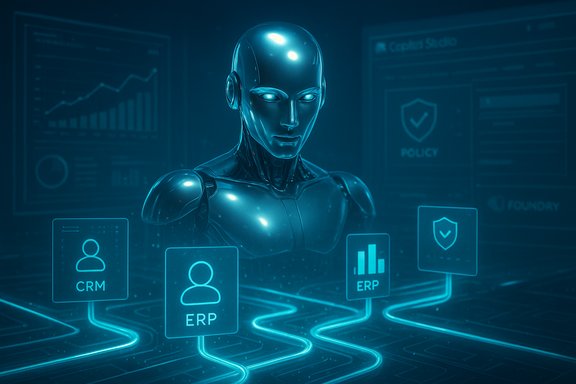
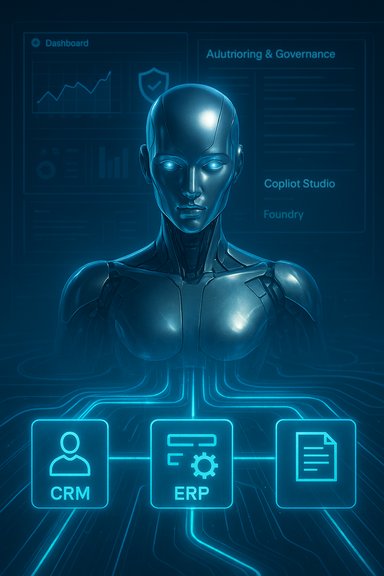
Microsoft’s recent product narrative reframes AI from helpful assistants to agents — autonomous or semi‑autonomous workers that plan, act, call tools, and produce auditable outcomes across apps and systems. Core elements of that architecture are Copilot Studio (authoring and low‑code/pro‑code tooling), Azure AI Foundry (model hosting, grounding and orchestration), and Agent 365 (tenant registry, identity and governance). These primitives aim to make agents manageable at scale by treating them as first‑class directory principals with identities, telemetry and lifecycle controls. This architectural shift is intended to lower the friction between experimentation and production, but it also creates a larger operational surface that IT teams must secure and govern.
Microsoft’s platform plays include:
Examples that resemble the vertical‑agent thesis:
(The AIRoute profile announces an interesting entrant to the vertical‑agent market; independent verification of customer wins, performance and security posture will be the next necessary step for organizations considering any production deployment.
Source: digitimes AIRoute Technology Reinvents Workflows Powered by Microsoft AI Agents
Source: digitimes AIRoute Technology Reinvents Workflows Powered by Microsoft AI Agents
 Background / Overview
Microsoft’s recent product narrative reframes AI from helpful assistants to agents — autonomous or semi‑autonomous workers that plan, act, call tools, and produce auditable outcomes across apps and systems. Core elements of that architecture are Copilot Studio (authoring and low‑code/pro‑code tooling), Azure AI Foundry (model hosting, grounding and orchestration), and Agent 365 (tenant registry, identity and governance). These primitives aim to make agents manageable at scale by treating them as first‑class directory principals with identities, telemetry and lifecycle controls. This architectural shift is intended to lower the friction between experimentation and production, but it also creates a larger operational surface that IT teams must secure and govern.Microsoft’s platform plays include:
- Low‑code authoring and templates (Copilot Studio) for rapid prototyping.
- A cloud runtime and model/router catalog (Azure AI Foundry) to select models by cost/latency/quality.
- A control plane (Agent 365) that inventories agents, assigns identities and enforces policies.
- Desktop runtime primitives such as Agent Workspace and “computer use” capabilities that let agents operate UI flows when no API exists.
What AIRoute claims — concise summary
According to the profile, AIRoute:- Is a US‑based AI startup focused on building vertical AI agents.
- Designs agents to deeply understand domain data, workflows and decision processes, not only to answer questions but to execute steps and produce decisions in context.
- Positions those vertical agents to plug into enterprise stacks — notably Microsoft’s agent ecosystem — and accelerate operational automation.
How vertical AI agents integrate with Microsoft’s stack
Authoring, grounding and runtime
Vertical agents succeed when three technical layers are combined:- Reasoning: LLMs and specialized models that craft plans and language.
- Grounding: A knowledge layer (dataverse/semantic indexes/foundry) that anchors agents to tenant data and reduces hallucinations.
- Action: Connectors, APIs and UI automation capabilities that let agents effect change in systems of record.
Identity, governance and observability
A critical operational expectation for any agent deployed to corporate tenants is identity and auditability. Microsoft’s Agent 365 and Entra identity model treat agents as directory objects, enabling:- Per‑agent identities with least‑privilege permissions,
- Tenant‑level registries and admin approval flows,
- Auditable telemetry routed into Purview / Sentinel for monitoring.
UI automation and the “computer use” capability
Where legacy systems have no API, agents can be made to operate through UI automation — simulating clicks, form fills, and navigation. This expands utility but increases brittleness and risk; UI automation needs robust error handling, replayability, and clear remediation pathways to be acceptable in production. Startups that offer vertical agents must either avoid fragile UI flows or provide hardened wrappers to reduce operational risk.Potential use cases and early customer signals
Vertical agents are best applied to workflows that are:- Multi‑step and cross‑system (e.g., contract intake → extract → validate → create ledger entries).
- Repetitive but knowledge‑intensive (e.g., claims triage, compliance checks).
- High‑volume with auditable outcomes (e.g., invoice processing, vendor onboarding).
Examples that resemble the vertical‑agent thesis:
- Sales or proposal generation pipelines where agents synthesize data from CRM, contract repositories and pricing rules to produce draft deliverables.
- Claims intake agents that extract structured fields from documents, apply business rules, and surface exceptions for human review.
- Manufacturing “ops” agents that analyze telemetry, surface anomalies and recommend corrective steps while keeping an audit trail.
Strengths: where AIRoute’s focus could deliver value
- Domain specialization reduces hallucination risk. Vertical agents that come pre‑trained or fine‑tuned on industry semantics can improve answer quality and decision relevance compared with generalist copilots. That domain grounding is a practical performance lever.
- Faster time to value. Packaging connectors, validation logic and templates for common vertical workflows shortens pilot cycles and increases the chance of reaching measurable ROI during early tests.
- Alignment with Microsoft enterprise primitives. By designing agents to run on Copilot Studio / Azure AI Foundry and to integrate with Agent 365 controls, AIRoute can fit into enterprise governance and security practices instead of creating shadow AI sprawl.
Risks and operational challenges
- Activation risk and the pilot‑to‑production gap. Industry research and independent reporting repeatedly show many agent pilots fail to scale without disciplined governance, clear KPIs and activation evidence. Enterprises must demand measurable activation, not vendor claims. This is a meaningful practical risk for startups promising rapid scale.
- Security and data protection. Agents with broad read/write access or UI automation capabilities increase the attack surface. Without strict least‑privilege, per‑agent identities, and robust telemetry, agents can become vectors for data leakage or misuse. Enterprises must integrate agents into existing DLP and identity controls.
- Operational complexity. Managing fleets of agents introduces lifecycle tasks — versioning, credential rotation, observability, remediation playbooks and cost control. These are non‑trivial operations problems that multiply as agent counts scale.
- Vendor concentration and lock‑in. Heavy integration with a single cloud and agent control plane simplifies operations short term but can create vendor entrenchment and migration hurdles later. Enterprises should assess portability and exportability of knowledge assets.
- UI automation brittleness. Where agents rely on “computer use” for systems without APIs, an app redesign or UI change can break automations. Production usage must include monitoring, rapid rollback and retraining.
Implementation checklist — making vertical agents production‑safe
- Define a narrow pilot KPI (e.g., reduce intake processing time by X% for a single workflow).
- Map the agent’s data grounding: identify the systems of record, sensitive fields, and retention rules.
- Require per‑agent Entra identities and assign least‑privilege permissions through Agent 365-style flows.
- Instrument observability: logs, telemetry, and Purview/Sentinel ingestion for alerts and audit.
- Establish human‑in‑the‑loop validation stations for high‑risk decisions.
- Harden UI automations (if any) with retries, screenshot captures, and structured fallbacks.
- Track cost and model routing: use Foundry’s model router or equivalent to manage inference spend.
- Run an external security review (red‑team) and a staged rollout with rollback playbooks.
Commercial and market considerations
- Pricing models: Microsoft and many vendors are using a pay‑as‑you‑go meter for agent interactions while also packaging subscription SKUs. That hybrid model favors startups that can demonstrate low activation cost and a clear ROI per interaction.
- Partner ecosystem: Systems integrators and platform partners are building vertical copilots in partnership with vendors and cloud providers; startups that bring domain IP can monetize via managed services, agent catalog placements or industry templates.
- Evidence requirements: Procurement teams will increasingly require activation evidence (measured KPIs) and security attestations — claims alone are not sufficient for enterprise procurement decisions. That’s an important commercial hurdle for newer entrants.
Critical analysis and verification notes
- The core proposition — vertical, domain‑aware agents that plug into Microsoft’s agent stack — is technically plausible and consistent with the current vendor landscape. Microsoft’s product primitives exist to host, ground, orchestrate and govern such agents.
- However, vendor statements about “deep understanding” and production readiness are marketing‑forward and require independent verification. There is a known pilot‑to‑production gap in agentic AI: many pilots show promise but fail to deliver sustained business value without strong governance, instrumentation and human‑in‑the‑loop validation. Readers should treat performance claims as provisional until corroborated by third‑party case studies or customer references.
- Any numbers or customer anecdotes presented without detailed metrics, audit logs or RPO/RTO evidence should be flagged as unverifiable. For AIRoute specifically, any funding, deployment scale, or customer ROI claims not accompanied by measurable KPIs have yet to be independently validated.
Practical recommendations for IT leaders evaluating AIRoute or similar vendors
- Pilot narrow and measure: start with a definable, auditable workflow and insist on quantitative KPIs.
- Demand governance integration: require agents to be registered, identity‑bound and observable via the tenant control plane.
- Require explicit SLAs for data handling, retention and incident response; insist on independent security testing.
- Verify portability: get commitments for data export, knowledge export and agent logic extraction to avoid future lock‑in.
- Balance automation with human oversight: configure deterministic validation stations and escalation rules for risky actions.
Conclusion
AIRoute Technology’s emphasis on vertical AI agents aligns with the direction enterprise AI is taking: move from generalist assistants toward domain‑specialized digital workers that can reliably execute workflows. Microsoft’s agent ecosystem supplies the plumbing — authoring, runtime, identity and governance — that makes such a product strategy sensible and commercially viable. That same plumbing is why enterprise teams must be cautious: agentic workflows increase attack surface area, operational complexity and vendor lock‑in risk if not deployed with disciplined governance and measurable activation plans. For IT leaders and procurement teams, the correct posture is measured optimism: validate activation with narrow KPIs, require integration with tenant governance, and treat vendor performance claims as provisional until independently proven in production.(The AIRoute profile announces an interesting entrant to the vertical‑agent market; independent verification of customer wins, performance and security posture will be the next necessary step for organizations considering any production deployment.
Source: digitimes AIRoute Technology Reinvents Workflows Powered by Microsoft AI Agents
Source: digitimes AIRoute Technology Reinvents Workflows Powered by Microsoft AI Agents
Attachments
Last edited:
