

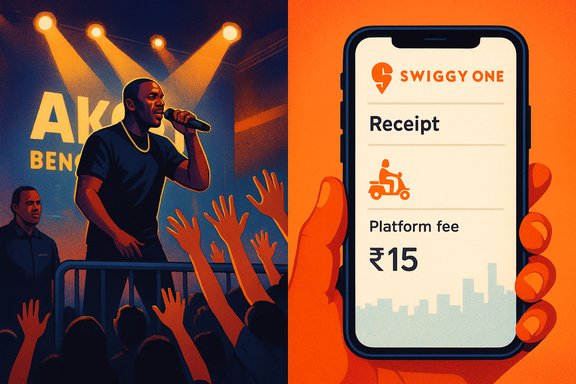
A viral clip from Akon’s Bengaluru stop — showing members of the front row repeatedly tugging at the singer’s trousers while he performed — and a separate corporate move by Swiggy to add a targeted fee on certain Swiggy One orders together illuminate two very different fault lines in modern India’s public life: how live events are policed (and who is responsible when crowd behaviour crosses the line), and how platform-driven commerce nudges costs, value and fairness between merchants, subscribers and casual users. Both stories were first reported in trade and breaking-news outlets and have since been amplified across social media and mainstream press; this feature pulls those strands together, verifies key facts against multiple independent accounts, and offers a practical, critical read for event managers, platform users, restaurants and regulators alike.
Live-music spectacle and platform commerce are both high-touch interactions: one depends on physical crowd management and social norms, the other on product design, pricing signals and economic incentives. The Akon incident — which unfolded during the Bengaluru leg of his India shows on November 14 — became widely shared after an Instagram clip showed fans in the VIP/barricade area pulling at the singer’s trousers while he continued performing. Major outlets documented the clip and the online backlash. Meanwhile, food-delivery platform decisions to shift per-order economics continue to make headlines in India’s fiercely competitive market. Storyboard18’s reporting on Swiggy’s plan flagged a discrete change: the company is introducing a new fee on certain Swiggy One orders for select restaurants — a move framed as surgical, targeted, and designed to protect margins while preserving subscription value for heavy users. That reporting sits alongside independent coverage showing platform fees have been rising selectively in recent months (platform fees to the order of ₹12–₹15 in some markets) as Swiggy and rivals rebalance subsidy regimes. This article takes each story in turn: summarising what happened, verifying specific claims with multiple sources, assessing the operational and reputational risks, and offering pragmatic recommendations for practitioners and consumers.
Source: Storyboard18 Akon’s Bengaluru concert draws criticism after fans pull at singer’s trousers on stage
Source: Storyboard18 Swiggy to introduce new fee on Swiggy One orders for select restaurants
 Background / Overview
Live-music spectacle and platform commerce are both high-touch interactions: one depends on physical crowd management and social norms, the other on product design, pricing signals and economic incentives. The Akon incident — which unfolded during the Bengaluru leg of his India shows on November 14 — became widely shared after an Instagram clip showed fans in the VIP/barricade area pulling at the singer’s trousers while he continued performing. Major outlets documented the clip and the online backlash. Meanwhile, food-delivery platform decisions to shift per-order economics continue to make headlines in India’s fiercely competitive market. Storyboard18’s reporting on Swiggy’s plan flagged a discrete change: the company is introducing a new fee on certain Swiggy One orders for select restaurants — a move framed as surgical, targeted, and designed to protect margins while preserving subscription value for heavy users. That reporting sits alongside independent coverage showing platform fees have been rising selectively in recent months (platform fees to the order of ₹12–₹15 in some markets) as Swiggy and rivals rebalance subsidy regimes. This article takes each story in turn: summarising what happened, verifying specific claims with multiple sources, assessing the operational and reputational risks, and offering pragmatic recommendations for practitioners and consumers.Akon in Bengaluru: what happened and why it matters
The incident, verified
On November 14, during Akon’s Bengaluru performance, a short video clip recorded by an attendee and shared on Instagram captured moments when the singer moved close to the VIP barrier and several audience members grabbed and pulled at his trousers. The visual record shows Akon repeatedly readjusting his clothing while continuing his set; the clip was reposted widely and became the focal point for public outrage about respect and safety at live events. Multiple reputable outlets reported the clip, described the viral reaction, and noted that Akon carried on with the tour schedule after the show.Two independent confirmations
- Indian Express reported the original Instagram post and the sequence of events, noting the clip’s author and the context (Akon performing his hit “Sexy Bitch” near the VIP section).
- NDTV and Hindustan Times independently covered the viral spread, the critical responses online, and emphasised that the singer continued performing despite the harassment.
Why this is more than an awkward video
The clip exposes layered problems common to modern stadium concerts:- Crowd management and VIP access control: VIP paddocks and front-row barriers are zones where artist–audience proximity is intentionally encouraged for spectacle. But that proximity requires robust stewarding and security protocols; when those controls fail, the artist becomes vulnerable to misconduct that crosses from enthusiastic interaction into harassment.
- Normalization of invasive behaviour: Some commentators treated the grabs as “fun” or “adoration,” but the clip prompted strong pushback precisely because the behaviour violated bodily autonomy and professional dignity. Public conflation of “fan enthusiasm” with entitlement to physical contact has reputational and legal consequences.
- Event logistics and promoter duty: Concert promoters, venue operators and security contractors bear legal and ethical duties to provide safe performance environments. When fans are permitted to enter physical space that allows repeated contact without intervening stewards, the event’s risk profile spikes.
- Diffusion of accountability on social platforms: The clip’s viral circulation forces the broader public to judge actions in near-real time, often before promoters or law enforcement have issued statements. That intensifies reputational fallout regardless of subsequent findings.
Strengths and limits of the reporting
Strengths: The video provides a direct, verifiable artefact of the incident and multiple independent outlets reproduced the same footage and eyewitness details — a strong base for factual reporting. Limitations and verification gaps: No authoritative report (police FIR, promoter statement or artist tweet) was immediately available in the coverage reviewed to confirm whether any formal complaint was filed, whether security staff were replaced or disciplined, or whether any attendee was ejected/arrested. Where a public statement is absent, treat operational claims about follow‑up action as unverified until the promoter or authorities publish details. Several high-profile local incidents in the past have shown that social outrage can accelerate formal responses; in this case, such a response had not been located in public reporting at the time of writing.Practical risks and recommendations for event professionals
- For promoters and venues:
- Tighten front-row stewarding: place multiple visible staff at VIP barriers and equip them with clear orders of escalation (verbal warnings → removal). Security presence must be trained specifically to prevent and de-escalate invasive crowd behaviours.
- Pre-event communication: issue explicit do-not-touch guidance for VIP zones as part of ticketing emails and on screens before artists step into proximity zones.
- Artist lines of retreat: design stage choreography with immediate withdrawal routes and protective zones when artists approach front rows.
- Incident documentation and transparency: publish a brief post-event statement when an incident escalates — acknowledging the incident, noting actions taken, and committing to corrective steps reduces reputational drift.
- For artists and managers:
- Contract security SLAs: include minimum stewarding ratios and a contractual right to pause the show if safety thresholds are exceeded.
- On-stage protocol: brief artists on safety options — a quick stop, a security escort — and empower them to call for a pause without commercial penalty.
- For attendees:
- Clear norms: recognise that close proximity does not imply consent; photography, touching and grabbing are not “fan love” but a choice that can cause harm.
Swiggy’s fee change: what Storyboard18 reported and how that fits the market
The reported change (Storyboard18)
Storyboard18’s item described Swiggy’s decision to introduce a new fee on Swiggy One orders for select restaurants, positioning the move as a targeted revenue-and-subsidy recalibration rather than a blanket price increase across all transactions. The piece framed the fee as part of a broader product segmentation: protect overall platform economics while keeping subscription value attractive for high-frequency users. The Storyboard18 report emphasised operational trade-offs and consumer-friction risks from visible per-order surcharges.Independent verification and context
Multiple independent industry outlets confirm that platform fees have been rising selectively across the Indian food-delivery market this year:- Economic Times and other business media documented Swiggy raising per-order platform fees in select markets to as much as ₹15 to protect unit economics as order volumes surged. The coverage places the adjustment in the context of prior increases and competitive pressure.
- Times of India and regional business pages reported similar platform-fee adjustments both by Swiggy and peer Zomato, noting that these changes are often selective (certain geographies, restaurant categories or order sizes) rather than uniform price hikes.
What the numbers mean (verification of key claims)
- The headline per-order platform fee numbers reported publicly in the last quarter cluster around ₹12–₹15 in regions with high demand and elevated last-mile costs. Multiple mainstream outlets documented the incremental fee moves and their timing. This places Storyboard18’s reporting in an accurate frame: the new fee is not an isolated rumor but one element of a measurable platform repricing trend.
- On attribution and causation: outlets consistently link the fee adjustments to a desire to protect margins as companies scale capital-intensive quick-commerce and promo-heavy campaigns. That causal reading is plausible and backed by public statements from industry analysts, investor commentary and prior earnings disclosures — but note: the precise internal P&L math and the exact margin contribution from the new fee remain company-internal figures and were not publicly disclosed in granular form at the time of reporting. Treat precise margin impact estimates as company-internal and therefore unverifiable from the outside without primary financial filings.
Operational and consumer implications
- Segmentation and perceived fairness: visible per-order fees tend to annoy casual, price-sensitive users more than subscribers. If Swiggy positions the fee as limited to certain restaurants or order types, it will likely drive a mix of behavioural responses: subscription conversions for heavy users and order drop-offs from light users.
- Merchant economics and contracts: merchants—especially small restaurants—must reconcile these per-order line items when reconciling receipts and settlements. More receipt complexity increases reconciliation effort and potential disputes. If the fee is collected by the platform (and not passed through to restaurants), restaurants still face the risk of reduced order volumes if customers react negatively.
- Regulatory and tax implications: platform fees are usually subject to GST and other local tax regimes; transparency in receipts and clear merchant settlement statements will be necessary to avoid compliance and reputational friction.
- Competitive response: new entrants and adjacent players (for example, Rapido’s reported food push and flat-fee strategies) may use simpler, low-fee models to target value-conscious segments — intensifying price competition. Reuters’ reporting on Rapido confirms that alternative pricing models are in the market.
Recommendations for stakeholders
- For Swiggy and platform product teams:
- Publish clear, in-context examples showing how the new fee affects typical bills (so customers can compare with and without subscription).
- Tie visible fee changes to immediate, customer-facing benefits (faster delivery SLAs, improved order accuracy guarantees) so the economics are explainable.
- Offer a temporary opt-out route for small merchants during the transition and automated reconciliation reports to reduce merchant friction.
- For restaurants:
- Monitor order volumes and cancellation rates closely after the fee roll-out; be prepared to adjust on‑platform pricing promotions or to negotiate placement with the platform if visibility or conversion drops.
- Keep accounts teams briefed and reconcile settlements weekly for the first two reporting cycles to catch any mismatches early.
- For consumers:
- Compare total order costs with and without Swiggy One subscription as the new fee may shift the breakeven point.
- If price-sensitive, shop the platform’s “value” formats (low-cost curated stores or targeted “Toing” offerings) until pricing stabilises.
Comparative analysis: spectacle safety vs. platform economics — shared governance lessons
Both stories reveal an important, shared theme: rapid scale — whether in audience size or platform transactions — exposes governance gaps that demand explicit mitigation.- Visibility compounds harm. A single viral clip (Akon) or a single visible line-item on a receipt (Swiggy fee) becomes the unit of public outrage. Both companies and event organisers must anticipate the reputational velocity of social media and design defensive transparency: clear policies, visible signage (for events) or explanation lines on receipts (for platforms).
- Accountability distribution matters. In the Akon case, the onus sits with promoters and venue security to prevent crowd intrusion; when they fail, the performer — though the visible victim — often bears reputational cost. In the Swiggy case, platform product designers make monetisation choices that shift costs to specific user segments; the perceived fairness of those choices determines brand trust. Institutional accountability (contracts, SLAs, and customer disclosures) should be designed preemptively.
- Operational playbooks reduce escalation. Both domains benefit from rehearsed, measurable responses:
- Events: a documented sequence for on-stage harassment (pause/announce/warn/remove/record) with named decision-makers.
- Platforms: a rollback threshold and customer protection fund for visible fee changes — including short-term refunds if UX or conversion shows clear negative signals.
Verification flags and claims that remain unconfirmed
- On the Akon item: independent outlets confirm the viral clip and the date (November 14). What remains unconfirmed in public reporting is whether the event promoter issued a formal disciplinary action against specific attendees, whether local police logged complaints, or whether any attendee was ejected and banned post-show. No definitive promoter or police statement was located in the reporting sampled; therefore any claim of formal enforcement should be treated as unverified until an official release appears.
- On the Swiggy fee: the exact restaurants, geographies and technical eligibility rules for the Swiggy One fee were described as "select" in Storyboard18’s report. Independent market reporting confirms selective platform-fee hikes in certain markets (e.g., platform-fee increases to ₹15 in parts of the country), but the precise per-restaurant eligibility rules are company product configurations and will only be final once the platform publishes its rollout matrix or a merchant bulletin — a detail that Storyboard18 flagged but that external outlets did not granularly reproduce. Treat fine-grained eligibility criteria as internal, product-level details pending official product documentation.
What readers should take away
- Public events need to treat security and crowd stewardship as essential creative infrastructure, not a peripheral cost. Spectacle without clear safety protocols invites incidents that can overshadow artistic programming and damage local reputations.
- Platforms must balance short-term margin moves with long-term trust: visible per-order fees can repair unit economics quickly but risk subscriber churn, competitor arbitrage and consumer ire if poorly communicated.
- In both domains, transparency is the cheapest insurance policy: clear pre-event rules and on-ticket warnings reduce boundary-pushing; clear in-app explanations, invoice breakdowns and temporary opt-out windows reduce consumer backlash.
- When virality happens, document, disclose, and commit to action. Rapid, human-centred responses (acknowledgement, plan, follow-up) limit reputational damage and restore stakeholder confidence.
Practical checklist: short actions each stakeholder can take now
- Event organisers:
- Audit front-row stewarding ratios and add roving security for VIP paddocks.
- Create a one‑paragraph incident-response script for staff and artists.
- Post a short code-of-conduct on event pages and ticket confirmations.
- Platforms (Swiggy-style):
- Publish a consumer-impact calculator showing how the fee affects average baskets.
- Issue a merchant FAQ and automated reconciliation CSV for affected restaurants.
- Monitor order elasticity for two full billing cycles and be ready to reverse or modulate fees where material churn occurs.
- Consumers:
- When ordering, compare total price including fees (not just item and delivery).
- If attending concerts, respect performer autonomy and report invasive behaviour to stewards immediately.
Conclusion
The two stories — Akon’s uncomfortable moment in Bengaluru and Swiggy’s incremental fee experiment — initially look unrelated, but they underline a shared managerial reality: modern public interactions are friction points where human behaviour, economic design and technological platforms meet. Both incidents were captured, amplified and judged instantly by millions online. The appropriate responses are not merely PR spin; they require operational changes that respect human dignity, clarify economic trade-offs, and rebuild trust with the people who make events and platforms function: audiences, customers, artists and merchants. Where spectacle meets stewardship and product design meets fairness, organisations that act decisively, transparently and humanely will be best placed to weather both viral controversy and economic recalibration.Source: Storyboard18 Akon’s Bengaluru concert draws criticism after fans pull at singer’s trousers on stage
Source: Storyboard18 Swiggy to introduce new fee on Swiggy One orders for select restaurants
