

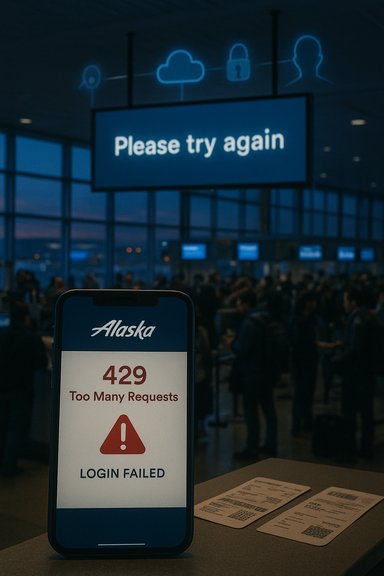
Alaska Airlines customers were locked out of their accounts on Tuesday morning after the carrier’s website and mobile app returned a rate-limit error when users tried to sign in, leaving many unable to book, change or view travel plans and forcing travelers to rely on airport counters for boarding passes.
Alaska Airlines has endured a string of high‑visibility technology disruptions this year, ranging from data‑center hardware failures that briefly grounded aircraft to large downstream outages tied to major cloud provider incidents. Those earlier incidents forced the carrier to hire outside consultants and undertake a formal review of its IT posture. The December 30 login failure adds a fresh, consumer‑facing episode to that pattern: this event primarily prevented users from authenticating to Alaska’s digital channels rather than grounding flights, but it aggravated already fragile customer confidence in the airline’s ability to run basic online services reliably.
However, those benefits come with tradeoffs:
The solution is not to abandon third‑party services — they are essential — but to pair them with stronger architectural partitioning, contractual accountability, and tested fallbacks. Practical measures include multi‑region, multi‑provider ingress; offline admin controls; and scheduled failover tests that exercise real‑world traffic patterns. These practices limit the blast radius of vendor incidents and give operators deterministic ways to recover when the cloud misbehaves.
Alaska Airlines has already acknowledged the issue and is working to restore access; for the airline to turn this episode into a long‑term advantage it must translate short‑term triage into enduring, measurable improvements — and demonstrate them publicly. Until then, travelers and frontline staff will bear the consequences of another digital outage, and every missed check‑in will be another data point in the growing case for resilience‑first design across the industry.
Source: Tri-City Herald https://www.tri-cityherald.com/news/business/article314059521.html
 Background
Alaska Airlines has endured a string of high‑visibility technology disruptions this year, ranging from data‑center hardware failures that briefly grounded aircraft to large downstream outages tied to major cloud provider incidents. Those earlier incidents forced the carrier to hire outside consultants and undertake a formal review of its IT posture. The December 30 login failure adds a fresh, consumer‑facing episode to that pattern: this event primarily prevented users from authenticating to Alaska’s digital channels rather than grounding flights, but it aggravated already fragile customer confidence in the airline’s ability to run basic online services reliably. What happened on Tuesday morning
Early reports began accumulating on social channels and outage trackers as customers tried — and failed — to sign into the Alaska Airlines app and website. The visible symptom was an interrupting message that read, in plain language, that the application had hit a usage threshold and to “retry after a few minutes.” Many users saw an HTTP 429‑style rate‑limit response or an Auth0 style message that matched known vendor rate‑limit wording. Alaska acknowledged the problem on its X account and said IT teams were investigating while advising travelers who did not already have boarding passes to arrive early and obtain passes at airport counters. Local reports noted the outage affected login and booking functions but did not immediately stop aircraft from operating out of the affected regional airports. Passenger threads on forums and Reddit showed intermittent patterns: some customers could intermittently access accounts while others remained blocked for hours, and many reported fallback behavior at airports (paper boarding passes and manual check‑ins) rather than flight cancellations. Those firsthand accounts matched public reporting and outage timelines.The error: rate limiting, 429s, and authentication vendors
The message users saw — “It seems this application has become very popular, and its available rate limit has been reached. Please retry after a few minutes” — is consistent with an upstream authentication or API gateway returning a 429 (Too Many Requests) response. In modern cloud‑native stacks, identity platforms or third‑party authentication services (for example, Auth0/Okta) commonly respond with this language when configured rate limits are exceeded. Public vendor community threads show identical wording used by authentication services when they enforce protective thresholds. Rate limiting is a standard defensive control to prevent abuse, credential stuffing, brute‑force attacks or runaway automated traffic. But when a critical, high‑volume endpoint like a carrier’s sign‑in flow is fronted by a vendor‑managed rate limiter that isn’t sized or configured for peak load or operational contingency, legitimate customer traffic can be blocked. That’s precisely the class of failure modern enterprises must plan for: protection meant to keep attackers out ends up keeping customers out.Why this incident matters beyond the login screen
Alaska’s online sign‑in is not a cosmetic function: it’s the gateway to bookings, check‑in, boarding passes, loyalty redemptions, special‑service requests and often to ancillary purchases. When those flows fail, the operational response pivots from fast, automated customer processing to slow, manual fallback procedures at airport counters and call centers. Manual processing reduces throughput and increases the risk of errors, missed connections and costs tied to re‑accommodation and overtime. Tuesday’s outage was reported as primarily digital in impact, but even a web‑only failure can magnify passenger friction across gates and contact centers. This is not hypothetical: earlier in the same cycle, Alaska experienced incidents that did affect flight operations — a data‑center hardware failure and a downstream cloud‑edge misconfiguration at a major hyperscaler — and the operational ripple effects were material. Those earlier incidents show how quickly IT fragility can escalate from an online inconvenience into a mass disruption when timing and dependencies align.Anatomy of the problem: vendor dependencies and single points of failure
Three technical realities explain how a login‑only event can produce widespread pain:- Third‑party identity providers sit on the critical path. Many firms outsource single sign‑on (SSO) and authentication to specialist vendors. That reduces internal burden but places a high‑frequency, mission‑critical API into a vendor contract and configuration envelope. If the vendor applies conservative rate limits, has a regional capacity problem, or receives a spike in automated traffic, legitimate sign‑ins can be throttled.
- Edge and management plane failures can cascade. Past incidents in which Azure Front Door (a global edge routing and application delivery platform) suffered a control‑plane misconfiguration demonstrate how a provider’s deployment or rollout can ripple into many tenant apps at once. When control planes or global ingress services fail, they block traffic before it reaches otherwise healthy back‑end services. Alaska was previously affected by such an event, which reduced access to websites and apps while recovery work proceeded at the cloud provider.
- Rate limits are operational knobs, not magic fixes. A rate limit that protects an API during abuse must be tuned, instrumented and paired with a tested fallback. If that fallback is absent, or if the only fallback requires reconfiguration at the vendor portal — itself inaccessible during an outage — operators are left without practical options. Public vendor forums show this exact behavior: when passwordless or token endpoints are rate‑limited, customers see the same messaging passengers reported on Tuesday.
Strengths and tradeoffs in Alaska’s current architecture
There’s a reason airlines use cloud vendors and third‑party identity providers: scale, security features, and faster time to market for consumer features like 2FA, federated identity and OAuth‑based session flows. Offloading auth to a specialist improves security posture when done with proper guardrails.However, those benefits come with tradeoffs:
- Benefit: Operational elasticity and security features — cloud providers and identity vendors offer global footprint and hardened controls that would be expensive to replicate in‑house. These platforms accelerate features and reduce internal maintenance.
- Tradeoff: Concentration risk and opaque control planes — when a few cloud or identity services sit in front of many critical flows, misconfigurations, capacity constraints, or control‑plane errors at the vendor create outsized blast radii. That was visible when a global edge provider’s configuration error affected multiple large customers simultaneously.
What this means for travelers — practical, immediate steps
Passengers impacted by a login failure should assume that digital self‑service may be degraded and prepare to rely on non‑digital paths. Practical actions include:- Save or print a boarding pass immediately when possible.
- Bring booking confirmation emails or reservation codes to the airport.
- Arrive earlier than usual to allow time for manual check‑in at counters or kiosks.
- Capture screenshots of loyalty balances and itineraries when the app is working.
- Use confirmation codes for web check‑in if credentialed login fails.
What Alaska (and similarly situated carriers) should do now
Repeated incidents create both public trust risk and regulatory attention. To rebuild resilience and customer confidence, the following actions are essential and technically practicable:- Implement multi‑path authentication and ingress: ensure that sign‑in and critical APIs are reachable through alternate routes or providers and that failover can be triggered automatically.
- Negotiate SLAs and runbook access with identity vendors: ensure that emergency reconfiguration and out‑of‑band admin access are contractually guaranteed and practically usable during an incident.
- Size rate limits for peak, not average, demand: protect against credential abuse with behavior analytics and adaptive throttling instead of blunt, static caps that block legitimate traffic during spikes.
- Test fallbacks in live drills: run tabletop and live failover tests that simulate vendor outages so staff know how to switch to manual and semi‑automated modes.
- Inventory and decouple critical dependencies: map the critical path for every end‑user flow (booking, check‑in, boarding pass issuance) and ensure each path has at least one independent method to complete it.
- Invest in observability and chaos engineering: instrument dependencies so that degradations are visible well before customers notice, and practice controlled fault injection to validate recovery.
Governance, investor and regulatory implications
Investors and regulators watch operational reliability closely because airline operations are tight choreography: staff, aircraft, crew scheduling and customer flows all depend on predictable IT systems. Past outages produced immediate market reactions and investor scrutiny, and the clustering of incidents raises questions at the board level about risk management and capital allocation for IT modernization. Public reporting of the earlier fleet groundings and cloud‑edge disruptions documented material passenger impacts and prompted Alaska to hire external consultants; regulators have also flagged the potential for increased oversight when technological fragility affects passenger movement at scale. From a governance perspective, the board and audit committee should demand a vendor‑dependency inventory, measurable remediation milestones, and a customer‑incident communication plan.透明, auditable reporting of root‑cause analyses — including vendor post‑incident reviews — will be necessary to restore confidence.The broader industry lesson: cloud convenience demands disciplined resilience
Airlines and other consumer‑facing industries have benefited tremendously from outsourcing to hyperscalers and specialized SaaS vendors. That convenience, however, concentrates systemic risk: a single configuration error in a global edge fabric or a poorly tuned rate limit on an authentication endpoint can take millions of customers offline in minutes.The solution is not to abandon third‑party services — they are essential — but to pair them with stronger architectural partitioning, contractual accountability, and tested fallbacks. Practical measures include multi‑region, multi‑provider ingress; offline admin controls; and scheduled failover tests that exercise real‑world traffic patterns. These practices limit the blast radius of vendor incidents and give operators deterministic ways to recover when the cloud misbehaves.
Strengths and shortfalls of potential fixes
- Strength: Redundancy and multi‑provider architectures reduce single‑vendor concentration risk and make outages less likely to fully block customer flows.
- Weakness: Multi‑provider complexity increases operational overhead, and poorly tested failover logic can create race conditions that worsen outages.
- Strength: Strong SLAs and post‑incident commitment from vendors create contractual levers for remediation and compensation, and encourage better vendor engineering.
- Weakness: SLAs rarely compensate for reputational harm or the operational complexity of manual re‑accommodation — they buy accountability, not immunity.
How customers — and IT teams — should evaluate progress
Customers will judge progress by three practical measures: fewer outages, faster incident‑to‑fix times, and fewer operational escalations that force mass manual processing. For IT teams and executives, measurable progress should include:- Documented dependency maps and testable alternate paths for critical flows.
- Regularly scheduled failover and chaos‑engineering exercises with demonstrated successful recovery times.
- Vendor contract changes that provide for emergency admin access and stronger SLAs around control‑plane changes.
- Observable reductions in 429‑style throttle incidents in production telemetry and in customer‑facing outage volumes.
Conclusion
Tuesday’s outage was, at face value, a login problem that inconvenienced customers and forced manual workarounds at airports. But it is also a symptom of a larger challenge facing modern airlines: how to extract the operational efficiencies of cloud and SaaS platforms while insulating mission‑critical customer and operational flows from vendor missteps and capacity limits. The fix demands disciplined engineering, contractual muscle, and a willingness to invest in redundancy and testing.Alaska Airlines has already acknowledged the issue and is working to restore access; for the airline to turn this episode into a long‑term advantage it must translate short‑term triage into enduring, measurable improvements — and demonstrate them publicly. Until then, travelers and frontline staff will bear the consequences of another digital outage, and every missed check‑in will be another data point in the growing case for resilience‑first design across the industry.
Source: Tri-City Herald https://www.tri-cityherald.com/news/business/article314059521.html
