UAE-based Alef Education and TMRW Edtech signed a memorandum of understanding during the Education World Forum in London in May 2026 to explore an AI-powered education ecosystem for schools, governments, and large institutions across the GCC and wider MENA region. The announcement is not just another edtech partnership dressed in artificial-intelligence language; it is a bet that the next phase of school digitization will be won by platforms that merge learning, administration, data, and cloud infrastructure. For WindowsForum readers, the interesting part is the Microsoft-native framing: Azure, Dynamics 365, and Copilot are being positioned not as back-office utilities, but as the operating substrate for an education system. That makes this deal less about a single classroom app and more about who gets to define the control plane for AI-era schooling.
For the past decade, education technology has largely been sold in slices. One system handled attendance, another hosted learning content, another tracked assessments, another managed payroll or procurement, and yet another promised analytics dashboards for administrators. The result was familiar to anyone who has worked in enterprise IT: a thicket of portals, integrations, exports, permissions models, and half-finished digital transformation programs.
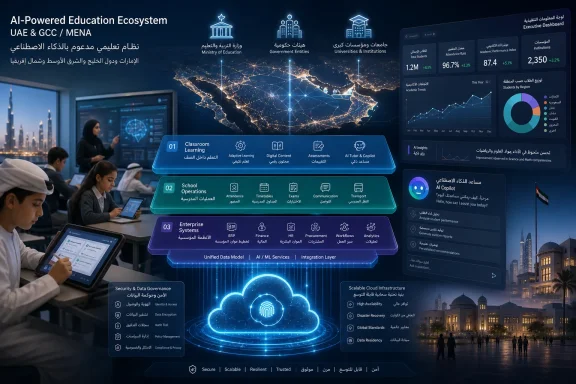
Alef Education and TMRW Edtech are pitching something more ambitious. Alef brings AI-driven learning systems and adaptive educational content; TMRW brings school management and enterprise resource planning capabilities. The promised endpoint is a unified digital ecosystem that connects what happens in the classroom with what happens in the institution.
That matters because the biggest problem in education software has rarely been the absence of tools. It has been the inability of those tools to speak a common operational language. A student’s learning gaps, a teacher’s workload, a school’s timetable, a ministry’s reporting requirements, and a finance department’s resource planning all sit in different systems, even though they describe the same institution.
The partnership’s central claim is that AI can only become useful at scale when it has access to both pedagogical and operational context. A chatbot bolted onto a lesson plan is a novelty. A system that can understand curriculum progress, attendance patterns, intervention history, staffing capacity, parental communications, and procurement constraints is something closer to infrastructure.
That is why the phrase “ecosystem” deserves scrutiny. In vendor language, it can mean little more than a bundle. In practice, an ecosystem becomes consequential when it changes procurement, governance, workflows, and data ownership. Alef and TMRW appear to be aiming for the latter.
That positioning is shrewd. Ministries of education, private school groups, and national transformation programs do not buy technology the way individual teachers adopt apps. They worry about identity, auditability, procurement controls, data residency, security, reporting, service continuity, and vendor viability. A platform built on Microsoft’s cloud stack enters those conversations with a familiar vocabulary.
Dynamics 365 points to the administrative layer: student records, admissions, finance, human resources, procurement, customer-style engagement, and case management. Azure supplies the cloud infrastructure, security tooling, analytics foundation, and AI services. Copilot gives the platform a productivity and assistant layer that administrators, teachers, and support staff may already recognize from Microsoft 365.
This does not automatically make the system better. It does make it easier to sell into institutions already standardized around Microsoft identity, productivity, and cloud services. That is a major advantage in the GCC and MENA markets, where public-sector modernization programs often prefer large, supportable platforms over fragmented software portfolios.
For Microsoft, deals like this also serve a broader strategic purpose. The company has spent years turning its cloud from a general-purpose platform into a vertical-industry engine. Healthcare, finance, retail, manufacturing, and government each have their own flavor of cloud transformation. Education is now receiving the same treatment, with AI used as both catalyst and justification.
Alef’s existing pitch revolves around personalized learning, adaptive assessments, data-informed teaching, and AI-supported pathways. These are education-specific functions. TMRW’s pitch is broader and more operational: school management, enterprise resource planning, workflow automation, and institution-scale administration. The partnership makes sense because each side fills the other’s blind spot.
Learning platforms often struggle to escape the classroom. They can recommend content, generate insights, and help teachers intervene, but they may not control the surrounding institutional machinery. ERP and school management systems, meanwhile, can run the institution but often sit at a distance from the learning process itself. They know who is enrolled, who paid fees, who is absent, and who is assigned to which class; they may not know whether the student is actually mastering fractions or reading comprehension.
The promise of this collaboration is to collapse that distance. If done well, a government or school network could see learning outcomes and operational capacity in the same frame. If done poorly, it could become another dashboard that displays more data than anyone can act on.
This is where the AI rhetoric needs discipline. Schools do not need generative models simply because generative models exist. They need systems that reduce administrative load, identify students who need help, support teachers without deskilling them, and give leaders reliable evidence for decisions. AI is useful only to the extent that it improves those workflows.
That makes the region attractive for Alef Education, which is already rooted in the UAE and has positioned itself as a government-facing education technology provider. It also makes the region demanding. Selling into this market means dealing with Arabic and English language needs, national curricula, ministry reporting requirements, public procurement processes, data residency expectations, and a wide range of school operating models.
A Microsoft-native platform may help with some of those requirements, especially when institutions already trust Microsoft for identity, productivity, compliance, and cloud operations. But local execution will matter more than global architecture diagrams. Education systems are not merely data systems; they are political, cultural, and pedagogical systems.
The MENA opportunity also comes with uneven infrastructure. Some institutions are cloud-ready, well-funded, and technically mature. Others are still trying to rationalize legacy systems, inconsistent connectivity, and paper-heavy workflows. A platform that works only for flagship schools will struggle to become regional infrastructure.
Alef and TMRW will therefore need to prove modularity. Governments and school groups rarely move all at once. They pilot, phase, integrate, localize, and renegotiate. The winning platform will be the one that can start small without becoming trapped in pilot purgatory.
That distinction matters because edtech history is crowded with announcements that sounded transformational and later dissolved into limited pilots. Education buyers are cautious for good reasons. A failed school software rollout can disrupt timetables, frustrate teachers, expose sensitive student data, and consume public money with little visible learning benefit.
The companies say they will explore joint go-to-market opportunities in government-led and institutional education sectors. That phrasing suggests the next phase will be commercial validation: which ministries, school networks, or large institutions want the combined proposition; how it will be packaged; and what degree of integration is technically and contractually feasible.
The real test will not be whether Alef and TMRW can produce an impressive architecture slide. It will be whether they can deliver a coherent implementation path. That means migration tools, integration connectors, localized curriculum support, teacher training, administrator onboarding, data governance policies, security controls, and measurable outcomes.
A platform that promises to connect learning and operations also inherits the risk of both. If the learning model disappoints, schools will blame the platform. If the ERP implementation drags, schools will blame the platform. If the AI assistant makes dubious recommendations, schools will blame the platform. Integration multiplies value, but it also concentrates accountability.
Education generates sensitive, longitudinal, highly personal data. Attendance, grades, behavioral notes, learning difficulties, family communications, health accommodations, language proficiency, teacher feedback, payment records, and intervention history can all become part of a student’s institutional profile. When such data is connected across systems, it becomes more useful — and more risky.
For administrators, unified data can reveal patterns that fragmented systems obscure. Chronic absenteeism may correlate with learning decline. Timetable pressure may affect teacher performance. Procurement delays may influence access to digital resources. Ministry officials may see whether interventions are working across regions rather than relying on end-of-term reporting.
For students and families, however, the same data can feel like surveillance if governance is weak. AI systems can label, rank, predict, and recommend. Those functions must be transparent enough for educators to challenge and restrained enough to avoid turning children into permanent risk scores.
This is where Microsoft’s enterprise cloud architecture may reassure buyers, but it cannot settle the policy questions. Security controls are necessary, but they are not the same as educational ethics. Encryption does not decide whether a prediction should be shown to a teacher, a parent, a principal, or a ministry official. Role-based access does not decide how long a student’s AI-generated profile should follow them.
Alef and TMRW will need a strong answer to data governance if they want the partnership to be more than a regional sales motion. The system’s credibility will depend on who owns the data, how models are trained or tuned, whether institutions can audit recommendations, and how errors are corrected.
A unified platform could genuinely reduce burden. If lesson insights, attendance, assessment data, parent communication, student support workflows, and administrative reporting live in one place, teachers may spend less time duplicating entries across systems. Copilot-style assistants could summarize progress, draft communications, generate differentiated materials, or surface students who need intervention.
But the danger is equally obvious. AI systems can create a new layer of performative administration, where teachers must review machine-generated recommendations, justify why they ignored them, and feed the platform with more structured data than the old process required. In that scenario, AI becomes not an assistant but a supervisor.
The strongest implementations will treat teachers as professional users, not data-entry endpoints. That means giving them control over recommendations, making AI outputs explainable, and designing workflows around classroom realities. A platform that optimizes for executive dashboards while neglecting teacher experience will eventually encounter resistance.
There is also the question of pedagogical trust. Personalized learning can help students practice at the right level, but it can also narrow education into measurable micro-skills. Schools need systems that support teacher judgment, not systems that quietly redefine learning as whatever the software can track.
Governments want improved outcomes, operational efficiency, equity, workforce readiness, and evidence that public money is producing results. Vendors sell platforms, modules, dashboards, and transformation roadmaps. The gap between those two languages is where many projects falter.
Alef’s advantage is that it already speaks the language of outcomes and public-sector partnership. Its messaging emphasizes AI-powered personalized learning, institutional impact, and government collaboration. TMRW’s advantage is that it speaks the language of system operations: ERP, school management, workflow, and Microsoft-based architecture.
Together, they can offer a more complete story. The question is whether the story remains coherent once it encounters procurement rules, legacy databases, national curriculum requirements, union concerns, parental expectations, and budget cycles.
Governments should insist on measurable milestones. Not vague AI adoption goals, but concrete indicators: reduced administrative duplication, faster reporting cycles, improved intervention timing, teacher workload reduction, better attendance tracking, and credible learning gains. If the platform cannot be evaluated beyond adoption numbers, it will become another digital transformation trophy.
The same pattern has played out in customer relationship management, human resources, security operations, healthcare records, and developer tooling. First come point solutions. Then come platforms. Then comes the fight over who controls the data model, identity layer, workflow engine, and AI interface.
Education is now entering that phase. The institution that once bought a learning app may soon be asked to buy an education operating environment. That has benefits: fewer silos, stronger governance, and better analytics. It also has risks: vendor lock-in, procurement concentration, and a reduced ability for smaller specialist tools to compete.
Microsoft’s role amplifies both sides. Schools and ministries already using Microsoft 365, Entra ID, Teams, SharePoint, Power BI, or Azure may find a Microsoft-native education platform easier to adopt and manage. But the deeper the integration, the more difficult it becomes to switch later.
That is not an argument against the partnership. It is an argument for disciplined architecture. Open standards, exportable data, clear APIs, and contractual protections matter more in a unified platform than in a standalone app. When a system becomes institutional infrastructure, exit strategy is part of responsible adoption.
Most of the value will come from plumbing. Data normalization, identity management, workflow automation, secure cloud deployment, reporting pipelines, and human-in-the-loop review will determine whether AI systems are helpful or chaotic. The glamorous front end depends on a boring back end.
That is why the Alef-TMRW deal is worth watching. It is not promising a single AI tutor or a standalone chatbot. It is pointing toward a platform model in which AI is embedded across teaching, learning, administration, and institutional decision-making.
The risk is that “AI-powered” becomes a gloss over conventional software consolidation. If the system merely wraps existing ERP and learning tools in Copilot branding, it will not change much. If it genuinely connects educational signals with operational workflows in a way that teachers and administrators trust, it could become a template for regional edtech modernization.
The difference will be visible in implementation. Real AI transformation should shorten feedback loops, reduce redundant work, and improve decisions. Cosmetic AI transformation will produce demos, dashboards, and procurement headlines.
Procurement gravity favors large, integrated vendors because they appear safer. A Microsoft-native platform backed by established regional and education-focused companies will be attractive to decision-makers who want scale and accountability. But procurement gravity can also pull institutions toward oversized systems that are difficult to customize and slow to deploy.
Alef and TMRW will need to avoid the classic enterprise trap: selling a national vision and delivering a multi-year configuration project. Education leaders have limited patience for systems that require schools to reorganize themselves around software. The best platforms adapt to institutional complexity without surrendering to it.
There is also a competitive dimension. Other cloud providers, learning management systems, student information systems, and AI education startups are circling the same opportunity. The winners will not simply be the companies with the most advanced models. They will be the ones that can navigate trust, localization, procurement, training, and long-term support.
The MoU gives Alef and TMRW permission to explore that path together. It does not guarantee they will complete it.
The Alef-TMRW partnership should be read as a marker of where institutional education software is headed: away from isolated classroom tools and toward cloud-native, AI-assisted operating environments that promise to connect learning, administration, and policy. That future could make schools more responsive, teachers better supported, and governments more capable of seeing what actually works. It could also centralize sensitive student data and deepen dependency on a small number of platform providers. The next phase will be decided not by the elegance of the announcement, but by whether Alef, TMRW, Microsoft, and their prospective customers can turn AI ambition into governed, useful, and humane educational infrastructure.
 The Classroom App Is Giving Way to the Education Stack
For the past decade, education technology has largely been sold in slices. One system handled attendance, another hosted learning content, another tracked assessments, another managed payroll or procurement, and yet another promised analytics dashboards for administrators. The result was familiar to anyone who has worked in enterprise IT: a thicket of portals, integrations, exports, permissions models, and half-finished digital transformation programs.Alef Education and TMRW Edtech are pitching something more ambitious. Alef brings AI-driven learning systems and adaptive educational content; TMRW brings school management and enterprise resource planning capabilities. The promised endpoint is a unified digital ecosystem that connects what happens in the classroom with what happens in the institution.
That matters because the biggest problem in education software has rarely been the absence of tools. It has been the inability of those tools to speak a common operational language. A student’s learning gaps, a teacher’s workload, a school’s timetable, a ministry’s reporting requirements, and a finance department’s resource planning all sit in different systems, even though they describe the same institution.
The partnership’s central claim is that AI can only become useful at scale when it has access to both pedagogical and operational context. A chatbot bolted onto a lesson plan is a novelty. A system that can understand curriculum progress, attendance patterns, intervention history, staffing capacity, parental communications, and procurement constraints is something closer to infrastructure.
That is why the phrase “ecosystem” deserves scrutiny. In vendor language, it can mean little more than a bundle. In practice, an ecosystem becomes consequential when it changes procurement, governance, workflows, and data ownership. Alef and TMRW appear to be aiming for the latter.
Microsoft Is the Quiet Third Player in the Room
The companies’ decision to frame the platform around Microsoft technologies is the most revealing part of the announcement. Azure, Dynamics 365, and Copilot are not incidental brand names here. They tell governments and large education providers that this is meant to look and behave like enterprise software, not a classroom experiment.That positioning is shrewd. Ministries of education, private school groups, and national transformation programs do not buy technology the way individual teachers adopt apps. They worry about identity, auditability, procurement controls, data residency, security, reporting, service continuity, and vendor viability. A platform built on Microsoft’s cloud stack enters those conversations with a familiar vocabulary.
Dynamics 365 points to the administrative layer: student records, admissions, finance, human resources, procurement, customer-style engagement, and case management. Azure supplies the cloud infrastructure, security tooling, analytics foundation, and AI services. Copilot gives the platform a productivity and assistant layer that administrators, teachers, and support staff may already recognize from Microsoft 365.
This does not automatically make the system better. It does make it easier to sell into institutions already standardized around Microsoft identity, productivity, and cloud services. That is a major advantage in the GCC and MENA markets, where public-sector modernization programs often prefer large, supportable platforms over fragmented software portfolios.
For Microsoft, deals like this also serve a broader strategic purpose. The company has spent years turning its cloud from a general-purpose platform into a vertical-industry engine. Healthcare, finance, retail, manufacturing, and government each have their own flavor of cloud transformation. Education is now receiving the same treatment, with AI used as both catalyst and justification.
AI Is the Hook, but Integration Is the Product
The announcement speaks the language of AI-powered learning, and that is understandable. AI is the term that attracts boardroom attention, budget flexibility, and political urgency. But the more durable product is integration.Alef’s existing pitch revolves around personalized learning, adaptive assessments, data-informed teaching, and AI-supported pathways. These are education-specific functions. TMRW’s pitch is broader and more operational: school management, enterprise resource planning, workflow automation, and institution-scale administration. The partnership makes sense because each side fills the other’s blind spot.
Learning platforms often struggle to escape the classroom. They can recommend content, generate insights, and help teachers intervene, but they may not control the surrounding institutional machinery. ERP and school management systems, meanwhile, can run the institution but often sit at a distance from the learning process itself. They know who is enrolled, who paid fees, who is absent, and who is assigned to which class; they may not know whether the student is actually mastering fractions or reading comprehension.
The promise of this collaboration is to collapse that distance. If done well, a government or school network could see learning outcomes and operational capacity in the same frame. If done poorly, it could become another dashboard that displays more data than anyone can act on.
This is where the AI rhetoric needs discipline. Schools do not need generative models simply because generative models exist. They need systems that reduce administrative load, identify students who need help, support teachers without deskilling them, and give leaders reliable evidence for decisions. AI is useful only to the extent that it improves those workflows.
The GCC and MENA Are Not Just Expansion Markets
The geographic focus is important. The GCC and wider MENA region are not being treated as passive buyers of imported edtech. They are increasingly test beds for national-scale education modernization, multilingual learning tools, AI governance experiments, and public-private technology partnerships.That makes the region attractive for Alef Education, which is already rooted in the UAE and has positioned itself as a government-facing education technology provider. It also makes the region demanding. Selling into this market means dealing with Arabic and English language needs, national curricula, ministry reporting requirements, public procurement processes, data residency expectations, and a wide range of school operating models.
A Microsoft-native platform may help with some of those requirements, especially when institutions already trust Microsoft for identity, productivity, compliance, and cloud operations. But local execution will matter more than global architecture diagrams. Education systems are not merely data systems; they are political, cultural, and pedagogical systems.
The MENA opportunity also comes with uneven infrastructure. Some institutions are cloud-ready, well-funded, and technically mature. Others are still trying to rationalize legacy systems, inconsistent connectivity, and paper-heavy workflows. A platform that works only for flagship schools will struggle to become regional infrastructure.
Alef and TMRW will therefore need to prove modularity. Governments and school groups rarely move all at once. They pilot, phase, integrate, localize, and renegotiate. The winning platform will be the one that can start small without becoming trapped in pilot purgatory.
The MoU Is a Signal, Not a Product Launch
It is worth slowing down on the nature of the agreement. A memorandum of understanding is not a finished product, a binding rollout, or proof that a market has been won. It is a formal expression of intent to explore collaboration, identify joint opportunities, and work toward a strategic alignment.That distinction matters because edtech history is crowded with announcements that sounded transformational and later dissolved into limited pilots. Education buyers are cautious for good reasons. A failed school software rollout can disrupt timetables, frustrate teachers, expose sensitive student data, and consume public money with little visible learning benefit.
The companies say they will explore joint go-to-market opportunities in government-led and institutional education sectors. That phrasing suggests the next phase will be commercial validation: which ministries, school networks, or large institutions want the combined proposition; how it will be packaged; and what degree of integration is technically and contractually feasible.
The real test will not be whether Alef and TMRW can produce an impressive architecture slide. It will be whether they can deliver a coherent implementation path. That means migration tools, integration connectors, localized curriculum support, teacher training, administrator onboarding, data governance policies, security controls, and measurable outcomes.
A platform that promises to connect learning and operations also inherits the risk of both. If the learning model disappoints, schools will blame the platform. If the ERP implementation drags, schools will blame the platform. If the AI assistant makes dubious recommendations, schools will blame the platform. Integration multiplies value, but it also concentrates accountability.
The Data Layer Is Where the Real Power Accumulates
The most consequential part of an AI-powered education ecosystem is not the interface. It is the data layer beneath it.Education generates sensitive, longitudinal, highly personal data. Attendance, grades, behavioral notes, learning difficulties, family communications, health accommodations, language proficiency, teacher feedback, payment records, and intervention history can all become part of a student’s institutional profile. When such data is connected across systems, it becomes more useful — and more risky.
For administrators, unified data can reveal patterns that fragmented systems obscure. Chronic absenteeism may correlate with learning decline. Timetable pressure may affect teacher performance. Procurement delays may influence access to digital resources. Ministry officials may see whether interventions are working across regions rather than relying on end-of-term reporting.
For students and families, however, the same data can feel like surveillance if governance is weak. AI systems can label, rank, predict, and recommend. Those functions must be transparent enough for educators to challenge and restrained enough to avoid turning children into permanent risk scores.
This is where Microsoft’s enterprise cloud architecture may reassure buyers, but it cannot settle the policy questions. Security controls are necessary, but they are not the same as educational ethics. Encryption does not decide whether a prediction should be shown to a teacher, a parent, a principal, or a ministry official. Role-based access does not decide how long a student’s AI-generated profile should follow them.
Alef and TMRW will need a strong answer to data governance if they want the partnership to be more than a regional sales motion. The system’s credibility will depend on who owns the data, how models are trained or tuned, whether institutions can audit recommendations, and how errors are corrected.
Teachers Will Judge the Platform by the Work It Removes
Every education technology company says it helps teachers. Teachers, having heard this before, tend to judge by a simpler metric: does it remove work or add work?A unified platform could genuinely reduce burden. If lesson insights, attendance, assessment data, parent communication, student support workflows, and administrative reporting live in one place, teachers may spend less time duplicating entries across systems. Copilot-style assistants could summarize progress, draft communications, generate differentiated materials, or surface students who need intervention.
But the danger is equally obvious. AI systems can create a new layer of performative administration, where teachers must review machine-generated recommendations, justify why they ignored them, and feed the platform with more structured data than the old process required. In that scenario, AI becomes not an assistant but a supervisor.
The strongest implementations will treat teachers as professional users, not data-entry endpoints. That means giving them control over recommendations, making AI outputs explainable, and designing workflows around classroom realities. A platform that optimizes for executive dashboards while neglecting teacher experience will eventually encounter resistance.
There is also the question of pedagogical trust. Personalized learning can help students practice at the right level, but it can also narrow education into measurable micro-skills. Schools need systems that support teacher judgment, not systems that quietly redefine learning as whatever the software can track.
Governments Want Outcomes, but Vendors Sell Platforms
The partnership’s government-facing ambitions are unsurprising. National and regional education systems are the biggest prize in edtech because they offer scale, legitimacy, and long-term contracts. They are also the hardest customers to satisfy.Governments want improved outcomes, operational efficiency, equity, workforce readiness, and evidence that public money is producing results. Vendors sell platforms, modules, dashboards, and transformation roadmaps. The gap between those two languages is where many projects falter.
Alef’s advantage is that it already speaks the language of outcomes and public-sector partnership. Its messaging emphasizes AI-powered personalized learning, institutional impact, and government collaboration. TMRW’s advantage is that it speaks the language of system operations: ERP, school management, workflow, and Microsoft-based architecture.
Together, they can offer a more complete story. The question is whether the story remains coherent once it encounters procurement rules, legacy databases, national curriculum requirements, union concerns, parental expectations, and budget cycles.
Governments should insist on measurable milestones. Not vague AI adoption goals, but concrete indicators: reduced administrative duplication, faster reporting cycles, improved intervention timing, teacher workload reduction, better attendance tracking, and credible learning gains. If the platform cannot be evaluated beyond adoption numbers, it will become another digital transformation trophy.
Windows Shops Should See the Familiar Enterprise Pattern
For IT professionals, the Alef-TMRW announcement follows a familiar enterprise pattern. A fragmented application category matures, buyers demand integration, cloud hyperscalers become the default infrastructure, and AI arrives as the accelerant that makes consolidation sound urgent.The same pattern has played out in customer relationship management, human resources, security operations, healthcare records, and developer tooling. First come point solutions. Then come platforms. Then comes the fight over who controls the data model, identity layer, workflow engine, and AI interface.
Education is now entering that phase. The institution that once bought a learning app may soon be asked to buy an education operating environment. That has benefits: fewer silos, stronger governance, and better analytics. It also has risks: vendor lock-in, procurement concentration, and a reduced ability for smaller specialist tools to compete.
Microsoft’s role amplifies both sides. Schools and ministries already using Microsoft 365, Entra ID, Teams, SharePoint, Power BI, or Azure may find a Microsoft-native education platform easier to adopt and manage. But the deeper the integration, the more difficult it becomes to switch later.
That is not an argument against the partnership. It is an argument for disciplined architecture. Open standards, exportable data, clear APIs, and contractual protections matter more in a unified platform than in a standalone app. When a system becomes institutional infrastructure, exit strategy is part of responsible adoption.
AI in Education Needs Less Magic and More Plumbing
The public conversation around AI in schools often swings between utopia and panic. One side imagines perfectly personalized tutors for every child. The other imagines plagiarism machines, surveillance classrooms, biased predictions, and teachers displaced by automation. The reality will be more mundane and more consequential.Most of the value will come from plumbing. Data normalization, identity management, workflow automation, secure cloud deployment, reporting pipelines, and human-in-the-loop review will determine whether AI systems are helpful or chaotic. The glamorous front end depends on a boring back end.
That is why the Alef-TMRW deal is worth watching. It is not promising a single AI tutor or a standalone chatbot. It is pointing toward a platform model in which AI is embedded across teaching, learning, administration, and institutional decision-making.
The risk is that “AI-powered” becomes a gloss over conventional software consolidation. If the system merely wraps existing ERP and learning tools in Copilot branding, it will not change much. If it genuinely connects educational signals with operational workflows in a way that teachers and administrators trust, it could become a template for regional edtech modernization.
The difference will be visible in implementation. Real AI transformation should shorten feedback loops, reduce redundant work, and improve decisions. Cosmetic AI transformation will produce demos, dashboards, and procurement headlines.
The Deal’s Real Test Will Be Procurement Gravity
The partnership arrives at a moment when education buyers are under pressure to modernize but also under pressure to prove restraint. AI enthusiasm is high, but so is skepticism. Budgets are finite, cybersecurity concerns are rising, and public institutions are increasingly aware that digital platforms can create dependencies that last for decades.Procurement gravity favors large, integrated vendors because they appear safer. A Microsoft-native platform backed by established regional and education-focused companies will be attractive to decision-makers who want scale and accountability. But procurement gravity can also pull institutions toward oversized systems that are difficult to customize and slow to deploy.
Alef and TMRW will need to avoid the classic enterprise trap: selling a national vision and delivering a multi-year configuration project. Education leaders have limited patience for systems that require schools to reorganize themselves around software. The best platforms adapt to institutional complexity without surrendering to it.
There is also a competitive dimension. Other cloud providers, learning management systems, student information systems, and AI education startups are circling the same opportunity. The winners will not simply be the companies with the most advanced models. They will be the ones that can navigate trust, localization, procurement, training, and long-term support.
The MoU gives Alef and TMRW permission to explore that path together. It does not guarantee they will complete it.
The Fine Print Behind the AI Education Cloud
The concrete implications of the partnership are narrower than the rhetoric but still significant. This is the stage where schools, ministries, and IT teams should separate what has been announced from what has merely been implied.- Alef Education and TMRW Edtech have signed an MoU, which signals strategic intent rather than a completed product rollout.
- The collaboration is aimed at GCC and MENA education markets, especially governments, large institutions, and school systems with enterprise-scale needs.
- The proposed platform is expected to combine Alef’s AI-driven learning technologies with TMRW’s school management and ERP systems.
- Microsoft Azure, Dynamics 365, and Copilot are being positioned as the foundation for a Microsoft-native education platform.
- The most important unresolved issues are implementation scope, data governance, localization, teacher workflow impact, and measurable educational outcomes.
- The partnership’s success will depend less on AI branding than on whether the combined system reduces fragmentation without creating a new form of platform lock-in.
The Alef-TMRW partnership should be read as a marker of where institutional education software is headed: away from isolated classroom tools and toward cloud-native, AI-assisted operating environments that promise to connect learning, administration, and policy. That future could make schools more responsive, teachers better supported, and governments more capable of seeing what actually works. It could also centralize sensitive student data and deepen dependency on a small number of platform providers. The next phase will be decided not by the elegance of the announcement, but by whether Alef, TMRW, Microsoft, and their prospective customers can turn AI ambition into governed, useful, and humane educational infrastructure.
References
- Primary source: CairoScene
Published: 2026-05-24T10:30:08.090660

Alef Education & TMRW Edtech Partner on AI Powered Education Ecosystem
The partnership will explore AI-powered education systems across GCC and MENA markets.cairoscene.com - Related coverage: tmrw.education

tmrw | AI Education Platform for Smarter Learning Outcomes
Discover tmrw - the AI-first education platform that unifies systems, simplifies complexity, and empowers educators worldwide. tmrw.education
- Related coverage: techafricanews.com

Alef Education and TMRW Edtech Partner to Launch AI-Powered Education Ecosystem - TechAfrica News
The two education innovators have signed a Memorandum of Understanding (MoU) to explore a strategic collaboration aimed at delivering a new generation of AI-powered education solutions across key markets in the GCC and MENA region. techafricanews.com
- Related coverage: en.arageek.com

Alef Education and TMRW Edtech Forge AI-Powered School Ecosystem Partnership - Arageek
Alef Education and TMRW Edtech have signed a Memorandum of Understanding to explore a strategic partnership en.arageek.com
- Related coverage: tmrw.io

TMRW Education and Learning Software
Create interactive learning experiences with Genesis, our AI-powered builder. Launch your learning universe with Cosmos. No code required. Start free today. tmrw.io
- Related coverage: annualreport.alefeducation.com
Our Journey | Alef Education Integrated Annual Report 2025
Alef Education Integrated Annual Report 2025 | One Platform. Ready for the World.annualreport.alefeducation.com
- Related coverage: tradingview.com

ZAWYA: Alef Education and TMRW Edtech join forces to reimagine future of AI-powered education across GCC and MENA
Abu Dhabi, Alef Education, a UAE-based global leader in education technology, and TMRW Edtech have joined forces to redefine the future of schooling through advanced AI-driven innovation. The two education innovators have signed a Memorandum of Understanding (MoU) to explore a strategic collaborati…www.tradingview.com
- Related coverage: businesswire.com
- Related coverage: ir.alefeducation.com
- Related coverage: smartannualreport.com