

Amazon’s 2025 stumble looks less like a long-term problem and more like a reset: the company closed the year with renewed momentum in cloud computing, meaningful margin improvement in retail, and a string of infrastructure and customer deals that position it to be a stronger earnings story in 2026. Investors who wrote off Amazon after middling returns in 2025 should be re-evaluating the balance of durable growth (AWS and advertising), structural margin tailwinds (robotics and logistics), and one-off capital investments that will shape the company’s trajectory over the next 12 months.
Amazon today is three things at massive scale: the world’s largest public cloud provider (AWS), the world’s largest e-commerce retailer, and an increasingly profitable advertising and media company sitting on top of an enormous logistics and robotics engine. Each of those pillars has a different growth profile, margin characteristic, and capital intensity — which complicates headline valuation comparisons but also creates multiple levers for upside.
The most important developments that will determine where Amazon is one year from now are:
AWS’s re-acceleration has three practical implications:
On the supply side, AWS has publicly said it is accelerating capital expenditures to close capacity gaps. That capex spending pressures free cash flow in the near term but is a necessary input for meeting the surge in AI demand. The trade-off is classic: spend now to capture high-margin, recurring cloud revenue later.
Key margin tailwinds:
Advertisers are increasingly using Amazon’s AI tools to create and target campaigns, and Prime Video’s ad-supported audience and other content assets add new inventory for marketers. That mix increases average monetization per active user and injects outsized margin improvements into the overall business.
DeepFleet — Amazon’s internal generative-AI model for robot coordination — acts like a traffic manager for the fleet, cutting average travel time and congestion in fulfillment centers. The company reports measurable percentage improvements in robot travel efficiency attributable to DeepFleet. At Amazon’s scale, even single-digit percentage gains translate into material operating-cost reductions.
Today’s forward price-to-earnings multiple for Amazon sits in the high‑20s to low‑30s range depending on the data provider and the date. By contrast, leading retail peers trade at higher forward multiples in some cases and lower in others; Walmart and Costco’s forward P/E multiples vary by provider but are not identical to the “40x” illustrative multiple sometimes used in commentary.
If investors become comfortable that:
Source: The Globe and Mail Where Will Amazon Be in 1 Year?
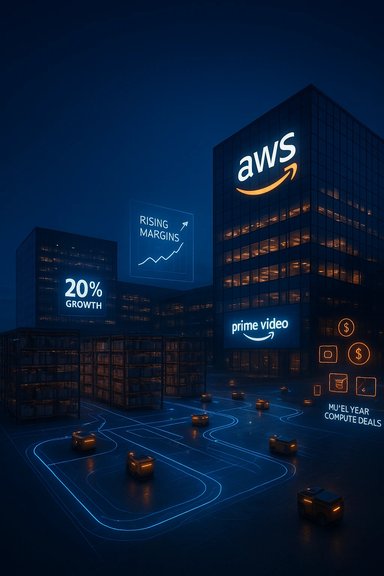 Background / Overview
Amazon today is three things at massive scale: the world’s largest public cloud provider (AWS), the world’s largest e-commerce retailer, and an increasingly profitable advertising and media company sitting on top of an enormous logistics and robotics engine. Each of those pillars has a different growth profile, margin characteristic, and capital intensity — which complicates headline valuation comparisons but also creates multiple levers for upside.The most important developments that will determine where Amazon is one year from now are:
- Whether AWS continues to re-accelerate revenue growth as AI infrastructure demand expands.
- Whether Amazon sustains and deepens retail operating leverage as ad monetization and robotics cut unit costs.
- How the company’s outsized capex program winds into recurring revenue growth and margin expansion.
- How the market rerates Amazon’s multiple as earnings visibility improves.
AWS: From infrastructure laggard to AI-scale contender
Re-acceleration and the economics of scale
Amazon Web Services (AWS) remains the company’s crown jewel for profitability and long-term free cash flow generation. After several quarters of slower growth relative to its cloud rivals, AWS re-accelerated to about 20% year-over-year revenue growth in the most recent quarter. That rate is still below the extraordinary growth rates of Microsoft Azure and Google Cloud for the same period, but it marks an important inflection: AWS is now growing faster than it was earlier in the year and showing tangible benefits from its renewed capacity investments.AWS’s re-acceleration has three practical implications:
- A 20%+ growth rate on an already-giant revenue base translates into very large incremental dollars of revenue and operating income.
- The unit economics of cloud — where incremental margin can be substantial once capital is productive — allow AWS to convert much of that growth into disproportionate operating income.
- Continued acceleration would materially change investor perception: at scale, even modest percentage acceleration produces sizable absolute profit upside.
Custom silicon, Bedrock, SageMaker and agentic AI
AWS’s advantage is not just scale; it is also an expanding stack of proprietary and differentiated assets:- Custom silicon (Trainium for training and Inferentia for inference) gives AWS optionality on cost-per-token economics versus GPU-only stacks.
- An AI software stack — Bedrock for model deployment, SageMaker for model development, and an increasing emphasis on agentic solutions — makes AWS sticky to enterprise customers.
- Large, exclusive or semi‑exclusive compute agreements and purpose-built data center projects (including multi‑gigawatt capacity buildouts) indicate that AWS is serious about matching demand for frontier AI workloads.
Big customer deals and capacity strategy
A crucial turning point was the emergence of multi‑year compute agreements with large AI labs and service providers. In the past year Amazon has signed very large cloud commitments with major AI developers, reflecting a shift toward multi‑year capacity contracts in AI. Those deals do two things: they provide predictable revenue and they justify the incremental capital Amazon is committing to its cloud infrastructure.On the supply side, AWS has publicly said it is accelerating capital expenditures to close capacity gaps. That capex spending pressures free cash flow in the near term but is a necessary input for meeting the surge in AI demand. The trade-off is classic: spend now to capture high-margin, recurring cloud revenue later.
E-commerce, advertising and operating leverage
Retail’s margin story: the quiet improvement
Amazon’s retail business is huge in sales but thin in per-dollar margins. What’s changed — and what matters for a 12‑month outlook — is operating leverage. The company’s North America retail segment showed a notable increase in operating income in the most recent results, even after accounting for special charges. That points to meaningful cost efficiency gains from better inventory placement, faster delivery, and ongoing improvements in fulfillment productivity.Key margin tailwinds:
- Better inventory placement and routing reduce delivery miles and speed up delivery, which increases customer satisfaction and lowers per‑order logistics cost.
- Advertising and media monetization allows Amazon to extract higher-margin revenue on top of existing retail flows.
- Robotics and automation cut labor and handling costs on a per‑order basis as deployment scales.
Advertising: high-margin growth engine
Amazon’s advertising business has matured into a high-margin engine that complements retail. Advertising revenue is now a multi‑billion-dollar stream and has been growing at strong double-digit rates. Because ad revenue carries much higher gross margins than physical goods, incremental ad dollars flow more directly to operating income.Advertisers are increasingly using Amazon’s AI tools to create and target campaigns, and Prime Video’s ad-supported audience and other content assets add new inventory for marketers. That mix increases average monetization per active user and injects outsized margin improvements into the overall business.
Robotics, DeepFleet and the logistics moat
One million robots and an AI orchestration layer
Amazon has now deployed more than one million robots across its fulfillment network. The company’s robotics program is not anecdotal — it is a systemic productivity strategy. Robots are not a simple capital replacement; they change the shape of the fulfillment network, enabling higher throughput in smaller footprints and supporting faster delivery options.DeepFleet — Amazon’s internal generative-AI model for robot coordination — acts like a traffic manager for the fleet, cutting average travel time and congestion in fulfillment centers. The company reports measurable percentage improvements in robot travel efficiency attributable to DeepFleet. At Amazon’s scale, even single-digit percentage gains translate into material operating-cost reductions.
What robots actually buy Amazon
Robotics and AI in fulfillment deliver multiple benefits:- Lower per‑order labor costs and fewer human lifting and repetitive tasks.
- Ability to store more SKUs closer to customers, shortening delivery times.
- Reduced delivery error rates and faster throughput that supports higher sales volumes with the same or slightly higher fixed costs.
Valuation: is Amazon attractively priced for 2026 outcomes?
Multiples, math and market psychology
Amazon’s valuation is a compound of very different businesses — high-margin AWS, low-margin retail, and fast-growing, high-margin advertising. That mix can make simple peer comparisons misleading, but they’re still useful for framing potential upside.Today’s forward price-to-earnings multiple for Amazon sits in the high‑20s to low‑30s range depending on the data provider and the date. By contrast, leading retail peers trade at higher forward multiples in some cases and lower in others; Walmart and Costco’s forward P/E multiples vary by provider but are not identical to the “40x” illustrative multiple sometimes used in commentary.
If investors become comfortable that:
- AWS can sustain or accelerate growth above the recent 20% pace,
- Retail operating income continues to climb through advertising and robotics,
then a re‑rating of the multiple is plausible. The math is straightforward: a modest multiple expansion from the current forward P/E into the mid‑30s or 40s (assuming realized earnings growth) could produce mid‑to‑high‑teens to low‑30s percentage upside in the stock over a 12‑month period.
A simple sensitivity framework
- Estimate forward EPS using current market price and published forward P/E: this yields an implied earnings baseline.
- Project 12‑month EPS under a reasonable acceleration scenario for AWS and modest retail margin improvement.
- Apply conservative, base-case, and optimistic multiples to that EPS to build a range of target prices.
Risks and what could go wrong
Capacity and capital risk
Amazon is pouring capital into cloud and logistics infrastructure. If demand for AI compute softens, or if competitors win important multi‑year customers, that capex could look less productive and depress free cash flow for longer than expected. The timing of capex turning into sustainable, high-margin revenue is therefore a material execution risk.Competitive intensity in cloud AI
Microsoft and Google have shown faster headline growth in recent quarters, and both have proprietary AI models, custom chips, and large enterprise relationships. AWS has technical advantages in custom silicon and enterprise tooling, but switching dynamics and the pace at which customers consolidate with one cloud provider create ongoing competitive pressure.Regulatory, legal and macro uncertainty
Amazon faces regulatory and legal headwinds that can create one‑time charges or ongoing restrictions. Additionally, macro slowdowns that reduce consumer spending would disproportionately affect Amazon’s lower-margin retail business, while sustained inflation could raise logistics costs despite automation gains.Execution risk on robotics and AI
Deploying robotics at scale is complex. Supply chain issues, reliability challenges, or suboptimal integration with human workflows could slow expected productivity gains. Similarly, AI models like DeepFleet require quality data and continuous retraining; errors, safety incidents, or failed deployments could undermine operational benefits.Where might the stock be in one year?
Baseline view: modest re‑rating if execution holds
If AWS continues to grow at or above 20% and retail operating leverage persists — driven by advertising and robotics — Amazon’s operating income could expand meaningfully in 2026. Combined with a reasonable multiple expansion as earnings become more visible and less lumpy, a mid‑teens to low‑30s percent upside from current price levels into year‑end 2026 is a defensible base-case scenario.Bull case: AI-driven re-acceleration and a structural rerate
In a bull case where AWS growth accelerates meaningfully (driven by broader adoption of Trainium-backed capacity and major multi‑year deals), and advertising growth continues above current levels, Amazon could deliver materially higher incremental operating income. Under that outcome, a re‑rating into a multiple comparable with high‑growth retail or large-cap cloud peers could drive 30%+ upside or more over 12 months.Bear case: capital missteps and slower end-market adoption
If AWS capex outpaces demand, or if customers consolidate more tightly with Microsoft or Google, Amazon’s growth and margin story could disappoint. Combined with macro weakness in retail, that outcome could result in a flat or down year for the stock.Practical takeaways for investors
- Amazon remains a diversified growth-and-profit engine. AWS’s re‑acceleration, expanding ad revenue, and logistics automation together create multiple, compounding sources of operating leverage that can support faster earnings growth in 2026.
- Valuation is reasonable but not a free lunch. The stock trades at a forward multiple that embeds positive improvement but still leaves room for re‑rating if AWS and retail margins inflect.
- Watch the leading indicators closely:
- AWS revenue growth rate and bookings/backlog dynamics.
- Advertising revenue growth and monetization metrics.
- Robotics efficiency gains and fulfillment throughput improvements.
- Capital expenditure guidance and the pace at which new capacity comes online.
- Scenario planning is essential. Investors should construct target-range scenarios (base, bull, bear) using explicit EPS and multiple assumptions to avoid anchoring on single-point price targets.
Conclusion
Where Amazon will be in one year hinges on a small set of high‑leverage variables: the trajectory of AWS’s AI-driven revenue growth, the pace at which robotics and logistics automation translate into retail margin expansion, and whether recent large compute deals convert that promise into durable, high‑margin cloud revenue. The company’s public results and investments show the pieces are in place for a stronger 2026; the challenge is timing and execution. For long-term investors, Amazon today represents a mix of investment-grade structural advantages and executional risks — a combination that often rewards those who can model scenarios, remain patient, and allocate capital with measured conviction.Source: The Globe and Mail Where Will Amazon Be in 1 Year?
