

Amazon’s multi‑year bankroll for Spanish data centers has just stepped into truly historic territory: Spanish press reported a fresh, €18.0 billion top‑up to Amazon Web Services’ previously announced plan, bringing the company’s cumulative commitment in Spain to roughly €33.7 billion through the end of the decade — a sum that would rank among the largest single‑country cloud infrastructure investments in European history.
For readers tracking the hyperscaler rush into Europe, this is the latest and largest chapter in a story that began more than a decade ago. AWS first launched an infrastructure region in Spain in 2022 and expanded that commitment in 2024 with a public pledge of €15.7 billion to grow the AWS Europe (Spain) Region and related projects; that earlier pledge included detailed estimates on jobs, GDP impact and renewable energy sourcing.
The new figure — reported on the opening day of Mobile World Congress (MWC) 2026 in Barcelona — describes an additional investment of €18.0 billion that, if confirmed by Amazon in an official release, would raise AWS’s total Spain commitment to €33.7 billion through a long‑range horizon (reports cite through 2035). Spanish national and regional officials have framed the development as transformational for Aragón, Zaragoza and the southern‑European data center footprint.
At the same time, the move is unmistakably part of a continent‑wide capital expenditure surge by hyperscalers that is being driven by generative AI workloads, the skyrocketing demand for GPU capacity, and the need for new high‑power, low‑latency campuses capable of housing next‑generation AI infrastructure. Industry research and regional press have been tracking a broader pipeline of projects in Spain and Aragón valued at tens of billions, indicating Spain has emerged as one of Europe’s most attractive data‑center corridors.
Local reporting has highlighted ambitious follow‑on projects in Aragón — from new campuses to server‑reuse facilities and even server refurbishment factories — that would multiply the region’s data‑center power capacity and create both construction and long‑term technical jobs. Municipal and regional leaders have framed these developments as a generational economic opportunity.
Key local considerations:
However, environmentalists and investigative reporting groups caution that renewable‑matching and “water‑positive” claims do not eliminate local resource pressures. Data center cooling and ancillary infrastructure can place heavy demands on local water and grid capacity — impacts that are local and immediate, even when the electricity is contracted from renewable projects that may sit elsewhere on the grid. Investigations and watchdog reporting have already raised alarms about water stress in drought‑prone regions that are receiving new hyperscale projects. Those concerns are particularly acute in semi‑arid parts of Spain where water allocation and agricultural usage are politically sensitive.
What to watch in AWS’s sustainability delivery:
That said, readers should treat the aggregate €33.7 billion figure with cautious attention to confirmation: Amazon’s corporate channels documented the earlier €15.7 billion program and the Spain region commitments in depth, but independent verification via a matching Amazon press release or securities filing is the responsible next step before treating the new cumulative sum as final corporate guidance. Meanwhile, regional policymakers, environmental groups and enterprise customers will be watching implementation details closely — because the way these huge investments are built will determine whether they end up as long‑term engines of industry and jobs, or as flashpoints in debates over resource allocation and corporate influence.
Source: The Tech Buzz https://www.techbuzz.ai/articles/amazon-commits-33-7b-to-spain-data-centers-in-ai-push/
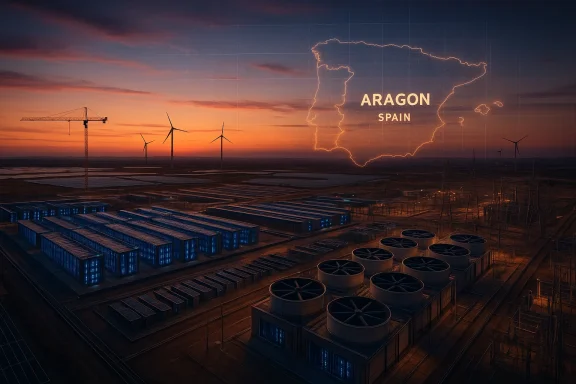 Background / Overview
For readers tracking the hyperscaler rush into Europe, this is the latest and largest chapter in a story that began more than a decade ago. AWS first launched an infrastructure region in Spain in 2022 and expanded that commitment in 2024 with a public pledge of €15.7 billion to grow the AWS Europe (Spain) Region and related projects; that earlier pledge included detailed estimates on jobs, GDP impact and renewable energy sourcing.The new figure — reported on the opening day of Mobile World Congress (MWC) 2026 in Barcelona — describes an additional investment of €18.0 billion that, if confirmed by Amazon in an official release, would raise AWS’s total Spain commitment to €33.7 billion through a long‑range horizon (reports cite through 2035). Spanish national and regional officials have framed the development as transformational for Aragón, Zaragoza and the southern‑European data center footprint.
At the same time, the move is unmistakably part of a continent‑wide capital expenditure surge by hyperscalers that is being driven by generative AI workloads, the skyrocketing demand for GPU capacity, and the need for new high‑power, low‑latency campuses capable of housing next‑generation AI infrastructure. Industry research and regional press have been tracking a broader pipeline of projects in Spain and Aragón valued at tens of billions, indicating Spain has emerged as one of Europe’s most attractive data‑center corridors.
What Amazon reportedly announced (the numbers and the framing)
- The fresh commitment is reported as €18.0 billion in additional capital to expand and modernize AWS data center campuses in Spain. That increases AWS’s publicly stated Spain commitment from the €15.7 billion previously announced to a cumulative €33.7 billion.
- The Spanish reporting links the announcement to AWS activity at MWC 2026 in Barcelona and frames the funds as aimed at expanding GPU‑heavy capacity, upgrading networking and power infrastructure, and otherwise future‑proofing facilities for large generative AI workloads.
- Officials cited in the coverage say the expanded program will support or maintain tens of thousands of local jobs and contribute materially to Spanish GDP over the life of the investment; the earlier €15.7 billion plan included AWS’s own estimates of roughly 17,500 annual full‑time–equivalent jobs and a multi‑billion euro boost to GDP. The new cumulative totals reported in press accounts suggest considerably larger economic impact figures if the increased commitment is realized.
Why this matters: the AI scaling imperative
Generative AI demands a qualitatively different footprint
Training and inference for large generative models change the economics and engineering of cloud infrastructure. AI workloads:- Require orders of magnitude more GPU compute and specialized XPU instances than typical web or enterprise applications.
- Drive demand for much denser networking and cooling ecosystems, and for power delivery measured in megawatts per campus rather than kilowatts per hall.
- Create new relationships with chip and subsystem suppliers (GPUs, custom accelerators, networking silicon), and produce long procurement lead times.
Europe is the strategic prize
For hyperscalers, Europe is both a big market and a regulatory patchwork that rewards local presence: proximity reduces latency for enterprise and public‑sector workloads, helps meet data‑sovereignty and procurement requirements, and improves resilience across national borders. Spain’s grid and renewable energy projects, plus logistical proximity to Southern Europe and North Africa, make it an attractive hub for additional capacity. The country’s Aragón region, with land availability and active local support, has become a focal point for multiple large projects.Regional footprint: Aragón and the local economy
AWS’s earlier €15.7 billion plan centered on Aragón (Zaragoza province), where existing AWS campuses already operate and where local governments have worked to create a data‑center friendly environment. Under that plan, AWS estimated support for approximately 17,500 FTE jobs annually (across the economy) and a substantial GDP contribution through 2033. The new, larger commitment would accelerate and expand those effects if implemented.Local reporting has highlighted ambitious follow‑on projects in Aragón — from new campuses to server‑reuse facilities and even server refurbishment factories — that would multiply the region’s data‑center power capacity and create both construction and long‑term technical jobs. Municipal and regional leaders have framed these developments as a generational economic opportunity.
Key local considerations:
- Short‑term: construction jobs, civil works, grid connection and substation work, and an expanded local supply chain.
- Medium/long‑term: facilities management, energy services, network engineering, and high‑skill roles tied to AI operations.
- Public‑policy leverage: regional authorities have used tax, permitting and workforce‑training incentives to attract hyperscaler investment.
Sustainability claims and the environmental debate
AWS and Amazon have long presented renewable energy commitments as central to their data‑center expansion narratives. The company has said it matches data‑center electricity use in Aragón with 100% renewable sources and has previously announced large renewable portfolios tied to its Spain operations. Those sustainability pledges are part of Amazon’s global Climate Pledge and net‑zero commitments.However, environmentalists and investigative reporting groups caution that renewable‑matching and “water‑positive” claims do not eliminate local resource pressures. Data center cooling and ancillary infrastructure can place heavy demands on local water and grid capacity — impacts that are local and immediate, even when the electricity is contracted from renewable projects that may sit elsewhere on the grid. Investigations and watchdog reporting have already raised alarms about water stress in drought‑prone regions that are receiving new hyperscale projects. Those concerns are particularly acute in semi‑arid parts of Spain where water allocation and agricultural usage are politically sensitive.
What to watch in AWS’s sustainability delivery:
- Whether contracted renewable projects are geographically and temporally aligned with the load (not just “power‑purchase offsets”).
- How AWS designs cooling systems to minimize fresh water use (air cooling, closed‑loop systems, or reuse of process water).
- Local grid reinforcements and how they allocate costs between hyperscalers, utilities and taxpayers.
Economic and strategic implications for Europe and hyperscaler competition
This commitment — if validated and implemented — reshapes several vectors:- Capacity lock‑in: A large AWS program in Spain secures GPU and rack space that competitors will find harder to match quickly, particularly for on‑prem‑adjacent and low‑latency European customers.
- Supplier leverage: Densely populated regional campuses create predictable demand for GPUs, custom accelerators and high‑bandwidth networking components, which changes supplier negotiations and capacity allocation for NVIDIA, AMD, Intel, and others.
- Regulatory and sovereignty dynamics: A bigger AWS physical presence strengthens arguments for negotiating technical sovereignty, local processing, and procurement frameworks with EU and member‑state governments.
- Market ripple effects: Local real‑estate markets, power project financing, and ancillary service providers (cooling, security, facility maintenance) all stand to gain and be reshaped. Industry research has already documented a broad pipeline of European data‑center projects that, combined, exceed multiple tens of billions of euros.
Risks, open questions, and points of verification
This announcement — and the coverage around it — raises as many questions as it answers. Responsible readers should note the following caveats.- Corporate confirmation and detail
- At the time of writing, Amazon’s public press portals detail the earlier €15.7 billion program and Spain region activity, but a stand‑alone Amazon press release matching a €33.7 billion cumulative figure (or the €18.0 billion incremental number) was not publicly posted to AWS’s official news pages. That makes independent confirmation essential before treating the full €33.7 billion as final corporate guidance.
- Execution risk and timeframe
- The headline numbers stretch across many years. Large infrastructure projects face common execution risks: grid connection delays, environmental permitting, community opposition, supply‑chain constraints for GPUs and semiconductor components, and shifts in corporate capex strategy. Amazon’s own public filings and earnings commentary in recent quarters have emphasized dramatically higher capex in 2026 as it scales AI investments, but long‑range projects still carry uncertainty.
- Local environmental and water impact
- Renewable‑energy contracts do not eliminate water or local ecological impacts. Investigative reporting has highlighted water stress in some host regions for hyperscale centers; local stakeholders, environmental groups, and regulators will likely scrutinize project permits and mitigation commitments tightly.
- Market concentration and regulatory scrutiny
- A dramatic buildout by a single hyperscaler can trigger broader policy scrutiny about market concentration, infrastructure control and the EU’s strategic posture on cloud sovereignty. European regulators have already been active in probing large cloud gatekeepers and in shaping rules like the Digital Markets Act; continued concentration may invite more formal market inquiries.
What the announcement means for enterprise IT and WindowsForum readers
For CIOs, cloud architects and procurement leads, the reported expansion has several practical implications:- Capacity planning: Enterprises building AI systems should anticipate increased local capacity for GPU instances in Europe over the coming years, which may reduce latency and procurement timelines. Plan for hybrid architectures that can take advantage of regionally available high‑performance instances.
- Procurement and contracts: Longer term, the availability of denser, nearby capacity could reshape cost‑models for training large models vs. using global burst capacity. Revisit long‑term cloud budget forecasts and vendor‑neutral multi‑cloud strategies where appropriate.
- Sustainability and risk management: Expect more due diligence requests from customers and regulators around local environmental mitigation, renewable sourcing specifics, and supply‑chain provenance for specialized hardware.
- Talent and supplier ecosystem: Local hiring, training and partner ecosystems will expand; organizations should consider partnerships with training programs tied to AWS initiatives and local universities.
- Revisit your AI roadmap with cloud‑capacity timelines in mind.
- Model cost and latency tradeoffs for Spain‑hosted instances vs. other EU regions.
- Engage procurement for multi‑year reserved‑instance or committed‑use negotiations as capacity comes online.
- Track sustainability reporting from AWS projects and align vendor due diligence with your organization’s ESG requirements.
Bigger picture: the hyperscaler arms race
This development is symptomatic of a global re‑scaling of cloud capex to meet AI needs. Industry trackers and forum discussions show the market reallocating investments toward regions offering suitable land, power and local political support. The scale and speed of these commitments place enormous strain on supply chains, energy grids and local planning institutions. Corporate earnings commentary and third‑party research point to a continued, intense capital spending cycle across the largest cloud providers as they vye for AI leadership.Conclusion
Amazon’s move in Spain — reported as an additional €18.0 billion on top of a previous €15.7 billion pledge, for a total of €33.7 billion — would, if fully validated and executed, be a watershed moment for European cloud infrastructure. The scope ties together the major trends reshaping enterprise IT: AI‑driven demand for GPU capacity, hyperscale long‑term capital commitments, and the interplay of sustainability and local resource constraints.That said, readers should treat the aggregate €33.7 billion figure with cautious attention to confirmation: Amazon’s corporate channels documented the earlier €15.7 billion program and the Spain region commitments in depth, but independent verification via a matching Amazon press release or securities filing is the responsible next step before treating the new cumulative sum as final corporate guidance. Meanwhile, regional policymakers, environmental groups and enterprise customers will be watching implementation details closely — because the way these huge investments are built will determine whether they end up as long‑term engines of industry and jobs, or as flashpoints in debates over resource allocation and corporate influence.
Source: The Tech Buzz https://www.techbuzz.ai/articles/amazon-commits-33-7b-to-spain-data-centers-in-ai-push/
