

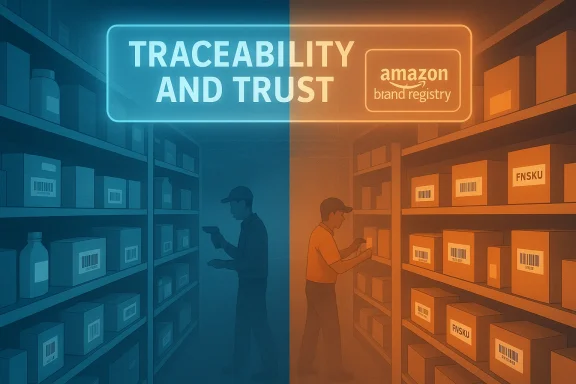
Amazon is ending a quietly consequential beack‑end practice that has existed for years: starting March 31, 2026, Amazon will stop “commingling” identical SKUs across sellers in its fulfillment network, and will require stricter barcode and labeling rules that split inventory along seller and brand lines—an operational pivot aimed at restoring traceability and trust, but one that will reshape logistics, costs, and marketplace power dynamics for millions of sellers and buyers.
Commingling—also spelled “co‑mingling”—was a logistical shortcut that let Amazon fulfill customer orders from the closest identical unit in its warehouses, regardless of which seller actually supplied that physical unit. The system improved delivery speed and lowered storage movement, because identical products (same manufacturer barcode) could be pooled and treated interchangeably. That efficiency, however, came with a downside: when a problem arose (defective units, counterfeit goods, or quality complaints), tracing responsibility back to a single seller was often impossible. Amazon’s official notice says that because many sellers now keep inventory closer to end customers, the original speed benefit is less important, so the company can return to seller‑specific inventory tracking. The practical rules Amazon announced are straightforward but consequential:
But the change also signals an underlying shift: platforms are increasingly optimizing for traceability and brand accountability, even when that comes at the cost of operational convenience for some sellers. For consumers who prioritize safety and provenance—particularly in categories like cosmetics, supplements, and electronics—that is likely a positive tradeoff. For smaller sellers operating on thin margins and relying on porous inventory rules to scale, it is a structural headwind that will require investment or business‑model pivots.
Sellers should act now: audit SKUs, evaluate Brand Registry status, and plan labeling workflows before March 31, 2026. Buyers will likely see benefits in trust and authenticity, though some users could notice small perf or price differences in edge cases. Regulators and seller advocacy groups will watch whether the change meaningfully tilts the marketplace structure; the debate over platform neutrality and seller equity is likely to gain momentum as the policy rolls out. Industry observers and the seller community have already begun to weigh the tradeoffs, and the next three months will determine whether Amazon’s operational claims about sustaining delivery speed without commingling hold true in practice.
Source: nextpit.com Amazon Is Quietly Tweaking Your Orders—Here’s Why
 Background / Overview
Commingling—also spelled “co‑mingling”—was a logistical shortcut that let Amazon fulfill customer orders from the closest identical unit in its warehouses, regardless of which seller actually supplied that physical unit. The system improved delivery speed and lowered storage movement, because identical products (same manufacturer barcode) could be pooled and treated interchangeably. That efficiency, however, came with a downside: when a problem arose (defective units, counterfeit goods, or quality complaints), tracing responsibility back to a single seller was often impossible. Amazon’s official notice says that because many sellers now keep inventory closer to end customers, the original speed benefit is less important, so the company can return to seller‑specific inventory tracking. The practical rules Amazon announced are straightforward but consequential:- Brand owners who hold the Brand Representative selling role in Amazon Brand Registry will be allowed to ship products with the manufacturer barcode (UPC, EAN, ISBN) without additional Amazon barcode stickers for items that already have a manufacturer barcode.
- Resellers who are not brand representatives will be required to label units with Amazon’s own barcode (FNSKU/Amazon barcode sticker), even when a manufacturer barcode already exists.
- For products without a manufacturer barcode, all sellers must use Amazon barcodes.
Why Amazon is making the change
Trust, traceability, and counterfeits
Amazon’s stated motivation centers on trust. When identical SKUs from multiple sellers were pooled, a single barcode didn’t reveal which seller had physically supplied the shipped item. That made accountability vague—customers with defective or counterfeit goods often landed in slow disputes because Amazon and the seller ecosystem lacked a clean audit trail. Separating inventory by seller restores that trail: every unit Amazon receives and stocks will be traceable to a specific seller account. This reduces ambiguity in claims, eases root‑cause investigation, and lowers the opportunity for malicious actors to slip counterfeit units into pooled inventory.Logistics and the evolving supply chain
The commingling system existed because it saved on fulfillment complexity and improved delivery times by pulling from the physically nearest identical unit. Amazon’s rationale for ending the practice is that seller behavior has changed: more sellers keep inventory closer to customers (regional distribution), reducing the speed advantage of commingling. With advances in Amazon’s warehouse network and seller stocking strategies, the company believes it can maintain delivery performance without pooling identical units. Industry commentary has echoed this point while noting Amazon’s broader shift toward greater control over marketplace data and product provenance.What exactly changes on March 31, 2026
The barcode rules (what to label and who)
- Brand Registry — Brand Representative role: If you are a registered brand owner with the Brand Representative selling role, and your product already carries a valid manufacturer barcode (UPC, EAN, ISBN), you will not be required to apply Amazon barcode stickers (FNSKUs) to prevent commingling. That means these units can be shipped using manufacturer barcodes and will remain assigned to your account without stickering.
- Resellers / Non‑brand representatives: If you are not the registered brand representative, you must apply Amazon barcode stickers to all units you send to FBA, even when the product already has a manufacturer barcode. This returns FBA prep to a seller‑specific model, where each labeled unit is tied to a seller account.
- Products without manufacturer barcodes: For items that lack a manufacturer barcode (white‑label goods, some accessories), every seller must use Amazon barcodes—no exceptions.
Timing and scope
The policy applies to inventory shipped on or after March 31, 2026—that is, units physically sent to Amazon fulfillment centers from that date forward. Existing inventory already in Amazon’s network before the cutoff may be treated under the prior rules until it is consumed; sellers must follow Amazon's inventory and labeling guidance to ensure compliance for future shipments.Immediate impact: shoppers, brands, and resellers
For buyers — safer provenance, possibly higher confidence
The most visible buyer benefit is better traceability. If a cosmetic, supplement, or electronic part turns out defective or counterfeit, Amazon can identify which seller supplied that specific unit and resolve the case faster. This is especially important in high‑risk categories where counterfeit goods carry safety or health risks. Market coverage and seller commentary expect a net improvement in product authenticity and fewer misdelivered “wrong‑source” items reaching customers over time. That said, some shoppers worry about delivery speed and pricing. The commingled network’s efficiency previously shaved logistics costs and sometimes enabled faster fulfillment. If inventory becomes more siloed, there is a plausible risk of slightly longer transit times in fringe scenarios and higher operational costs that sellers could pass on as marginal price increases. These outcomes are possible but not guaranteed—much depends on how sellers reconfigure distribution and whether Amazon compensates with improved routing. Industry analysts have flagged this as a key risk to monitor.For brand owners — regained control and simplified barcode options
Brands that enroll as Brand Representatives in Amazon Brand Registry get a clear advantage: they can continue to use manufacturer barcodes and avoid the labor and cost of Amazon barcode stickers, while benefiting from the improved traceability the policy seeks to provide. This change strengthens brand owners’ control over their supply chain on Amazon, reduces prep overhead for large brand operations, and may help curb unauthorized resellers who previously benefited from commingling anonymity.For resellers and small sellers — more prep, more cost
Resellers who relied on commingling to avoid unit stickering now face an operational inflection point. Mandatory application of Amazon barcodes to every unit adds labor, labeling supplies, and either in‑house prep time or third‑party prep fees. For sellers with hundreds or thousands of SKUs, that can be a meaningful margin pressure. Many small sellers will need to:- Adjust warehouse and packaging workflows,
- Budget for labeling supplies or Amazon/third‑party labeling services,
- Reassess pricing and inventory allocation strategies across channels.
Technical and operational specifics
What are the barcode types and terms to know?
- Manufacturer barcode: UPC, EAN, or ISBN—these are the globally recognized codes assigned by manufacturers (often via GS1).
- FNSKU / Amazon barcode sticker: A seller‑specific Amazon barcode that ties a physical unit to one seller’s account in FBA. Resellers will need to ensure every unit has the correct FNSKU label for their listing.
Labeling workflows and choices
Sellers have three basic labeling options:- Print and apply FNSKU stickers in‑house (requires printers, sticker stock, labor).
- Use Amazon’s labeling service at the fulfillment center (if Amazon continues to offer the paid service for these new requirements).
- Contract third‑party prep centers or 3PLs that will apply labels before shipping to Amazon.
Strategic analysis: winners, losers, and competitive dynamics
Winners
- Brand owners: They regain control over product provenance and avoid stickering costs if registered correctly. This strengthens brands’ leverage on Amazon and can help enforce MAP (minimum advertised price) and authorized reseller policies.
- Large sellers with robust logistics: Companies that already run regional inventories or have in‑house prep capabilities will face smaller incremental costs and will benefit from clearer attribution in disputes.
Losers
- Small resellers and arbitrage sellers: These businesses will see their operating models disrupted by per‑unit labeling and potentially higher fees. Thin margins could be squeezed or eliminated.
- Third‑party sellers who relied on commingling to scale quickly: The added complexity may raise barriers to entry and concentrate marketplace power toward larger, better‑resourced sellers.
Competitive and regulatory considerations
The policy tightens Amazon’s control over the fulfillment chain in a way that favors brand‑registered sellers. Critics will likely view the change as another example of a platform tilting rules to benefit brand owners and large partners at the expense of resellers—an issue that has attracted regulatory and antitrust scrutiny in the past. While Amazon’s stated intent is trust and safety, the net effect is to centralize provenance control and can reduce arbitrage opportunities that smaller sellers used to exploit. This is a nuanced public policy area that merits watchfulness from competition authorities and seller advocacy groups. Industry coverage and community reaction already highlight these concerns; they are plausible lines of debate as implementation unfolds.Practical playbook: steps sellers should take now
- Audit your SKUs — Identify which products have manufacturer barcodes and which don’t, and tag which you sell as a brand owner vs. reseller.
- Check Brand Registry status — If you are a brand owner, confirm the Brand Representative selling role is correctly set up to avoid unnecessary stickering. If you’re not enrolled but sell branded goods, evaluate the costs/benefits of applying to Brand Registry.
- Run cost models — Calculate per‑unit labeling labor and material costs, or third‑party prep fees, and update margins and pricing accordingly.
- Decide labeling operations:
- In‑house printing: buy thermal printers, labels, and set up QC processes.
- Amazon labeling service: confirm availability, pricing, and capacity for your volumes.
- Third‑party prep/3PL: secure contracts and lead times.
- Plan inventory locations — If you previously relied on commingling to minimize transit times, consider increasing regional stock or leveraging FBA inbound placement strategies to maintain delivery performance.
- Communicate with customers and partners — If margins change or delivery experiences shift temporarily, transparency will preserve trust.
- Monitor Seller Central updates — Amazon may publish clarifications and exceptions as implementation nears; keep a routine review cadence.
Risks and open questions (what to watch closely)
- Labeling service availability and cost: If Amazon scales back its labeling service or charges a premium, small sellers will bear heavier burdens. Seller forum threads show this is an immediate, unresolved concern.
- Impact on delivery times and inventory balancing: The worst‑case scenario is localized stockouts and slower delivery where commingling previously allowed cross‑seller fills; but this is not certain and depends on sellers’ rebalancing. Expect some transient variability.
- Enforcement edge cases: How will returns, multi‑pack SKUs, or refurb/used items be handled under the new rules? Amazon’s documentation will need to address these granular scenarios; until then sellers should flag ambiguous item types with Amazon support.
- Regulatory scrutiny: Platform rule changes that advantage certain seller classes can attract scrutiny. Advocacy groups and regulatory bodies might review the competition effects if small sellers suffer systematically. This is speculative but plausible given the broader debates over marketplace platform power.
What this means for shoppers and the marketplace long term
If implemented cleanly, the transition could increase buyer confidence in product authenticity and make dispute resolution faster and fairer. Brands will gain sharper control over their Amazon presence, enabling better enforcement against counterfeiters and unauthorized distribution. For the marketplace as a whole, the update is another step in Amazon’s long arc: balancing scale and speed against control and trust. Tepend on Amazon’s operational execution, the availability of cost‑effective labeling services, and how sellers adapt their supply chains.But the change also signals an underlying shift: platforms are increasingly optimizing for traceability and brand accountability, even when that comes at the cost of operational convenience for some sellers. For consumers who prioritize safety and provenance—particularly in categories like cosmetics, supplements, and electronics—that is likely a positive tradeoff. For smaller sellers operating on thin margins and relying on porous inventory rules to scale, it is a structural headwind that will require investment or business‑model pivots.
Final verdict: a necessary correction that raises new tradeoffs
Amazon’s end of commingling is both predictable and disruptive. Predictable because the company has been increasingly focused on authenticity and traceability; disruptive because the operational implications ripple through seller workflows and margins. The policy gives brands better control and improves the audit trail for bad units, but it will also raise costs for resellers and change how inventory is routed and managed.Sellers should act now: audit SKUs, evaluate Brand Registry status, and plan labeling workflows before March 31, 2026. Buyers will likely see benefits in trust and authenticity, though some users could notice small perf or price differences in edge cases. Regulators and seller advocacy groups will watch whether the change meaningfully tilts the marketplace structure; the debate over platform neutrality and seller equity is likely to gain momentum as the policy rolls out. Industry observers and the seller community have already begun to weigh the tradeoffs, and the next three months will determine whether Amazon’s operational claims about sustaining delivery speed without commingling hold true in practice.
Quick checklist (actionable, 10‑minute priorities)
- Verify Brand Registry status and Brand Representative role.
- Map top 25 SKUs by volume and check barcode type (manufacturer vs. none).
- Estimate labeling cost per unit (materials + labor) and update pricing models.
- Decide whether to onboard a 3PL or keep labeling in‑house; request quotes now.
- Subscribe to Seller Central notifications and follow the Amazon forum thread on commingling to capture clarifications.
Source: nextpit.com Amazon Is Quietly Tweaking Your Orders—Here’s Why