

In less than five years the Abdul Majid Bhurgri Institute of Language Engineering (AMBILE) has moved from an ambitious provincial plan into a functioning language-engineering lab that is actively producing datasets, tools and localization work aimed at putting Sindhi onto the same technological footing as better-resourced languages. What AMBILE has accomplished so far—open Sindhi corpora, a public dataset of Shah Jo Risalo verses, OCR and font engineering, and institutional partnerships with local universities and government departments—marks one of the clearest examples in South Asia of a government-backed, data-first strategy for saving a regional language from digital extinction.
The Sindhi language is spoken by millions across Pakistan and the diaspora, but like many regional languages it has lagged behind in computational resources—clean corpora, labeled datasets, robust fonts, and support in major platforms—that are prerequisites for natural language processing (NLP) and modern voice and chat-driven applications. AMBILE was established under a provincial act and named to honor Abdul Majid Bhurgri, a pioneer in Sindhi computing. The institute’s mandate, as published by its own documentation, is explicitly technical: create computational standards for Sindhi, build speech synthesis and recognition, develop OCR and transliteration pipelines, construct lexical databases such as a Sindhi WordNet, and train human resources in language engineering.
Those goals are neither rhetorical nor abstract—the institute’s public track record lists tangible deliverables: a large, machine-readable corpus of classical Sindhi poetry (Shah Jo Risalo), offline Sindhi OCR tooling, multilingual font engineering (including specialized fonts for historical scripts), and a repository strategy that includes uploads to community platforms such as Hugging Face and other academic data archives. These moves are pragmatic: open, reusable datasets are the fastest route to getting global research and industry working on Sindhi problems.
At the same time, several high-impact claims—particularly those naming direct integrations with global corporate LLM providers—require clearer, external confirmation. Responsible stewardship of linguistic heritage demands transparent licensing, metadata, and sustainable governance. If AMBILE addresses those governance and documentation gaps, its roadmap from cultural preservation to broad technological inclusion is both realistic and replicable for other regional-language initiatives.
If AMBILE follows through on these operational imperatives, it will not only secure Sindhi’s technological future but provide a tested blueprint for other regional-language initiatives worldwide—how data, standards, government engagement and cultural stewardship can be combined to make a language machine-ready without sacrificing the context and rights of its speakers.
Source: UrduPoint AMBILEs Rapid Progress: Bridging Sindhi Language With Global Tech Giant - UrduPoint
 Background: why AMBILE matters
The Sindhi language is spoken by millions across Pakistan and the diaspora, but like many regional languages it has lagged behind in computational resources—clean corpora, labeled datasets, robust fonts, and support in major platforms—that are prerequisites for natural language processing (NLP) and modern voice and chat-driven applications. AMBILE was established under a provincial act and named to honor Abdul Majid Bhurgri, a pioneer in Sindhi computing. The institute’s mandate, as published by its own documentation, is explicitly technical: create computational standards for Sindhi, build speech synthesis and recognition, develop OCR and transliteration pipelines, construct lexical databases such as a Sindhi WordNet, and train human resources in language engineering. Those goals are neither rhetorical nor abstract—the institute’s public track record lists tangible deliverables: a large, machine-readable corpus of classical Sindhi poetry (Shah Jo Risalo), offline Sindhi OCR tooling, multilingual font engineering (including specialized fonts for historical scripts), and a repository strategy that includes uploads to community platforms such as Hugging Face and other academic data archives. These moves are pragmatic: open, reusable datasets are the fastest route to getting global research and industry working on Sindhi problems.
What AMBILE has released and claimed
Shah Jo Risalo corpus and labeled dataset
One of AMBILE’s most concrete and verifiable releases is the Shah Jo Risalo dataset: a structured, machine-readable corpus of the classical Sufi anthology with verse-by-verse entries and explanatory annotations. The dataset hosted on Hugging Face lists approximately 43,700+ poetic lines and is explicitly released for research and non-commercial use under a Creative Commons-style license. This is a significant resource: poetry is linguistically dense, and a verse-level corpus with aligned explanations is enormously useful for tasks such as semantic analysis, translation, and training culturally-aware language models.Broader Sindhi corpora and POS-tagged word lists
AMBILE’s public materials describe a larger set of resources beyond the Bhittai corpus: a cleaned Sindhi token collection said to contain millions of tokens, audio corpora for speech technology, images with text for OCR training, and a POS-tagged word dataset of around 162,000 entries intended for morphological and syntactic modeling. AMBILE lists multiple distribution channels for these resources—Hugging Face, GitHub, Kaggle, IEEE Dataport and academic dataverses—although the fullest, most immediately verifiable instance found during research was the Hugging Face Shah Jo Risalo dataset.Bhittaipedia and cultural digitization
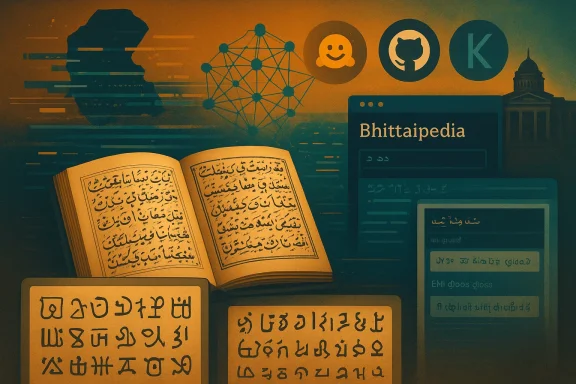
AMBILE has prioritized digitizing classical Sindhi literature and cultural heritage. The institute’s flagship portal, Bhittaipedia, packages Shah Abdul Latif Bhittai’s work with word-by-word glosses, transliterations, maps of places mentioned in the poetry, and AI-driven machine-translation into scores of languages—AMBILE claims machine translation into over 130 languages for the Bhittai material. That sort of cultural digitization is strategic: it both creates high-quality training data and forms a public-facing product that connects tech work to everyday cultural use.OCR, fonts, TTS/STT and government localization
AMBILE reports development of an offline Sindhi OCR engine, custom multilingual fonts (including scripts tied to Indus Valley artifacts), and TTS/STT work intended to support Sindhi voice applications. The institute has engaged with provincial government departments on plans to localize government websites and services into Sindhi, and it lists ISO 9001:2015 certification as part of its institutional credentials. These operational efforts indicate a pipeline from research to deployment—important because NLP efforts that never reach an actual product deliver little social value.Independent corroboration and what can be verified
When assessing AMBILE’s progress it is crucial to separate documented, verifiable work from aspirational or partnership claims that currently lack independent corroboration.- The Shah Jo Risalo dataset and its structure are publicly available on Hugging Face, a widely used platform for NLP datasets, and the dataset metadata explicitly lists AMBILE as the author/curator. That dataset contains the 43,700+ verse count cited by AMBILE. This is a direct, verifiable asset that researchers can download and inspect.
- Pakistani national outlets and independent newspapers have covered AMBILE’s activities and ambitions: Daily Times, The Tribune and other regional press have reported on AMBILE’s AI initiatives, MoUs with local universities, and government-backed localization projects. Those news reports corroborate that AMBILE is an active, state-backed institute pursuing Sindhi digitalization.
- AMBILE’s own project pages and documentation provide a multi-part repository strategy (Hugging Face, GitHub, Kaggle, Zenodo, IEEE Dataport, and a claimed presence on Harvard Dataverse). While multiple distribution channels are consistent with best practice, external confirmation of every repository entry is mixed: Hugging Face entries are visible and downloadable; claims of mirrored datasets on specific academic repositories are signaled on AMBILE’s pages but not all were independently located during the review. In short: dataset hosting on community platforms is real and verifiable; the complete list of archival mirrors may require direct confirmation per dataset.
- Major tech ecosystem support: AMBILE and regional reporting assert that Sindhi resources are connected to large technology players—including references to Google integration and the claim that Sindhi OCR has been integrated into “Google’s core products.” This claim is significant if fully accurate, but it could not be independently confirmed on Google’s public channels at the time of reporting. Separately, Microsoft documents show that Microsoft’s AI-generated alt-text service and some Copilot capabilities include Sindhi (language code sd-Arab-PK) among supported languages—this demonstrates that major vendors are expanding Sindhi support in at least some features. That supports AMBILE’s broader thesis that Sindhi is reaching mainstream platforms, but the specific vendor-level partnerships AMBILE names require more formal confirmation.
What’s strong about AMBILE’s approach
- Data-first, public-facing assets. By publishing a large, well-structured literary dataset (Shah Jo Risalo) and offering other corpora, AMBILE follows the textbook strategy for creating downstream NLP capability. Open, labeled data accelerates progress far faster than isolated tool development. The Hugging Face dataset is the clearest example of this strength.
- Institutional backing and cross-sector engagement. The institute is embedded in the provincial culture and technology ecosystem, has signed MoUs with local universities, and has engaged government IT departments about localization. That reduces the “research-to-deployment” gap and creates a practical path for Sindhi features to reach citizens.
- Multi-format focus. AMBILE’s scope covers fonts and encoding, OCR for printed and manuscript materials, word-level lexical work (WordNet), text corpora and speech datasets. This broad view is necessary: languages with complex orthographies and long literary traditions require work at multiple layers to be machine-ready.
- Cultural preservation plus technology. Projects like Bhittaipedia are both preservationist and utilitarian: they create scholarly resources while also generating high-quality, grounded data suitable for AI training. This reduces the risk that cultural datasets are misused without context.
Risks, gaps and open questions
While AMBILE’s progress is impressive, several technical, legal and governance concerns warrant attention.- Partnership claims need independent confirmation. AMBILE’s statements about direct integration with global players such as OpenAI, Microsoft Copilot and Google Gemini are strategically important but, in the public record available at the time of this writing, lack direct vendor confirmation. Until those companies publish formal announcements or interoperable endpoints are demonstrably live, treat such claims as either strategic outreach or preliminary integration rather than finished engineering partnerships. Independent verification is essential before placing mission-critical reliance on any such integration.
- Licensing and commercial restrictions. AMBILE’s Shah Jo Risalo dataset is released under a Creative Commons non-commercial license on some platforms. Non-commercial licenses protect cultural heritage but can complicate industry uptake: commercial LLM vendors, cloud providers, or startups typically require commercial-use rights or explicit data-use agreements before ingesting corpora into proprietary systems. If the intent is to accelerate broad commercial adoption of Sindhi capabilities, AMBILE will need careful licensing decisions and possibly dual-license or data-use agreements.
- Dataset quality controls and annotation transparency. The value of a POS-tagged lexicon or a cleaned corpus depends on annotation standards, inter-annotator agreement, and error rates. AMBILE’s public descriptions list large numbers—millions of tokens, 162k POS-tagged words—but detailed documentation of annotation schemas, sample error rates, and evaluation benchmarks would greatly increase researcher trust and uptake. Without those technical metadata, organizations may be reluctant to use the data for production LLM training.
- Copyright, provenance and sensitive content. Classical literature like Shah Jo Risalo involves multiple editorial lineages; AMBILE documents its compilers and sources, but large-scale scraping and reuse of contemporary materials can result in copyright entanglements. Additionally, voice datasets and user-contributed content must observe privacy rules; a clear data governance and informed-consent policy is needed.
- Long-term sustainability and funding. Creating datasets is the first hard step; maintaining them, updating them with community corrections, and operating compute-intensive services (TTS, STT, LLM fine-tuning) require stable funding and partnerships. Government grant cycles and political changes can interrupt continuity. AMBILE’s ISO certification and MoUs are positive signs, but a published sustainability plan would reassure partners.
- Community inclusion and transparency. Local universities and scholars must be continuously involved to ensure linguistic nuance, dialect variation and script differences are represented. The corpus must span registers (colloquial, literary, legal, medical) if the resulting models are to be robust across citizen-facing tasks. AMBILE’s MoU with the University of Sindh is a start; broadening community contributions and offering simple channels for corrections will be essential.
Practical implications for users and developers
- For researchers: AMBILE’s Hugging Face resources are ready for immediate academic use; researchers should review the dataset license before reuse and should request full metadata and annotation documentation for responsible experiments. Fine-tuning multilingual LLMs with the Shah Jo Risalo corpus is feasible, but researchers should control for domain skew (poetry vs. common speech).
- For government implementers: Localization of public portals into Sindhi is now technically achievable, especially for static content and basic UIs; integration of voice assistants and legal/health chatbots will require careful testing and a staged rollout with human oversight. AMBILE’s stated MOUs with provincial IT departments suggest pilots are forthcoming.
- For companies and vendors: If you operate multilingual products, AMBILE provides one of the clearest sources of curated Sindhi data to accelerate support. However, verify license terms and request a commercial-use agreement where necessary. Microsoft’s public language lists show that Sindhi is already present in some online services, making business integration feasible.
Recommended next steps for AMBILE and partners
AMBILE’s foundation is strong; the following operational steps would maximize impact while mitigating risk:- Publish full dataset metadata and annotation guidelines. Include sample statistics, inter-annotator agreement metrics, known error rates and test splits to enable reproducible research.
- Clarify licensing tiers. Consider a two-tier approach: a permissive research license for academic work and a negotiated commercial license for industry to encourage production use.
- Publicly document third-party integrations and provide technical proof-of-integration pages or API endpoints when partnerships are active. This reduces ambiguity for researchers and product teams.
- Establish an independent data-audit process and third-party benchmarking (e.g., leaderboards for Sindhi OCR, TTS, STT, and MT tasks). Transparency will build trust.
- Expand community contribution channels and set up a small grants program for university scholars to annotate dialectal data and create evaluation benchmarks.
- Publish a sustainability and funding plan: staffing, compute costs, hosting, and a roadmap for moving from datasets to deployable services (APIs, models).
- Consider publishing lightweight model weights or on-device fine-tuned models for common tasks under clear, secure licensing to enable adoption in low-bandwidth environments.
A balanced verdict
AMBILE represents an important and pragmatic model for language survival in the AI era: state-backed infrastructure combined with an openness-to-collaboration strategy that has already produced usable datasets and demonstrated technical acumen in fonts, OCR and portal work. The public availability of the Shah Jo Risalo dataset on Hugging Face is concrete evidence that AMBILE is not merely promising work but delivering assets the global research community can use.At the same time, several high-impact claims—particularly those naming direct integrations with global corporate LLM providers—require clearer, external confirmation. Responsible stewardship of linguistic heritage demands transparent licensing, metadata, and sustainable governance. If AMBILE addresses those governance and documentation gaps, its roadmap from cultural preservation to broad technological inclusion is both realistic and replicable for other regional-language initiatives.
What WindowsForum readers should watch for next
- Official vendor confirmations from Google, Microsoft or OpenAI about Sindhi integrations or public references to AMBILE resources. A formal integration announcement will transform AMBILE’s datasets from useful research inputs into production-grade signals for global platforms.
- New dataset releases or benchmark leaderboards that provide reproducible metrics for Sindhi OCR, TTS, STT and MT. These will allow independent evaluation of AMBILE’s technical claims.
- MoUs or funded projects with universities and the Science & IT department that move localization from pilot to province-wide deployment. Localized government services are an immediate and measurable public benefit.
Final thoughts
Language resilience in the age of AI is not only a technical challenge; it is a political and cultural project. AMBILE’s combination of technical outputs, institutional backing and public-facing cultural products (like Bhittaipedia) gives the Sindhi language a practical path into modern computing ecosystems. The institute’s immediate accomplishments—especially the open Shah Jo Risalo corpus—give both researchers and product teams the raw materials to build Sindhi-capable NLP systems. The work ahead is governance and transparency: clear metadata, licensing that matches strategic goals, documented partnerships, and robust community involvement.If AMBILE follows through on these operational imperatives, it will not only secure Sindhi’s technological future but provide a tested blueprint for other regional-language initiatives worldwide—how data, standards, government engagement and cultural stewardship can be combined to make a language machine-ready without sacrificing the context and rights of its speakers.
Source: UrduPoint AMBILEs Rapid Progress: Bridging Sindhi Language With Global Tech Giant - UrduPoint
