

AMD’s latest Radeon Software: Adrenalin Edition driver — version 25.10.2 — arrives as a mixed bag: a headline slate of game-ready optimizations and new Vulkan/feature support for modern RDNA hardware, paired with platform compatibility noise that has reignited debate about Windows 10’s place in the PC gaming ecosystem. The release brings targeted tuning for Battlefield 6 and Vampire: The Masquerade – Bloodlines 2, initial Work Graphs support for Radeon RX 9000-series, and explicit product support for the AMD Ryzen AI 5 330 NPU-equipped processor, while also publishing a long list of fixes and known issues. However, reporting around whether 25.10.2 is the first Adrenalin driver to drop Windows 10 is inconsistent across outlets and community posts; the official packaging and INF data should be checked before upgrading production machines.
AMD’s Adrenalin driver stream is the primary distribution channel for Radeon graphics drivers and associated user-space features such as Radeon Overlay, Record and Stream, and bundled Ryzen AI NPU components. Over 2024–2025 AMD’s cadence has included preview builds timed to major AAA launches (Battlefield 6 being a recent example) and WHQL-signed recommended branches for stable systems. The 25.10.2 drop follows that pattern: a game-targeted release that also introduces enabling support for modern GPU and API features (notably Vulkan extension expansion and an experimental Work Graphs capability on RDNA 4/9000 silicon). This article summarizes the package contents and public changelog, verifies key technical claims where authoritative documentation is accessible, cross-references community and vendor reporting, and provides a practical assessment of the benefits and risks for different user groups — from competitive gamers to workstation users.
Adrenalin Edition 25.10.2 is a technically ambitious driver drop that moves AMD’s RDNA platform forward on Vulkan, media, and new GPU scheduling fronts while delivering targeted game fixes for high‑profile titles. The release is also a reminder that modern driver updates can carry substantial operational consequences — from security and feature support to compatibility with OS lifecycles. Users and IT teams should balance the tangible benefits (game tuning, new Vulkan hooks, Work Graphs enablement) against the documented and community‑reported risks, and should perform the simple but necessary verification of the installer and the official release notes prior to deploying this driver widely.
(Verification note: where release-note language or packaging metadata conflicted across vendor pages and community mirrors, that conflict is called out above and readers are advised to consult the exact AMD driver release page and INF data for the 25.10.2 package they download before proceeding.
Source: Neowin AMD Adrenalin Edition 25.10.2 drops Windows 10 support, adds Battlefield 6 optimizations
 Background / Overview
AMD’s Adrenalin driver stream is the primary distribution channel for Radeon graphics drivers and associated user-space features such as Radeon Overlay, Record and Stream, and bundled Ryzen AI NPU components. Over 2024–2025 AMD’s cadence has included preview builds timed to major AAA launches (Battlefield 6 being a recent example) and WHQL-signed recommended branches for stable systems. The 25.10.2 drop follows that pattern: a game-targeted release that also introduces enabling support for modern GPU and API features (notably Vulkan extension expansion and an experimental Work Graphs capability on RDNA 4/9000 silicon). This article summarizes the package contents and public changelog, verifies key technical claims where authoritative documentation is accessible, cross-references community and vendor reporting, and provides a practical assessment of the benefits and risks for different user groups — from competitive gamers to workstation users.What’s in Adrenalin 25.10.2
New product and game support
- AMD Ryzen AI 5 330: The release notes list explicit support for the Ryzen AI 5 330 processor family, indicating updated NPU/MCDM runtime components are packaged or recognized. This matters for systems that intend to leverage on-chip AI acceleration for encoding, upscaling, or middleware that can route tasks to the NPU.
- New game support:
- Battlefield 6 (DirectX 12) — per‑title optimizations and stability work.
- Vampire: The Masquerade – Bloodlines 2 (DirectX 12) — added compatibility tuning.
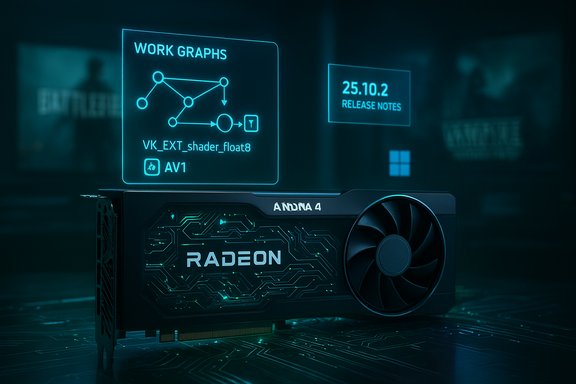
These game entries echo AMD’s ongoing policy of shipping preview drivers close to AAA launches to reduce day‑one friction for Radeon users. - Work Graphs support (initial): The driver introduces Work Graphs support on Radeon RX 9000‑series GPUs as an initial implementation. Work Graphs are a modern GPU-driven scheduling paradigm that lets more work be dispatched and synchronized on the GPU side without repeated CPU intervention — potentially improving efficiency in complex rendering or compute pipelines. The feature’s presence in the release notes signals AMD’s RDNA 4 hardware is being prepared for engine- and middleware-level adoption.
Vulkan and media capabilities
- Expanded Vulkan extension set: The package includes support for extensions such as VK_EXT_shader_float8 and several video encode/decode extensions (including AV1 encode/decode entries), plus dense-geometry-format support for ray-tracing workflows. This broadens the vendor-side capability to run modern Vulkan features and to support evolving upscaling and video pipelines. Community summaries highlight this as a step toward broader FSR 4/Floating‑8 shader compatibility and AV1 hardware encode readiness.
Bug fixes, known issues, and CVE entries
25.10.2’s notes list a variety of fixes for crashes and rendering corruption across the RX 6000/7000/9000 families, plus multiple known issues that remain open (Cyberpunk 2077 with Path Tracing timeouts, Battlefield 6 timeouts on specific Ryzen AI HX SKU, texture flicker with Record and Stream, and others). The release notes also reference a string of security advisories (CVEs) addressed by the driver build; community posts and early adopters flagged those CVE IDs in the published notes. Users should treat the CVE list as an important reason to move to the patched package if their deployment accepts the driver.Compatibility and the Windows 10 question — what’s verified?
One of the most consequential claims circulating about 25.10.2 is that it is the first Adrenalin driver to drop Windows 10 compatibility entirely and require Windows 11 (version 21H2 or later). This has direct implications for users who remain on Windows 10, especially now that Microsoft ended mainstream support for many Windows 10 SKUs.- Evidence that supports a Windows 11 requirement: multiple community summaries and local news outlets reporting on the 25.10.2 release note text that lists Windows 11 version 21H2 and newer as the compatibility baseline, and that omit Windows 10 from the “Compatible Operating Systems” section for the new package. This is the claim circulating in the press and social summaries.
- Evidence that contradicts the claim: other community posts and Reddit snippets of the release note excerpts show the 25.10.2 package contents described as including a Windows driver version and referencing compatibility with Windows 10 and Windows 11 (or a Windows driver build compatible with Windows 10 in package meta). Community posts also report install failures and INF-level mismatches (Error 182) on RDNA 2 cards after the package — a behavior consistent with packaging/regression issues rather than an intentional Windows‑10 exclusion.
- Visit the official AMD driver release notes page for the exact driver revision you downloaded and confirm the “Compatible Operating Systems” section. If the page lists only Windows 11 (21H2+), treat the package as Windows 11‑targeted.
- On the downloaded installer, extract the INF files or review the installer log to confirm whether your GPU's Device ID is included and whether the INF supports Windows 10. Community insurers: run the installer in a test VM first.
- If you rely on Windows 10 for legacy software or managed environments, delay adoption until AMD publishes an explicit clarification or a WHQL-signed release that lists Windows 10 in the compatibility table.
Security and enterprise perspective
AMD’s 25.10.2 notes include several CVE entries fixed in the build. While the notes list many CVE identifiers, organizations and security-conscious users should treat each CVE by its severity and exposure profile. Patching GPU drivers is a valid part of a secure endpoint posture because drivers operate in privileged contexts and can mediate graphics, video decode, and DMA-like paths.- For enterprises that must comply with extended life-cycle policies or require formal WHQL signing, the recommended approach is to test the driver on representative hardware and confirm certification or vendor-signed WHQL presence before wide rollout. AMD’s preview/optional driver channel is useful for day‑one fixes, but enterprise validation mandates controlled testing and rollback plans.
- If a build indeed removes Windows 10 support, enterprising IT teams must map affected assets and schedule migration or ESU enrollment as appropriate; Windows 10 end-of-support realities have already influenced vendor behavior across the industry. The broader ecosystem — publishers, anti‑cheat vendors, and driver authors — has been shifting toward Windows 11 as the preferred baseline for new features and security contexts.
Real-world implications for gamers and creators
What users stand to gain
- Battlefield 6: per‑title fixes typically reduce frame‑time spikes, address DX12 pathing issues, and can resolve class-of‑engine bottlenecks in open‑world multiplayer matches. Expect smoother pacing in large multiplayer scenarios for supported hardware.
- Vulkan/FSR and video pipelines: expanded Vulkan extension support and AV1 encode/decode improvements are forward‑looking for streaming and upscaling. Streamers and editors who plan to adopt AV1 encode or the latest FSR/FSR‑like upscalers will benefit from the improved driver hooks.
- Work Graphs: for developers and future titles that adopt Work Graphs, the initial support on RX 9000 series provides a path to better GPU-side parallelism and lower CPU overhead in specific workloads. That’s a technical win for engine teams willing to code to this model.
Risks and pain points
- Preview/WHQL status and regression risk: 25.10.2 (like many game‑day drivers) can be released as preview/optional builds before WHQL promotion. These faster cycles increase regression risk: unrelated titles and capture/overlay software have historically been affected. Community reports already note issues with recording, missing RDNA 2 INF entries, and problems with Radeon Record and Stream. If you rely on stability (streaming, production work), wait for the WHQL or vendor‑confirmed recommended build.
- Anti-cheat and platform security interplay: Battlefield 6’s Javelin anti-cheat and related platform requirements (TPM, Secure Boot, VBS/HVCI) mean that OS-level platform configuration can block multiplayer access independent of driver compatibility. If users attempt to remain on Windows 10, anti‑cheat gating plus evolving driver support may make multiplayer access more fragile. AMD’s driver changes that touch low-level scheduling or GPU/firmware interactions can incidentally influence anti‑cheat behavior — another reason to test first.
- Device‑level features removed or disabled: community notes surfaced a curious detail: USB‑C power charging support for Radeon RX 7900 series was explicitly disabled in this build and users were told to fallback to an older driver (25.3.1) if they needed it. That kind of per‑SKU feature removal is unusual and must be checked before upgrading machines that rely on dock/VirtualLink‑like power delivery paths.
Installation guidance — a conservative plan
If you plan to install 25.10.2, follow a predictable, low-risk path:- Confirm compatibility: verify the official AMD release notes and the “Compatible Operating Systems” list for the specific build you will download (check INF and package metadata). If Windows 10 is not listed and you run Windows 10, do not proceed.
- Back up and prepare rollback:
- Create a Windows System Restore point or a full system image.
- Keep a copy of the current working driver installer and note the driver version string.
- Test in a controlled environment:
- Install the new driver on a spare machine or VM to validate the major workflows (games, capture, VR, professional apps).
- Use safe install practices:
- Prefer a Custom install, deselect optional components if you do not need them, and run the installer as Administrator. If the installer is a preview build, consider using AMD Cleanup Utility or DDU in Safe Mode to fully clean before downgrade/upgrade cycles if regression occurs.
- Monitor community reports:
- Early adopters often post install issues and fixes (INF mismatches, Error 182, recording failures). Use community threads as an early-warning system but prioritize vendor documentation.
Technical analysis — what Work Graphs and expanded Vulkan mean in practice
- Work Graphs: The initial Work Graphs support for RX 9000 is an enabling step, not an immediate performance panacea. For a measurable benefit, game engines and middleware must adopt Work Graphs-aware scheduling. When that happens, expect lower CPU submission overhead and potentially better utilization of GPU asynchronous compute units for tasks that are GPU‑suitable (e.g., procedural generation, compute-heavy lighting passes). Early adopters in dev communities will probably see the first gains; mainstream benefits depend on uptake.
- Vulkan extension set: VK_EXT_shader_float8 and related extensions expand the precision/performance trade-offs available to shader authors and make more advanced upscalers and ray-tracing hacks feasible. AV1 encode improvements in the driver are also important to streamers who are pushing to lower bandwidth while maintaining quality. These changes position AMD hardware to be competitive in modern streaming and Vulkan-native titles.
Cross-check: vendor vs community reports
A robust editorial discipline requires cross-referencing AMD’s official channels against third‑party coverage and community logs. For 25.10.2:- Vendor-level documentation was fragmented across driver build pages and regional/older release‑note variants; AMD’s previous preview driver (25.10.1) explicitly listed Windows 10 and Windows 11 support and bundled a Ryzen AI NPU driver, showing the company’s historical willingness to support Windows 10 on many RDNA‑class GPUs.
- Community and news posts summarizing 25.10.2 report both the feature highlights (Battlefield 6 optimizations, Work Graphs, Vulkan extensions) and mention a Windows 11‑only compatibility listing in some localized copies of the release notes. Simultaneously, community installs surfaced INF errors on older RDNA 2 cards, which caused some users to interpret failures as deliberate Windows 10 exclusion. This mix of signals means that the Windows 10‑support claim is not fully verifiable without checking the exact English AMD release page for the 25.10.2 Windows package or examining the installer INF.
Final assessment — strengths, weak spots, and guidance
Strengths- Timely game optimizations: Battlefield 6 and Bloodlines 2 support reduces day‑one friction for players on supported hardware.
- Forward‑looking features: Work Graphs and Vulkan extension expansion prepare AMD silicon for next‑generation engine features and AI/video workflows.
- Security fixes: The driver lists multiple CVE fixes; patching is appropriate where those CVEs are relevant to your threat model.
- Windows 10 compatibility ambiguity: Conflicting reports and inconsistent release‑note metadata make the claim that 25.10.2 drops Windows 10 support unverifiable without AMD’s explicit clarification. Treat the Windows 11‑only assertion with caution until the official English release notes or the installer INF confirm the change.
- Preview/regression exposure: Early adopters may encounter regressions (recording failures, INF mismatches, RDNA 2 non‑support messages). If stability matters, wait for WHQL/recommended builds.
- Per‑SKU feature removals: The disabling of USB‑C charging on specific RX 7900 SKUs is a surprising step that can break particular device setups — confirm feature requirements before installing.
- If you are a competitive gamer chasing day‑one tuning for Battlefield 6 and run supported RX 7000/9000 hardware on Windows 11: the patch is worth testing in a controlled setup.
- If you are a Windows 10 user, or manage Windows 10 workstations: do not install until the AMD release note explicitly confirms Windows 10 compatibility for this 25.10.2 package, or until AMD publishes a hotfix that restores Windows 10 support. Verify via the AMD release-page metadata and the installer INF.
- For streamers and creators, test the build for Record/Stream workflows; community reports show capture regressions in early installs. Maintain rollback media and test in non‑critical environments first.
Adrenalin Edition 25.10.2 is a technically ambitious driver drop that moves AMD’s RDNA platform forward on Vulkan, media, and new GPU scheduling fronts while delivering targeted game fixes for high‑profile titles. The release is also a reminder that modern driver updates can carry substantial operational consequences — from security and feature support to compatibility with OS lifecycles. Users and IT teams should balance the tangible benefits (game tuning, new Vulkan hooks, Work Graphs enablement) against the documented and community‑reported risks, and should perform the simple but necessary verification of the installer and the official release notes prior to deploying this driver widely.
(Verification note: where release-note language or packaging metadata conflicted across vendor pages and community mirrors, that conflict is called out above and readers are advised to consult the exact AMD driver release page and INF data for the 25.10.2 package they download before proceeding.
Source: Neowin AMD Adrenalin Edition 25.10.2 drops Windows 10 support, adds Battlefield 6 optimizations
