

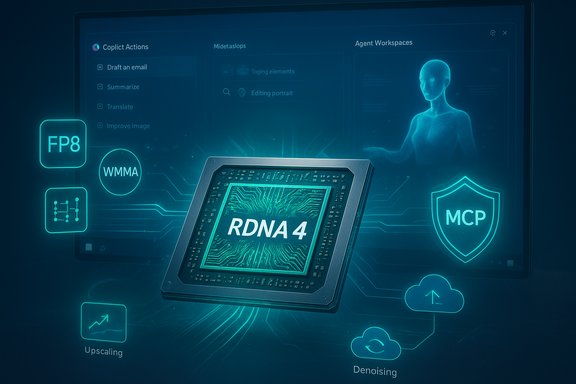
AMD’s push to make Windows 11 PCs smarter and Microsoft’s decision to make Windows “agentic” collided this autumn in a pair of announcements that together redraw the boundaries between silicon, operating system, and security — and they raise as many questions as they promise solutions. AMD’s RDNA 4-based Radeon RX 9070 series promises major AI acceleration on Windows 11, while Microsoft’s Ignite-previewed agentic features — Copilot Actions, Agent Workspaces, and the Model Context Protocol (MCP) — turn the OS into a platform where autonomous agents can act on users’ behalf. The result is a powerful, fast, and potentially risky new landscape for creators, gamers, and enterprise admins alike.
Background / Overview
Windows is being recast as an AI-first platform in two complementary ways. Hardware vendors such as AMD are baking dedicated AI pipelines and support for narrower data types (like FP8) directly into GPUs to accelerate on-device inference and creative workflows. At the same time, Microsoft is building OS-level primitives that let agents — software entities able to take multi-step actions — run in contained environments within Windows, connect securely to apps and cloud services via MCP, and be managed with new governance controls.These moves are tightly coupled. AMD’s RDNA 4 claims are framed explicitly around delivering fast, on-device generative AI and upscaling that Windows 11 can exploit; Microsoft’s agentic vision is similarly predicated on hybrid compute — blending cloud reasoning with on-device acceleration on Copilot+ hardware. That partnership is central to understanding both the upside and the risk.
AMD’s RDNA 4 and the Radeon RX 9070 Series: What changed
The headline upgrades
AMD’s official announcement for RDNA 4 and the Radeon RX 9070 family lays out a broad set of upgrades aimed at both gamers and creators:- New RDNA 4 compute units with higher per‑CU throughput and revamped ray‑tracing accelerators.
- Second‑generation AI accelerators with expanded math pipelines that explicitly support newer low‑precision formats (including FP8/BF8/HF8), plus optimizations for sparsity.
- FP8-enabled WMMA (Wave Matrix Multiply Accumulate) paths used to boost ML-powered upscaling in FidelityFX Super Resolution 4 (FSR 4).
- Product SKUs and power/price points: RX 9070 XT (64 CUs, 16 GB, up to 3.0 GHz boost, 304 W, $599 SEP) and RX 9070 (56 CUs, 16 GB, up to 2.5 GHz boost, 220 W, $549 SEP).
FP8, WMMA, and what they mean in practice
FP8 (8‑bit floating point) and WMMA additions matter because many modern inference workloads trade precision for throughput. Lower-precision formats reduce memory use and increase arithmetic density, letting hardware execute more operations per cycle with less power. AMD advertises multiples of improvement in INT8 and FP16/FP8 throughput versus RDNA 3; the company specifically highlights sparsity-aware paths that multiply effective throughput for inference tasks. The key practical outcomes AMD pitches are:- Faster generative model inference (image and creative workflows).
- ML‑enhanced upscaling and frame reconstruction (FSR 4) with improved temporal stability.
- Better on‑device responsiveness for features Microsoft expects to ship as part of Copilot+ experiences.
Vendor claims vs. independent coverage
Vendor numbers are compelling — AMD cites “up to 70%” improvements on certain generative AI workloads compared to the RX 7900 GRE in its marketing materials — but those figures are vendor-supplied and measured under controlled conditions that favor the new hardware. Independent outlets (Ars Technica, The Verge, TechPowerUp) confirm the architectural changes and pricing, and initial hands-on coverage supports meaningful gains for both gaming and ML workloads, but they caution real-world variability: driver maturity, workload mix, system configuration, and thermal limits can all change outcomes. In short, the hardware enables faster on-device AI on Windows 11, but real-world gains will be workload-dependent and will improve as drivers and applications adopt the new primitives.Windows 11’s Agentic Shift: What Microsoft announced at Ignite
The core components
At Ignite 2025 Microsoft disclosed the OS-side plumbing for agentic behavior. Key pieces include:- Copilot Actions: an agentic layer able to execute multi-step interactions across the desktop and web (UI-level automation, file operations, cross-app workflows).
- Agent Workspaces: isolated, lightweight desktop sessions where agents run under separate agent accounts, visible and interruptible by the user.
- Model Context Protocol (MCP): a standardized mechanism for agents to discover and connect to tools, apps, and services safely.
- Windows AI Foundry and local AI components: APIs and runtimes that let Windows run models locally (on-device) when hardware permits — a capability Microsoft ties to the Copilot+ tier of machines.
Why this matters technically
Turning an OS into an agent host is both a platform play and a security challenge. Agents are given the tools to interact with UIs, files, and services — operations that traditionally require human-mediated permissions and context. Microsoft’s approach attempts to mitigate risk with identity separation, scoping of file access, runtime isolation, and telemetry/audit trails. But enabling agents to act on behalf of users also introduces a new principal (the agent account) into identity and policy surfaces that administrators must govern.Cross-checking the claims: verification and nuance
AMD performance and feature claims — verification
Independent reporting corroborates AMD’s RDNA 4 architectural advances and product specifications (CU counts, clocks, memory, TBP, and pricing). AMD’s own press materials provide the authoritative spec sheet; outlets such as Ars Technica and TechPowerUp independently summarized and verified those specs and contextualized likely performance positions against Nvidia’s current stack. That triangulation supports the basic truth of AMD’s hardware claims: the RX 9070 series brings new AI pipelines and FSR 4 support and ships at the stated MSRPs. However, the specific percentage performance claims (e.g., “up to 70% faster on generative AI tasks”) should be treated as vendor benchmarks that need third‑party reproduction before treating them as universal. Early independent tests show meaningful improvements in targeted scenarios, but results vary by workload and system.Microsoft’s agentic security and governance claims — verification
Microsoft’s Ignite documentation and Windows Experience posts are the primary source for the agentic architecture: they describe agent accounts, Agent Workspaces, the MCP protocol, and the experimental gate in Settings. Those documents confirm Microsoft’s stated security model and opt‑in approach. Independent coverage from outlets such as Windows Central and The Verge echoes Microsoft’s claims, while also raising cautionary flags from security analysts about new attack surfaces and governance complexity. In other words, Microsoft’s design includes sensible mitigations, but independent observers emphasize the need for rigorous testing, telemetry transparency, and enterprise controls before widescale adoption.Strengths: What this combination delivers for users and developers
- Faster on‑device AI: RDNA 4’s AI pipelines and FP8 paths make high‑quality local inference feasible on more workloads — lower latency, better privacy for certain tasks, and offline capability for some Copilot features. This benefits creatives (faster render/denoise/upscaling), gamers (FSR 4), and developers exploring local model deployment.
- Platform-level automation: Copilot Actions and MCP provide a consistent programmatic model for building agentic workflows tied to Windows shell primitives — enabling richer productivity automations and tighter integration between local apps and cloud services. For enterprises, standardization via MCP could simplify safe agent integrations.
- User-visible safety mechanics: Agent Workspaces, agent accounts, explicit experimental toggles, and visible step lists are thoughtful controls that make agents auditable and interruptible, reducing the risk of silent, untraceable actions. Microsoft’s emphasis on opt-in at preview is important and should reduce surprise for end users.
- Ecosystem alignment: AMD and Microsoft co‑design signals (hardware acceleration plus OS APIs) reduce friction for app developers aiming to ship on-device features — a crucial step toward richer local AI experiences across the Windows PC market.
Risks and unresolved challenges
- Vendor benchmark uncertainty: “Up to X%” claims are marketing‑forward. Real-world results will depend on drivers, model compilers, and application-level optimization. Early adopters should expect variation and occasional regressions until drivers and apps mature. Consumers and IT buyers should rely on independent reviews for workload-relevant metrics.
- New attack surface: Agents that can control UIs, access files, and call cloud services create opportunities for abuse if an agent is malicious or compromised. Even with agent accounts and signing/revocation plans, the complexity of managing agent identities, supply chains, and tool connectors (MCP servers) opens governance burdens for enterprises.
- Policy and telemetry transparency: Microsoft’s preview-era promises about telemetry, audit logs, and consent flows are necessary but not sufficient until independently verifiable. Enterprises will need clear, auditable guarantees about what is collected, retained, and exposed to cloud services. Microsoft’s architecture shows thoughtfulness, but the implementation is the test.
- Hardware fragmentation: The Copilot+ tier and on-device acceleration specifications risk fragmenting the Windows experience. Some Copilot features will perform differently depending on whether a system has a qualifying NPU, a modern AMD GPU, or none of the above. That divergence forces developers and IT pros to implement tiered experiences or accept degraded behavior on non‑Copilot+ systems.
- Usability vs. control tradeoff: Agentic convenience (agents acting autonomously) inherently reduces friction at the cost of increasing the need for governance. Balancing user productivity gains against corporate security policies and personal privacy will be an ongoing operational challenge for administrators.
Practical guidance: what readers should do now
For desktop users and prosumers
- Wait for independent reviews before upgrading hardware solely for AI claims. Vendor numbers are an entry point, not the final word.
- Keep drivers and Windows updated — RDNA 4 features and Windows agentic components will improve rapidly during the first months post-launch.
- Treat agentic features as experimental by default — follow Microsoft’s opt‑in path and evaluate Copilot Actions or Agent Workspaces in a controlled, non‑critical environment first.
For enterprise IT and security teams
- Establish governance from day one: define policies for agent provisioning, identity management (Entra/Intune integration), audit log retention, and revocation workflows.
- Pilot, instrument, and measure: run small pilots to validate agent behavior, telemetry, and resource impacts. Insist on immutable audit trails for agent actions.
- Segment Copilot+ features by risk: treat agentic features and on‑device inference differently depending on data sensitivity; disallow agent access to regulated datasets until controls are proven.
- Contractual and supply‑chain diligence: require agent signing, attestation, and third-party security validation for agents used in production.
For developers and ISVs
- Adopt MCP carefully: the Model Context Protocol is promising for standardization, but early implementations will vary. Design for graceful degradation when MCP servers or agent connectors are unavailable.
- Optimize for tiers: provide both cloud and on‑device modes where possible — this keeps apps functional across Copilot+ and non‑Copilot hardware.
- Prioritize auditability: implement clear logs and user-visible step previews when exposing agentic features to end users.
What to watch next (and what is still unverifiable)
- Independent benchmarks of RDNA 4 across generative AI models (SDXL, LLM inference, VSR) and cross‑vendor comparisons with Nvidia and Intel GPU/NPU stacks.
- Microsoft’s telemetry and audit log publications — specifically, whether the promised immutable, reviewable agent logs and auditing surfaces meet enterprise needs in practice.
- MCP adoption and third‑party agent signing/revocation workflows — success here will determine whether agentic automation becomes a manageable platform or an operational headache.
- Real-world usability studies documenting how often agents achieve correct results without human oversight and the frequency/impact of erroneous agent actions.
Conclusion
The intersection of AMD’s RDNA 4 hardware and Microsoft’s agentic Windows 11 is the most consequential PC-era rearchitecture in years: silicon is being designed for AI workloads, and the OS is being redesigned for agents that can act. Together, they promise genuinely useful on‑device AI — faster creative workflows, higher‑quality upscaling in games, and friction‑reducing automations that could save time across personal and enterprise scenarios.Those benefits are real, but they come with tradeoffs. Vendor benchmarks and preview documentation point the way, but the final verdict will be decided by driver maturity, developer adoption, independent performance validation, and whether enterprises and security teams can operationalize governance effectively. For consumers, cautious excitement and patience for independent reviews are warranted. For IT leaders, the correct posture is proactive governance: pilot deliberately, instrument thoroughly, and insist on auditable controls before agentic features act on critical systems.
The new era is here: faster GPUs and more capable agents on Windows 11. The next six to twelve months will determine whether that era is defined by productivity gains or by an avalanche of operational complexity that outpaces policy and tooling. Either way, it is a pivotal moment for the PC — and one every Windows enthusiast, administrator, and developer should follow closely.
Source: TechPowerUp AMD Details AI Innovations for Windows 11 PCs at Microsoft Ignite
Source: TechPowerUp Windows 11 Agentic Features Are Security Nightmare, Microsoft Confirms
