• Thread Author
Microsoft’s AI pivot isn't a marketing slogan anymore — it’s the architecture of the software you open every morning, the cloud that runs your company's tools, and a major thesis shaping portfolios on Wall Street.

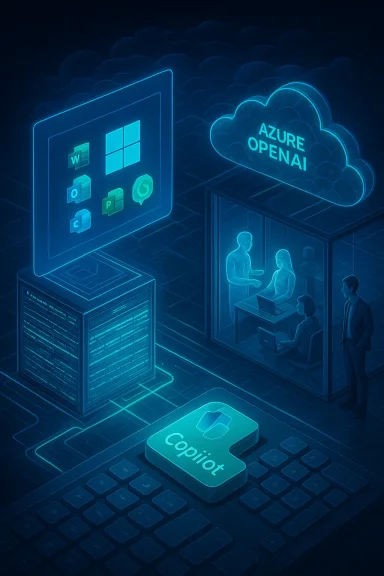
Neon blue isometric scene of Azure OpenAI and Copilot powering cloud apps.Overview​

Microsoft has moved from incremental AI features to making artificial intelligence the default interaction layer across Windows, Office, Azure, GitHub, and Xbox. That transition — driven by product bundling, datacenter buildouts, deep OpenAI ties, and aggressive subscription packaging — means that for U.S. users and investors the company is no longer “just” a software vendor: it’s positioning itself as the AI operating system of the modern digital life. The company’s public filings and product announcements, along with independent reporting and community reaction, show the strategy is already measurable in revenue, user counts, pricing changes, and new infrastructure.
This feature unpacks what Microsoft actually flipped, why it matters to everyday workflows, how it’s monetizing AI, and the concrete risks — regulatory, privacy, competitive, and financial — that should shape how you use Microsoft products and whether you own its stock.

Background: the three engines of Microsoft's AI pivot​

Microsoft’s pivot has three tightly coupled engines that together explain why its AI push is both comprehensive and hard to escape.

1) Copilot as the new UI layer​

Microsoft has folded "Copilot" from a branded add‑on into an across-the-stack assistant — visible in Windows, Office apps, Edge/Bing, GitHub, and as the user-facing Copilot app. The company has been explicit about embedding AI in the OS experience, adding a Copilot key and built‑in access points so assistance is a tap or keyboard shortcut away. That’s deliberate: make AI the path of least resistance for users and enterprises.

2) Azure + OpenAI + Fairwater: the infrastructure and model axis​

The AI experiences you interact with are often just the tip of a much larger infrastructure iceberg. Microsoft’s Azure cloud hosts many commercial AI workloads and — following multi‑billion dollar infusions and a restructured partnership with OpenAI in late 2025 — Microsoft is both a major investor and the primary commercial channel for many large language models and foundation-model services. To support large-scale model training and inference at low latency, Microsoft has built purpose‑built "Fairwater" AI datacenters and linked them into a high‑capacity fabric designed to behave like a distributed AI supercomputer. Those investments underpin Copilot and Azure OpenAI offerings and explain why Microsoft can roll AI into products at scale.

3) Consumer/subscription monetization (Office, GitHub, Xbox)​

Rather than selling AI as a standalone product everywhere, Microsoft is packaging it into subscriptions and enterprise contracts. Consumer bundles such as Microsoft 365 Premium and GitHub Copilot tiers, and Game Pass changes for Xbox, are the direct commercial manifestations of this pivot. The result: recurring revenue tied to AI usage, per‑user licensing for business Copilot seats, and usage‑basustomers building their own copilots.

What users see on their PCs: Copilot in Windows and Microsoft 365​

Windows: an OS with AI baked in​

If you run Windows 11, Copilot will increasingly feel like a built‑in capability rather than a separate app. Microsoft’s design and updates map Copilot to the taskband system shortcuts — making conversational assistance available in place rather than as an extra workflow. That design choice lowers friction for casual and power users alike: asking Copilot to summarize an email, rewrite a document, or troubleshoot a setting is now a one‑tap or one‑keystroke action.
What to expect:
  • Integrated prompts and summaries inside File Explorer, Paint/Photos, and system dialogs.
  • A Copilot chat experience that can read context from apps and files when permitted.
  • Hardware-level signals like the Copilot key on new keyboards and Copilot+ hardware tiers for low-latency on‑device features.

Microsoft 365 Copilot and consumer AI bundling​

Microsoft’s strategy shifted from premium enterprise-only Copilot licensing and standalone consumer tiers toward bundling advanced Copilot features into a consumer "Microsoft 365 Premium" bundle (announced and priced as a consumer tier). That both accelerates consumer adoption and simplifies the marketing story — but it also moved some previously freestanding pricing into subscription increases for mainstream consumers. If your household uses Office apps, one upgrade can give everyone access to advanced AI features and extra storage.
Practical implications:
  • Consumers now face a clearer tradeoff: pay for bundled Copilot features (and Defender storage/security add‑ons) or keep older, lower‑priced plans without advanced AI.
  • At work or school, AI features can arrive via tenant‑level rollouts; admins control who sees Copilot and what it may access.

The engine room: Azure, OpenAI, and Fairwater datacenters​

Azure is the backbone for third‑party and in‑house AI​

Every company that says “we added generative AI” and runs on Azure is contributing to Microsoft’s AI monetization. Azure sells both raw compute and managed model hosting (Azure OpenAI Services), turning usage into metered revenue. Microsoft publicly disclosed Azure’s scale: the company reported Azure surpassing roughly $75 billion in annual revenue, a figure that highlights how cloud and AI are now core to Microsoft’s top line. That number is not only a revenue milestone — it’s the financial justification for massive capital spending on AI infrastructure.

Fairwater and the idea of an "AI superfactory"​

Microsoft’s Fairwater datacenters (Wisconsin, Atlanta, and planned sites) are not ordinary cloud builds — they’re rack‑scale, GPU-dense facilities purpose-built for large model training. Microsoft describes connecting multiple Fairwater sites into a distributed supercomputing fabric so training jobs can run across sites as if they were a single machine. That engineering bet is a defensive moat: owning the capacity and the low-latency fabric reduces dependence on third‑party training partners and gives Microsoft control over cost, performance, and scheduling for frontier models.
What it means for users and enterprises:
  • Faster model iterations and lower-latency inference for services hosted on Azure.
  • A consolidated path for enterprises wanting compliant, tenant-isolated model hosting with access to frontier models.
  • Ongoing capital intensity that can pressure margins in the short term, even while long‑term revenue benefits accrue.

Gaming: Xbox, Game Pass, and a content/subscription shift​

Microsoft is reframing gaming around recurring subscriptions and cloud streaming rather than single‑purchase titles. Game Pass remains the razor for subscription engagement; Microsoft restructured tiers and raised the price on top levels to reflect added content and cloud capabilities. That matters because the Xbox ecosysteor for AI — from moderation and personalization to generative content features and NPC behavior — and Microsoft is monetizing gaming through subscriptions more than hardware sales.
Key consumer impacts:
  • Subscription pricing changes (including a material increase to Game Pass Ultimate in recent adjustments) mean higher ongoing costs for heavy users.
  • Expect AI-driven features (procedural narrative generation, smarter in‑game assistants, content moderation tools) to arrive first in subscription services and cloud-streaming experiences.

Developers and GitHub: coding copilots and new pricing models​

GitHub Copilot is one of the clearest examples of Microsoft monetizing AI via developer productivity. The product now has tiered consumer and business plans with clear monthly pricing, premium request allowances, and pay‑as‑you‑go controls. For professional developers the pricing is straightforward and broadly affordable, but Microsoft has introduced premium request allowances for access to higher‑capacity models — an example of how usage of frontier models is being metered in creative ways. Official GitHub pages list Pro and Pro+ monthly pricing tiers and support free access for eligible students and open‑source maintainers.
Why this matters:
  • Developers now pay for model access almost the same way they pay for cloud compute: a mix of fixed subscription and metered overages.
  • The structure creates predictable revenue for Microsoft while giving teams control over costs.

The investment story: why investors treat Microsoft as an AI proxy​

Microsoft’sd by institutional investors as a de facto way to own exposure to the AI cycle: cloud infrastructure (Azure), model partnerships (OpenAI and others), recurring productivity revenue (Microsoft 365 + Copilot), and consumer subscriptions (Game Pass). Analysts point to clearer AI monetization paths and durable enterprise relationships when arguing Microsoft deserves a premium multiple; skeptics worry whether the stock already prices in perfect execution.
Load‑bearing facts investors should know:
  • Azure passed an annual revenue threshold that underscores cloud scale (Microsoft reported Azure topping roughly $75B for the fiscal year).
  • Microsoft restructured and expanded consumer subscription tiers to fold in AI features, creating another recurring revenue vector (Microsoft 365 Premium).
  • The company remains a major OpenAI investor and has updated the partnership structure, which materially affects its strategic reach into model ownership and distribution.
These are the five or six sentences that actually move markets; they now have public, verifiable documentation. When you read earnings slides and investor letters, this is where Microsoft is asking shareholders to judge trade‑offs: near‑term capital intensity for datacenters versus long‑term revenue capture across millions of users.

Privacy, governance, and regulatory risks: the less sexy but crucial part​

The shift to AI everywhere brings friction beyond pricing. There are four core risk vectors users and enterprises must weigh.
  • Data privacy and inference risk. Copilot’s power comes from reasoning over user documents, emails, and tenant data. That raises questions about what data is retained, how it’s used to improve models, and whether sensitive information could be exposed through model outputs. Microsoft emphasizes tenant isolation and enterprise controls, but the practical details — auditing, retention windows, and prompts that touch personal data — remain critical governance questions for buyers.
  • Regulatory scrutiny and antitrust exposure. Bundling AI across operating systems, productivity apps, and cloud services creates narratives regulators watch closely: market foreclosure, tying, and leverage of dominance. U.S. and EU regulators are actively considering frameworks for AI safety and competition; Microsoft’s scale makes it a natural target for both lines of inquiry.
  • Model reliability and hallucination issues. Not every Copilot reply is a fact-checked answer. Teams must build guardrails, human-in-the-loop review, and verification workflows, particularly when Copilot outputs touch finance, legal, or clinical decisions.
  • Lock‑in risk. The more an organization builds agents, copilots, and workflows on Azure + Microsoft 365 identity + Graph data, the higher the switching costs. That’s good for customers who want an all‑in stack, but it reduces negotiation power over time and concentrates systemic risk.
Callouts: these risk areas are already driving product choices, contract language, and procurement policies inside enterprises. Procurement offices and security teams should demand clear data governance contracts and measurable SLAs for AI behavior.

What you should do next — practical, no‑nonsense guidance​

Whether you’re a user, an IT leader, or an investor, here are concrete steps to take this quarter.

For everyday users​

  • Try Copilot intentionally. Spend an afternoon testing Copilot on real tasks (summaries, first drafts, spreadsheet formulas) so you understand its strengths and limitations.
  • Enable privacy controls. Check what Copilot and Microsoft 365 settings your tenant or local account exposes, and use the available toggles for data sharing and telemetry.
  • Budget for subscriptions. If you’re a household or freelancer, evaluate Microsoft 365 Premium vs. legacy plans — the bundled AI features are attractive, but they come with recurring cost increases.

For IT and security teams​

  • Audit Copilot/agent access scopes across your tenant.
  • Define explicit data-handling rules for AI assistants.
  • Pilot Copilot in controlled groups with monitoring and a rollback path.
  • Negotiate model/usage SLAs and audit rights in vendor contracts.
These sequential steps let you capture productivity wins while preventing surprises from hallucinations, data leaks, or runaway spending.

For developers and product teams​

  • Use Azure OpenAI and Copilot Studio to prototype, but architect for model abstraction: decouple model providers so you can switch or fail over to alternatives (OpenAI, Anthropic, in‑house) without ripping apart the app.
  • Budget for premium model usage; GitHub Copilot’s tiered premium requests show how metering can alter economics.

For investors​

  • Separate short-term sentiment (earnings beats/misses, capex cycles) from the long-term adoption thesis (product bundling, Azure monetization, enterprise stickiness).
  • Watch Azure growth rates, Copilot paid seat metrics, and Fairwater capacity disclosures — those numbers map directly to revenue upside and capital intensity. Microsoft’s filings and corporate blog now provide more granular metrics than prior years; use them.

Strengths and where Microsoft could trip​

Notable strengths​

  • End‑to‑end stack. Microsoft controls identity, productivity apps, developer tooling, cloud infrastructure, and gaming platforms — a unique horizontal reach few rivals match.
  • Enterprise trust and compliance. Microsoft’s enterprise contracts, compliance programs, and global datacenter footprint ease large organizations’ path to adopt Copilot-like services.
  • Monetization clarity. Bundles like Microsoft 365 Premium, per‑user Copilot seats, and Azure metered usage mean Microsoft can show how AI becomes recurring revenue rather than discretionary cloud spend. ([microsoft.comt.com/investor/reports/ar25/index.html)

Where the company could stumble​

  • Capital intensity and margins. Fairwater and similar builds are expensive. The market will punish any perception that capex is outpacing sustainable revenue growth. Recent reporting has already shown swings in Microsoft’s valuation tied to questions about capex and future growth trajectories.
  • Regulation and litigation. Bundling AI into core OS and productivity flows invites scrutiny and potential regulatory remedies that could require structural changes.
  • Overpromising features. Users will quickly grow impatient with AI features that are “good enough for demos” but not robust for enterprise decision making. Managing expectations and improving reliability remain essential.

How to read the headlines: hype vs. verifiable shifts​

There’s a lot of breathless copy about “AI takeover.” Strip the hyperbole and focus on measurable signals:
  • Product integrations that change defaults (Copilot key, built-in prompts) are harder to reverse than marketing banners. Those are permanent UX changes.
  • Datacenter investments and partner deals (OpenAI recapitalization and Fairwater sites) change Microsoft’s cost base and capability stack — and they’re documented in corporate communications.
  • Pricing moves (Microsoft 365 Premium bundles, Game Pass reprice, GitHub Copilot tiers) have immediate wallet effects and signal how Microsoft intends to extract recurring revenue from AI.
If you prefer shorter guidance: treat product UX shifts as effectively permanent; treat pricing as a leading indicator of where Microsoft expects value capture; treat datacenter and model investments as leading indicators of platform capability and risk.

Conclusion: the practical takeaway​

Microsoft’s AI pivot is not a single product launch — it’s a coordinated repositioning of operating system, cloud, developer tooling, and consumer subscriptions around generative AI. For U.S. users, that means AI features will increasingly be part of familiar workflows in Windows and Microsoft 365 whether you actively choose them or not. For enterprises, the company now offers a full-stack AI pathway (identity, tenant governance, model hosting) that simplifies procurement but raises lock‑in and governance trade‑offs. For investors, Microsoft’s scale — reflected in Azure’s multi‑billion annual run rate and its strategic OpenAI stake — underpins a credible AI monetization thesis, but it comes with elevated capital spending and regulatory scrutiny.
Actionable next steps are straightforward: experiment deliberately with Copilot in noncritical workloads, harden governance and data handling, budget for subscription and premium‑model costs, and monitor Microsoft’s Azure/revenue and Copilot seat disclosures as the primary signals of AI monetization progress. The company has flipped the switch; the practical task for users and investors is to understand what that switch controls, what it costs, and what guardrails you need in place.


Source: AD HOC NEWS Microsoft Just Flipped the Switch: What Its AI Pivot Means for You (and Your Money)
 

Dave Plummer’s cheeky, synthwave‑soaked dash of whimsy is more than an amusing throwback — it’s a sharp little provocation that asks what a system utility could become when a storied engineer treats it like art, not just tooling. The retired Microsoft developer behind the original Windows Task Manager released a flamboyant, retro‑futuristic dashboard for his personal Tempest AI project, published the code on GitHub, and invited the community to poke, clone, and argue about it — a move that has sparked wide interest across designers, power users, and open‑source tinkers alike.

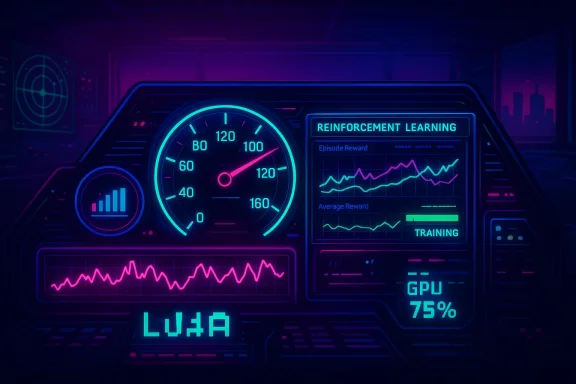
Neon futuristic dashboard displaying reinforcement learning metrics, training progress, and GPU usage.Background / Overview​

Who is Dave Plummer — and why does this matter?​

Dave W. Plummer is widely recognized inside and outside Microsoft for authoring the classic Windows Task Manager and other small but influential Windows utilities. His work on Task Manager began in the mid‑1990s; the tool later shipped in Windows NT and evolved through subsequent Windows releases. Plummer’s name carries weight in Windows circles not only because of the technical legacy but because his projects have repeatedly married clever engineering with hands‑on practicality.
The new dashboard is built as the live visualization front end for Tempest AI — a reinforcement‑learning project that teaches a neural network to play Atari’s 1981 arcade game Tempest by running the game inside the MAME emulator, streaming per‑frame state to a Python training server, and feeding actions back to the emulator in real time. The GitHub repository documents the architecture: a Lua layer inside MAME, a Python training app (Rainbow DQN variant), and a web‑based metrics dashboard served locally. That same repo is where the flashy UI lives, and Plummer shared the demo publicly. (github.com)

The Project: Tempest AI’s Retro‑Futuristic Dashboard​

What the dashboard looks and sounds like​

This is not the austere, utilitarian Task Manager of Windows 10 or 11. Plummer’s interface is loud by deliberate design: bold neon palettes, speedometer‑style gauges, pulsing graphs, animated telemetry, and a pounding synthwave soundtrack. The demo intentionally leans into a retro‑futurist aesthetic — think arcades, radar consoles, and 1980s sci‑fi — applied to system telemetry rather than gameplay alone. Commentators have pointed out that the result is half art installation, half engineering demo.
Plummer himself undercut any pretense of corporate polish with a self‑effacing tweet: “This is probably what Task Manager would look like (and sound like) if I were still around.” That line — alternately playful and provocative — framed the release: the project is a personal experiment, not an official Microsoft UI proposal.

What’s in the code (and how it works)​

The GitHub repo is a full implementation of the Tempest AI pipeline. Key components include:
  • Lua scripts that run inside MAME and extract game state every frame.
  • A Python server that reads serialized frame packets and trains a Rainbow DQN‑style agent on the GPU.
  • A replay buffer, training loop, and an expert‑system bootstrap that seeds early learning.
  • A live web dashboard (self‑contained HTML/CSS/JS) that visualizes metrics and injects spectacle into otherwise dry telemetry. (github.com)
The README is explicit about the system design and the dashboard’s role: it’s a real‑time metrics surface that shows training throughput, model performance, resource usage, and other telemetry — except it does so with theatrical flair. The repository’s languages reflect this hybrid nature: Assembly (for ROM reference), Python (training), and Lua (MAME scripting), with front‑end assets packaged as part of the project. (github.com)

Verified technical details​

Plummer’s own notes and third‑party reporting confirm several concrete points:
  • The code and demo are publicly available on GitHub (davepl/tempest_ai). (github.com)
  • The project uses a combination of Lua (in MAME) and Python on the training side, with a local web dashboard at a specified port. (github.com)
  • Plummer reported — and reviewers verified — that the dashboard is resource‑heavy; on an M2 Mac Pro he observed roughly 75% GPU usage at 30 FPS for the visual demo, which underlines that the interface is visually ambitious rather than lightweight. That technical detail matters when anyone thinks about running the UI on everyday hardware.

Why the project has drawn attention​

Nostalgia meets craft​

There’s a cultural appetite for re‑imagining classic UIs through the lens of modern design and tooling. Plummer’s dashboard taps directly into that feeling: it’s both a what if — “what if Task Manager had been designed by someone who wanted a sci‑fi dashboard?” — and a celebration of an engineer’s unusual sensibility. Fans of retro computing, synthwave aesthetics, and interface nostalgia have been quick to amplify the demo across social platforms and forums.

Open source and learnability​

Because Plummer published the repository, the release is more than showpiece — it’s an educational artifact. The README walks through architecture, configuration, and keys like replay buffer sizes and training hyperparameters. For students of reinforcement learning, hobbyists exploring emulator‑based RL, and developers curious about bridging legacy game code with modern neural nets, the repo provides a pragmatic, runnable example. That availability explains why the piece has traction: it’s an invitation to learn, replicate, and iterate. (github.com)

A conversation starter about utility design​

Plummer’s tongue‑in‑cheek comment about “what Task Manager would look like if I were still around” forced a productive conversation: what should diagnostic utilities be? Is there room for playful, expressive visualizations in tools that historically emphasize clarity and minimalism? The release matters because it reframes mundane software artifacts as canvases for creativity — and because the person doing the reframing is the engineer behind one of Windows’ ubiquitous utilities.

Critical analysis: strengths, opportunities, and risks​

Strengths — what this project gets right​

  • Educational clarity. The repository is not just showy; it documents the RL architecture with concrete parameters and runnable scripts. That makes Tempest AI a valuable learning resource for anyone exploring emulator‑based RL. (github.com)
  • Design courage. The dashboard demonstrates how telemetry can be engaging — animated, kinetic, and even musical — without losing data fidelity. For teams that need attention‑grabbing dashboards (e.g., control centers, game studios, demo floors), the design shows creative possibilities.
  • Open craftsmanship. Publishing the source lowers the barrier to replication and study. Developers can review the training loop, reproduce experiments, and extract components for other projects. (github.com)
  • Community spark. The project provoked lively comment and critique across specialist sites and forums, illustrating the value of independent creators in shaping design discourse.

Opportunities — where this experiment could influence the broader ecosystem​

  • Experimental UIs for dev tools. The dashboard invites more ambitious visual languages for developer and monitoring tools — especially in domains where attention and situational awareness benefit from motion and audio cues.
  • Bridging nostalgia and modern UX. Designers can learn how retro visual metaphors can be applied responsibly to modern information density, creating interfaces that are both playful and functional.
  • Reusable telemetry components. Plummer’s live dashboard code could seed a library of engaging telemetry widgets that other projects reuse — if the license and packaging are clarified (more on that below).

Risks and limitations — what to watch out for​

  • Performance and practicality. The demo’s GPU demand is real: reviewers measured significant GPU use on modern hardware, which makes it impractical as a default system utility or a continuously running admin tool. Visual spectacle can compete with system performance — the opposite of what you want in a monitoring application.
  • Accessibility concerns. Flashing gauges, dense animation, and intense audio make the demo poor for accessibility by default. Monitoring tools often must be usable for people with sensory sensitivities or assistive tech; a spectacle‑first approach can exclude those users unless careful accessibility options are implemented.
  • Security and operational concerns. The dashboard runs as a local web server and interfaces with emulator instances. If deployed carelessly, network sockets and exposed dashboards can create attack surfaces. Plummer’s README advises running locally and adjusting socket addresses — but hobbyists repackaging or exposing the UI could introduce risks. (github.com)
  • Licensing ambiguity. The GitHub README contains a license note limiting the project to educational and research use and warns about copyrighted ROMs and trademarks; however, there is no standard open‑source license file in the repository. That ambiguity creates legal uncertainty for downstream reuse, redistribution, and commercial use. Anyone who wants to fork or embed parts of the project should treat licensing with caution and contact the author or obtain explicit permission. (github.com)
  • Design‑for‑design’s sake. The UI trades minimalism for personality; it’s intentionally theatrical. For the general user base that expects fast, quiet, and efficient utilities — like those for diagnosing a hung process or killing runaway threads — such a dramatic interface could crowd the core task. That tension is central to the critique many commentators raised.

A closer look: technical verifications and reproducibility​

What the README confirms​

Plummer’s README provides a reproducible blueprint:
  • MAME runs the game with an autoload Lua script that extracts ~195 state variables per frame and streams them to a TCP socket.
  • A Python server ingests frames, feeds them to a prioritized replay buffer, and trains a Rainbow DQN variant on GPU.
  • The web dashboard is served locally (default HTTP port shown in README), and metrics are emitted from the training loop for visualization. (github.com)
Practical configuration entries — like state_size = 195, batch_size = 256, memory_size = 15,000,000, and training hyperparameters — are spelled out in the repository, making an exact reproduction feasible for someone with equivalent hardware and legally obtained ROMs. That level of transparency is rare for a playful demo and is one of the project’s strongest technical contributions. (github.com)

What we verified independently​

  • The repository exists and is public on GitHub under davepl/tempest_ai. (github.com)
  • The repo documents the heavy GPU usage reported by Plummer in the demo context; third‑party outlets corroborated that metric during hands‑on reporting. Running the dashboard at high FPS and with full visual effects will tax modern GPUs — an important practical caveat.
  • The dashboard is deliberately separate from Microsoft or official Windows tooling: it’s an independent, personal project built around a specific RL experiment. That distinction matters for expectations and downstream claims.

Design lessons for product teams and hobbyists​

Where to borrow from Plummer’s experiment​

  • Use narrative telemetry: give system metrics story arcs (e.g., gauges that animate only on thresholds) rather than constant motion. This lowers cognitive load while preserving spectacle.
  • Provide opt‑outs: the demo’s audio and animation are polarizing; make them toggleable by design so the same dashboard can be calm or demonstrative depending on user needs.
  • Document everything: the GitHub README is a model for making complex projects accessible. Clear runbooks, hyperparameter tables, and runnable commands drastically lower the barrier to entry.

Where product teams should be cautious​

  • Preserve function over form for diagnostic utilities. The moment visuals obscure immediate actions (like finding and killing a hung process), the tool fails its primary use case.
  • Always include accessibility defaults. Motion reduction, high‑contrast options, and screen‑reader support should be part of any design intended for general use.
  • Clarify license terms early. If you publish a visually compelling demo and expect community reuse, include a standard open‑source license and clear guidance on trademarked or copyrighted assets (e.g., ROMs). (github.com)

Community reaction and cultural context​

Across reporting outlets and enthusiast forums, the response has been a mix of amusement, admiration, and critique. Outlets framed the release as a nostalgia‑driven design experiment and flagged the resource costs and accessibility tradeoffs. Community threads highlighted two recurring themes: gratitude for an engineer’s candid creative outlet, and debate about whether such aesthetic directions could ever be appropriate in a mainstream tooling context. The project catalyzed exactly the sort of design argument you want when a cultural artifact gets reimagined: it forced people to think about why conventional utilities look the way they do and who they serve.

Final takeaways​

Dave Plummer’s retro‑futuristic Task Manager concept is a delightful, well‑documented thought experiment that lives at the intersection of craftsmanship, teachability, and theatrical design. It’s valuable for three reasons: as a runnable reinforcement‑learning example, as an argument about how telemetry can be expressed, and as a cultural prompt that asks modern designers to revisit assumptions about utility UI.
That said, the project is intentionally a passion play — not a production‑ready replacement for Windows’ Task Manager. It showcases what spectacle can do for engagement, but it also exposes common pitfalls: high resource usage, accessibility gaps, and licensing ambiguity. For designers and engineers, the best parts to take away are the readability of the technical documentation, the careful coupling of emulator internals to a training loop, and the courage to treat a daily tool as a canvas.
If you’re curious to explore further, the code is public and the README gives step‑by‑step instructions to run the system locally — but be mindful of the practical requirements (MAME, legally obtained ROMs, GPU resources) and the license notice embedded in the repo. Use the demo as a laboratory for ideas, not as an out‑of‑the‑box system utility replacement, and remember: not every piece of software needs to be monochrome to be useful — but it does need to be usable. (github.com)


Source: thewincentral.com Nostalgic Windows Project Reimagines Task Manager
 

Amdocs’ announcement at Mobile World Congress 2026 that it is collaborating with Microsoft to deliver AI‑accelerated application modernization represents a clear signal that the next phase of enterprise transformation will be run by coordinated AI agents, not just human consultancies and lift‑and‑shift projects. The partnership combines Amdocs’ new agentic operating system (aOS) and its Agentic Services with Microsoft’s Foundry platform, Azure OpenAI capabilities, GitHub Copilot integrations and Fabric IQ to automate, orchestrate, and measure end‑to‑end modernization work—from assessing the business case through automated refactoring and migration to Azure.

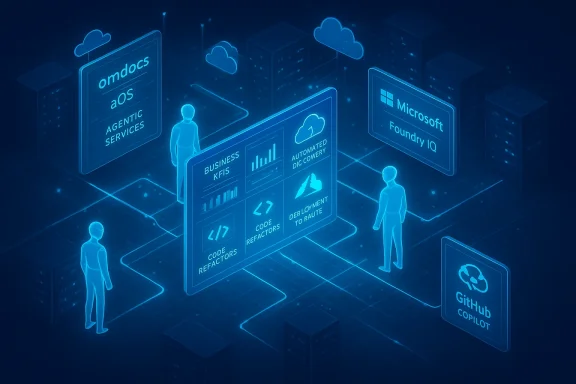
Futuristic blue holographic scene of cloud-based dev tools, code panels, and team avatars.Background / Overview​

Modernization has entered a new phase. Over the past two years, enterprise modernization projects moved from tool‑led migrations and manual refactors to pilot AI use cases that accelerate discovery and testing. Vendors now package “agentic” tooling—software agents that perform specialized engineering and operational tasks—into orchestration layers that promise repeatable, measurable outcomes. Amdocs’ aOS and Agentic Services are explicitly built as a multi‑agent orchestration fabric that coordinates specialized agents running across domains (business, IT, network), while Microsoft’s Foundry and Fabric IQ provide the data, model orchestration, and governance layer those agents will consume and act upon. (azure.microsoft.com)
This is not Amdocs’ first step alongside Microsoft: the two companies have been deepening their partnership around telco AI and cloud modernization for several years, and Amdocs’ recent launches—amAIz and the CES25 suite—already leaned heavily on Azure and Microsoft AI services. The MWC 2026 announcement formalizes a tighter operational play: deliver Service‑as‑Software modernization where AI agents execute work under human supervision and produce measurable outcomes.

What Amdocs + Microsoft Are Offering​

At a high level the joint offering announced at MWC 2026 combines three pillars:
  • Agent orchestration and domain‑specific agent libraries (Amdocs Agentic Services / aOS) to automate modernization tasks and multi‑agent workflows.
  • A model, knowledge and observability layer (Microsoft Foundry, Foundry IQ, Fabric IQ) to ground agents in enterprise data, manage models, and provide governance and auditability.
  • Developer and migration tooling (Microsoft Migration Agents, GitHub Copilot integrations, migration accelerators) that speed refactoring, code‑translation, testing and deployment into Azure.
Concretely, Amdocs says customers will be able to deploy coordinated Amdocs + Microsoft IT agents that automate activities such as automated discovery and mapping of legacy applications, code analysis and refactoring recommendations, automated test generation and execution, deployment orchestration to Azure, and continuous observability of post‑migration health. The joint approach is described as “from business case to execution” with measurable business outcomes and full observability and control.

Core technical ingredients (what each partner brings)​

  • Amdocs
  • Agentic operating system (aOS) and Amdocs Agentic Services: prebuilt, telco‑domain and enterprise workflows; modernization and quality engineering expertise; production experience with massive transaction volumes.
  • Domain templates and configurable agent libraries, built for large, regulated environments (telcos, media).
  • Microsoft
  • Foundry (agent and app factory), Foundry IQ (knowledge and retrieval for agents), and Fabric IQ (business data intelligence) for context‑aware agents and governance.
  • Azure OpenAI / Foundry Models and GitHub Copilot to accelerate code transformation, and Microsoft Migration Agents to operationalize migration tasks.

Why This Matters: The Promise for Enterprises​

Amdocs frames the collaboration as delivering a step change in speed, quality, and traceability for modernization projects. The promise is persuasive for several reasons:
  • Scale and specialization: Amdocs brings deep, verticalized expertise in telco OSS/BSS and large enterprise systems; Microsoft supplies an enterprise‑grade AI and governance fabric. That combination reduces the “translation cost” between business outcomes and engineering execution.
  • End‑to‑end automation: By chaining discovery, code transformation, test automation, and deployment in agent workflows, the partnership aims to cut manual handoffs and the typical multi‑quarter (or multi‑year) timelines of legacy modernization.
  • Built‑in governance and observability: Modernization at scale requires auditability, data sensitivity controls, and performance telemetry. Foundry’s IQ and Fabric IQ are designed to provide the knowledge, permissions, and observability required to run agents across sensitive enterprise datasets.
  • Business measurement: The pitch emphasizes “measurable business outcomes.” That is, the offering is intended not just to produce technical artifacts but to tie results to business KPIs (cost, time to market, system resilience). Amdocs also points to its managed‑services footprint—where it already runs critical, revenue‑generating systems—to underscore operational credibility.

Demonstrations at MWC 2026 — What To Watch For​

Amdocs said it will demonstrate cloud transformation–specialized agents at partner demo pods, and Microsoft will showcase the joint solution at its booth. Expect demos focused on:
  • Automated discovery and dependency mapping for complex telco stacks (OSS/BSS).
  • Agentic workflows that convert legacy code patterns into cloud‑native microservices or containerized workloads with automated tests and CI/CD triggers.
  • Governance workflows that show Foundry IQ enforcing document and data permissions during RAG (retrieval‑augmented generation) and agent activity.
These demos are important because they will show whether the orchestration is genuinely end‑to‑end—and whether it can be constrained safely in a regulated environment.

Critical Analysis: Strengths​

  • Practical enterprise focus, not vaporware
    Amdocs is not a pure play AI startup. It runs billions of daily transactions for global telcos and has a large managed services business. That operational experience reduces a common enterprise fear: that AI projects produce prototypes but not production outcomes. Amdocs’ emphasis on managed outcomes and observability addresses that gap.
  • Combining vertical expertise with platform power
    The partnership pairs Amdocs’ telco‑centric templates and workflows with Microsoft’s Foundry and Fabric IQ. This is a compelling model: specialized industry knowledge combined with a general, governable AI foundation. Foundry’s explicit focus on agent governance, knowledge indexing and model routing is designed to tame one of the riskiest elements of agentic deployments—ungoverned access to enterprise data.
  • Built for observability and governance
    Foundry and Fabric’s control planes promise monitoring, policy enforcement and audit trails. These capabilities are not optional for enterprises subject to regulatory, privacy, or security constraints. The ability to enforce sensitivity labels end‑to‑end—while agents act on data—will be a key differentiator if implemented correctly.
  • Faster path to measurable outcomes
    If the agent workflows produce consistent, auditable artifacts (refactored code, test coverage, runbooks, rollback plans) and tie those artifacts to business KPIs, the offering could materially shorten value realization cycles for large modernization programs.

Critical Analysis: Risks, Gaps and Unanswered Questions​

  • Vendor lock‑in and architectural gravity
    The joint solution is deep into Microsoft’s stack (Foundry, Azure OpenAI, Fabric, GitHub Copilot). Enterprises must weigh the cost of tighter coupling to Microsoft against the engineering and business benefits. For large, heterogeneous estates that rely on multi‑cloud or non‑Microsoft stacks, moving core modernization orchestration into a Microsoft‑centric flow could complicate future flexibility.
  • Data sovereignty, regulation and privacy risks
    Running agentic workflows over sensitive customer, billing or network data introduces compliance challenges. While Foundry touts permission enforcement and sensitivity label propagation, implementing those controls across legacy systems, third‑party data stores and regional data‑residency requirements is nontrivial and remains a major integration effort. Real world enforcement will determine whether the governance claims are realized.
  • Hallucinations, correctness and software quality
    AI‑assisted code transformation and automated refactoring can accelerate development—but it also raises the specter of subtle correctness bugs and latent defects. Enterprises must ensure that agent‑produced code is subject to rigorous, domain‑specific testing and human review. The promise of “accelerated refactoring” must be proven across many customer sites and codebases before being accepted as repeatable.
  • Integration complexity and hidden migration costs
    Modernization projects typically surface hidden business rules, custom integrations, and long‑tail exceptions. The economics for AI‑accelerated modernization will depend on how well agents can detect and handle those irregularities without constant human triage. If human intervention remains frequent, the claimed efficiency gains will be diluted.
  • Governance fatigue and operational overhead
    Adding an agent control plane, data indexing, and observability layers is itself an operational burden. Enterprises should expect a nontrivial period of configuration, tuning, and governance rulecrafting before agents can be trusted to act autonomously or semi‑autonomously.

Where This Fits in the Competitive Landscape​

This Amdocs + Microsoft approach is one among several vendor strategies to industrialize modernization with AI and managed services:
  • Kyndryl launched AI‑powered mainframe modernization services with Microsoft Cloud in late 2024, emphasizing mainframe lift‑and‑transform scenarios. That program shows hyperscaler‑plus‑services players are racing to own specific legacy domains.
  • DXC’s “DXC Complete with SAP and Microsoft” targets SAP transformation and bundles managed services with SAP Business AI on Azure—another example of specialized modernization using Microsoft’s platform.
  • Public cloud providers (AWS, Azure, Google Cloud) and large consultancies are releasing agentic features in migration toolkits and managed modernization programs, raising the bar—and the competitive pressure—for outcome‑oriented offerings. Recent industry moves suggest a multi‑front race: platform providers build programmable agent and governance layers while services firms productize vertical migration playbooks.
The market is therefore shifting to a pattern: platform providers (Microsoft) provide the operational fabric and model governance; systems integrators and software vendors (Amdocs, DXC, Kyndryl) provide vertical know‑how, agent libraries, and outcome accountability.

Practical Guidance: How Enterprises Should Evaluate the Offer​

If you’re responsible for application modernization, use this checklist to assess whether a pilot with Amdocs + Microsoft is appropriate:
  • Business alignment
  • Are you measuring modernization success in business terms (revenue enablement, TCO reduction, time‑to‑market), not only technical milestones?
  • Do you have explicit KPIs to measure agent‑driven automation (time per refactor, test pass rate, post‑migration incidents)?
  • Data & compliance readiness
  • Have you cataloged data sensitivity and residency requirements for systems that agents will index or access?
  • Can Foundry IQ and Fabric IQ enforce those policies across your estate? Request a proof‑of‑concept that demonstrates enforcement across representative datasets.
  • Technical integration
  • What is the current application dependency map? Ask vendors for a pilot that targets a clearly scoped service with well‑defined interfaces.
  • How will the migration agents integrate with your CI/CD pipeline, secrets management, and runtime observability?
  • Human process and governance
  • Who will own agent governance? Identify a cross‑functional team (security, legal, architecture, SRE) to define guardrails and escalation paths.
  • Ensure review and sign‑off steps are baked into agent workflows for high‑risk changes.
  • Proof metrics and rollback
  • Define success criteria up front and require artifact‑level outputs: refactored code, coverage reports, migration checklists, rollback plans, and runbooks.
  • Ensure the pilot includes demonstrable rollback tests and canary deployments to validate production readiness.

A Practical 6‑Step Roadmap to a Low‑Risk Pilot​

  • Identify a single, business‑impacting application with moderate complexity and clear KPIs.
  • Run automated discovery and dependency mapping (agentic discovery) to validate the estate’s suitability.
  • Execute an agentic refactor on a non‑critical environment with full test automation and human sign‑off gates.
  • Use Foundry IQ to demonstrate data access, sensitivity enforcement, and query auditing across agent actions.
  • Measure outcomes (time saved vs baseline, defect density, deployment time) and adjust agent workflows.
  • Expand scope incrementally—add additional services and operationalize within managed‑service boundaries.
This staged approach reduces risk while providing concrete artifacts for both technical and business stakeholders.

What Success Looks Like — And What Failure Could Look Like​

Success will be visible in quantitative improvements: shorter migration timelines, reproducible refactor artifacts, stable CI/CD rollouts, and measurable reduction in manual effort for repetitive tasks. Equally important: success means the governance plane (Foundry / Fabric IQ) prevents unauthorized data access while enabling agents to function effectively.
Failure scenarios are clear too: a pilot that produces code with undetected domain‑specific bugs, an agent that accesses or leaks sensitive data, or a program whose incremental gains are consumed by integration and governance overhead. In those cases, costs rise, trust declines, and organizations revert to manual, human‑led modernization approaches.

Recommendations for CIOs, CTOs and Architects​

  • Treat agentic modernization as both a technology and organizational change program. The tech is accelerative only when governance, skills, and processes are in place.
  • Require vendors to produce reproducible artifacts and measurable KPIs as part of any contract. Avoid vague outcome promises.
  • Pilot in low‑risk contexts but ensure the pilot exercises the full stack: discovery, transformation, testing, migration, and governance.
  • Demand transparency on data handling: how Foundry IQ indexes sensitive data, how RAG is performed, and how logs and audits are retained and protected.
  • Consider multi‑cloud and portability tradeoffs: if vendor lock‑in is a concern, insist on exportable artifacts and a migration exit plan.

Final Assessment — A Pragmatic Step, Not a Magic Bullet​

The Amdocs + Microsoft collaboration crystallizes the industry’s shift toward agentic, outcomes‑oriented modernization. It combines Amdocs’ vertical depth and operational muscle with Microsoft’s Foundry, model and governance layer—an attractive combination for regulated, scale‑sensitive enterprises such as telcos. If the parties deliver on governance, reproducible artifacts and measurable business outcomes, this approach could materially shorten modernization timelines and reduce operational risk.
Yet the offering also surfaces perennial modernization tensions: vendor lock‑in, the difficulty of taming legacy complexity, and the governance burden of agentic systems. Enterprises should therefore treat any initial engagement as a controlled experiment: require measurable outputs, insist on strict data sovereignty and auditability, and scale only after the pilot proves correctness, safety, and ROI.
MWC 2026 will be the first public stage for Amdocs’ agentic modernization demos with Microsoft. Watch the demos closely, probe the governance proof points, and insist on artifact‑level evidence—because at the end of the day, modernization that can be measured and repeated is the only modernization that will stick.

Source: ACCESS Newswire MWC 2026: Amdocs Collaborates with Microsoft to Bring AI-Accelerated Application Modernization to Enterprises
 

Amdocs’ announcement at Mobile World Congress 2026 that it is partnering with Microsoft to deliver AI‑accelerated application modernization crystallizes a larger shift: modernization is moving from lift‑and‑shift projects and siloed advisory work to coordinated, agent‑driven workflows that promise measurable business outcomes from business case to execution. This collaboration pairs Amdocs’ Agentic Services and its agentic operating system (aOS) with Microsoft’s enterprise AI stack — notably Microsoft Foundry (including Azure OpenAI in Foundry Models), migration tooling, GitHub Copilot integrations and Fabric intelligence — to create end‑to‑end, agent‑orchestrated modernization paths that target speed, resilience, and observability across cloud migrations and refactorings. ]

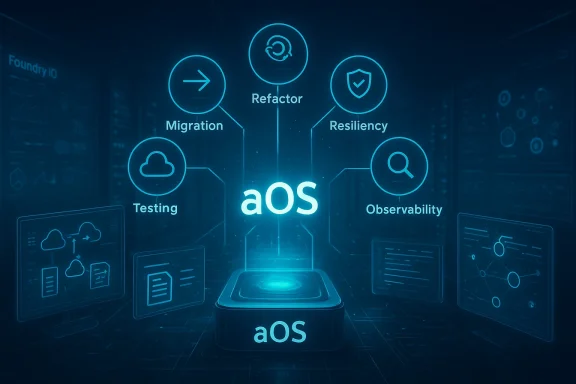
Futuristic neon dashboard showing aOS components: Migration, Refactor, Resiliency, Testing, Observability.Background / Overview​

Amdocs framed the MWC 2026 announcement as the next evolution of its aOS strategy: a telco‑focused, agentic operating system that embeds domain knowledge, prebuilt agent libraries and workflows to operationalize generative AI across business, IT and network domains. aOS is already being pitched as a production‑grade control layer for multi‑agent processes — one that orchestrates migration, refactoring, quality engineering, observability and recovery agents into coordinated flows. Amdocs has promoted aOS and its Agentic Services publicly in February 2026, with the Microsoft collaboration presented as a targeted application of those capabilities to accelerate Azure migrations and modernization.
Microsoft’s side of the story centers on Foundry — the company’s enterprise agent and app platform — and the intelligence layers Microsoft now positions as critical for agentic automation: Work IQ, Fabric IQ, and Foundry IQ. Foundry supplies knowledge bases, an agent runtime, tool integrations and guardrails; its agent services enable orchestration of tool calls, identity enforcement, and observability for production agents. Microsoft’s industry blog on MWC 2026 highlights the broader partner ecosystem (including Amdocs) building atop Foundry and Fabric to deliver telco AI use cases.
Together, the two vendors propose a packaged path: prebuilt, customizable modernization workflows delivered as a mix of software plus Software‑as‑Service execution — what Amdocs calls “Service‑as‑Software” — with Microsoft technologies providing runtime models, toolsets and governance.

Why this matters: the agentic thesis for modernization​

Modernization projects historically fail or underdeliver for two recurring reasons: (1) complexity and tight coupling in legacy estates (business logic, databases, bespoke integrations), and (2) the human‑intensive, repeatable but error‑prone operational work required to analyze, refactor and replatform code at scale. The Amdocs–Microsoft model directly addresses both by combining:
  • Domain encapsulation: Amdocs’ telco ontologies, agent libraries and aOS workflows embed domain rules that speed decisions and reduce manual interpretation errors.
  • Agentic automation: Microsoft Foundry’s agent runtime and knowledge bases let agents call tools (APIs, Azure services, build pipelines, governance checks) in a controlled, auditable fashion.
  • Orchestration at scale: Multi‑agent choreography — where migration, refactor, resiliency, test, and observability agents coordinate — shortens cycle times while maintaining traceability.
Put simply: the partnership reframes modernization from a sequence of discrete projects into an operational product that runs repeatable agentic workflows, which can be measured, tuned, and governed like any other software product.

What each partner brings to the table​

Amdocs — aOS, Agentic Services, and telco DNA​

  • aOS (agentic operating system): Amdocs positions aOS as a telco‑grade control layer for agentic processes, with a Cognitive Core that supplies telco‑specific agent libraries, taxonomy, and end‑to‑end workflows for OSS/BSS modernization. aOS is designed to sit atop existing stacks and orchestrate cross‑domain execution.
  • Agentic Services: Packaged, prebuilt agents and workflows for migration, refactoring, resiliency, testing and troubleshooting. These services are delivered as configurable modules intended to reduce time‑to‑value.
  • Domain expertise and delivery muscle: Amdocs’ decades of running mission‑critical telco systems and large transformation programs are a central value proposition — they bring both code‑level knowledge and field delivery teams for hybrid human‑AI operations.

Microsoft — Foundry, model and agent plumbing, governance​

  • Foundry and Foundry IQ: Provides knowledge bases, model hosting (including Azure OpenAI and other Foundry Models), agent runtime and integrations for enterprise data and tooling. Foundry’s security, identity and observability mechanisms are central to production‑grade agent deployment.
  • Fabric IQ and data layer: Fabric IQ indexes business data and connects it to agents, enabling grounded retrieval, business context and governance for responses and actions.
  • Developer automation tooling: GitHub Copilot and integrated developer workflows accelerate code refactoring, accelerate repetitive code transformations and help keep human engineers productive within an agentic pipeline.
The collaboration explicitly lists Microsoft Migration Agents, Azure OpenAI in Foundry Models, GitHub Copilot, Fabric IQ and Foundry components as key building blocks used in the combined solution.

How the solution is intended to operate — a technical walkthrough​

1. Discovery and intent capture​

An Amdocs/Microsoft pair of agents ingests application inventories, code repositories, network topology and business priorities. Foundry IQ (knowledge bases) indexes relevant documentation and permissions, while aOS maps telco ontologies to existing BSS/OSS constructs. This produces a prioritized modernization backlog with measurable KPIs.

2. Automated analysis and pattern identification​

Agents analyze code, runtime telemetry, configuration drift and dependencies. GitHub Copilot‑assisted agents and static analysis tools propose refactoring candidates, migration pathways and test harnesses. The result: a producible plan that balances risk, cost and time.

3. Agentic execution and refactoring​

Coordinated agents orchestrate code transformation steps — from template‑based refactors to containerization and infrastructure as code provisioning — invoking Azure services, CI/CD pipelines and test automation. Instrumentation and logs are captured for every action for traceability.

4. Observability, evaluation and rollback​

Fabric IQ and Foundry observability capture business‑level metrics and model evaluation signals; resiliency and troubleshooting agents run fault‑injection and automated rollback when thresholds are breached. The model loop monitors agent decisions and flags drift or emergent risk.

5. Continuous optimization​

Agents run periodic sweeps: updating knowledge bases, re‑evaluating refactoring queues, retraining grounding signals and optimizing cost/performance across Azure. Amdocs’ quality engineering playbooks are embedded into agent workflows to preserve service quality.

Business benefits claimed — and which are realistic​

Amdocs and Microsoft frame several measurable business outcomes from the joint offering:
  • Faster modernization timelines: By automating discovery, analysis and repetitive refactoring tasks, the solution aims to reduce calendar time compared with manual programs. This is credible where repetitive patterns exist (e.g., standard middleware refactors).
  • Improved quality and consistency: Automation of standardized transformations plus embedded test harnesses should reduce human error and increase repeatability, especially across multi‑tenant telco estates.
  • Observability and traceability: Foundry and Fabric provide conversation‑level and action‑level logs that improve auditability for regulatory and operational needs.
  • Operational resilience: Automated resiliency tests, rollbacks and troubleshooting agents improve mean time to repair when migration issues surface — assuming proper governance and guardrails are in place.
These benefits are plausible and align with tangible industry results when automation is applied to repeatable processes. However, the magnitude of gains will vary widely depending on legacy heterogeneity, organizational readiness and the degree of human oversight in the loop.

Key technical and operational risks — what enterprise CIOs must weigh​

The agentic modernization approach offers promise — but it also introduces new vectors of complexity and risk. Organizations evaluating this joint solution should consider the following detailed concerns.

1. Data governance, privacy and residency​

Agents need access to sensitive code, configuration and customer data. Ensuring correct enforcement of data residency, RBAC, and document‑level permissions across Foundry knowledge bases and Amdocs workflows is nonnegotiable for regulated operators. Enterprises must confirm how identity and access are enforced and how logs are retained for compliance.

2. Model grounding, hallucination and correctness​

When agents generate refactoring proposals or configuration changes, incorrect suggestions can be dangerous. Ensuring models are grounded with verified artifacts, guarded by deterministic checks, and reviewed by human engineers for high‑risk actions is essential. Foundry’s grounding and tool‑call enforcement help, but they are not a substitute for strict validation in mission‑critical paths.

3. Audit trails and change provenance​

Modernization must be auditable. Enterprises need crisp provenance — who/what made each change, what data was used, why a decision was taken, and how it maps to compliance requirements. The combination of Foundry’s logging and Amdocs’ observability features is promising, but validating the end‑to‑end audit chain in a customer’s context will take effort.

4. Vendor and platform lock‑in​

Packaging modernization as prebuilt, vendor‑managed agentic workflows can acceay also increase dependency on specific frameworks, connectors and models. Enterprises must evaluate portability — for example, whether workflows can be rehosted on other clouds or with alternative agent runtimes — and negotiate operational exit paths. Amdocs’ multi‑vendor posture is meant to mitigate this, but customers should validate contractual and technical portability guarantees.

5. Security posture of agentic workflows​

Agents that can call APIs, provision infrastructure, or change production configurations create an expanded attack surface. Identity hardening, least privilege, and runtime isolation (e.g., network segmentation, private endpoints) must be built in, tested and verified. Foundry and Azure provide primitives; integrating them correctly into Amdocs’ orchestration is a nontrivial systems engineering challenge.

Practical adoption roadmap — a prescriptive approach​

For enterprises considering the Amdocs–Microsoft route, a pragmatic, staged adoption lowers risk and accelerates value capture.
  • Start with a bounded pilot that targets a single application family or service domain. Validate agentic discovery, refactor proposals and automated test harnesses before broad rollout.
  • Build a governance charter that defines model use, data access, change approval gates, and incident response for agentic actions. Include legal, security and compliance stakeholders early.
  • Establish a human‑in‑the‑loop policy for high‑impact changes. Use agents for low‑risk or pre‑approved transformations and mandate human sign‑off for production‑critical changes.
  • Instrument end‑to‑end observability: business KPIs, telemetry, model evaluations and provenance logs must all be correlated for effective audits and continuous improvement. Fabric IQ and Foundry observability components are intended to help here.
  • Negotiate contractual portability and security SLAs with vendors. Ensure the ability to extract reusable artifacts (playbooks, migration blueprints, IaC templates) from the managed service to avoid long‑term lock‑in.

MWC 2026 demos and what to look for on the show floor​

Amdocs said it will demonstrate cloud transformation‑specialized agents at partner demo pods while Microsoft will showcase the integrated solution at its booth. For attendees and evaluators, the demos to prioritize:
  • End‑to‑end migration walkthroughs that show discovery → refactor → deployment → rollback, with real‑time observability. Look for reproducible artifacts like IaC templates and test result histories.
  • Agent orchestration flows where multiple specialized agents (migration, optimization, observability, resiliency, troubleshooting) coordinate on a single change and provide traceable decisions.
  • Governance controls in practice: RBAC enforcement, sensitive data redaction, consent flows and audit replay to validate the enterprise readiness of the offering.

How this sits in the broader market — vendors, partners and positioning​

The Amdocs move is part of a broader industry pattern: systems integrators and platform vendors are packaging agentic automation into domainized offerings. Other vendors (cloud hyperscalers and specialized software vendors) are similarly offering agentic agent frameworks, migration accelerators and domain templates. The distinguishing factor for Amdocs is its telco domain depth and aOS positioning, while Microsoft’s differentiator is the Foundry runtime plus Fabric’s data intelligence. Together, they present a credible path for service providers and large enterprises where telco domain knowledge materially accelerates decisioning.
However, customers should compare alternative vendor offerings on three axes: domain fidelity (how well does the provider understand industry specifics), openness and portability (can you switch cloud or agent runtimes?), and operational liability (SLA, security, auditability). The market is moving fast; due diligence and small, measured pilots remain best practice.

Verification of the headline claims and financial context​

Amdocs’ press materials explicitly state the components used in the collaboration (Amdocs Agentic Services, Microsoft Foundry including Azure OpenAI models, Microsoft Migration Agents, GitHub Copilot and Fabric IQ). This is corroborated by Microsoft’s MWC blog where Amdocs is cited as a partner embedding Microsoft Foundry and Azure OpenAI into telco modernization solutions.
Amdocs’ public filings and investor communications confirm scale and financial context: their SEC filing and annual report filings for fiscal 2025 provide the revenue and financial disclosure backdrop referenced in press materials, and the company’s investor news pages and SEC 20‑F filings are the official record for fiscal figures stated in press releases. Enterprises evaluating vendor statements should cross‑check press claims against the company’s SEC filings for full financial context.

Final analysis — strengths, caveats, and a clear call to caution​

Strengths
  • Integrated domain + platform approach: Amdocs’ telco knowledge combined with Microsoft’s Foundry runtime is a strong fit for communications operators that need domain accuracy plus production‑grade agent control.
  • Operational focus: Packaging modernization as a repeatable, measurable product (Service‑as‑Software) addresses the perennial “how do we scale modernization?” question.
  • Enterprise observability and governance primitives: Microsoft Foundry’s built‑in identity, RBAC, and logging plus Amdocs’ delivery playbooks offer a pragmatic control plane for risky modernization efforts.
Caveats and risks
  • Not a silver bullet: Agentic automation accelerates some tasks but cannot magically solve brittle business logic, undocumented customizations, or hidden vendor dependencies without significant human insight and governance.
  • Security and compliance must be engineered, not assumed: Production agentic actions require hardened identity, network isolation, and forensic logging. Organizations must validate these controls in their environment.
  • Watch for lock‑in: Customers should negotiate portability of artifacts and exit strategies before embedding business‑critical modernization pipelines into a single vendor ecosystem.
Cautious optimism is the right posture: the technical foundations (agent runtimes, knowledge indexing, model hosting and orchestration) are now mature enough to make this approach practical. But successful large‑scale modernization will still depend on disciplined governance, human oversight, incremental pilots and contractual clarity.

Conclusion​

The Amdocs–Microsoft collaboration announced at MWC 2026 is a strategic, concrete example of how the agentic wave is moving from concept to operational product. By combining Amdocs’ aOS and Agentic Services with Microsoft Foundry, Fabric IQ, Azure OpenAI and developer tooling, the partnership offers enterprises a packaged, measurable path to modernization that emphasizes speed, observability and repeatability. Those benefits are real — especially for telco operators with deep domain complexity — but they come with material responsibilities: careful governance, security engineering, and contractually ensured portability.
Enterprises evaluating this route should focus on tight pilots, clear human‑in‑the‑loop rules, and provable audit trails before scaling. If Amdocs and Microsoft deliver on their promises — and customers validate controls in production — agentic modernization could become a dominant pattern for moving legacy estates into an AI‑enabled future.

Source: The Globe and Mail MWC 2026: Amdocs Collaborates with Microsoft to Bring AI-Accelerated Application Modernization to Enterprises
 

Back
Top