

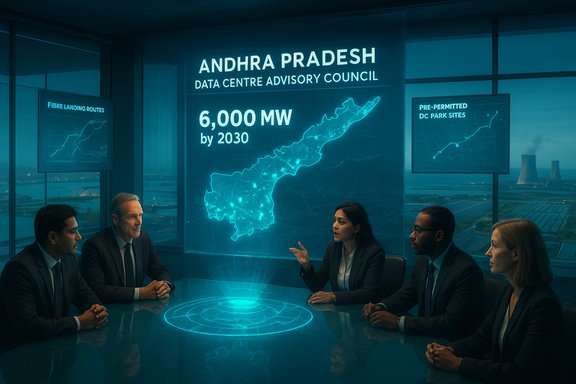
Andhra Pradesh’s government has moved from ambitious pitch to structured execution by constituting a dedicated Data Centre Advisory Council tasked with delivering a roadmap to 6,000 MW of data‑centre capacity by 2030, positioning Visakhapatnam as the state’s flagship AI‑era infrastructure hub.
The announcement formalises a coordinated push to translate large headline investments and policy promises into operational hyperscale capacity. The Council — created by Government Order (G.O. 46) — builds on the Andhra Pradesh Data Centre Policy 4.0 and brings together hyperscale cloud providers, global and domestic data‑centre operators, land and real‑estate advisors, power and cooling specialists, telecom and fibre providers, industry bodies, and academic institutions under a single advisory platform.
This is not a small target. Six thousand megawatts of commissioned IT load by 2030 implies multiple gigawatt‑scale clusters, deep integration with renewable and grid power infrastructure, dense subsea and terrestrial fibre, dedicated real‑estate supply chains, and a workforce pipeline able to staff tens of thousands of operations and engineering roles. The Council’s remit ranges across utilities, land policy, permissions, talent, cyber resilience and investor outreach — all essential to move from memoranda of understanding (MoUs) to concrete builds and operations.
However, the path to 6,000 MW by 2030 is narrow and requires disciplined execution on utilities, environmental controls, supply‑chain management and fiscal structuring. Variations in reported investment figures and the need for primary government order text to be publicly accessible mean planners and investors must demand verified contracts and timelines rather than rely solely on press reports.
The Council’s immediate work should be to publish an actionable pipeline, concrete timelines, and measurable KPIs — and to translate anchor announcements into binding, investor‑grade commitments. If it succeeds, Andhra Pradesh’s integrated approach could become a case study in how state policy, anchored private capital, and operational governance together unlock hyperscale data‑centre capacity at national scale.
Source: The Hindu Govt. forms apex Advisory Council to help A.P. reach 6,000 MW data centre capacity by 2030
 Background
The announcement formalises a coordinated push to translate large headline investments and policy promises into operational hyperscale capacity. The Council — created by Government Order (G.O. 46) — builds on the Andhra Pradesh Data Centre Policy 4.0 and brings together hyperscale cloud providers, global and domestic data‑centre operators, land and real‑estate advisors, power and cooling specialists, telecom and fibre providers, industry bodies, and academic institutions under a single advisory platform.This is not a small target. Six thousand megawatts of commissioned IT load by 2030 implies multiple gigawatt‑scale clusters, deep integration with renewable and grid power infrastructure, dense subsea and terrestrial fibre, dedicated real‑estate supply chains, and a workforce pipeline able to staff tens of thousands of operations and engineering roles. The Council’s remit ranges across utilities, land policy, permissions, talent, cyber resilience and investor outreach — all essential to move from memoranda of understanding (MoUs) to concrete builds and operations.
Overview: what the Council is and who’s on it
The Council is described as an “apex” advisory body with cross‑sector representation. Key constituents reported to be included:- Government leadership and secretariat drawn from the state ITE&C department and APEDB.
- Hyperscale and cloud players (representation cited from Microsoft Azure and leading global operators).
- Major global and national data‑centre operators (NTT GDC India, ST Telemedia GDC).
- Real‑estate, land and industrial advisors (Cushman & Wakefield, JLL).
- Local data‑centre ecosystem firms (Pi Data Centres).
- Power and cooling technology providers (Schneider Electric).
- Connectivity providers (Jio Platforms) and state network backbone representation.
- Industry bodies and policy/standards groups (NASSCOM, DSCI, ISPAI, IEEMA).
- Academic and research partners (Andhra University, IIM Visakhapatnam, IIT Tirupati).
- Resilience and security stakeholders (CERT‑In, APSDMA, APTS, state cyber operations).
- Technical coordination and meeting support reportedly assigned to a private consultancy operating as the Council’s technical secretariat.
Why this matters: anchors, momentum and market context
Two headline anchor commitments underpin the Council’s early credibility: a 1 GW Google data‑centre cluster proposed for Visakhapatnam, and a 550 MW commitment from Sify Infinit Spaces. Those announcements create immediate investor and market momentum that the Council’s framework is intended to harness into wider private investment and operational capacity.- Anchor investments matter because they catalyse developer interest, accelerate supplier chains, and justify upstream capacity expansion in power and fibre.
- Making Visakhapatnam a data‑centre node aligns with the city’s port and coastal fibre landing potential — a logical location for subsea cable landings and east‑coast network density.
- The State’s Data Centre Policy 4.0 creates incentive architecture (land, power, fiscal incentives, single window support) meant to shorten lead‑times for hyperscale projects.
Strengths: what the Council can realistically deliver
The Council’s design and stakeholder mix deliver several practical advantages that improve the probability of achieving large‑scale capacity targets:- Holistic stakeholder alignment. Bringing cloud, operators, real‑estate, power and telecom under one forum reduces the friction of multi‑party coordination and accelerates decisions on land, power and network synchronization.
- Anchor‑driven pipeline. Converting Google and Sify commitments into shovel‑ready projects will catalyse the local supply chain and attract follow‑on investments; anchors reduce perceived project risk.
- Renewable‑first messaging. Reported planning to pair anchor data centres with renewable energy commitments (including dedicated renewable capacity allocations) aligns with global enterprise and cloud buyers that increasingly insist on green‑power credentials.
- Dedicated secretariat and technical coordination. A central operational cell can materially reduce bureaucratic drag and keep cross‑agency timelines aligned with developers’ construction schedules.
- Academic and skills integration. Tying in Andhra University, IIM Visakhapatnam and IIT Tirupati enables a clearer path to training, research and localized skills pipelines required for large‑scale operations and AI workloads.
- Security and resilience on the agenda. Early inclusion of national cyber authorities and the state’s disaster management agency helps frame secure, compliant and resilient design standards rather than leaving them to ad‑hoc measures.
Key technical and policy levers the Council must master
To make 6,000 MW a reality, the Council must deliver against a set of interlocking technical and policy deliverables. These are the “must‑win” areas:- High‑capacity, low‑latency fibre and subsea landing infrastructure — multiple, redundant cable landing stations and robust terrestrial backhaul.
- Large, dedicated power feed capacity with a mix of renewables and firming solutions (storage, long‑term PPAs, gas or other firming generators) to ensure 24x7 availability.
- Industrial‑scale, plug‑and‑play DC parks with predefined land parcels, utility corridors and pre‑permitted site envelopes to compress lead times.
- Water and environmental management frameworks tailored for heat rejection and sustainability (closed‑loop cooling, water reuse, environmental impact mitigation).
- Real‑estate and land allocation norms that protect long construction windows while providing investor certainty and enforceable timelines.
- Streamlined single‑window clearances with SLAs aligned to hyperscale build schedules.
- Workforce development and certification pipelines to staff operations, maintenance and AI workload engineering.
- Cybersecurity, compliance and data sovereignty standards mapped to international buyer expectations.
Risks and blind spots: what could derail the plan
Ambitious targets expose states to a range of operational and strategic risks. The Council mitigates many of them in intent, but practical challenges remain:- Power adequacy and grid stability. Supplying gigawatts of IT load requires significant new generation and transmission capacity. Even if a large slice is renewable, firm power must be designed for 24/7 availability — otherwise customers will factor in high availability costs and demand expensive firming imports.
- Capex and fiscal exposure. Large transmission and renewable projects often require state facilitation, guarantees, or off‑balance funding; poor structuring could saddle the state with contingent liabilities if projects underperform.
- Water and environment constraints. Hyperscale cooling can strain local water resources if not managed with closed‑loop systems and alternative heat rejection strategies. Environmental clearances and local opposition can slow site execution.
- Timeline realism. Moving from MoUs and land allotments to commissioned capacity typically takes 18–36 months per major project under favourable conditions. Achieving thousands of megawatts within a five‑year window requires parallel, well‑sequenced execution across numerous fronts.
- Competition from other Indian states and global markets. Telangana, Karnataka, Maharashtra, Gujarat and Tamil Nadu also compete aggressively for hyperscale capacity; Andhra’s advantage will depend on execution speed, power economics, and operational reliability rather than policy proclamations alone.
- Supply‑chain bottlenecks. Large data‑centre buildouts coincide with global demand for transformers, UPS systems, chillers and specialised electrical equipment. Supplier shortages or long lead times can push schedules and inflate costs.
- Market concentration risk. Heavy reliance on one or two anchor tenants concentrates political and economic risk — if an anchor delays, it can ripple through the entire development pipeline.
- Cybersecurity and regulatory risk. Hyperscale data infrastructure is a national security concern. Divergent compliance expectations from international customers can complicate site design and incident response processes.
Numbers and claims: what is verified and what needs caution
Several headline numbers underpin the initiative, but some reporting inconsistencies mean claims must be read with caution:- The Council’s target of 6,000 MW by 2030 is the state’s stated ambition and is repeated across announcements.
- Anchor projects cited include a 1 GW Google cluster and a 550 MW Sify Infinit Spaces project. Multiple national and international outlets have reported these commitments.
- Reported investment figures for anchors differ across outlets: some sources report Google’s investment at approximately $6 billion for 1 GW (with a portion earmarked for renewables), while others quote larger dollar figures in different reporting. Sify’s investment is commonly reported in local currency values consistent with a multi‑thousand‑crore commitment for 550 MW.
- The specific Government Order number (G.O. 46 / G.O.Ms.No. 46) is cited in multiple summaries of the move; direct access to the full government order text may require consulting the state’s official gazette or departmental release for the complete text.
Operational checklist: prioritized next steps for the Council and the state
To convert strategy into capacity, the Council should prioritise a tight set of actions and governance steps:- Finalise and publish the Council’s charter, roles, timelines and measurable KPIs for 2026–2030.
- Publish a transparent, project‑by‑project pipeline with land parcels, entitlement status, expected start and commercial operation dates.
- Lock in long‑term power arrangements (PPAs + storage or firming) tied to each anchor and major project, with clear allocation mechanisms for renewables.
- Fast‑track three to five pre‑permitted DC park sites with multi‑utility corridors and plug‑and‑play site readiness.
- Define water and environmental standards per park and implement enforceable mitigation measures.
- Establish a scheduler cell within the Secretariat to synchronise land allotment, power allocation, last‑mile fibre and construction milestones.
- Set up a skills and certification programme with academia and industry to fast‑track operator training and AI‑workload engineering talent.
- Create a resilience and security compliance playbook aligned with national cyber rules and international buyer expectations.
- Design investor risk‑sharing instruments that avoid open fiscal guarantees but provide confidence via escrowed utility commitments and enforceable regulatory SLAs.
- Launch a transparent grievance and arbitration process for disputes between developers, utilities and the state to preserve timelines.
Environmental and social governance: planning for sustainable scale
Large‑scale hyperscale infrastructure draws scrutiny on water use, land use, and community impacts. The Council must make sustainability more than a label:- Prioritise water‑efficient cooling designs (adiabatic cooling, direct air‑side economisation where feasible, high Coefficient of Performance chillers, reuse of greywater).
- Insist on integrated renewable energy procurement with storage solutions rather than unbundled RECs alone, so buyers can claim demonstrable 24x7 low‑carbon power.
- Enforce biodiversity and land‑use impact assessments for each site, and incorporate compensatory afforestation and community livelihood programmes where applicable.
- Design local hiring and skilling commitments into land allotments and project approvals to create visible benefits for host communities.
Investor playbook: what hyperscalers and operators should demand
For global hyperscalers, the proposition is attractive but conditional. Savvy buyers and operators will seek the following from the state and the Council:- Binding, bankable power delivery commitments with clear remedies and financial assurances.
- Multiple, diverse fibre landing options and guarantees of route redundancy.
- Fast, pre‑permitted land parcels within DC parks that allow concurrent civils and plant installation.
- Clear tax, land and labour policy guarantees, with transparent timelines and enforceable dispute resolution.
- Local incentives tied to operational timelines to avoid speculative land hoarding.
- Open data on environmental constraints and utility dispatch protocols to calculate reliability and resiliency risk.
Competitive landscape: how Andhra competes with other Indian states
India’s data‑centre market is intensely competitive. Andhra Pradesh’s coastal advantage and new policy need to outmatch:- Hyderabad and Telangana (established data‑centre and IT ecosystem),
- Mumbai and Pune (financial centre and dense enterprise base),
- Chennai and Tamil Nadu (cable landing and manufacturing),
- Gujarat and Maharashtra (industrial land and port connectivity),
- Karnataka (Bengaluru’s enterprise demand and talent pool).
Conclusion: cautious optimism with hard deadlines
Constituting an apex Data Centre Advisory Council is a necessary and pragmatic step that shifts Andhra Pradesh from aspiration to operational governance. The state has assembled an impressive roster of public and private stakeholders and anchored early momentum with major project announcements. That combination — if converted into bankable power contracts, pre‑permitted park land, robust fibre connectivity and a skilled local workforce — can make Visakhapatnam a leading data‑centre node in the Indian Ocean region.However, the path to 6,000 MW by 2030 is narrow and requires disciplined execution on utilities, environmental controls, supply‑chain management and fiscal structuring. Variations in reported investment figures and the need for primary government order text to be publicly accessible mean planners and investors must demand verified contracts and timelines rather than rely solely on press reports.
The Council’s immediate work should be to publish an actionable pipeline, concrete timelines, and measurable KPIs — and to translate anchor announcements into binding, investor‑grade commitments. If it succeeds, Andhra Pradesh’s integrated approach could become a case study in how state policy, anchored private capital, and operational governance together unlock hyperscale data‑centre capacity at national scale.
Source: The Hindu Govt. forms apex Advisory Council to help A.P. reach 6,000 MW data centre capacity by 2030
