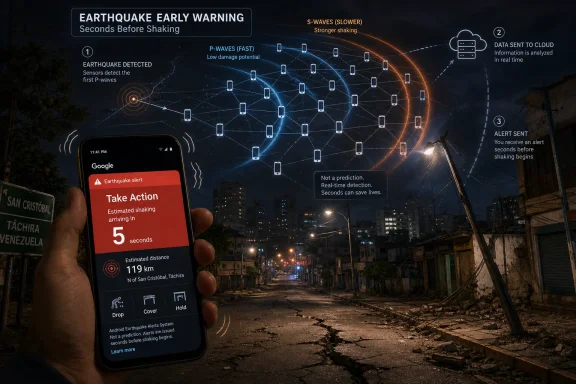
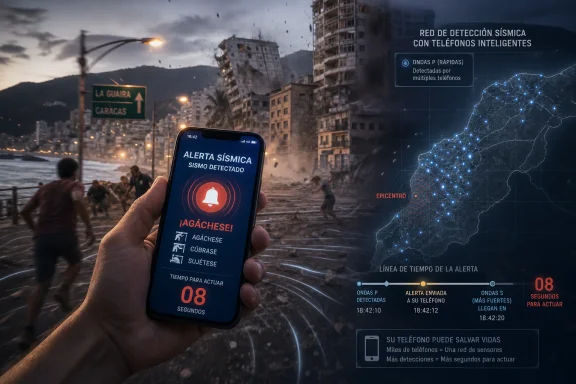
On Wednesday, June 24, 2026, Android phones in Venezuela reportedly warned some residents seconds before destructive shaking arrived from back-to-back earthquakes measured around magnitude 7.2 and 7.5 near the country’s Caribbean coast. The alerts were not prophecy, and they were not evidence that Google “knew” the earthquake before nature did. They were a demonstration of a more consequential shift: the smartphone in a pocket has become part of the world’s emergency infrastructure. That is both a technical triumph and a governance problem hiding in plain sight.
The important distinction is between prediction and early warning. Earthquake prediction, in the sense most people imagine it, means knowing in advance that a specific quake will happen at a specific place and time. That is not what Android did in Venezuela, and it is not what any serious earthquake early warning system claims to do.
What Google’s Android Earthquake Alerts System can do is detect the first physical signs of an earthquake after rupture has already begun, then send a warning faster than the most damaging seismic waves can travel. That difference may sound academic until the phone buzzes while the floor is still still. In those few seconds, the gap between “the earthquake has started” and “the strongest shaking has reached you” becomes operational time.
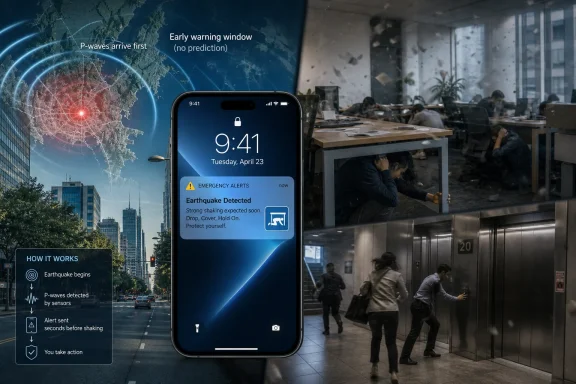
That time is brutally short. It may be enough to step away from glass, unlock a door, stop a medical procedure, duck under a sturdy table, or halt a train in a more instrumented environment. It is not enough to evacuate a city. The value of the system is not that it turns earthquakes into scheduled events; it turns surprise into a countdown.
Venezuela’s case made the mechanism visible because screenshots circulating on social media reportedly showed Android estimating a roughly magnitude 6.2 event hundreds of kilometers away before stronger shaking was felt in some locations. Those real-time estimates were not final scientific measurements. They were fast, uncertain, machine-generated judgments made under pressure, which is precisely what an early warning system is built to produce.
That same sensor can also detect ground motion. A single phone shaking is meaningless; it may be on a bus, in a pocket, dropped on a couch, or sitting beside a washing machine. But many phones in the same area detecting the same unusual vibration pattern at roughly the same time is a different signal.
Google’s system treats Android devices as a vast distributed sensing grid. When a phone detects motion that resembles seismic activity, it can send an anonymized signal and approximate location to Google’s servers. The server then compares reports from nearby devices to decide whether the pattern looks like an earthquake rather than local noise.
This is not the same as a dedicated seismometer network. Phones are consumer devices with uneven placement, inconsistent sensor quality, unpredictable power states, and users who can disable relevant settings. But the network has one overwhelming advantage: scale. Billions of Android devices exist, and in densely populated areas that means the sensing grid is already deployed.
The result is an inversion of traditional infrastructure logic. Instead of first building a national network of purpose-built instruments, then connecting it to an alerting system, Google begins with the alerting endpoints themselves. The phone is both sensor and siren.
That creates a race. If sensors close enough to the epicenter detect the early waves and send data electronically, the warning can travel through communication networks far faster than the damaging seismic waves move through the Earth. The more distance between the epicenter and the user, the more warning time may be available.
This is the same basic logic behind traditional earthquake early warning networks. Systems such as ShakeAlert in the western United States rely on dedicated seismic stations to detect and characterize earthquakes quickly. Google’s contribution is not a new law of physics; it is a different deployment model.
The challenge is that “quickly” and “accurately” are often enemies. An early alert must be sent before all the data is in. If the system waits for certainty, it loses the seconds that make warning useful. If it acts too aggressively, it risks false alarms, over-warning, and user fatigue.
That is why early magnitudes can differ from later official measurements. The system is estimating an evolving event from partial data. In a large doublet, such as the reported Venezuela sequence, the job becomes even harder because the ground motion may involve closely spaced ruptures, overlapping signals, and rapid revisions.
Countries with dense, modern seismic networks are comparatively rare. Japan, Mexico, parts of the United States, Taiwan, and a handful of other regions have invested heavily in earthquake monitoring and public alerting. Many vulnerable countries have not, either because of cost, institutional weakness, political instability, geography, or competing priorities.
That is where Android’s model becomes powerful. It can provide a basic layer of warning in places that lack dedicated national early warning systems. A software update and a population of connected phones can sometimes stand in for infrastructure that would otherwise take years and significant public funding to build.
But that same fact should make us pause. If residents in a disaster-prone country receive their most immediate warning from a private operating system vendor, then public safety has quietly migrated into a corporate platform. The service may be free to users, but it is not democratically governed in the way a national emergency agency is supposed to be.
The public will understandably focus on whether the alert arrived. Administrators, civil authorities, and technologists should also ask who controls the system, who audits the thresholds, who explains failures, and who decides which countries receive which capabilities. Earthquake warning is not just an app feature when lives depend on it.
That trade-off is not obviously inferior. In many urban environments, the number of phones may compensate for the noisiness of individual devices. Machine learning and statistical filtering can discard isolated events and look for correlated motion. The crowd becomes the instrument.
Yet this scale also creates unevenness. Android penetration varies by country, region, income, and network availability. Alerts require connectivity. Phones may be switched off, offline, in battery-saving modes, or configured in ways that reduce participation. Rural areas, where connectivity is weaker and phones are more spread out, may get less reliable detection and less warning time.
There is also a platform divide. Android users may receive one kind of alert while iPhone users rely on other channels, if any exist. In countries without a robust public warning layer, that can make disaster notification dependent on handset ecosystem rather than citizenship.
That is an uncomfortable place for emergency management to land. A warning system that works best for connected Android users is still valuable, especially if the alternative is no warning at all. But it should be understood as a layer, not a substitute for public investment in resilient communications, seismic monitoring, building codes, drills, and emergency response.
Earthquake early warning works best when users already know what to do. A buzzing phone during an emergency can confuse as easily as clarify if the user has never seen the alert before. The difference between a “Be Aware” notification and a “Take Action” alert matters, but only if people understand that the latter demands immediate protective action.
Google’s system typically distinguishes lighter shaking from moderate-to-severe shaking. A lower-level alert may be a standard notification meant to provide awareness. A higher-level alert can break through more aggressively and urge immediate safety steps. This hierarchy is sensible, because not every quake should produce the same level of interruption.
But emergency communication has always struggled with the same problem: a warning is not the same as preparedness. If people do not trust the alert, they may ignore it. If they receive too many weak alerts, they may become numb. If the alert arrives in a language, format, or context that does not match local practice, seconds can be lost to interpretation.
This is where governments and civil society still matter. Public drills, school programs, workplace protocols, and local messaging determine whether a smartphone alert becomes action. Google can deliver a signal; it cannot single-handedly create a culture of earthquake readiness.
That episode matters because it punctures the fantasy that a massive phone network is automatically reliable. Earthquake early warning is hard under ideal circumstances, and the hardest cases are often the ones where warning matters most: large, complex, rapidly evolving earthquakes near populated areas. Systems can underestimate magnitude, issue alerts too late, or fail to escalate severity appropriately.
Venezuela may become a counterexample if later analysis shows that the Android system performed well. But even a success should not erase the need for scrutiny. The same technology that looks miraculous when it works can become opaque when it fails.
Traditional public systems are not immune from failure either. Sensors break, agencies miscommunicate, cellular networks clog, and official alerts can arrive late or not at all. The difference is that public systems usually have clearer lines of responsibility, public records, legislative oversight, and institutional accountability.
For Android, the accountability model is fuzzier. Google can publish papers, blog posts, and support documents, but the operational details of thresholds, model changes, false positives, and country-by-country performance are not typically exposed in the same way a public agency’s infrastructure might be. That opacity is tolerable for a convenience feature. It is harder to accept for an emergency warning system.
This is not inherently sinister. In many cases, the private platform is the fastest and most reliable way to reach people. Governments want access to those channels because citizens already carry them. The smartphone is the most universal emergency terminal ever deployed.
But the political economy is awkward. Google built Android Earthquake Alerts because it could, because it serves a public good, and because it reinforces Android’s value as a platform. That does not make the system bad. It does mean the incentives are not identical to those of a public seismic agency.
A national warning system has obligations to all residents, including those without smartphones, without data plans, without Google services, or without compatible devices. A platform system begins with the installed base. Its reach is impressive, but its boundaries are shaped by markets.
This distinction matters most in fragile states and lower-income regions. The places most likely to benefit from phone-based warning may also be the places least able to demand transparency from the company providing it. A ministry can negotiate with Google, but ordinary residents cannot meaningfully audit the algorithm that decides whether their phone screams before the ground moves.
The more immediate question is trust. Users are being asked to trust that the system detects real earthquakes, avoids unnecessary panic, estimates severity well enough, and delivers alerts quickly. Governments are being asked to trust that a private vendor’s infrastructure will remain available, maintained, and responsive in crises.
Trust in emergency systems is built through performance, transparency, and repetition. If alerts arrive before shaking and give useful advice, people learn to heed them. If alerts are wrong, late, or unexplained, people learn the opposite. There is no branding campaign that can overcome enough bad emergency experiences.
The system also depends on telecommunications infrastructure that may be stressed during disasters. Cellular networks can be damaged or congested. Power outages can cut routers and towers. In the best case, earthquake alerts travel before the disaster has degraded the network. In the worst case, the very channels needed for warning are already compromised.
That is why redundancy matters. Android alerts should complement sirens, radio, television, public alert protocols, agency feeds, and local emergency planning. The strongest warning ecosystem is not one perfect channel; it is several imperfect channels overlapping.
Every administrator already lives with this reality. Identity providers, mobile device management, endpoint security, push notification services, cloud authentication, browser update channels, and app stores are now part of operational resilience. When one platform changes behavior, an enterprise can feel it immediately.
Earthquake alerts are a public-safety version of the same pattern. The endpoint is no longer just a client device. It is a sensor, a policy surface, a communications node, and a behavioral trigger. That is true for Android phones during earthquakes, Windows PCs during security incidents, and managed devices during any emergency communication campaign.
For organizations with staff in seismic zones, this should prompt practical thinking. Do employees know how device-based alerts behave? Are company phones configured to receive emergency notifications? Do mobile policies disable location features that might affect alerting? Are emergency procedures written for a world where some workers may get seconds of warning on personal devices while others do not?
The Venezuela quake is a reminder that technology policy is not abstract. A setting buried in a phone can shape what happens in the first seconds of a disaster. That is exactly the kind of detail IT departments are trained to care about, even when the technology in question was marketed as a consumer feature.
The real evaluation will require after-action analysis. How many users received alerts? How many received them before strong shaking? How many received only low-level alerts? How accurate were the initial magnitude and intensity estimates? Did alerts arrive in the areas that needed them most? Did network conditions affect delivery?
Those questions are not pedantic. They determine whether the system saved lives, merely impressed users, or performed unevenly. Early warning systems must be judged statistically, not anecdotally.
Google has a strong incentive to publicize success stories, and news outlets have a strong incentive to frame them dramatically. “Android warned people before the quake” is a clean headline. “A probabilistic system using consumer accelerometers may have delivered varying amounts of warning to some users depending on distance, network conditions, and alert thresholds” is more accurate and less clickable.
The responsible position is to hold both thoughts at once. Android Earthquake Alerts is an impressive use of planetary-scale consumer hardware for public benefit. It is also a system whose performance should be measured rigorously, especially after major disasters.
This expectation problem is unavoidable. Earthquake early warning cannot help people directly above or very near the epicenter in the same way it can help people farther away. The destructive waves may arrive before detection, processing, and delivery can complete. No amount of cloud scale repeals distance.
That limitation needs to be communicated clearly. Otherwise, public understanding will drift toward magical thinking: Google predicts earthquakes, phones know disasters in advance, alerts should always arrive before shaking. The Republic World framing that “Google didn’t predict it” is therefore not just semantic hygiene; it is essential public education.
A good warning system teaches its own limits. It tells users what it can do, what it cannot do, and how to respond without overpromising. In a disaster, credibility is a finite resource.
Google should want that clarity too. The system’s long-term value depends on trust, and trust depends on not letting marketing outrun physics. The best version of Android Earthquake Alerts is not a miracle machine; it is a fast, imperfect, useful alarm.
The more challenging story is that the world is outsourcing pieces of emergency infrastructure to companies whose platforms were not designed through public procurement, public oversight, or local democratic control. Sometimes that outsourcing produces lifesaving capability where none existed. Sometimes it creates dependencies that are poorly understood until the emergency arrives.
The right answer is not to reject private systems. That would be foolish, especially when the alternative is silence. The right answer is to integrate them deliberately into public warning strategies, demand transparent performance reporting, and build redundant systems around them.
For countries without mature seismic networks, Android’s crowdsourced model can be a bridge. But a bridge is not a destination. Building codes, emergency drills, resilient communications, public alert protocols, and scientific monitoring remain the boring infrastructure that determines whether a major earthquake becomes a tragedy or a catastrophe.
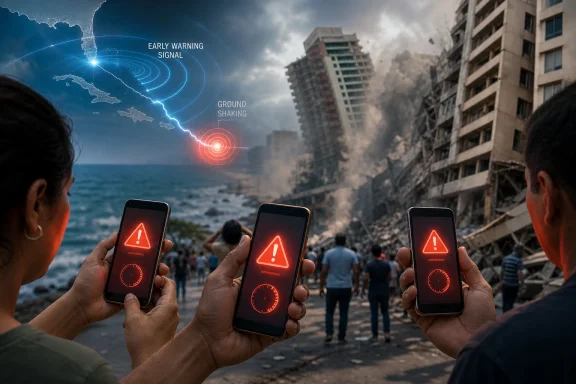 Google Did Not Predict the Quake, It Beat the Quake to the User
The important distinction is between prediction and early warning. Earthquake prediction, in the sense most people imagine it, means knowing in advance that a specific quake will happen at a specific place and time. That is not what Android did in Venezuela, and it is not what any serious earthquake early warning system claims to do.What Google’s Android Earthquake Alerts System can do is detect the first physical signs of an earthquake after rupture has already begun, then send a warning faster than the most damaging seismic waves can travel. That difference may sound academic until the phone buzzes while the floor is still still. In those few seconds, the gap between “the earthquake has started” and “the strongest shaking has reached you” becomes operational time.
That time is brutally short. It may be enough to step away from glass, unlock a door, stop a medical procedure, duck under a sturdy table, or halt a train in a more instrumented environment. It is not enough to evacuate a city. The value of the system is not that it turns earthquakes into scheduled events; it turns surprise into a countdown.
Venezuela’s case made the mechanism visible because screenshots circulating on social media reportedly showed Android estimating a roughly magnitude 6.2 event hundreds of kilometers away before stronger shaking was felt in some locations. Those real-time estimates were not final scientific measurements. They were fast, uncertain, machine-generated judgments made under pressure, which is precisely what an early warning system is built to produce.
The Sensor Was Already in Your Pocket
The reason Android can participate in earthquake detection is almost comically mundane: the accelerometer. Every modern smartphone uses one to understand motion and orientation. It helps rotate the display, count steps, stabilize interactions, and infer whether the device is being moved.That same sensor can also detect ground motion. A single phone shaking is meaningless; it may be on a bus, in a pocket, dropped on a couch, or sitting beside a washing machine. But many phones in the same area detecting the same unusual vibration pattern at roughly the same time is a different signal.
Google’s system treats Android devices as a vast distributed sensing grid. When a phone detects motion that resembles seismic activity, it can send an anonymized signal and approximate location to Google’s servers. The server then compares reports from nearby devices to decide whether the pattern looks like an earthquake rather than local noise.
This is not the same as a dedicated seismometer network. Phones are consumer devices with uneven placement, inconsistent sensor quality, unpredictable power states, and users who can disable relevant settings. But the network has one overwhelming advantage: scale. Billions of Android devices exist, and in densely populated areas that means the sensing grid is already deployed.
The result is an inversion of traditional infrastructure logic. Instead of first building a national network of purpose-built instruments, then connecting it to an alerting system, Google begins with the alerting endpoints themselves. The phone is both sensor and siren.
The Physics Is Simple; the Implementation Is Not
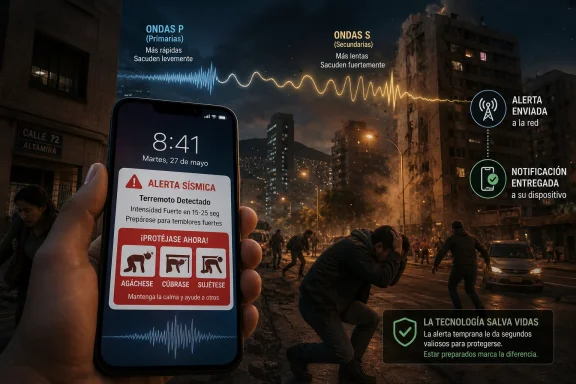
The core trick depends on the fact that earthquakes travel in waves. Primary waves, or P-waves, move fastest and usually cause less damage. Secondary waves, or S-waves, arrive later and produce stronger shaking. Surface waves, often among the most damaging, can arrive later still depending on distance and geology.That creates a race. If sensors close enough to the epicenter detect the early waves and send data electronically, the warning can travel through communication networks far faster than the damaging seismic waves move through the Earth. The more distance between the epicenter and the user, the more warning time may be available.
This is the same basic logic behind traditional earthquake early warning networks. Systems such as ShakeAlert in the western United States rely on dedicated seismic stations to detect and characterize earthquakes quickly. Google’s contribution is not a new law of physics; it is a different deployment model.
The challenge is that “quickly” and “accurately” are often enemies. An early alert must be sent before all the data is in. If the system waits for certainty, it loses the seconds that make warning useful. If it acts too aggressively, it risks false alarms, over-warning, and user fatigue.
That is why early magnitudes can differ from later official measurements. The system is estimating an evolving event from partial data. In a large doublet, such as the reported Venezuela sequence, the job becomes even harder because the ground motion may involve closely spaced ruptures, overlapping signals, and rapid revisions.
Venezuela Shows Why Phone-Based Warning Matters
The Venezuela earthquakes were not merely a technology story. Reports described collapsed buildings, widespread panic, airport disruption, and serious damage after two powerful quakes struck near the northern coast, with shaking felt far beyond the immediate epicentral region. The human stakes are what make the Android alert worth examining.Countries with dense, modern seismic networks are comparatively rare. Japan, Mexico, parts of the United States, Taiwan, and a handful of other regions have invested heavily in earthquake monitoring and public alerting. Many vulnerable countries have not, either because of cost, institutional weakness, political instability, geography, or competing priorities.
That is where Android’s model becomes powerful. It can provide a basic layer of warning in places that lack dedicated national early warning systems. A software update and a population of connected phones can sometimes stand in for infrastructure that would otherwise take years and significant public funding to build.
But that same fact should make us pause. If residents in a disaster-prone country receive their most immediate warning from a private operating system vendor, then public safety has quietly migrated into a corporate platform. The service may be free to users, but it is not democratically governed in the way a national emergency agency is supposed to be.
The public will understandably focus on whether the alert arrived. Administrators, civil authorities, and technologists should also ask who controls the system, who audits the thresholds, who explains failures, and who decides which countries receive which capabilities. Earthquake warning is not just an app feature when lives depend on it.
Android’s Advantage Is Scale, and Scale Cuts Both Ways
Google’s earthquake alerting system benefits from Android’s reach. A purpose-built seismic network may have high-quality instruments but relatively sparse coverage. Android has lower-quality instruments but extraordinary density in populated areas.That trade-off is not obviously inferior. In many urban environments, the number of phones may compensate for the noisiness of individual devices. Machine learning and statistical filtering can discard isolated events and look for correlated motion. The crowd becomes the instrument.
Yet this scale also creates unevenness. Android penetration varies by country, region, income, and network availability. Alerts require connectivity. Phones may be switched off, offline, in battery-saving modes, or configured in ways that reduce participation. Rural areas, where connectivity is weaker and phones are more spread out, may get less reliable detection and less warning time.
There is also a platform divide. Android users may receive one kind of alert while iPhone users rely on other channels, if any exist. In countries without a robust public warning layer, that can make disaster notification dependent on handset ecosystem rather than citizenship.
That is an uncomfortable place for emergency management to land. A warning system that works best for connected Android users is still valuable, especially if the alternative is no warning at all. But it should be understood as a layer, not a substitute for public investment in resilient communications, seismic monitoring, building codes, drills, and emergency response.
The Alert Is Only as Useful as the Behavior It Triggers
The most dramatic framing of the Venezuela story is that phones warned people before deadly shaking. The more practical framing is that phones attempted to convert a few seconds of warning into safer human behavior. That conversion is not automatic.Earthquake early warning works best when users already know what to do. A buzzing phone during an emergency can confuse as easily as clarify if the user has never seen the alert before. The difference between a “Be Aware” notification and a “Take Action” alert matters, but only if people understand that the latter demands immediate protective action.
Google’s system typically distinguishes lighter shaking from moderate-to-severe shaking. A lower-level alert may be a standard notification meant to provide awareness. A higher-level alert can break through more aggressively and urge immediate safety steps. This hierarchy is sensible, because not every quake should produce the same level of interruption.
But emergency communication has always struggled with the same problem: a warning is not the same as preparedness. If people do not trust the alert, they may ignore it. If they receive too many weak alerts, they may become numb. If the alert arrives in a language, format, or context that does not match local practice, seconds can be lost to interpretation.
This is where governments and civil society still matter. Public drills, school programs, workplace protocols, and local messaging determine whether a smartphone alert becomes action. Google can deliver a signal; it cannot single-handedly create a culture of earthquake readiness.
The Turkey Lesson Still Shadows the System
Any serious assessment of Android Earthquake Alerts has to mention the criticism that followed the 2023 Turkey earthquake. After that catastrophe, questions were raised about whether Google’s system delivered the highest-level warnings to enough people before the strongest shaking. Google later acknowledged problems with how the system handled that event, according to subsequent reporting.That episode matters because it punctures the fantasy that a massive phone network is automatically reliable. Earthquake early warning is hard under ideal circumstances, and the hardest cases are often the ones where warning matters most: large, complex, rapidly evolving earthquakes near populated areas. Systems can underestimate magnitude, issue alerts too late, or fail to escalate severity appropriately.
Venezuela may become a counterexample if later analysis shows that the Android system performed well. But even a success should not erase the need for scrutiny. The same technology that looks miraculous when it works can become opaque when it fails.
Traditional public systems are not immune from failure either. Sensors break, agencies miscommunicate, cellular networks clog, and official alerts can arrive late or not at all. The difference is that public systems usually have clearer lines of responsibility, public records, legislative oversight, and institutional accountability.
For Android, the accountability model is fuzzier. Google can publish papers, blog posts, and support documents, but the operational details of thresholds, model changes, false positives, and country-by-country performance are not typically exposed in the same way a public agency’s infrastructure might be. That opacity is tolerable for a convenience feature. It is harder to accept for an emergency warning system.
Private Infrastructure Is Filling a Public Vacuum
The deeper story is not that Android phones can detect earthquakes. It is that private platforms are increasingly becoming the interface through which people experience public emergencies. Weather alerts, missing-person alerts, wildfire warnings, health notifications, war-zone updates, and now earthquake warnings often arrive through phones controlled by Apple, Google, carriers, and app ecosystems.This is not inherently sinister. In many cases, the private platform is the fastest and most reliable way to reach people. Governments want access to those channels because citizens already carry them. The smartphone is the most universal emergency terminal ever deployed.
But the political economy is awkward. Google built Android Earthquake Alerts because it could, because it serves a public good, and because it reinforces Android’s value as a platform. That does not make the system bad. It does mean the incentives are not identical to those of a public seismic agency.
A national warning system has obligations to all residents, including those without smartphones, without data plans, without Google services, or without compatible devices. A platform system begins with the installed base. Its reach is impressive, but its boundaries are shaped by markets.
This distinction matters most in fragile states and lower-income regions. The places most likely to benefit from phone-based warning may also be the places least able to demand transparency from the company providing it. A ministry can negotiate with Google, but ordinary residents cannot meaningfully audit the algorithm that decides whether their phone screams before the ground moves.
The Privacy Question Is Smaller Than the Trust Question
It is tempting to make privacy the center of this debate because Android, Google, location data, and emergency alerts sit in the same sentence. Privacy is relevant, but it is not the only issue. Google says the system uses approximate location and anonymized signals, and the detection model does not require turning every phone into a personally identified tracking station.The more immediate question is trust. Users are being asked to trust that the system detects real earthquakes, avoids unnecessary panic, estimates severity well enough, and delivers alerts quickly. Governments are being asked to trust that a private vendor’s infrastructure will remain available, maintained, and responsive in crises.
Trust in emergency systems is built through performance, transparency, and repetition. If alerts arrive before shaking and give useful advice, people learn to heed them. If alerts are wrong, late, or unexplained, people learn the opposite. There is no branding campaign that can overcome enough bad emergency experiences.
The system also depends on telecommunications infrastructure that may be stressed during disasters. Cellular networks can be damaged or congested. Power outages can cut routers and towers. In the best case, earthquake alerts travel before the disaster has degraded the network. In the worst case, the very channels needed for warning are already compromised.
That is why redundancy matters. Android alerts should complement sirens, radio, television, public alert protocols, agency feeds, and local emergency planning. The strongest warning ecosystem is not one perfect channel; it is several imperfect channels overlapping.
For WindowsForum Readers, the Lesson Is Platform Reality
At first glance, a Google Android earthquake alert may seem outside the usual WindowsForum lane. But for sysadmins and IT pros, the story lands squarely in familiar territory: consumer platforms are becoming critical infrastructure whether the org chart admits it or not.Every administrator already lives with this reality. Identity providers, mobile device management, endpoint security, push notification services, cloud authentication, browser update channels, and app stores are now part of operational resilience. When one platform changes behavior, an enterprise can feel it immediately.
Earthquake alerts are a public-safety version of the same pattern. The endpoint is no longer just a client device. It is a sensor, a policy surface, a communications node, and a behavioral trigger. That is true for Android phones during earthquakes, Windows PCs during security incidents, and managed devices during any emergency communication campaign.
For organizations with staff in seismic zones, this should prompt practical thinking. Do employees know how device-based alerts behave? Are company phones configured to receive emergency notifications? Do mobile policies disable location features that might affect alerting? Are emergency procedures written for a world where some workers may get seconds of warning on personal devices while others do not?
The Venezuela quake is a reminder that technology policy is not abstract. A setting buried in a phone can shape what happens in the first seconds of a disaster. That is exactly the kind of detail IT departments are trained to care about, even when the technology in question was marketed as a consumer feature.
The Real Success Metric Is Not the Screenshot
The viral artifact in this story is the screenshot: a Google alert, an estimated magnitude, a distance, a timestamp, a user saying the phone warned them first. Screenshots are compelling because they turn invisible infrastructure into proof. They are also insufficient.The real evaluation will require after-action analysis. How many users received alerts? How many received them before strong shaking? How many received only low-level alerts? How accurate were the initial magnitude and intensity estimates? Did alerts arrive in the areas that needed them most? Did network conditions affect delivery?
Those questions are not pedantic. They determine whether the system saved lives, merely impressed users, or performed unevenly. Early warning systems must be judged statistically, not anecdotally.
Google has a strong incentive to publicize success stories, and news outlets have a strong incentive to frame them dramatically. “Android warned people before the quake” is a clean headline. “A probabilistic system using consumer accelerometers may have delivered varying amounts of warning to some users depending on distance, network conditions, and alert thresholds” is more accurate and less clickable.
The responsible position is to hold both thoughts at once. Android Earthquake Alerts is an impressive use of planetary-scale consumer hardware for public benefit. It is also a system whose performance should be measured rigorously, especially after major disasters.
The Next Disaster Will Test the Contract
The most important consequence of the Venezuela alerts may be expectation. Once people learn that their phones can warn them before shaking, they will expect the same next time. If the alert does not come, or arrives late, the absence will feel like failure even if the physics made warning impossible.This expectation problem is unavoidable. Earthquake early warning cannot help people directly above or very near the epicenter in the same way it can help people farther away. The destructive waves may arrive before detection, processing, and delivery can complete. No amount of cloud scale repeals distance.
That limitation needs to be communicated clearly. Otherwise, public understanding will drift toward magical thinking: Google predicts earthquakes, phones know disasters in advance, alerts should always arrive before shaking. The Republic World framing that “Google didn’t predict it” is therefore not just semantic hygiene; it is essential public education.
A good warning system teaches its own limits. It tells users what it can do, what it cannot do, and how to respond without overpromising. In a disaster, credibility is a finite resource.
Google should want that clarity too. The system’s long-term value depends on trust, and trust depends on not letting marketing outrun physics. The best version of Android Earthquake Alerts is not a miracle machine; it is a fast, imperfect, useful alarm.
The Seconds Android Bought in Venezuela Are a Policy Argument
The Venezuela quake sequence gives the technology industry an appealing story: billions of phones, already deployed, cooperating quietly to give people warning before disaster hits. That story is real. It is also incomplete.The more challenging story is that the world is outsourcing pieces of emergency infrastructure to companies whose platforms were not designed through public procurement, public oversight, or local democratic control. Sometimes that outsourcing produces lifesaving capability where none existed. Sometimes it creates dependencies that are poorly understood until the emergency arrives.
The right answer is not to reject private systems. That would be foolish, especially when the alternative is silence. The right answer is to integrate them deliberately into public warning strategies, demand transparent performance reporting, and build redundant systems around them.
For countries without mature seismic networks, Android’s crowdsourced model can be a bridge. But a bridge is not a destination. Building codes, emergency drills, resilient communications, public alert protocols, and scientific monitoring remain the boring infrastructure that determines whether a major earthquake becomes a tragedy or a catastrophe.
Venezuela’s Phone Alerts Leave Five Hard Lessons
The Venezuela alerts should be treated neither as a gimmick nor as a finished solution. They are evidence that mass-market devices can contribute to public safety at scale, and evidence that public safety is now entangled with platform power in ways governments can no longer ignore.- Android’s alerts were early warnings after the earthquakes began, not predictions made before seismic rupture occurred.
- The system works by using smartphone accelerometers as a distributed sensor network, then comparing signals from nearby devices to identify likely earthquake activity.
- The warning window exists because electronic communications can outrun the slower, more damaging seismic waves after faster initial waves are detected.
- Early magnitude estimates can be wrong or incomplete, especially during large or complex earthquake sequences.
- Phone-based alerts are most valuable when paired with public education, reliable connectivity, official emergency systems, and realistic expectations about their limits.
- The success of a private alerting platform should push governments toward stronger oversight and redundancy, not complacency.
References
- Primary source: News9live
Published: 2026-06-25T09:14:11.009186
Google Sent Earthquake Alerts Before Venezuela's Deadly Quakes: Here's How Android Knew First | Tech News - News9live
Google's Android Earthquake Alerts System warned some users in Venezuela seconds before two powerful earthquakes struck the country. The system uses accelerometers inside millions of Android phones to detect the first seismic waves and confirm earthquake activity through Google's servers.www.news9live.com
- Independent coverage: India TV News
Published: 2026-06-25T09:00:11.008592
How Google alerted Venezuela residents seconds before powerful earthquakes struck | Technology - India TV News
Google's Android Earthquake Alerts System drew attention as Venezuela residents received earthquake warnings seconds before powerful tremors struck. The technology uses billions of Android smartphones as a global earthquake detection network, allowing Google to identify seismic activity.www.indiatvnews.com - Independent coverage: Times Now
Published: 2026-06-25T08:30:11.007991
Google Warned Android Users Before Venezuela's Massive Earthquake: Here's The Technology Behind It | Times Now
Recent powerful earthquakes in Venezuela highlighted the effectiveness of Google's Android Earthquake Alerts System, which utilises millions of smartphones equipped with accelerometers to detect seismic activity. , Technology & Science, Times Nowwww.timesnownews.com - Independent coverage: ETV Bharat
Published: Thu, 25 Jun 2026 08:21:13 GMT
Venezuela Earthquake: How Google Warned Android Users Seconds Before The Disaster Struck
Google's Android Earthquake Alerts System warned users in Venezuela before earthquakes struck, using millions of smartphones as a giant network of seismic detectors.www.etvbharat.com
- Independent coverage: The Daily Jagran
Published: 2026-06-25T07:30:11.009492
How Did Google Send Earthquake Alert In Venezuela Even Before It Struck? The Answer Is In Your Android Smartphones
Venezuela Earthquake: Following earthquakes in Venezuela, Google's Android earthquake alerts warned users seconds before impact by detecting it early. But how did Google do that? The answer is inside your smartphones.www.thedailyjagran.com - Independent coverage: Oneindia
Published: 2026-06-25T06:30:11.009813
Seconds Before Disaster: How Google’s System Detected Venezuela Quakes Early - Oneindia News
Google’s Android Earthquake Alerts System reportedly sent warnings seconds before powerful 7.1 and 7.5 magnitude earthquakes struck Venezuela, sparking curiosity over how the technology detects seismic activity using smartphones.www.oneindia.com
- Independent coverage: Republic World
Published: 2026-06-25T06:30:11.008292
No, Google Didn't Predict Venezuela's Earthquake, Here's What Actually Happened | Republic World
On Wednesday evening, Venezuela was rocked by back-to-back earthquakes, a magnitude 7.2 followed just 39 seconds later by a 7.5 mainshock. While devastation unfolded, some residents reported receiving Google earthquake alerts seconds before the tremors reached them.www.republicworld.com - Related coverage: axios.com
Venezuela earthquakes kill dozens, injure hundreds as buildings damaged
The 2 quakes killed dozens of people, injured hundreds and damaged buildings across the country, officials said.www.axios.com
- Related coverage: thedailybeast.com
Trump Posts Grim Update After Horror Venezuela Earthquakes
Dozens have been confirmed dead, and hundreds more have been injured.www.thedailybeast.com
- Related coverage: mappr.co
Mapped: Venezuela's Strongest Earthquake in Over a Century — M7.2 and M7.5 Hit the Caribbean Coast | Mappr
Two huge quakes — M7.2 and M7.5, 39 seconds apart — struck Venezuela's Caribbean coast near Morón on 24 June 2026, the country's strongest earthquake since 1900. Epicenter map, magnitude history and what comes next.www.mappr.co - Related coverage: blog.google
Android earthquake alerts now available everywhere in the U.S.
Android Earthquake Alerts is expanding to all 50 U.S. states, using phones to detect earthquakes and send early warnings to users.blog.google - Related coverage: androidcentral.com
Google rolls out a global earthquake detection network powered by Android phones | Android Central
Google is using the unparalleled reach of the Android platform to create the world’s largest earthquake detection network.www.androidcentral.com - Related coverage: cbsnews.com
Venezuela earthquakes kill at least 164, injure hundreds, acting president says - CBS News
Venezuela's acting president said the death toll from powerful twin earthquakes was likely to rise, as USGS modeling suggested thousands may have been killed.www.cbsnews.com - Related coverage: androidauthority.com
Scientists prove Android Earthquake Alerts system actually works pretty well
Google's Android Earthquake Alerts system uses your phone's accelerometer to provide crucial seconds of warning before seismic activity.www.androidauthority.com - Related coverage: itechpost.com
Android Earthquake Alert System: How Google's Accelerometer Detects Tremors
Android’s Earthquake Alert System works by using the phone’s accelerometer that detects an earthquake’s initial P-wave.www.itechpost.com - Related coverage: knkx.org
The death toll rises to 164 after major Venezuela earthquakes topple many buildings
Venezuela's acting President Delcy Rodríguez said Thursday that at least 164 people were killed and 971 were injured after two major, back-to-back earthquakes struck northern Venezuela.www.knkx.org - Related coverage: 1-e8259.azureedge.net
Venezuela rocked by 7.5, 7.2 earthquakes: What happened and what we know | Earthquakes News | Al Jazeera
Rescue efforts under way as Venezuela declares a state of emergency after powerful twin quakes cause widespread damage.1-e8259.azureedge.net
- Official source: play.google.com
- Official source: support.google.com

Get help during an emergency with your Android phone - Android Help
You can use the Personal Safety app to save and share your emergency info. Your phone can also contact emergency services automatically in some countries and regions and with certain operators.
support.google.com
- Related coverage: livescience.com
Google has turned 2 billion smartphones into a global earthquake warning system — it's just as effective as seismometers | Live Science
Google's earthquake early-warning system has used phone accelerometers to increase quake alerts by tenfold across 98 countries.www.livescience.com - Related coverage: tropicanafm.com
VIDEO | Así reportaron el fuerte temblor en Venezuela HOY 24 de junio; también se sintió en Colombia - Tropicana Colombia
En este país como en diversas zonas de Colombia se registró un movimiento telúrico durante la tarde del último miércoles de junio.www.tropicanafm.com - Related coverage: phys.org
- Related coverage: caloes.ca.gov