

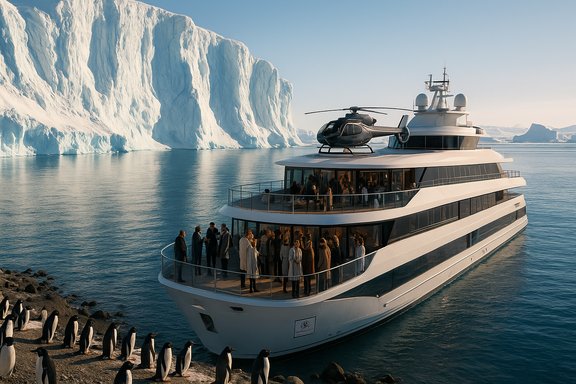
Antarctica’s transformation from the realm of Shackleton and Amundsen into a playground for the ultra-wealthy has accelerated sharply: expedition numbers have ballooned since the 1990s, luxury liners and private jets now shuttle tourists to the ice, and celebrities and members of royal families increasingly appear on passenger manifests — a development that is reshaping the economics, infrastructure, and environmental calculus of polar travel.
Today the trip that once consumed months of exhaustion can be packaged into a fortnight of curated experiences. Visitors disembark to photograph penguin colonies, kayak in iceberg-scattered bays, or participate in “citizen science” projects, all after nights in heated cabins served gourmet meals. The contrast is dramatic: from raw exploration to luxury polar expeditions that market exclusivity, comfort and conservation storytelling.
Growth has been driven by two concurrent developments: the proliferation of expedition-style cruise vessels and the rise of luxury, high-margin polar products marketed to affluent travelers and experience-seeking younger professionals. The market diversification has multiplied itinerary types — from inexpensive (relatively speaking) sea cruises to ultra-luxury fly-in safaris and bespoke private yacht charters.
Caveat: public reporting about specific celebrity visits varies in completeness and accuracy. In many cases the identities of high-profile passengers are withheld by operators for privacy, and media stories rely on secondhand reporting. Because of that, individual names and anecdotes should be treated cautiously unless confirmed by multiple reliable sources.
IAATO’s visitor guidance addresses landing limits, wildlife interactions, and biosecurity decontamination. However, because IAATO membership is voluntary and non‑member activity is harder to track, critics argue that self‑regulation leaves gaps — particularly as the number and diversity of operators increases.
The current moment is a policy and management inflection point. Without stronger, science‑driven limits and transparent, verifiable mitigation from operators, the very growth that drives interest and funding for Antarctic conservation may erode the fragile systems that make the continent unique. Conversely, if the industry, treaty states and the scientific community can align around measurable standards, adaptive management and genuine decarbonization pathways, tourism can help fund protection and global engagement without undermining the continent’s ecological integrity.
Antarctic tourism — in its luxury forms and broader market expansion — poses both an opportunity and a test: can human beings find ways to experience one of Earth’s last wild places while ensuring that their presence leaves it, if not untouched, then at least unimpaired for generations of researchers, inhabitants of gateway communities, and the planet as a whole? The next few seasons will be decisive in answering that question.
Source: Zoom Bangla News Antarctica Tourism Sees Surge in Celebrity Visitors and Luxury Cruises
 Background
From Heroic Age hardship to 21st-century comfort
The first successful expedition to the South Pole, led by Roald Amundsen in 1911, epitomized the Heroic Era of Antarctic exploration: months of dog-sledging, primitive clothing, and constant peril from frostbite, scurvy and starvation. That chapter of human engagement with Antarctica was defined by survival, scientific curiosity, and national prestige.Today the trip that once consumed months of exhaustion can be packaged into a fortnight of curated experiences. Visitors disembark to photograph penguin colonies, kayak in iceberg-scattered bays, or participate in “citizen science” projects, all after nights in heated cabins served gourmet meals. The contrast is dramatic: from raw exploration to luxury polar expeditions that market exclusivity, comfort and conservation storytelling.
How many visitors are we talking about?
Antarctic visitation has grown from low thousands in the early 1990s to well over 70,000–100,000+ people per season in recent years, depending on which season and reporting body you consult. Data trends across multiple industry and news reports show a steep upward trajectory: the late 2010s and early 2020s saw significant jumps, and several widely circulated counts place recent seasons comfortably north of 100,000 total visitors when combining cruise passengers, fly-in guests, and support staff.Growth has been driven by two concurrent developments: the proliferation of expedition-style cruise vessels and the rise of luxury, high-margin polar products marketed to affluent travelers and experience-seeking younger professionals. The market diversification has multiplied itinerary types — from inexpensive (relatively speaking) sea cruises to ultra-luxury fly-in safaris and bespoke private yacht charters.
Overview: What’s changed in Antarctic tourism
The new product set
Modern Antarctic tourism now spans a spectrum:- Economy-minded expedition cruises that emphasize wildlife viewing and education.
- Photography and science-focused voyages with onboard specialists and workshops.
- Luxury cruises and private yacht charters offering concierge service, gourmet dining, hot tubs and bespoke shore excursions.
- Fly‑cruise options that use aircraft to bypass the often-rough Drake Passage, reducing transit time and offering quicker access to the Peninsula.
- Niche adventures: polar diving, camping on the ice, helicopter drop-offs, and even paid “extreme” experiences such as polar marathons or skydiving in restricted packages.
Luxury and celebrity interest
High-profile visitors — celebrities, billionaires and occasionally members of royal families — are increasingly visible in coverage of polar voyages. Their trips are often chartered or arranged on the upper end of the market, featuring private transfers, bespoke shore programs and substantial media attention. While some operators actively court this clientele as part of brand positioning, the overall effect is to lend glamour and media coverage to a destination long perceived as forbidding.Caveat: public reporting about specific celebrity visits varies in completeness and accuracy. In many cases the identities of high-profile passengers are withheld by operators for privacy, and media stories rely on secondhand reporting. Because of that, individual names and anecdotes should be treated cautiously unless confirmed by multiple reliable sources.
The economics of getting to the ice
Typical price ranges
- Mainstream expedition cruises: approximately $7,000–$20,000 per person for 10–14 day itineraries, depending on cabin grade and operator.
- Premium and luxury expeditions: $20,000–$60,000 per person for enhanced amenities, smaller guest counts, and additional activities (kayaking, camping, helicopter excursions).
- Ultra‑luxury and bespoke packages: these can exceed $100,000 per person when private jets, entire yacht charters, exclusive landings and on‑ice private lodging are included.
Most common travel routes
- Sail from South America: Ushuaia, Argentina, remains the most common embarkation point for Antarctic cruises. The conventional sea route crosses the Drake Passage and typically requires two days of transit each way.
- Fly‑cruise: a growing number of operators offer a mixed model where passengers fly from Punta Arenas (or other regional hubs) to a runway near the Peninsula and join a vessel there. This avoids the Drake Passage and reduces sea days, but increases carbon intensity per traveler because of the additional flight segments.
- Private jets and yachts: high‑net‑worth travelers increasingly use private aviation and luxury yachts to compress travel time and ensure privacy; these options also lengthen the list of logistical and environmental concerns.
When to go
The Antarctic tourist season follows the Southern Hemisphere summer: roughly late October through mid‑March. Conditions are mildest then, wildlife is most active, and sea ice retreats enough to allow ship access to key landing sites. Peak wildlife activity and longer daylight hours make December through February the most popular months.Luxury polar expeditions: what $50k buys you
Luxury polar operators have translated traditional cruise extravagances into a polar context. Amenities and services that set these voyages apart include:- Spacious suites with premium bedding, private balconies (on larger vessels), and heated floors in en‑suite bathrooms.
- Fine dining and curated beverage programs — caviar service and sommelier‑led pairings are common on top‑tier vessels.
- Comprehensive wellness offerings — spas, gyms, saunas and polar‑safe hot tubs.
- Advanced onboard technology — high-bandwidth satellite internet, noise‑reduction systems to minimize wildlife disturbance, and sophisticated camera labs for professional photographers.
- Small‑group shore excursions led by experienced naturalists, scientists and photographers.
- Optional helicopter drops, submersible dives, or private landing privileges in specially negotiated spots (under strict environmental rules).
Environmental consequences and mitigation
The footprint of Antarctic tourism
Antarctic tourism generates a notable ecological footprint that manifests in several ways:- Greenhouse gas emissions: long international flights plus cruise ship fuel consumption contribute substantial CO₂ per traveler. Recent analyses estimate per‑visitor emissions in the range of roughly 4–7 metric tons of CO₂ equivalent depending on itinerary type and whether a flight is included — numbers that rival or exceed many shorter international trips.
- Local pollution and black carbon: ship and aircraft exhaust can deposit soot and black carbon on snow and ice; dark particles accelerate melt by absorbing more solar radiation.
- Wildlife disturbance: shore landings, even when carefully managed, can stress wildlife colonies (penguins, seals, seabirds), alter behavior, or increase chick mortality in sensitive sites.
- Invasive species and contamination: equipment, clothing, and even ship hulls can introduce non‑native organisms or pollutants to the fragile Antarctic ecosystem.
- Waste and infrastructure strain: increased visitation concentrates pressure on nearby gateway communities (Ushuaia, Punta Arenas) and on the fragile logistics that support Antarctic stations and rescue capability.
Industry responses and technological mitigation
Operators, cruising associations and manufacturers are advancing mitigation strategies, but solutions are imperfect and often partial:- Hybrid and alternative fuels: several polar‑capable vessels now employ hybrid systems (battery + conventional engines) or use liquefied natural gas (LNG) to reduce sulfur, NOx and particulate emissions. Some purpose‑built polar ships feature sizeable battery banks that allow silent electric operation for short periods in sensitive areas.
- Energy efficiency and hull design: new hull forms and propulsion systems (for example, technologies that reduce drag and improve fuel economy) help cut consumption.
- Wastewater and waste management: modern expedition ships often include advanced wastewater treatment and solid waste handling to limit discharges.
- Scientific partnerships and citizen science: operators increasingly fund research, provide platforms for scientists, and include guests in monitoring programs as part of “responsible tourism” packages.
- Voluntary codes and capacity controls: the polar tourism industry has long relied on guidelines and voluntary restrictions — such as limits on group sizes ashore and distance rules for wildlife interaction — often coordinated through self‑regulatory bodies.
Why mitigation is still incomplete
- No single binding regulatory authority: Antarctica is governed by the Antarctic Treaty System, but enforcement of tourism limits is complex and largely left to national programs and industry associations. Voluntary compliance can be inconsistent.
- Alternative fuels are transitional: LNG lowers certain emissions but is still a fossil fuel. True zero‑carbon propulsion (green hydrogen, ammonia, or fully battery‑electric polar vessels) is technically challenging and not yet widely deployable at the scale required.
- Fly options increase carbon intensity per trip: fly‑cruise reduces sea time and can be marketed as a more comfortable option, but the additional aviation emissions often make these itineraries more carbon‑intensive per passenger than direct sea crossings.
- Growing volumes stress management regimes: even with best practices, sheer visitor numbers create cumulative impacts (noise, human presence, microplastics) that are difficult to reverse.
Governance, rules and the debate over limits
Who sets the rules?
The Antarctic Treaty System (ATS) and subsidiary agreements establish environmental protocols for the continent, but tourism regulation is largely implemented through member states’ permitting systems and through the International Association of Antarctica Tour Operators (IAATO), whose members voluntarily follow best-practice guidelines.IAATO’s visitor guidance addresses landing limits, wildlife interactions, and biosecurity decontamination. However, because IAATO membership is voluntary and non‑member activity is harder to track, critics argue that self‑regulation leaves gaps — particularly as the number and diversity of operators increases.
Arguments for stricter controls
- Science and conservation priorities: critics warn that tourism growth risks undermining long‑term conservation and research goals. Increased human presence can alter animal behavior and disturb long-term environmental baselines.
- Precautionary principle: given Antarctica’s sensitivity, some scientists call for binding visitor limits, stricter permitting and harmonized environmental impact assessments across jurisdictions.
- Carbon accountability: as the world seeks deep decarbonization, polar travel’s outsized emissions profile makes it an obvious target for stricter mitigation or offsetting frameworks.
Arguments against heavy-handed limits
- Economic and educational benefits: tourism finances scientific projects, supports local economies in gateway towns, and helps build public engagement with climate issues through direct experience.
- Operational pragmatism: operators and some policymakers argue that well‑managed tourism with industry standards and close collaboration with researchers can deliver net conservation benefits through funding and public awareness.
Practical advice for travelers and operators
For prospective visitors
- Evaluate operator transparency: choose companies that publish itineraries, environmental policies, and emissions data.
- Prefer vessels with demonstrable mitigation technology: hybrid propulsion, advanced wastewater handling and strict biosecurity protocols.
- Assess the true carbon cost: compare fly‑cruise vs. sea options and consider offset programs that fund verified Antarctic research or conservation projects.
- Respect local rules: follow briefing guidance, maintain distance from wildlife, and comply with decontamination checks.
For operators and industry stakeholders
- Invest in measurable emissions reductions (fuel switching, energy efficiency).
- Increase transparency by publishing per‑voyage emissions, passenger manifests (where privacy allows) and environmental monitoring results.
- Fund independent scientific monitoring at frequently visited sites to detect and respond to impacts.
- Collaborate with treaty partners to explore binding capacity limits and harmonized permitting where science indicates risk.
Opportunities and risks ahead
Strengths of the current model
- Public engagement: visitors who experience Antarctica often become vocal advocates for climate action and conservation upon return.
- Funding for science: tourist fees and operator contributions have financed research, station support and outreach programs in several instances.
- Technological progress: investment in hybrid propulsion, improved waste processing and quieter ship designs are tangible technical advances driven in part by polar market demand.
Significant risks
- Cumulative environmental harm: even well‑managed visits add up; more frequent landings and increasing human activity can shift ecosystem baselines.
- Greenwashing risk: sustainability claims that lack quantifiable verification risk misleading consumers and delaying necessary policy action.
- Regulatory lag: governance frameworks can be slow to adapt to rapid market growth, leaving ecological thresholds unmonitored or unmanaged.
- Inequitable access and cultural framing: the luxury pivot reshapes perceptions of Antarctica as a status destination rather than a shared scientific commons, raising questions about who gets to represent the continent and how narratives about climate change are framed.
What responsible Antarctic tourism should look like
The most defensible model balances access, conservation and scientific integrity. Essential elements include:- Science‑led visitation thresholds: adaptively managed limits on the number of landings and site visits based on ongoing ecological monitoring.
- Real emissions accounting: operators must publish transparent, independently verified emissions per passenger and set credible decarbonization roadmaps.
- Strict biosecurity and site rotation: strengthened decontamination protocols and rotation of popular landing sites to reduce cumulative disturbance.
- Investment in local and scientific capacity: a portion of ticket revenue should be earmarked for research, long‑term monitoring and community resilience in gateway towns.
- Consumer education: voyages should include pre‑departure briefings and on‑board literacy about the continent’s scientific and legal status, avoiding sensationalism.
Conclusion: an inflection point for the last great wilderness
Antarctica’s rise as a luxury destination and celebrity magnet underscores a broader shift in global travel: extreme places are being packaged as experiences, and high-end tourism markets are expanding into ecosystems once insulated by difficulty and expense. That commercial interest brings resources, attention and the potential for stewardship — but it also raises unmistakable conservation risks.The current moment is a policy and management inflection point. Without stronger, science‑driven limits and transparent, verifiable mitigation from operators, the very growth that drives interest and funding for Antarctic conservation may erode the fragile systems that make the continent unique. Conversely, if the industry, treaty states and the scientific community can align around measurable standards, adaptive management and genuine decarbonization pathways, tourism can help fund protection and global engagement without undermining the continent’s ecological integrity.
Antarctic tourism — in its luxury forms and broader market expansion — poses both an opportunity and a test: can human beings find ways to experience one of Earth’s last wild places while ensuring that their presence leaves it, if not untouched, then at least unimpaired for generations of researchers, inhabitants of gateway communities, and the planet as a whole? The next few seasons will be decisive in answering that question.
Source: Zoom Bangla News Antarctica Tourism Sees Surge in Celebrity Visitors and Luxury Cruises
