

Anthropic’s shock announcement of a planned $50 billion buildout of U.S. AI-optimized data centers — paired with Microsoft’s simultaneous expansion of its Fairwater AI campuses — marks a decisive escalation in the infrastructure race that will define who controls the compute that powers the next generation of large language models and enterprise AI services.
Modern generative AI is not just a software story: it is an infrastructure story. The performance and cost of frontier models hinge on access to vast pools of GPU compute, extremely high-bandwidth interconnects, and storage systems built around sustained multi‑terabyte-per-second throughput. Companies that can secure and operate purpose-built, high-density AI data centers will control critical levers of model development, inference latency, pricing and ultimately market access.
In November 2025 two headlines crystallized that dynamic. Anthropic announced a headline $50 billion commitment to build custom data centers in Texas and New York with partner Fluidstack, promising to bring gigawatts of capacity online through 2026. Microsoft, already pursuing an aggressive capital plan for AI infrastructure, continued rolling out its Fairwater family of AI campuses — connecting new sites into an AI “superfactory” that stitches massive GPU farms together with a private optical backbone. Both moves underscore a single market truth: the AI race is increasingly a race for power, cooling, interconnect and land, as much as for algorithms or datasets.
Anthropic’s buildout signals a strategic bet on vertical control of compute to accelerate Claude’s roadmap; Microsoft’s Fairwater architecture signals a systems-level rethink of how cloud and supercomputing converge for AI. Both moves will reshape procurement dynamics, vendor leverage, and the geography of compute — with consequences that extend from datacenter campuses to the software that runs on Windows desktops and enterprise clouds. The companies’ statements are bold and transformative, but the ultimate test will be in delivery: real operational telemetry, grid integration records, and independent verification of performance and sustainability claims must follow for these projects to move from promise to durable public benefit.
Anthropic and Microsoft are investing where the models live — in power feeds, chilled loops, fiber trunks and rack-scale GPU domains — and that movement is remaking the economics and geopolitics of AI. The next 18 months will reveal whether these investments translate into cheaper, faster, and more accessible AI for enterprises and developers, or whether they entrench a small set of players whose scale sets the terms for competition and innovation.
Source: RS Web Solutions Tech Giants Invest Heavily in Anthropic and Microsoft Data Centers
 Background / Overview
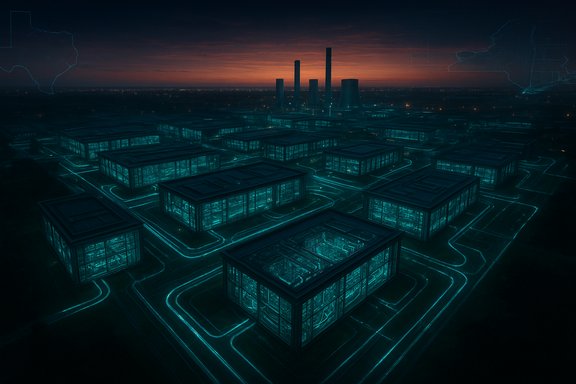
Modern generative AI is not just a software story: it is an infrastructure story. The performance and cost of frontier models hinge on access to vast pools of GPU compute, extremely high-bandwidth interconnects, and storage systems built around sustained multi‑terabyte-per-second throughput. Companies that can secure and operate purpose-built, high-density AI data centers will control critical levers of model development, inference latency, pricing and ultimately market access.In November 2025 two headlines crystallized that dynamic. Anthropic announced a headline $50 billion commitment to build custom data centers in Texas and New York with partner Fluidstack, promising to bring gigawatts of capacity online through 2026. Microsoft, already pursuing an aggressive capital plan for AI infrastructure, continued rolling out its Fairwater family of AI campuses — connecting new sites into an AI “superfactory” that stitches massive GPU farms together with a private optical backbone. Both moves underscore a single market truth: the AI race is increasingly a race for power, cooling, interconnect and land, as much as for algorithms or datasets.
Anthropic’s $50 billion bet: what’s in the plan
The headline and the partner
Anthropic publicly framed the program as a $50 billion investment in American computing infrastructure, with two initial regions named — Texas and New York — and Fluidstack named as the infrastructure partner responsible for rapid site delivery and operational scale. The company said the campuses will be “custom built for Anthropic” to support the Claude family of models and frontier research. This is a strategic pivot: Anthropic has long relied on major cloud providers for raw capacity, but the $50 billion commitment signals a move toward owning or tightly controlling bespoke physical assets that are optimized for dense GPU workloads.Jobs, timelines and scope
Anthropic’s public materials and partner statements put the first wave of capacity online through 2026 and project roughly 800 permanent jobs plus about 2,400 construction roles tied to the initial campuses. Those figures were repeated across major outlets and in Fluidstack’s own announcement. While large, those employment numbers are modest relative to the multi‑year economic lifecycle of hyperscale campuses, where operations roles accrue slowly as construction winds down.Technical intent: dense compute, liquid cooling, lower latency
Anthropic’s statements emphasize purpose-built design features: specialized GPU clusters, liquid cooling to enable higher per-rack power density, and architectural choices aimed at cutting latency and operating costs for sustained model training and inference. The intent is to create facilities tuned to the specific thermal, power and I/O profile of training frontier models — not generic, multi-tenant cloud regions. Industry reporting indicates those designs typically include rack-scale aggregation (NVLink/NVSwitch fabrics), exabyte-class storage fabrics, and closed-loop liquid cooling to manage thermal loads.What’s confirmed — and what remains company-reported
Anthropic’s press release is explicit about the headline figure, partner, and job projections, but several operational details remain proprietary or projections: exact site coordinates, final per-site power draws, the precise GPU inventories, and the cadence of chip deliveries. These are the types of claims that require independent verification once facilities are near production. Until then, treat capacity timelines and aggregate energy needs as company-provided projections.Microsoft’s Fairwater push: from single campus to distributed superfactory
From a flagship to a fabric
Microsoft’s Fairwater program was designed from the outset to treat data centers as pieces of a distributed supercomputer rather than as isolated facilities. The Fairwater campus in Mount Pleasant, Wisconsin — branded by Microsoft as “the world’s most powerful AI datacenter” — and a newly operational Fairwater site in Atlanta are now described as nodes in a continent-spanning AI fabric connected by a dedicated optical backbone. Microsoft’s public engineering posts and product blogs detail an architecture that emphasizes the rack as the unit of acceleration.The $80 billion capex frame
Microsoft’s broader fiscal 2025 capital commitment to AI-enabled infrastructure — widely reported as approximately $80 billion for that fiscal year — contextualizes Fairwater as part of an enormous, company-level capacity push aimed at meeting enterprise and model developer demand. Reuters and other outlets reported Microsoft’s fiscal plan, which the company has framed as an investment in making Azure AI-ready at unprecedented scale.Design highlights: NVL72, liquid cooling, and two-story halls
Fairwater’s technical narrative is explicit and detailed:- Racks built around NVL-style designs that can host up to 72 of NVIDIA’s Blackwell-generation (GB200/GB300) GPUs, connected with NVLink/NVSwitch fabrics to create very large pooled memory and intra-rack bandwidth.
- Closed-loop liquid cooling to enable high per-rack power densities — Microsoft cites figures like 140 kW per rack and about 1,360 kW per row in certain Fairwater designs, values that are far higher than legacy cloud racks.
- A two‑story hall design that shortens cable runs and reduces latency between racks, explicitly trading building complexity for cluster performance.
Technology under the hood: why these sites are different
Rack-first architecture and NVLink-based domains
The key technical shift in the newest AI campuses is the move to treat an entire rack as a single, tightly-coupled accelerator. NVLink and NVSwitch fabrics enable all-to-all GPU communication within a rack with aggregate intra-rack bandwidth measured in terabytes per second, dramatically reducing the communication overhead that traditionally forced models into brittle, cross-host sharding. That enables larger contiguous model partitions and more efficient training steps. Microsoft’s published architecture notes and third-party reporting describe NVL72-style racks and pooled GPU memory envelopes that make this possible.Liquid cooling and thermal engineering
Liquid cooling is now central to AI data center design. Closed-loop systems extract heat at the source (GPU heat plates or cold plates) and permit much higher electrical density per rack without the airflow, fan and evaporative-water demands of earlier designs. Microsoft and other operators describe closed-loop approaches that significantly reduce continuous water withdrawals compared with legacy evaporative cooling, while also enabling higher steady-state GPU utilization. Those tradeoffs — less grid water but higher electrical load in heat rejection equipment — are central to assessing environmental impact.Networking: private fiber and high-throughput fabrics
Large-model training is communication-bound. Gradient exchanges and activation shuffles require low-latency, massively parallel exchanges between GPUs. Operators are deploying a combination of ultra-fast spine/leaf fabrics (InfiniBand or 800 Gbps+ Ethernet) inside sites and dedicated long-haul fiber between sites so multi-site synchronous training behaves like a single, massive supercomputer rather than a federation of smaller clusters. Microsoft’s Fairwater design explicitly documents both elements.Economic and workforce impacts
Jobs and local stimulus
Both Anthropic and Microsoft promise local economic stimulus. Anthropic’s announcements cite roughly 800 permanent operations roles and some 2,400 construction jobs tied to its initial campuses; Microsoft’s Fairwater developments have already prompted local hiring pledges and training programs such as “Datacenter Academies” to develop regional skills for operations and engineering roles. These are meaningful local benefits, but the long-term payroll from data centers is typically small compared to construction-phase employment and the indirect economic activity depends heavily on local supplier ecosystems.Supply-chain concentration and the Nvidia choke point
A structural consequence of the scale of these projects is concentration of procurement power among a handful of vendors — notably NVIDIA for high-end accelerators and a small set of system integrators for rack systems. Companies with deep pockets are able to secure large allocations of GB‑family accelerators, escalating lead times and advantaging well-financed competitors. That dynamic reinforces a consolidation trend in compute access. Industry reporting and investor commentary repeatedly point to hardware scarcity and vendor bottlenecks as strategic constraints.Environmental and grid challenges
Gigawatts, water and local grids
Large AI campuses can demand gigawatts of power on aggregate across multiple sites, and even modest megawatt-per-site footprints can stress local transmission and distribution systems. Modern liquid-cooled designs reduce routine water draw versus legacy evaporative systems, but they do not eliminate large electrical demand or the need for robust cooling and heat rejection systems. Independent analyses and local utility filings are required to quantify final net impacts; company claims about “low water usage” or “renewable PPAs” are meaningful but must be validated against contract and operational telemetry.Public skepticism and regulatory attention
Public and policymaker scrutiny is increasing. Local stakeholders have raised concerns about power draw, land use, and the opaque incentives often used to attract hyperscale projects. Civic debates now regularly weigh short-term construction gains against long-term grid impacts and the potential for concentrated corporate footprints that pay limited property tax relative to local service needs. Environmental advocates likewise press for transparent lifecycle carbon accounting — from chip manufacture through site operation — and for guarantees that renewable energy commitments are backed by robust long-term procurement.Competitive landscape and market implications
Centralization vs. democratization of AI compute
These projects tilt the market toward centralized compute ownership by firms that can absorb the capex burden — a dynamic that may make it harder for smaller AI labs to compete without deep cloud partnerships. Anthropic’s move aims to give it greater independence from major clouds, while Microsoft’s expansions further solidify Azure’s role as a platform for high-end model development and enterprise AI services. The net effect is mixed: on one hand, more capacity can reduce unit costs and enable new applications; on the other, compute consolidation may raise switching costs and limit competitive diversity.Stock, procurement and vendor ripple effects
Announcements of multi-billion-dollar infrastructure programs have immediate market effects: vendor stocks (GPU suppliers, system integrators) typically react positively, while smaller cloud or AI firms may face pressure to secure chip inventory or partner for capacity. Microsoft’s $80 billion capex frame is a market signaling event that recalibrates expectations for enterprise AI availability and pricing. Meanwhile, Anthropic’s $50 billion headline amplifies competitive pressure and will force suppliers to further prioritize large customers.Verification, caveats and what remains uncertain
- Company‑reported headline numbers deserve scrutiny. The $50 billion and $80 billion figures are credible as corporate commitments or planned capital allocations, but they aggregate multi‑year, multi‑project spending and can include vendor contracts, hardware purchases, and facility capex that are staged over time. Treat headline totals as strategic commitments rather than single-year capital outlays unless explicitly stated.
- GPU counts and “hundreds of thousands” claims are workload- and configuration-dependent. Public statements about “hundreds of thousands of GPUs” or “10× the fastest supercomputer” are useful for scale context but depend on exact hardware mix (GB200 vs GB300), NVL configuration and whether the metric measures theoretical FP16 TFLOPS or application-level throughput. Independent audits and telemetry are required to validate such claims.
- Environmental figures (net water use, carbon intensity) depend on final cooling approach, heat reuse, and long-term power procurement. Closed‑loop liquid cooling reduces evaporative water use but can raise electrical load for heat rejection; renewable PPA announcements matter only if backed by long-term, contracted renewable supply at scale. Treat sustainability claims as conditional until backed by PPAs and independent environmental reviews.
- Timelines are optimistic and conditional. Anthropic’s “online through 2026” language and Microsoft’s staged rollouts are plausible but face real-world headwinds: supply-chain lead times for advanced accelerators, grid upgrade schedules, and permitting processes can all delay final production phases. Many of the most aggressive capacity promises in recent trade coverage reflect aspirational schedules rather than audited delivery milestones.
Risks, trade-offs and regulatory friction
- Power-grid strain: Local grids must upgrade transmission, substations and redundancy to support sustained high IT loads; that can be costly and politically fraught.
- Water and thermal management: Even with closed-loop cooling, heat rejection and seasonal thermal constraints remain operational risks in certain climates.
- Strategic concentration: Control of GPU supply chains and the capability to field rack‑scale accelerators can entrench competitive advantages for large incumbents.
- Workforce bottlenecks: Highly specialized roles in data center engineering, liquid cooling operations, and large-model MLOps are in short supply; training programs will be necessary to fill those gaps.
What this means for enterprises, developers and Windows-focused IT teams
- Enterprise buyers should expect more on‑demand access to frontier-class inference and training in Azure and via Anthropic enterprise products — but pricing and regionally available SKUs will vary as capacity comes online.
- Organizations considering in-house model training must weigh whether to partner with hyperscalers, rent GPU time from “neocloud” providers, or pursue co-location strategies with companies like Fluidstack; each path carries trade-offs in latency, governance and cost predictability.
- Windows-centric IT teams integrating Copilot and Azure AI services will benefit from reduced latency and higher throughput once Fairwater-class capacity is integrated into Azure regions. However, they should plan pilots carefully, validate performance claims with real workloads, and monitor cost overruns tied to high GPU-hour prices.
Final assessment — strengths, strategic logic, and real risks
Anthropic’s $50 billion and Microsoft’s ongoing Fairwater expansion are rational moves in a market where compute scarcity can bottleneck growth and product differentiation. Owning or tightly controlling large-scale, AI-optimized infrastructure gives these companies:- Lower marginal costs for sustained training at scale,
- Better latency and performance for enterprise customers,
- Strategic independence (for Anthropic) or platform lock-in (for Microsoft).
Anthropic’s buildout signals a strategic bet on vertical control of compute to accelerate Claude’s roadmap; Microsoft’s Fairwater architecture signals a systems-level rethink of how cloud and supercomputing converge for AI. Both moves will reshape procurement dynamics, vendor leverage, and the geography of compute — with consequences that extend from datacenter campuses to the software that runs on Windows desktops and enterprise clouds. The companies’ statements are bold and transformative, but the ultimate test will be in delivery: real operational telemetry, grid integration records, and independent verification of performance and sustainability claims must follow for these projects to move from promise to durable public benefit.
Anthropic and Microsoft are investing where the models live — in power feeds, chilled loops, fiber trunks and rack-scale GPU domains — and that movement is remaking the economics and geopolitics of AI. The next 18 months will reveal whether these investments translate into cheaper, faster, and more accessible AI for enterprises and developers, or whether they entrench a small set of players whose scale sets the terms for competition and innovation.
Source: RS Web Solutions Tech Giants Invest Heavily in Anthropic and Microsoft Data Centers
