

Microsoft’s decision to make Anthropic’s Claude family an enabled-by-default option inside Microsoft 365 Copilot is a structural shift in how enterprises will source, govern, and pay for generative AI inside Office—one that replaces a legacy opt‑in model with a Microsoft‑managed subprocessor arrangement and imposes immediate action items for tenant administrators and compliance teams.
Microsoft 365 Copilot has evolved from an embedded, single-backend assistant toward an orchestration layer that can route requests to multiple foundation-model providers. Through 2025 Microsoft gradually added Anthropic’s Claude variants as selectable backends inside Copilot experiences such as Researcher and Copilot Studio, initially under an opt‑in flow that required tenant admins to accept Anthropic’s separate commercial terms. Recent product and admin changes consolidate that relationship: Anthropic has been onboarded as a Microsoft subprocessor and Microsoft will enable Anthropic models by default for most commercial tenants in the public cloud on January 7, 2026. Administrators who want to preserve the prior posture must proactively disable the new toggle in their Microsoft 365 admin center before (or shortly after) that date.
This is not a cosmetic feature flag: it recasts provider relationships, shifts certain data‑processing guarantees, and broadens the operational surface area of Copilot by making third‑party model routing a default tenant configuration rather than an explicit customer choice.
Administrators should:
Treat vendor claims—whether about model superiority, token pricing or multi‑billion compute commitments—as starting points for rigorous internal validation. Where regulatory constraints apply (notably EU/UK data residency regimes and government clouds), follow a conservative posture: don’t assume protections you rely on will automatically extend to third‑party model routing. Act now to audit your admin settings, inform legal and procurement, and build the telemetry and playbooks you’ll need to operate Copilot as a mission‑critical service in a multi‑model future.
Source: FourWeekMBA Microsoft 365 Copilot Enables Anthropic Claude Models by Default - FourWeekMBA
 Background / Overview
Microsoft 365 Copilot has evolved from an embedded, single-backend assistant toward an orchestration layer that can route requests to multiple foundation-model providers. Through 2025 Microsoft gradually added Anthropic’s Claude variants as selectable backends inside Copilot experiences such as Researcher and Copilot Studio, initially under an opt‑in flow that required tenant admins to accept Anthropic’s separate commercial terms. Recent product and admin changes consolidate that relationship: Anthropic has been onboarded as a Microsoft subprocessor and Microsoft will enable Anthropic models by default for most commercial tenants in the public cloud on January 7, 2026. Administrators who want to preserve the prior posture must proactively disable the new toggle in their Microsoft 365 admin center before (or shortly after) that date.This is not a cosmetic feature flag: it recasts provider relationships, shifts certain data‑processing guarantees, and broadens the operational surface area of Copilot by making third‑party model routing a default tenant configuration rather than an explicit customer choice.
What changed — the essential facts
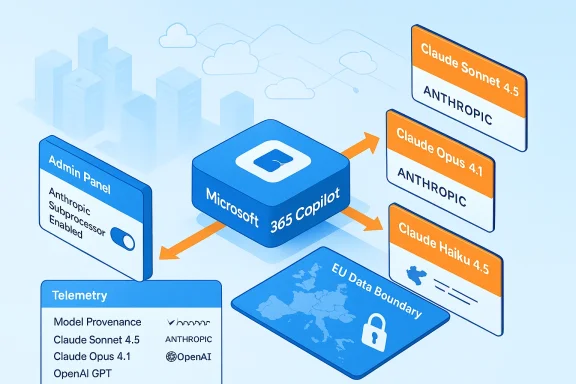
- Microsoft will treat Anthropic as a Microsoft subprocessor, bringing Anthropic‑hosted processing into Microsoft’s Online Services contractual framework (Product Terms and Microsoft Data Protection Addendum) when routed through Copilot.
- For most commercial tenants in the public/commercial cloud, Anthropic models will be enabled by default on January 7, 2026; an admin toggle surfaced in December 2025 allows tenant administrators to opt out.
- EU/EFTA/UK tenants are explicitly treated differently: Anthropic‑processed requests remain excluded from Microsoft’s EU Data Boundary and in‑country guarantees, so Anthropic will be disabled by default in those regions unless admins actively re‑enable it.
- Anthropic models are not available in government/sovereign clouds (GCC, GCC High, DoD, sovereign clouds); no toggle is present in those environments.
How Claude is surfaced in Copilot and Foundry
Where you’ll see Claude inside Microsoft tooling
Microsoft has made Claude variants selectable across multiple Copilot surfaces and in Azure Foundry:- Microsoft 365 Copilot (Word, Excel, PowerPoint, Outlook, Teams) — selectable backends for certain agent experiences such as Researcher.
- Copilot Studio — builders can assign Anthropic models (for example, Claude Sonnet and Claude Opus) to agent roles inside low‑code/no‑code orchestration flows.
- Azure AI Foundry — serverless deployments of Claude Sonnet, Opus and Haiku variants are available in preview, with SDKs and Entra authentication for enterprise integration.
Model variants and positioning
Microsoft and Anthropic position the Claude family as distinct options depending on task fit:- Claude Sonnet (Sonnet 4 / Sonnet 4.5): marketed for high‑throughput, large‑context, predictable outputs and agent orchestration.
- Claude Opus (Opus 4.1): tuned for multi‑step reasoning and developer/agentic workflows—favored for deeper synthesis and coding assistance.
- Claude Haiku (Haiku 4.5): presented as a cost‑optimized, lower‑latency variant for throughput‑sensitive tasks.
Legal, compliance and data‑residency implications
Subprocessor status vs separate vendor agreement
Making Anthropic a Microsoft subprocessor consolidates the contractual surface: Anthropic’s processing will be governed by Microsoft’s Product Terms and DPA when requests are routed through Microsoft 365 Copilot, rather than by a separate bilateral enterprise agreement between a customer and Anthropic. That simplifies procurement in many cases, but it does not eliminate compliance review obligations: organizations still must confirm where inference and telemetry are processed, what subordinate subprocessors are engaged, and how data transfers are handled.Regional constraints — EU Data Boundary and the UK
Microsoft has stated that Anthropic‑processed requests are excluded from the EU Data Boundary and its in‑country processing guarantees. For organizations subject to EU/EFTA or UK law, enabling Anthropic may create cross‑border transfers of personal data that are not covered by Microsoft’s regional contractual promises. As a result, Anthropic will be disabled by default for tenants in those jurisdictions and administrators who previously opted into Anthropic under legacy terms must re‑opt into the new subprocessor flow to continue using Claude. This requires legal and technical review of lawful transfer mechanisms and potential compensating controls.Government and sovereign clouds
If your tenant operates under GCC, GCC High, DoD, or sovereign cloud contracts, Anthropic models are simply not available. That reflects certification, FedRAMP/DoD SRG and sovereignty requirements Anthropic has not met for those environments. Administrators in those clouds will see no Anthropic toggle to configure.Operational and security trade‑offs
Cross‑cloud processing and telemetry
Routing requests to Anthropic often means those requests leave Azure and are processed on Anthropic‑hosted endpoints (often in AWS or marketplaces), so you must treat Copilot as a cross‑cloud orchestration plane. That creates several operational realities:- Audit and telemetry must include model provenance (which model/provider handled each request), prompt context fingerprints, and response hashes for later verification.
- Runtime payloads may contain sensitive context. Define redaction rules, retention policies, and SIEM/forensic integration before enabling third‑party backends.
Data leakage, retention and model training
Even as Anthropic operates as a Microsoft subprocessor in this flow, the specifics of data retention, logging, and potential downstream use in model training depend on the contractual terms between Microsoft and Anthropic and the applied DPA clauses. Treat vendor‑reported statements about training‑data exclusion, retention timeframes, or non‑use assurances as claims to be validated in writing and preserved in procurement records. Wherever possible, demand per‑request logging and retention controls you can audit.Incident history and resilience
Recent incidents highlighted the fragility of synchronous generative AI at scale (for example, a December 2025 outage tied to unexpected traffic surges), showing that model availability and autoscaling behavior can create operational dependencies. Multi‑model diversity can mitigate single‑vendor outages, but administrators must plan failover modes and manual fallbacks for critical workflows.Commercial and procurement implications
Billing and Azure Consumption Commitments (MACC)
A key commercial wrinkle: Claude usage through Microsoft Foundry and some Copilot surfaces can be billed through the Microsoft Azure Consumption Commitment (MACC), letting enterprises leverage existing Azure spend commitments rather than opening a separate Anthropic invoice. That simplifies procurement for many organizations moving pilots to production. Validate MACC eligibility for your tenant and review billing mappings carefully.Headline compute and investment claims — treat with caution
Press coverage and vendor statements describe large headline commitments tied to the Anthropic–Microsoft–NVIDIA alignment, including references to roughly $30 billion of Azure compute commitments by Anthropic and staged investments “up to” $10 billion from NVIDIA and “up to” $5 billion from Microsoft. These are influential, but they are vendor‑reported, staged and conditional—read them as strategic intent rather than immediate cash transfers and verify line‑item details in contractual schedules or regulatory filings before treating them as hard accounting. Flag such figures for procurement and finance teams to verify.Practical recommendations for IT, security and compliance
Below is a prioritized checklist to act on immediately and over the coming weeks.Immediate (within 24–72 hours)
- Verify whether Anthropic is enabled or scheduled to be enabled by default for your tenant and locate the new Anthropic subprocessor toggle in Microsoft 365 Admin Center. If your organization must prevent data from being processed by Anthropic, disable the toggle now.
- Notify legal, privacy and procurement teams about the switch to a subprocessor model so they can review the Microsoft Product Terms and DPA amendments and decide whether to accept the new configuration.
- Identify any EU/EFTA/UK tenant locations and confirm whether Anthropic is disabled by default; if your teams previously used Anthropic under legacy terms, instruct legal to manage re‑opt‑in workflows where appropriate.
Short term (1–4 weeks)
- Audit your Copilot workloads and tag critical business processes that must not be routed to third‑party backends. Implement allow‑lists and per‑environment policies in Copilot Studio and Power Platform Admin Center.
- Ensure telemetry captures model/provider identifiers and that logs are forwarded to centralized SIEM with retention aligned to audit requirements.
- Run a scoped pilot to compare OpenAI vs Anthropic models on representative prompts with measurable metrics: accuracy, hallucination rate, latency, cost per 1M tokens, and data‑exposure surface. Vendor claims about benchmark superiority should be validated in your environment.
Medium term (1–3 months)
- Include model provenance and model‑selection policies in your enterprise AI governance playbook. Add Copilot model routing to change and release management processes.
- For regulated workloads subject to EU/UK data residency rules, document lawful transfer mechanisms and compensating controls (e.g., pseudonymization, tenancy isolation, contractual safeguards) if Anthropic use is necessary.
Technical governance: what to log and why it matters
Make sure your telemetry includes:- Tenant identifier and user acting on behalf of tenant.
- Model/provider id (e.g., Claude Sonnet 4.5, Claude Opus 4.1, OpenAI GPT‑X).
- Prompt hash and response hash (not full prompt where sensitive) to enable reproducibility without disclosing secrets.
- List of connectors or tools invoked (MCP calls to SharePoint, OneDrive, Outlook).
- Timestamp, latency, and billing meter identifiers for cost allocation.
Benefits and strategic upside
- Choice and task fit: Model diversity lets you route tasks to models optimized for throughput, long context, or agentic reasoning, improving quality or cost for specific workflows.
- Procurement simplicity: Subprocessor status plus MACC billing can reduce procurement friction for customers who prefer to keep billing inside their Azure commitments.
- Resilience: Multi‑model orchestration lowers single‑vendor risk and provides fallbacks during outages or throttling events.
Notable risks and open questions
- Vendor‑reported performance or investment figures (for example, the ~$30B Azure compute commitment and staged NVIDIA/Microsoft investments) should be treated as strategic claims that require contractual verification. These headline numbers are influential but conditional.
- The technical topology for where inference runs and how telemetry is shared can vary by Copilot surface and model selection; that variability complicates a one‑size‑fits‑all compliance posture. Confirm per‑surface processing rules before enabling Anthropic broadly.
- Government and sovereign cloud customers will not be able to use Anthropic via Copilot; organizations with hybrid cloud footprints must design deployment patterns that respect these availability gaps.
What this means for Windows and enterprise administrators
For Windows‑centric IT teams, Copilot’s transition into a multi‑model orchestration plane demands clearer operational playbooks. Treat Copilot as a service dependency: document failover modes, include Copilot and external model routing in business continuity plans, and add model vendor behaviours to your incident‑response runbooks. Evaluate whether user experiences can be preserved with local fallbacks (e.g., cached templates, offline macros) if a model provider becomes unavailable.Administrators should:
- Use tenant scoping to pilot Anthropic only where benefits are clear.
- Integrate Copilot telemetry into established Windows‑centered monitoring and SIEM pipelines.
- Keep governance documentation and pop‑up user notices up to date so employees understand when a third‑party model handled their prompt.
Conclusion
Microsoft’s move to enable Anthropic Claude models by default in Microsoft 365 Copilot marks a pivotal moment in enterprise AI: vendor relationships are shifting from optional add‑ons to platform‑level subprocessors, multi‑model orchestration is becoming the default operational pattern, and procurement, privacy, and security teams must respond quickly to preserve compliance and control. The change offers clear benefits—model choice, potential billing simplification, and resilience—but also brings immediate governance tasks: verify your tenant toggle, update contracts and retention policies, expand telemetry and SIEM coverage, and pilot models against representative workloads.Treat vendor claims—whether about model superiority, token pricing or multi‑billion compute commitments—as starting points for rigorous internal validation. Where regulatory constraints apply (notably EU/UK data residency regimes and government clouds), follow a conservative posture: don’t assume protections you rely on will automatically extend to third‑party model routing. Act now to audit your admin settings, inform legal and procurement, and build the telemetry and playbooks you’ll need to operate Copilot as a mission‑critical service in a multi‑model future.
Source: FourWeekMBA Microsoft 365 Copilot Enables Anthropic Claude Models by Default - FourWeekMBA
