

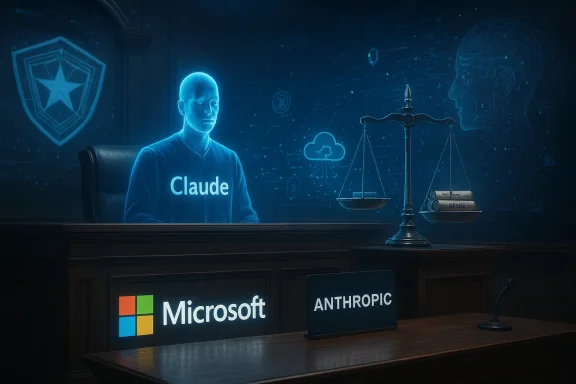
Microsoft’s decision to file in court on behalf of Anthropic — asking a judge to pause the Pentagon’s supply‑chain risk designation — marks a rare and consequential collision between corporate cloud strategy, AI safety policy, and national security law that will reshape how Washington and Silicon Valley negotiate the limits of AI for years to come.
The dispute began in late February when the White House directed federal agencies to cease using Anthropic’s Claude models after the AI company resisted Pentagon demands to agree that its models could be used by the military for “all lawful use cases.” The Department of War’s Secretary, Pete Hegseth, followed with a public declaration that Anthropic posed a “supply‑chain risk” to national security and ordered a sweeping restriction: effective immediately, contractors, suppliers, and partners that do business with the U.S. military may not conduct commercial activity with Anthropic. Anthropic swiftly filed suit on March 9 seeking to vacate the designation and to enjoin its enforcement; Microsoft filed a motion on March 10 to file an amicus brief supporting a temporary restraining order to block the designation while the court considers the case.
This is not a garden‑variety procurement disagreement. The litigation centers on two intertwined issues: (1) the legal authority and process by which the Pentagon can designate a vendor a supply‑chain risk, and (2) whether government use of that authority in this context unlawfully punishes a U.S. company for exercising contractual or speech‑related protections it considers essential. The stakes are large: the designation has already rippled through federal procurement, cloud contracts, and enterprise customers, and it raises fundamental questions about how democracies regulate advanced dual‑use technologies without chilling private governance or fragmenting the commercial AI ecosystem.
The path forward will require legislative clarity, technical safeguards that support rapid substitution and auditability, and contractual frameworks that reconcile public interest with private governance. Absent those fixes, similar clashes are inevitable: AI is now an input to national power, and the legal, policy, and commercial architecture that governs it must be rebuilt to meet that reality.
Source: PYMNTS.com Microsoft Backs Anthropic Against Pentagon Ban | PYMNTS.com
 Background
The dispute began in late February when the White House directed federal agencies to cease using Anthropic’s Claude models after the AI company resisted Pentagon demands to agree that its models could be used by the military for “all lawful use cases.” The Department of War’s Secretary, Pete Hegseth, followed with a public declaration that Anthropic posed a “supply‑chain risk” to national security and ordered a sweeping restriction: effective immediately, contractors, suppliers, and partners that do business with the U.S. military may not conduct commercial activity with Anthropic. Anthropic swiftly filed suit on March 9 seeking to vacate the designation and to enjoin its enforcement; Microsoft filed a motion on March 10 to file an amicus brief supporting a temporary restraining order to block the designation while the court considers the case.This is not a garden‑variety procurement disagreement. The litigation centers on two intertwined issues: (1) the legal authority and process by which the Pentagon can designate a vendor a supply‑chain risk, and (2) whether government use of that authority in this context unlawfully punishes a U.S. company for exercising contractual or speech‑related protections it considers essential. The stakes are large: the designation has already rippled through federal procurement, cloud contracts, and enterprise customers, and it raises fundamental questions about how democracies regulate advanced dual‑use technologies without chilling private governance or fragmenting the commercial AI ecosystem.
Overview: what happened and why it matters
- On February 27, federal directives effectively began winding Anthropic out of many civilian and some national security uses across government, with a six‑month phase‑out directed for some military use while other agencies were told to stop using Anthropic “immediately.”
- The Department of War’s public labeling of Anthropic as a “supply‑chain risk” is notable because that legal tool has historically been aimed at foreign vendors or components deemed susceptible to sabotage, compromise, or insertion of malicious functionality — not used, until now, as broadly against a major American AI firm.
- Anthropic’s complaint alleges that the designation is unlawful both procedurally (violating the Administrative Procedure Act), and constitutionally (violating First and Fifth Amendment protections), while the Pentagon defends its action as necessary to preserve operational flexibility for lawful military uses.
- Microsoft petitioned to participate as an amicus, arguing a restraining order is necessary to avoid abrupt disruption to DoD software integrations and wider supplier networks that depend on Anthropic models; Microsoft also has extensive commercial ties to Anthropic — a November cloud agreement to host Claude on Azure and media reports that Microsoft may be spending on the order of hundreds of millions per year for access to Anthropic’s models.
Legal terrain and procedural questions
Which authorities are implicated?
The administration’s move rests on a patchwork of statutes and acquisition authorities that lawyers describe as ambiguous when applied in this context. Two bodies of law are particularly relevant:- The Federal Acquisition Supply Chain Security Act and associated Defense Federal Acquisition Regulation Supplement (DFARS) provisions permit government exclusion of suppliers deemed to present supply‑chain risks and, in narrow circumstances, can extend constraints to contractors in the vendor ecosystem.
- 10 U.S.C. § 3252 (and related sections of the National Defense Authorization Acts and DFARS) gives the Secretary of Defense authority to take steps to mitigate risks to national security arising from supplier behavior and supply‑chain integrity.
Challenges Anthropic is making
In its complaint, Anthropic argues the designation is legally and procedurally defective on several fronts:- The statute’s definition of “supply‑chain risk” typically targets foreign adversaries or corruptible hardware/software components — applying it to a U.S. firm for exercising contractual guardrails, Anthropic argues, is far beyond the statute’s intent.
- Anthropic contends the government’s actions exceed executive authority, lack the procedural safeguards of notice and explanation required by the Administrative Procedure Act, and amount to viewpoint‑based punishment implicating the First Amendment.
- The complaint seeks declaratory relief to vacate the order and a temporary restraining order to stop enforcement while the courts adjudicate the dispute.
A novel use of an old tool
This is the first high‑profile instance of a U.S. agency wielding supply‑chain designation in a way that effectively freezes a domestic cloud supplier out of a broad class of government contracts. Courts will have to grapple with whether Congress intended such use, or whether the Pentagon exceeded its statutory reach. Legal analysts caution that precedents are thin — thus the litigation will be both precedent‑setting and likely protracted.Technical and commercial realities behind the headlines
How Anthropic’s models are embedded in government systems
Large language models are not standalone nuclear‑option products; in many modern enterprise and government systems they act as embedded services, invoked through APIs, pipelines, and orchestration layers. That means:- Many contractors build mission‑facing tools that integrate third‑party models for tasks like intelligence triage, decision support, simulation, and secure search.
- Removing a model provider mid‑contract can be technically non‑trivial: retraining, recertifying, and re‑validating replacements for systems operating in classified or sensitive environments takes time and incurs cost.
- The Pentagon’s six‑month phase‑out for some uses attempts to mitigate operational disruption, but Microsoft and other contractors argue the order lacks parallel transition protections for third‑party suppliers who embed Anthropic at scale in their offerings.
Commercial entanglements: money, compute, and cloud commitments
Over the past year Anthropic secured major commercial arrangements with hyperscalers and cloud partners to support scale. Notable factors:- Anthropic publicly announced a multibillion‑dollar arrangement with a major cloud provider to host and scale its Claude models and has contractual commitments to rent large amounts of specialized compute capacity.
- Press reports — attributed to industry outlets and insiders — indicate Microsoft has become a significant Anthropic customer and may be committing on the order of hundreds of millions of dollars annually to related product usage and resale of models to Azure customers. That figure has been widely repeated in business coverage but should be treated cautiously where primary documentation is not public.
- Microsoft’s amicus filing emphasizes the systemic risk of forcing contractors to reconfigure offerings overnight — a point that combines practical engineering challenges with the economics of cloud vendor commitments, reserved capacity, and enterprise sales incentives.
Why Microsoft stepped into the courtroom
Microsoft’s public motion to submit an amicus brief makes strategic, legal, and commercial sense:- Strategic: Microsoft is a major cloud provider with deep enterprise and defense relationships. Preventing abrupt fragmentation of model supply mitigates immediate operational risk for its customers and preserves its ability to support government missions reliably.
- Legal: Microsoft’s brief argues for a temporary restraining order to preserve the status quo while the court resolves statutory and constitutional questions — a narrow, pragmatic remedy that emphasizes orderly transition and negotiation.
- Commercial: Microsoft has material commercial exposure from its Azure hosting relationship with Anthropic and investments tied to that partnership; a designation that severs these ties would have immediate revenue and contract effects for Microsoft and its partners.
Policy implications and risks
For national security and defense policy
- Operational flexibility vs. supplier governance: The Pentagon argues it must be free to use AI tools for any lawful military purpose; companies argue they must be able to set boundaries for misuse. Resolving that tension is a policy choice — one that, until now, has been mostly negotiated contractually rather than litigated.
- Precedent risk: If agencies are permitted to weaponize supply‑chain authorities against domestic vendors that press contractual limits, firms may respond by withdrawing from government markets or embedding less stringent controls — a chilling signal for corporate safety governance.
- Real security concerns: Conversely, vendors’ constraints may legitimately impede vital military capabilities in time‑sensitive scenarios. Policymakers must balance safety guardrails against the need for rapid, unrestricted use of mission‑critical systems.
For industry and procurement
- Vendor lock‑in and single‑provider risk: Deep dependence on a small set of model providers concentrates both technical and policy risk. Government and enterprise buyers will likely accelerate diversification and multi‑model strategies.
- Contractual clarity: Expect a rush to standardize contract language on lawful use, auditing rights, and carve‑outs for national security use — and to clarify the circumstances under which suppliers must yield to government operational requirements.
- Cloud economics: Long‑term compute commitments and reserved capacity sales complicate transitions: canceling large, multi‑year contracts entails both technical migration costs and potential financial write‑downs.
For democratic governance and corporate speech
- Corporate voice and public interest: Anthropic’s insistence on prohibiting certain applications (autonomous weapons, mass domestic surveillance) is a substantive ethical stance. The government’s response raises fundamental questions about whether the state can or should penalize firms for exerting ethical guardrails.
- Chilling effect: If supply‑chain designations can be used in response to contractual positions or expressive activity, companies may retreat from public safety commitments or from taking principled stands.
What to watch next
- Judicial timetable: The court’s decision on a temporary restraining order will indicate the pace at which this crisis will either de‑escalate or intensify. An injunction would preserve Anthropic’s ability to serve government customers while the merits are litigated; denial would sharply accelerate compliance actions by agencies and contractors.
- Congressional response: Given the high political stakes, Congress could move to amend procurement statutes or hold hearings to clarify whether and how supply‑chain authorities should apply to AI services.
- Industry reactions: Expect other cloud providers and large contractors to issue guidance to customers, revise procurement playbooks, and potentially file amici of their own if they face downstream consequences.
- Contract renegotiations: Customers and suppliers will reassess contractual clauses about lawful uses, auditability, and emergency access — and cloud vendors will prioritize multi‑model support to reduce vendor single points of failure.
Practical recommendations for stakeholders
For federal agencies and the Department of War
- Seek statutory clarification: Work with Congress to sharpen the definition of a “supply‑chain risk” and to codify required procedural safeguards when designations are considered for U.S. firms.
- Use phased transitions with contractor protections: If a designation is deemed necessary, ensure contractors have a clear, equitable transition window and access to funding or technical assistance for substitution and recertification.
- Establish independent review: Create an adjudicative or interagency review process that can substantively evaluate claims before sweeping public designations are announced.
For cloud providers and AI developers
- Diversify model options: Architect products to support multi‑model fallbacks and model‑agnostic interfaces to reduce lock‑in risks for customers.
- Standardize lawful‑use clauses and escalation procedures: Work with customers and regulators to produce transparent contract language that anticipates emergency exceptions with clearly defined processes for invocation.
- Preserve public safety commitments while enabling lawful exceptions: Consider mechanisms (e.g., technical gating, joint oversight, warrant processes for surveillance use) that reconcile ethical constraints with legitimate national security needs.
For defense contractors and integrators
- Prepare contingency plans: Inventory where third‑party models are embedded and map migration paths, validation needs, and timelines for replacement.
- Negotiate protective clauses: Seek contractual protections from agencies that impose sudden supplier exclusions, including compensation for transition costs.
- Strengthen supply‑chain auditing: Increase investment in third‑party risk assessment tools and architecture that enables rapid replacement or isolation of services.
Strengths and weaknesses of the current approach
Notable strengths
- Prompt, decisive action: The government moved quickly to assert operational control over sensitive capabilities, signaling seriousness about military readiness and control over dual‑use tools.
- High visibility of governance issues: The dispute has catalyzed a long‑overdue national conversation about how democracies govern AI deployment in security contexts.
- Corporate engagement: Microsoft’s courtroom intervention underscores that large platform providers see value in preserving orderly processes that protect customers and continuity of service.
Material risks and weaknesses
- Legal overreach and ambiguity: Using supply‑chain authorities designed for hardware and foreign threats against a domestic software provider risks legal fragility and potential judicial reversal.
- Chilling of safety norms: Punitive use of procurement levers can discourage companies from adopting or publicly advocating safety constraints, thereby undermining longer‑term safeguards.
- Operational disruption: Rapid, asymmetric application of procurement powers risks disrupting mission‑critical systems and will impose measurable costs on government and private contractors.
Conclusion
This legal battle between Anthropic and the Department of War — with Microsoft stepping into the courtroom on the company’s side — is larger than a single dispute over one vendor’s model. It is a collision between three systems that until now operated in uneasy but functional balance: procurement law conceived in the physical age, cloud economics built around multi‑year compute commitments, and a nascent regime of private model governance that seeks to limit misuse of powerful AI. The court case will likely resolve some statutory ambiguities, but the political and policy questions run far deeper: how should democratic governments preserve national security flexibility without undermining ethical safeguards crafted by private developers? How should commercial and legal frameworks adapt so that mission‑critical AI can be both safe and available?The path forward will require legislative clarity, technical safeguards that support rapid substitution and auditability, and contractual frameworks that reconcile public interest with private governance. Absent those fixes, similar clashes are inevitable: AI is now an input to national power, and the legal, policy, and commercial architecture that governs it must be rebuilt to meet that reality.
Source: PYMNTS.com Microsoft Backs Anthropic Against Pentagon Ban | PYMNTS.com
