

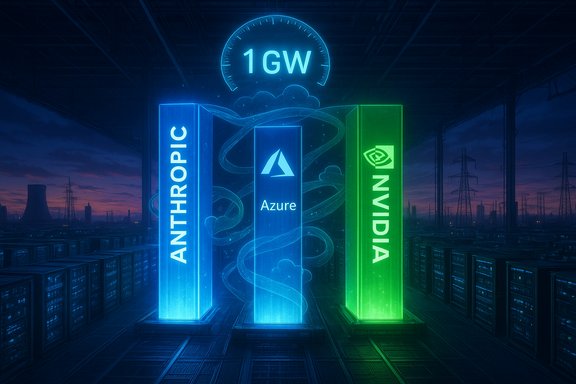
Anthropic’s surprise alliance with Microsoft and Nvidia rewrites the commercial map for frontier AI: Microsoft will invest up to $5 billion, Nvidia up to $10 billion, and Anthropic has committed to purchase roughly $30 billion of Azure compute — with an initial option to contract capacity scaling toward one gigawatt of Nvidia-powered infrastructure — while Anthropic’s Claude models are being expanded into Azure AI Foundry and Microsoft’s Copilot ecosystem.
Anthropic emerged in 2021 as one of the fastest-growing challengers to earlier frontier-model vendors, building the Claude family of large language models with a public emphasis on safety and enterprise readiness. Over 2024–2025 the company pursued a deliberate multi-cloud strategy — training and deploying models across AWS, Google Cloud, and other partners — and accepted major strategic investments from cloud providers, notably Amazon’s multi-billion-dollar injections. Recent reporting and vendor statements confirm Amazon’s multi-stage investment in Anthropic (totaling $4 billion in publicly disclosed tranches and earlier reporting that aggregated Amazon’s involvement to $8 billion), and Anthropic explicitly named AWS as a primary cloud training partner in those announcements. The newly announced three‑way alignment — publicized alongside Microsoft’s Ignite developer conference — converts those earlier, distributed cloud relationships into a higher‑stakes pattern: long‑term reserved cloud spend, deep chip‑to‑model engineering, and reciprocal capital commitments that make the vendor/customer lines blur. Put simply: Anthropic buys compute, Microsoft gains model distribution and revenue capture, and Nvidia secures demand for next‑generation accelerators while co‑designing silicon and software with a major model owner.
Source: Telecompaper Telecompaper
 Background / Overview
Anthropic emerged in 2021 as one of the fastest-growing challengers to earlier frontier-model vendors, building the Claude family of large language models with a public emphasis on safety and enterprise readiness. Over 2024–2025 the company pursued a deliberate multi-cloud strategy — training and deploying models across AWS, Google Cloud, and other partners — and accepted major strategic investments from cloud providers, notably Amazon’s multi-billion-dollar injections. Recent reporting and vendor statements confirm Amazon’s multi-stage investment in Anthropic (totaling $4 billion in publicly disclosed tranches and earlier reporting that aggregated Amazon’s involvement to $8 billion), and Anthropic explicitly named AWS as a primary cloud training partner in those announcements. The newly announced three‑way alignment — publicized alongside Microsoft’s Ignite developer conference — converts those earlier, distributed cloud relationships into a higher‑stakes pattern: long‑term reserved cloud spend, deep chip‑to‑model engineering, and reciprocal capital commitments that make the vendor/customer lines blur. Put simply: Anthropic buys compute, Microsoft gains model distribution and revenue capture, and Nvidia secures demand for next‑generation accelerators while co‑designing silicon and software with a major model owner. What was announced — the essentials
Headline financial and capacity commitments
- Anthropic committed to purchase approximately $30 billion of compute capacity on Microsoft Azure over multiple years.
- Nvidia pledged to invest up to $10 billion in Anthropic and to engage in deep technical collaboration to optimize Anthropic’s models for Nvidia hardware.
- Microsoft pledged to invest up to $5 billion in Anthropic and to expand access to Claude across Azure AI Foundry and the Copilot family (including GitHub Copilot and Microsoft 365 Copilot).
- The companies described access options that could scale to “up to one gigawatt” of Nvidia-powered compute capacity (an electrical-scale framing that industry analysts interpret as hyperscale GPU deployments across multiple data center sites).
Product and integration details
Microsoft will make several of Anthropic’s recent Claude variants available to Azure enterprise customers via Azure AI Foundry and will maintain Claude integration across the Copilot family. Public product messaging named specific Claude releases — Claude Sonnet 4.5, Claude Opus 4.1, and Claude Haiku 4.5 — as initial entrants into Azure’s model catalog and Microsoft Copilot surfaces. Nvidia and Anthropic will conduct co‑engineering work to optimize models for Grace Blackwell and the upcoming Vera Rubin architectures and next-generation system families.Why this matters: strategic implications for cloud, chips, and models
1) A new pattern of circular economics
The deal exemplifies the now‑familiar but increasingly consequential pattern where cloud providers and chipmakers are simultaneously customers, suppliers, and investors in model developers. Microsoft and Nvidia are not just selling infrastructure and silicon; they are taking financial stakes in the model vendor that will, in turn, commit large, multi‑year purchases back to them. That circularity can align incentives — guaranteeing demand for hardware and cloud capacity — but it also concentrates economic power and creates complex interdependencies that raise valuation, competition, and regulatory questions.2) Multi‑cloud, but with an anchor
Anthropic publicly maintained that it will continue a multi-cloud posture — citing ongoing relationships with AWS and Google Cloud — even as the Azure commitment anchors a large operational footprint on Microsoft. For enterprises, Claude’s availability across AWS, Google Cloud, and now Azure reduces switching friction and increases model choice within familiar vendor ecosystems. For the cloud providers, however, it’s also a way to capture downstream spend: making frontier models available inside a given cloud creates new stickiness for enterprise customers buying compute, storage, and managed AI services.3) The compute arms race accelerates
The one-gigawatt framing is meaningful because it signals a facilities and power scale that only the largest hyperscalers can support at pace. Delivery of gigawatt-class AI capacity requires major utility agreements, substations, liquid cooling, and phased rack deployments; it is not a simple GPU order. Industry estimates place the capital and operational cost for such continuous, high-density AI capacity in the tens of billions of dollars, depending on system configuration and regional energy costs. That dynamic explains why model owners need multi‑year cloud commitments to guarantee sustained capacity for training and inference.4) Nvidia’s strategic play: co‑design and demand security
For Nvidia, co‑engineering relationships with major model developers have become a competitive moat. Tuning model topologies, precision strategies, and parallelization approaches to make optimal use of Blackwell-era chips and new architectures materially reduces token cost and improves inference throughput. Partnering with Anthropic helps Nvidia validate architectural choices and lock in future orders, reinforcing its hardware leadership. That engineering intimacy can produce efficiency gains but also increases workload specialization that may disadvantage alternative silicon or general-purpose designs.Technical specifics and verification
What “1 gigawatt” actually implies
- One gigawatt refers to electrical feed capacity and facility scale, not a literal GPU count. Converting that electrical headroom to usable GPU capacity requires staging across data centers, substations, and rack‑scale networking. Industry reporting and vendor statements repeatedly treat the figure as a long‑term ceiling, not an immediate single‑site deployment.
Target hardware and model tuning
- Public announcements name Nvidia system families expected to be targeted: Grace Blackwell and Vera Rubin. Anthropic and Nvidia said they will engage in joint model ↔ silicon optimization to improve performance, efficiency, and total cost of ownership (TCO). Those are engineering statements confirmed by the companies’ public messaging and independent coverage.
Model availability and named versions
- Microsoft indicated that Claude Sonnet 4.5, Claude Opus 4.1, and Claude Haiku 4.5 will be available through Azure AI Foundry and will be exposed across Microsoft’s Copilot branded products. Multiple outlets and Microsoft’s communications corroborate these product names and the integration plan. Enterprises should expect phased rollouts and public preview windows rather than immediate universal availability.
Verification record: multiple independent confirmations
Major elements of the announcement — the headline investment ceilings, the $30 billion Azure compute commitment, the model availability on Azure, and the Nvidia co‑engineering pledge — are corroborated across multiple reputable outlets and the firms’ joint statements. Reuters and AP reported the $5 billion and $10 billion investment figures alongside the $30 billion compute purchase; financial outlets including the Financial Times and Bloomberg also independently reported the same top-line commitments. Where subtle differences appear (for example, reported valuations or revenue run‑rate projections), those discrepancies are noted and treated cautiously below.Risks, unanswered questions, and regulatory considerations
Valuation and revenue claims vary — treat with caution
Private‑market valuation figures for Anthropic differ across reports: some outlets quote private valuations in the low‑hundreds of billions, while others report higher or lower numbers; reported revenue run‑rates also vary. Those figures are frequently drawn from private, non‑audited sources or are derived from fundraising negotiations and should therefore be treated as approximations until audited filings or direct regulatory disclosures are available. The “up to” phrasing on investments and compute purchases adds a second layer of uncertainty about timing, tranche structure, and dilution.Concentration and competition concerns
The deal tightens relationships among three hyperscale actors that already wield outsized influence over the AI stack. That concentration raises potential competition and antitrust concerns in several ways:- Vertical entanglement: when a hardware vendor and cloud provider both take financial stakes in a model owner that then commits compute and product distribution back to them, market access for competing model vendors could be affected.
- Network effects in enterprise procurement: bundling a frontier model with cloud and productivity services amplifies switching costs for enterprise customers.
- Supplier dependence: model developers optimized to a narrow set of accelerator features risk reduced portability and vendor lock‑in — a technical risk that can become a commercial constraint.
Execution risk at enormous scale
Delivering gigawatt‑class capacity and coordinating co‑design across hardware and model roadmaps is a complex engineering and project‑management challenge. Risks include supply chain timing for next‑generation chips, building and permitting data center footprints with sufficient power and cooling, and integrating optimized software stacks that materially reduce TCO. Failure to execute on these fronts could delay promised capacity and create mismatches between model ambitions and practical deployment.The circularity problem: financial optics and incentives
Circular deals — where investors provide capital to a model vendor that will purchase compute from them — raise questions about whether headline figures primarily reflect commercial strategy or whether they also signal implicit underwriting of downstream demand. Stakeholders should scrutinize tranche conditions, governance rights granted to strategic investors, and any preferential pricing arrangements that could disadvantage other customers or competitors.What this means for WindowsForum readers and enterprise IT teams
Practical short‑term implications
- More model choice in Azure: enterprises using Microsoft 365 Copilot, GitHub Copilot, or Azure AI Foundry will soon have clearer options to route certain workloads to Claude models. That can be useful for teams optimizing for specific capabilities (e.g., reasoning, code generation, or cost-sensitive inference).
- Procurement planning: organizations negotiating long-term cloud agreements should factor in potential new licensing and routing options, but also the conditional nature of headline commitments. Treat the $30 billion figure as a long-range signal rather than an immediate new SKU.
Medium‑term architectural considerations
- TCO and model selection: co‑engineered model stacks may deliver superior performance on certain hardware families; teams will need to weigh the benefits of optimized performance against portability and vendor lock‑in.
- Capacity availability and SLAs: if Anthropic’s scale-ups consume substantial hyperscale capacity, spot and burst pricing availability could be affected for other customers; large enterprises should secure reserved capacity where possible.
Security, governance, and compliance
- Data residency and routing: enterprises must confirm where model inference is executed and how data is routed across cloud providers to maintain compliance with data residency and confidentiality obligations. Multi-cloud availability does not automatically imply identical governance or logging controls across providers.
- Supply chain and provenance: model provenance, engineering optimizations, and third‑party dependencies (including firmware and system software) become part of the secure supply chain that CIOs must manage proactively.
Looking ahead — likely outcomes and timelines
- Phased rollouts: expect Claude availability in Azure AI Foundry and Copilot to arrive in staged public previews and enterprise previews before general availability, with initial support for the named Sonnet/Opus/Haiku families.
- Staged investments and compute delivery: the $5B/$10B investments and the $30B Azure commitment will likely be executed over multiple years and tied to capacity delivery milestones and hardware shipments. Watch for tranche announcements and regulatory filings that clarify equity terms.
- Intensified co‑engineering: Nvidia and Anthropic will publish joint performance wins as they optimize models for Blackwell/Vera Rubin systems — expect benchmarking results and efficiency claims (with the usual need for independent verification).
Strengths and opportunities
- Enterprise choice and competition: Microsoft gains a stronger multi‑model Copilot story, which benefits enterprises seeking alternatives to a single provider’s models.
- Engineering gains: co‑design promises lower latency, improved throughput, and better TCO for production workloads when properly executed.
- Capacity security: Anthropic’s reserved spend signals predictable capacity planning that can reduce queueing for large model training runs.
Risks and caveats
- Concentration risk and regulatory scrutiny: vertical integration and circular financing increase antitrust sensitivity.
- Execution and timing uncertainty: gigawatt‑scale deployments are multi‑year projects with significant logistical hurdles.
- Valuation and financial opacity: public valuation and revenue claims vary across outlets; treat headline numbers and forecasts with caution until audited confirmations appear.
Bottom line
This three‑way pact between Anthropic, Microsoft, and Nvidia is a defining moment in the industrialization of frontier AI: it ties model design, chip architecture, and cloud distribution into a single coordinated fabric. For enterprise IT teams, it promises broader model choice inside Microsoft’s productivity and cloud stack and the prospect of materially improved performance via co‑engineering. For regulators, competitors, and corporate procurement teams, it raises fresh questions about concentration, transparency, and execution risk. The headline numbers — up to $10 billion from Nvidia, up to $5 billion from Microsoft, and an approximately $30 billion Azure compute commitment from Anthropic — are corroborated across multiple outlets, but their conditional and staged nature means the true test will be in the multi‑year delivery, tranche execution, and measurable operational outcomes that follow. The industry now moves from speculative capability to industrial-scale deployment planning, and the next 12–24 months will show whether this circular architecture produces sustained efficiency and choice — or whether it concentrates too much influence in too few hands.Source: Telecompaper Telecompaper
