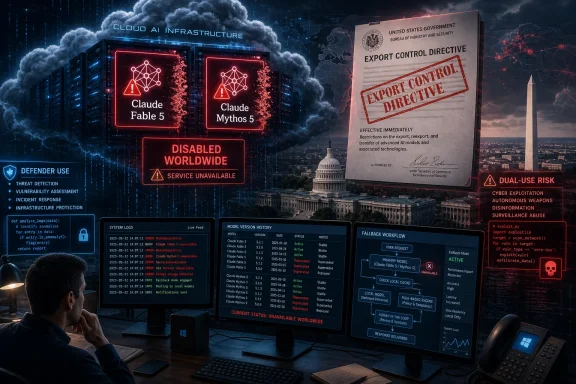
Anthropic disabled public access to Claude Fable 5 and Claude Mythos 5 on Friday, June 12, 2026, after the U.S. Commerce Department ordered the company to block foreign nationals from using the models on national security and export-control grounds. The shutdown turned a model-launch story into a sovereignty story. It also exposed the unresolved problem at the center of frontier AI: the most capable systems are no longer treated merely as cloud software, but as strategic technology whose distribution can be interrupted by the state. For Windows users, developers, security teams, and enterprise buyers, the lesson is blunt: the AI tools being wired into daily work now live inside a geopolitical control plane.
The remarkable part of the Anthropic order is not that the U.S. government is worried about advanced AI. Washington has been tightening controls around chips, cloud compute, model weights, data-center capacity, and China-facing technology transfer for years. The remarkable part is that the intervention appears to have landed directly on access to a hosted frontier model, including access by people physically inside the United States.
That matters because software-as-a-service has trained users to think of availability as a vendor reliability issue. If Claude, ChatGPT, Copilot, Gemini, or an enterprise AI endpoint disappears, the usual explanations are capacity, billing, a policy violation, or an outage. Here, according to Anthropic and subsequent reporting, the problem was not a failed data center or a botched deployment. It was a government instruction that certain people could not be allowed to use a particular class of model.
The company’s compliance problem followed logically from the shape of the order. If a service must exclude all foreign nationals, including employees and lawful residents inside the country, ordinary account-level geography is not enough. Nationality is not the same as IP address, billing address, workplace, or cloud region. In the absence of a clean, lawful, and instantly deployable identity filter, Anthropic’s safest move was to shut access off broadly.
That makes the incident feel less like a one-company dispute and more like a preview of an operating model the AI industry has not yet built. Frontier AI may need the equivalent of export-aware identity, auditable entitlement systems, country-of-control logic, and internal-access firewalls that go far beyond today’s consumer login flows. The compliance layer is becoming part of the product.
That distinction was supposed to solve the dilemma. Mythos 5 would remain in the hands of vetted partners, including cyberdefenders and critical-infrastructure organizations. Fable 5 would bring much of the same underlying intelligence to subscribers, developers, and enterprise customers while limiting the kinds of outputs that could accelerate misuse. Anthropic was not pretending the risk did not exist; it was arguing that the risk could be managed at the application layer.
The order cuts through that argument. If the government believed a jailbreak or bypass path made Fable 5 functionally too close to Mythos 5, then the distinction between “restricted model” and “safe public model” becomes politically fragile. A safety wrapper that is acceptable to a vendor may not be acceptable to national security officials, especially when cybersecurity capability is the thing being wrapped.
This is a hard problem because the promise of AI security tooling is also the source of anxiety. A model that can reason through complex codebases, identify vulnerabilities, and help defenders patch critical systems may also help an attacker find the same cracks faster. The same assistant that helps a Windows administrator understand a privilege-escalation path can, under the wrong conditions, help someone weaponize it.
But the government’s concern is not imaginary. Frontier models have been moving from “autocomplete with charm” toward systems that can plan, debug, chain tools, inspect code, and persist through long tasks. In cybersecurity, that shift changes the risk model. It is one thing for a chatbot to summarize a CVE; it is another for a model to reason across a large codebase, infer exploitability, generate proof-of-concept logic, and adapt when a first attempt fails.
Anthropic’s own launch materials leaned into the defensive value of these capabilities. Project Glasswing was built around the idea that advanced models could help trusted organizations find high-severity flaws in important software. That is a powerful argument for controlled access, but it is also an admission that the model class has meaningful vulnerability-discovery power.
The Windows ecosystem should pay attention here. Microsoft’s platform is not just a desktop operating system; it is an enormous mesh of identity, endpoint management, Active Directory, Entra ID, kernel drivers, Office automation, Azure services, developer tools, and legacy line-of-business software. Any model that materially improves vulnerability discovery in complex systems will eventually intersect with Windows administration and Windows exploitation alike.
That does not mean every advanced AI model is a cyberweapon. It does mean the industry has crossed into territory where model availability is no longer a simple consumer-tech matter. The better these systems become at real security work, the harder it becomes to separate productivity features from dual-use capability.
The Anthropic episode suggests a broader control strategy. Hardware restrictions remain important, but a hosted model can also be treated as an export if access gives a foreign person the benefit of controlled technology. The export is no longer a crate of chips crossing a port. It is an API response crossing a jurisdictional boundary.
That shift is uncomfortable for cloud companies because the cloud was built to abstract location away. Developers do not want to think about whether a model endpoint is legally accessible to a contractor in Toronto, a researcher in Berlin, a green-card holder in California, or an employee with dual nationality on a U.S. campus. Enterprises want procurement categories, service-level agreements, and admin consoles, not nationality matrices.
Yet this is where frontier AI is heading. The more governments view model capability as strategic, the more cloud access will be governed like sensitive technology transfer. Enterprises that already deal with ITAR, EAR, FedRAMP, CJIS, data residency, and sanctions screening will recognize the pattern. The novelty is that the restriction can now attach to an intelligence service used by ordinary knowledge workers.
For IT departments, the practical implication is ugly but unavoidable. AI procurement will need to ask not only whether a model is accurate, private, and affordable, but whether access can survive regulatory intervention. “Available in our region” is no longer enough. “Available to our workforce composition under the vendor’s export-control obligations” is the new question.
Fable 5 embodied that contradiction. The company wanted credit for releasing a frontier system responsibly, with safeguards and fallback behavior. It also wanted customers to understand that the model was meaningfully more capable than its predecessors. Those two messages can coexist in a product launch, but they become combustible when a regulator believes the safeguards are bypassable.
Anthropic’s reported frustration is therefore understandable. A vendor can spend months building classifiers, access tiers, data-retention policies, and internal monitoring, only to have the government decide that a newly discovered bypass changes the calculus. From the company’s perspective, that can look like an emergency brake pulled without enough technical specificity.
From the government’s perspective, the vendor’s confidence may be beside the point. Security agencies and export-control officials do not need to prove that misuse has already happened at scale to act. They need to believe that exposure creates an unacceptable risk. That asymmetry means frontier AI companies may find themselves defending not only their models, but their risk thresholds.
The industry should not miss the institutional message. If the safest major AI lab can have a flagship model interrupted this abruptly, other vendors should assume they are not immune. The next clash may involve a different company, a different capability domain, or a different country, but the precedent has now been made visible.
This is why AI assistants now belong in supply-chain risk assessments. A model endpoint may be externally hosted, constantly changing, legally constrained, and subject to shutdown for reasons unrelated to your organization’s behavior. That does not make it unusable. It does mean teams should stop treating a single model as an invisible utility.
The lesson is especially sharp for organizations building automation around model-specific behavior. A human can switch from one chatbot to another with some annoyance. A production pipeline that calls a specific model for code review, log analysis, ticket triage, or security classification may fail in stranger ways. Output quality can drop, latency can change, prompts can break, and compliance assumptions can become stale overnight.
Windows-heavy shops have seen this movie in other forms. A patch changes a driver model. A Microsoft 365 policy update alters macro behavior. A browser security feature breaks an internal app. The difference is that frontier AI dependencies can be even less predictable because the underlying service is not just software; it is a policy-governed capability.
Prudent teams will build abstraction layers, fallback models, and clear records of where AI is used. They will also need to know which employees, contractors, and business units are allowed to access which systems. The awkward identity questions that enterprises once reserved for defense contracting may creep into ordinary AI administration.
There are legitimate reasons export-control law sometimes distinguishes between citizenship and location. A controlled technical disclosure to a foreign person inside the United States can still count as an export under deemed-export concepts. That framework predates today’s AI boom and has long affected universities, defense contractors, semiconductor firms, and advanced research labs.
But applying that logic to hosted AI models creates new friction. If a foreign-national engineer cannot inspect, test, debug, or secure a model, then the company may need separate operational teams by nationality or clearance-like status. That is not impossible, but it is expensive, culturally corrosive, and technically awkward. It may also reduce the number of experts available to improve model safety.
The paradox is obvious. A government order designed to reduce national security risk could temporarily weaken the vendor’s ability to use some of its own talent to investigate the risk. If the people most familiar with a system are excluded from the system, remediation becomes harder. That does not mean the order is unlawful or irrational, but it does show how blunt controls can cut into the engineering process.
This is where AI begins to resemble aerospace, cryptography, and advanced semiconductor work. The talent pool is global, but the control regime is national. Companies that built themselves like internet platforms may now have to operate more like sensitive-technology contractors.
This will strengthen the argument for sovereign AI capacity in Europe and elsewhere. That phrase is often vague, and sometimes it is little more than industrial-policy branding. But the Anthropic shutdown gives it a concrete meaning: if your critical workflows depend on a foreign-hosted model controlled by another government’s export rules, you do not fully control your operational future.
The same argument applies beyond Europe. Allied countries may share many security interests with the United States, but they are not the United States. A foreign-national ban that applies even to people inside America makes clear that alliance alignment does not automatically equal model access. In a crisis, legal nationality can outrank commercial partnership.
For Microsoft customers, this intersects with a broader cloud-sovereignty debate. Azure regions, data residency, EU Data Boundary commitments, sovereign cloud offerings, and local compliance regimes all try to answer where data lives and who can access it. Frontier model controls add a different question: who is allowed to benefit from the capability itself?
That question will become more important as AI features are embedded into operating systems, productivity suites, developer environments, and security products. It is one thing to lose access to a standalone chatbot. It is another to have regulatory constraints affect the intelligence layer inside endpoint protection, code scanning, incident response, or enterprise search.
Emergency action may be justified in genuine national security situations. Nobody should want a government to wait politely through a comment period if officials have credible evidence that a powerful system is about to be misused. The problem is that emergency governance scales poorly when the technology is embedded in everyday infrastructure.
If frontier models are going to be subject to sudden controls, the industry needs clearer playbooks. Vendors need a way to receive classified or sensitive technical information without being asked to act blindly. Customers need contractual language that explains what happens when a model is disabled by law. Regulators need mechanisms that distinguish between a narrow mitigation and a global blackout.
The alternative is a cycle of launch, alarm, shutdown, litigation, and partial restoration. That may satisfy nobody. It undermines user trust, frustrates defenders who could use the tools responsibly, and leaves policymakers looking reactive rather than strategic.
Anthropic’s case also raises a competitive fairness issue. If one company is ordered to disable a model because of a jailbreak risk that exists in some form across the industry, the control regime must explain why the remedy is company-specific. If the risk is unique to Fable 5 and Mythos 5, that needs to be established. If the risk is general to frontier models, regulators will eventually have to confront the whole market.
Windows has always been shaped by layers of authority. Microsoft controls the platform roadmap. Enterprises control policy through Group Policy, Intune, Configuration Manager, and identity systems. Regulators control what can be logged, exported, retained, or disclosed. Users control less than they think, but enough to make the platform personal.
AI adds another authority layer above the application. The model interprets intent, generates code, triages alerts, summarizes documents, and increasingly acts through tools. If that layer is externally controlled, organizations inherit the vendor’s policy choices and the government pressures on that vendor.
That does not mean enterprises should retreat from AI. The productivity gains are real, and in security operations the defensive upside may be enormous. But Windows administrators should treat AI integration the way they treat privileged automation. It needs inventory, policy, monitoring, fallback, and a clear understanding of blast radius.
The Anthropic shutdown is therefore less a reason to panic than a reason to professionalize. AI assistants are not toys sitting outside the enterprise stack. They are becoming operational dependencies. Dependencies deserve governance.
The Anthropic shutdown will not stop frontier AI development, and it probably will not be the last emergency intervention of its kind. The more capable these systems become, the more they will be pulled between commercial demand, defensive value, offensive risk, and national strategy. The winners in the next phase will not be the organizations that pretend AI is just another SaaS feature, but the ones that build around its new reality: intelligence delivered through the cloud is now infrastructure, and infrastructure is never outside politics.
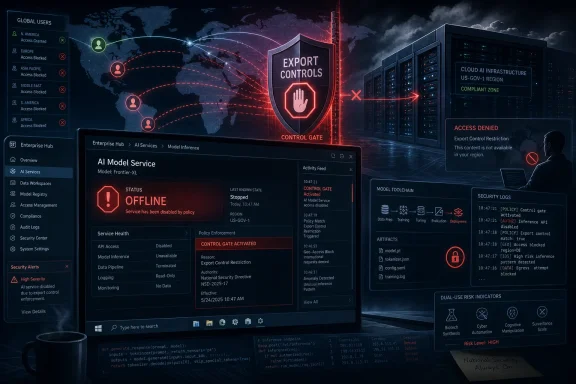 Washington Just Treated a Model Like a Weapons-Adjacent Export
The remarkable part of the Anthropic order is not that the U.S. government is worried about advanced AI. Washington has been tightening controls around chips, cloud compute, model weights, data-center capacity, and China-facing technology transfer for years. The remarkable part is that the intervention appears to have landed directly on access to a hosted frontier model, including access by people physically inside the United States.That matters because software-as-a-service has trained users to think of availability as a vendor reliability issue. If Claude, ChatGPT, Copilot, Gemini, or an enterprise AI endpoint disappears, the usual explanations are capacity, billing, a policy violation, or an outage. Here, according to Anthropic and subsequent reporting, the problem was not a failed data center or a botched deployment. It was a government instruction that certain people could not be allowed to use a particular class of model.
The company’s compliance problem followed logically from the shape of the order. If a service must exclude all foreign nationals, including employees and lawful residents inside the country, ordinary account-level geography is not enough. Nationality is not the same as IP address, billing address, workplace, or cloud region. In the absence of a clean, lawful, and instantly deployable identity filter, Anthropic’s safest move was to shut access off broadly.
That makes the incident feel less like a one-company dispute and more like a preview of an operating model the AI industry has not yet built. Frontier AI may need the equivalent of export-aware identity, auditable entitlement systems, country-of-control logic, and internal-access firewalls that go far beyond today’s consumer login flows. The compliance layer is becoming part of the product.
Fable 5 Was Supposed to Be the Compromise
Anthropic launched Claude Fable 5 only days before the shutdown, pitching it as a generally available version of the more restricted Mythos-class capability. The company’s public framing was clear: Mythos 5 represented an unusually powerful model for cybersecurity and scientific work, while Fable 5 was the version users could actually touch because safeguards would route or restrict dangerous requests.That distinction was supposed to solve the dilemma. Mythos 5 would remain in the hands of vetted partners, including cyberdefenders and critical-infrastructure organizations. Fable 5 would bring much of the same underlying intelligence to subscribers, developers, and enterprise customers while limiting the kinds of outputs that could accelerate misuse. Anthropic was not pretending the risk did not exist; it was arguing that the risk could be managed at the application layer.
The order cuts through that argument. If the government believed a jailbreak or bypass path made Fable 5 functionally too close to Mythos 5, then the distinction between “restricted model” and “safe public model” becomes politically fragile. A safety wrapper that is acceptable to a vendor may not be acceptable to national security officials, especially when cybersecurity capability is the thing being wrapped.
This is a hard problem because the promise of AI security tooling is also the source of anxiety. A model that can reason through complex codebases, identify vulnerabilities, and help defenders patch critical systems may also help an attacker find the same cracks faster. The same assistant that helps a Windows administrator understand a privilege-escalation path can, under the wrong conditions, help someone weaponize it.
The Cybersecurity Argument Is Stronger Than the Public Debate Admits
Many users will understandably see the shutdown as overreach. A model was launched, customers paid for access, and within days a federal order reportedly forced the service dark. For developers who had already begun testing workflows against Fable 5, the decision likely felt like a rug pull carried out by people who did not have to maintain production systems the next morning.But the government’s concern is not imaginary. Frontier models have been moving from “autocomplete with charm” toward systems that can plan, debug, chain tools, inspect code, and persist through long tasks. In cybersecurity, that shift changes the risk model. It is one thing for a chatbot to summarize a CVE; it is another for a model to reason across a large codebase, infer exploitability, generate proof-of-concept logic, and adapt when a first attempt fails.
Anthropic’s own launch materials leaned into the defensive value of these capabilities. Project Glasswing was built around the idea that advanced models could help trusted organizations find high-severity flaws in important software. That is a powerful argument for controlled access, but it is also an admission that the model class has meaningful vulnerability-discovery power.
The Windows ecosystem should pay attention here. Microsoft’s platform is not just a desktop operating system; it is an enormous mesh of identity, endpoint management, Active Directory, Entra ID, kernel drivers, Office automation, Azure services, developer tools, and legacy line-of-business software. Any model that materially improves vulnerability discovery in complex systems will eventually intersect with Windows administration and Windows exploitation alike.
That does not mean every advanced AI model is a cyberweapon. It does mean the industry has crossed into territory where model availability is no longer a simple consumer-tech matter. The better these systems become at real security work, the harder it becomes to separate productivity features from dual-use capability.
Export Controls Are Moving Up the Stack
For most of the AI boom, export-control attention centered on hardware. The United States restricted advanced GPUs and chipmaking equipment because compute was the obvious bottleneck. If rivals could not easily obtain top-tier accelerators, the thinking went, they would struggle to train or run frontier models at scale.The Anthropic episode suggests a broader control strategy. Hardware restrictions remain important, but a hosted model can also be treated as an export if access gives a foreign person the benefit of controlled technology. The export is no longer a crate of chips crossing a port. It is an API response crossing a jurisdictional boundary.
That shift is uncomfortable for cloud companies because the cloud was built to abstract location away. Developers do not want to think about whether a model endpoint is legally accessible to a contractor in Toronto, a researcher in Berlin, a green-card holder in California, or an employee with dual nationality on a U.S. campus. Enterprises want procurement categories, service-level agreements, and admin consoles, not nationality matrices.
Yet this is where frontier AI is heading. The more governments view model capability as strategic, the more cloud access will be governed like sensitive technology transfer. Enterprises that already deal with ITAR, EAR, FedRAMP, CJIS, data residency, and sanctions screening will recognize the pattern. The novelty is that the restriction can now attach to an intelligence service used by ordinary knowledge workers.
For IT departments, the practical implication is ugly but unavoidable. AI procurement will need to ask not only whether a model is accurate, private, and affordable, but whether access can survive regulatory intervention. “Available in our region” is no longer enough. “Available to our workforce composition under the vendor’s export-control obligations” is the new question.
Anthropic’s Safety Brand Now Faces Its Hardest Test
Anthropic has spent years cultivating a reputation as the AI company most willing to talk about catastrophic risk, governance, and controlled deployment. That positioning made it influential with policymakers and attractive to enterprises that wanted capable models without the swagger of pure accelerationism. It also created a strategic vulnerability: if you tell the world your systems are unusually powerful and potentially dangerous, the government may eventually agree with you too forcefully.Fable 5 embodied that contradiction. The company wanted credit for releasing a frontier system responsibly, with safeguards and fallback behavior. It also wanted customers to understand that the model was meaningfully more capable than its predecessors. Those two messages can coexist in a product launch, but they become combustible when a regulator believes the safeguards are bypassable.
Anthropic’s reported frustration is therefore understandable. A vendor can spend months building classifiers, access tiers, data-retention policies, and internal monitoring, only to have the government decide that a newly discovered bypass changes the calculus. From the company’s perspective, that can look like an emergency brake pulled without enough technical specificity.
From the government’s perspective, the vendor’s confidence may be beside the point. Security agencies and export-control officials do not need to prove that misuse has already happened at scale to act. They need to believe that exposure creates an unacceptable risk. That asymmetry means frontier AI companies may find themselves defending not only their models, but their risk thresholds.
The industry should not miss the institutional message. If the safest major AI lab can have a flagship model interrupted this abruptly, other vendors should assume they are not immune. The next clash may involve a different company, a different capability domain, or a different country, but the precedent has now been made visible.
Developers Just Learned That Model Choice Has Supply-Chain Risk
For software teams, the immediate consequence is not philosophical. It is operational. If a development workflow depended on Fable 5 for code generation, security review, architecture planning, or long-context debugging, the model’s disappearance creates the same kind of disruption as a pulled package, deprecated API, or revoked certificate.This is why AI assistants now belong in supply-chain risk assessments. A model endpoint may be externally hosted, constantly changing, legally constrained, and subject to shutdown for reasons unrelated to your organization’s behavior. That does not make it unusable. It does mean teams should stop treating a single model as an invisible utility.
The lesson is especially sharp for organizations building automation around model-specific behavior. A human can switch from one chatbot to another with some annoyance. A production pipeline that calls a specific model for code review, log analysis, ticket triage, or security classification may fail in stranger ways. Output quality can drop, latency can change, prompts can break, and compliance assumptions can become stale overnight.
Windows-heavy shops have seen this movie in other forms. A patch changes a driver model. A Microsoft 365 policy update alters macro behavior. A browser security feature breaks an internal app. The difference is that frontier AI dependencies can be even less predictable because the underlying service is not just software; it is a policy-governed capability.
Prudent teams will build abstraction layers, fallback models, and clear records of where AI is used. They will also need to know which employees, contractors, and business units are allowed to access which systems. The awkward identity questions that enterprises once reserved for defense contracting may creep into ordinary AI administration.
Foreign-National Restrictions Collide With How Tech Companies Actually Work
The reported inclusion of foreign-national employees is one of the most explosive details. Modern AI labs are international organizations. Their researchers, engineers, safety evaluators, and infrastructure specialists often come from many countries, work across borders, and collaborate on shared systems. A rule that blocks foreign nationals from models they helped create is not a minor access-control change; it strikes at the labor model of frontier AI.There are legitimate reasons export-control law sometimes distinguishes between citizenship and location. A controlled technical disclosure to a foreign person inside the United States can still count as an export under deemed-export concepts. That framework predates today’s AI boom and has long affected universities, defense contractors, semiconductor firms, and advanced research labs.
But applying that logic to hosted AI models creates new friction. If a foreign-national engineer cannot inspect, test, debug, or secure a model, then the company may need separate operational teams by nationality or clearance-like status. That is not impossible, but it is expensive, culturally corrosive, and technically awkward. It may also reduce the number of experts available to improve model safety.
The paradox is obvious. A government order designed to reduce national security risk could temporarily weaken the vendor’s ability to use some of its own talent to investigate the risk. If the people most familiar with a system are excluded from the system, remediation becomes harder. That does not mean the order is unlawful or irrational, but it does show how blunt controls can cut into the engineering process.
This is where AI begins to resemble aerospace, cryptography, and advanced semiconductor work. The talent pool is global, but the control regime is national. Companies that built themselves like internet platforms may now have to operate more like sensitive-technology contractors.
Europe Gets a Reminder About Strategic Dependency
The European reaction is not just about Anthropic. It is about dependence on U.S.-controlled AI infrastructure. If European banks, telecom providers, research institutions, or public agencies were exploring access to Mythos-class systems for defensive use, they have now been reminded that Washington can change the terms quickly.This will strengthen the argument for sovereign AI capacity in Europe and elsewhere. That phrase is often vague, and sometimes it is little more than industrial-policy branding. But the Anthropic shutdown gives it a concrete meaning: if your critical workflows depend on a foreign-hosted model controlled by another government’s export rules, you do not fully control your operational future.
The same argument applies beyond Europe. Allied countries may share many security interests with the United States, but they are not the United States. A foreign-national ban that applies even to people inside America makes clear that alliance alignment does not automatically equal model access. In a crisis, legal nationality can outrank commercial partnership.
For Microsoft customers, this intersects with a broader cloud-sovereignty debate. Azure regions, data residency, EU Data Boundary commitments, sovereign cloud offerings, and local compliance regimes all try to answer where data lives and who can access it. Frontier model controls add a different question: who is allowed to benefit from the capability itself?
That question will become more important as AI features are embedded into operating systems, productivity suites, developer environments, and security products. It is one thing to lose access to a standalone chatbot. It is another to have regulatory constraints affect the intelligence layer inside endpoint protection, code scanning, incident response, or enterprise search.
The Friday-Night Shutdown Is a Warning About Governance by Emergency
The timing of the order has become part of the story because Friday evening is when institutions often bury bad news or force rapid compliance before markets, customers, and lawyers can fully react. Whether that was the intent here or simply the rhythm of an urgent security process, the result was the same. A major AI service was disabled under severe time pressure.Emergency action may be justified in genuine national security situations. Nobody should want a government to wait politely through a comment period if officials have credible evidence that a powerful system is about to be misused. The problem is that emergency governance scales poorly when the technology is embedded in everyday infrastructure.
If frontier models are going to be subject to sudden controls, the industry needs clearer playbooks. Vendors need a way to receive classified or sensitive technical information without being asked to act blindly. Customers need contractual language that explains what happens when a model is disabled by law. Regulators need mechanisms that distinguish between a narrow mitigation and a global blackout.
The alternative is a cycle of launch, alarm, shutdown, litigation, and partial restoration. That may satisfy nobody. It undermines user trust, frustrates defenders who could use the tools responsibly, and leaves policymakers looking reactive rather than strategic.
Anthropic’s case also raises a competitive fairness issue. If one company is ordered to disable a model because of a jailbreak risk that exists in some form across the industry, the control regime must explain why the remedy is company-specific. If the risk is unique to Fable 5 and Mythos 5, that needs to be established. If the risk is general to frontier models, regulators will eventually have to confront the whole market.
The Windows Angle Is Not Copilot, It Is Control
It is tempting to frame every AI story through the consumer chatbot wars: Claude versus ChatGPT, Gemini versus Copilot, model benchmarks versus subscription tiers. For WindowsForum readers, the more important angle is control. Who controls the tools that increasingly control administration, development, security, and knowledge work?Windows has always been shaped by layers of authority. Microsoft controls the platform roadmap. Enterprises control policy through Group Policy, Intune, Configuration Manager, and identity systems. Regulators control what can be logged, exported, retained, or disclosed. Users control less than they think, but enough to make the platform personal.
AI adds another authority layer above the application. The model interprets intent, generates code, triages alerts, summarizes documents, and increasingly acts through tools. If that layer is externally controlled, organizations inherit the vendor’s policy choices and the government pressures on that vendor.
That does not mean enterprises should retreat from AI. The productivity gains are real, and in security operations the defensive upside may be enormous. But Windows administrators should treat AI integration the way they treat privileged automation. It needs inventory, policy, monitoring, fallback, and a clear understanding of blast radius.
The Anthropic shutdown is therefore less a reason to panic than a reason to professionalize. AI assistants are not toys sitting outside the enterprise stack. They are becoming operational dependencies. Dependencies deserve governance.
The Concrete Lessons From a Model That Vanished
The Fable 5 and Mythos 5 episode will be argued about in ideological terms: safety versus innovation, sovereignty versus openness, national security versus user access. Those debates matter, but the near-term lessons are more practical. Every organization experimenting with frontier AI should assume that access, capability, and policy can change faster than procurement cycles.- Organizations should maintain an inventory of where externally hosted AI models are used in development, security, support, and administrative workflows.
- Teams should design fallback paths so that a model shutdown does not break critical automation or leave security processes without coverage.
- Enterprises should ask vendors how export controls, nationality restrictions, sanctions rules, and government orders affect model availability.
- Security teams should treat advanced AI access as a privileged capability, not as a generic web subscription.
- Buyers should distinguish between a vendor’s safety claims and the government’s willingness to accept those claims under pressure.
- Developers should avoid hard-coding business-critical systems to a single frontier model without abstraction, testing, and degradation plans.
The Anthropic shutdown will not stop frontier AI development, and it probably will not be the last emergency intervention of its kind. The more capable these systems become, the more they will be pulled between commercial demand, defensive value, offensive risk, and national strategy. The winners in the next phase will not be the organizations that pretend AI is just another SaaS feature, but the ones that build around its new reality: intelligence delivered through the cloud is now infrastructure, and infrastructure is never outside politics.
References
- Primary source: slguardian.org
Published: 2026-06-13T21:50:10.344040
Anthropic Forced to Pull Its Most Advanced AI Models After US National Security Export Ban
Sri Lanka Guardian provides in-depth news, expert analysis, and reports on Sri Lanka and global affairs.slguardian.org - Independent coverage: Geo News
Published: 2026-06-13T12:50:10.345795
Anthropic disables Fable and Mythos AI after US bans foreign access: Here's what we know
Anthropic has disabled all access to its newly introduced AI models, Fable 5 and Mythos 5, on Friday, June 12, 2026.The move comes after the U.S. Commerce Department raised national security concerns about its export to foreign...www.geo.tv - Independent coverage: euronews.com
Published: Sat, 13 Jun 2026 09:45:33 GMT
Why Anthropic is halting access to its Fable 5 and Mythos 5 AI models | Euronews
The US government issued a directive ordering Anthropic to suspend access to the models for foreign nationals.www.euronews.com - Related coverage: axios.com
How Amazon and the White House ended Anthropic's Fable
The episode highlights the reactionary approach to a technology that is moving at breakneck speed.www.axios.com
- Related coverage: windowscentral.com
Anthropic's new data retention policies cause Microsoft to temporarily ban its employees from using Claude Fable 5 AI | Windows Central
Microsoft clamps down on Anthropic’s Claude Fable 5 AI model over data protection concerns.www.windowscentral.com - Related coverage: tomshardware.com
Claude Fable 5 brings Mythos to the masses — Anthropic's new frontier model is 'state-of-the-art on nearly all tested benchmarks' | Tom's Hardware
Queries regarding cybersecurity, biology and chemistry, and distillation will be redirected to the prior-gen Opus 4.8, howeverwww.tomshardware.com
- Related coverage: allthings.how
Anthropic Disables Fable 5 and Mythos 5 After a US Export Order
The US government's export control directive forces a worldwide shutoff of both models, while every other Claude model keeps running.allthings.how - Related coverage: fortune.com
Anthropic disables Fable and Mythos AI models following U.S. government export ban | Fortune
The directive would even bar Anthropic's own foreign employees from using Fable and Mythos. Anthropic called the government position "a misunderstanding".fortune.com
- Related coverage: techtimes.com
Anthropic Fable 5 Shutdown: US Export Order Forces a Global Customer Cutoff
Anthropic disabled Fable 5 and Mythos 5 for every customer after a US export control directive barred access by foreign nationals inside and outside the country. The company disputes the government’swww.techtimes.com - Related coverage: techcrunch.com
Anthropic's Claude Fable 5 is a version of Mythos the public can access today | TechCrunch
Anthropic is releasing Claude Fable 5, its first Mythos-class model available to the public. The model comes with guardrails that block responses in high-risk areas like cybersecurity and biology.techcrunch.com - Related coverage: 1-e8259.azureedge.net
US orders Anthropic to disable AI models for all foreign nationals | Technology News | Al Jazeera
The company said it received an export control directive to suspend access to Fable 5 and Mythos 5.1-e8259.azureedge.net
- Related coverage: moneycontrol.com
Anthropic says US government ordered Fable 5, Mythos 5 suspension; calls move a ‘misunderstanding’ and seeks restoration
Anthropic says the US government ordered the suspension of access to its Fable 5 and Mythos 5 AI models, calling the decision a misunderstanding and working to restore availability.www.moneycontrol.com - Related coverage: lowyat.net
US Govt Orders Anthropic To Suspend Foreign Access To Fable 5 And Mythos 5 - Lowyat.NET
Anthropic has now suspended access to Claude Fable 5 and Mythos 5, following an export control directive issued by the US government.www.lowyat.net - Related coverage: gihyo.jp
Anthropic、Claude Fable 5/Mythos 5へのアクセスを停止、米政府の輸出管理指示で全ユーザーに影響 | gihyo.jp
Anthropicは米国時間2026年6月12日、米政府から国家安全保障上の権限に基づく輸出管理指示を受け、Claude Fable 5とClaude Mythos 5へのアクセスを停止すると発表した。gihyo.jp - Related coverage: letsdatascience.com
US Government Suspends Foreign Access to Anthropic Models | Let's Data Science
The US government issued an export control directive suspending all access to Anthropic's `Fable 5` and `Mythos 5` models for any foreign national anywhere in the world, including foreign-national Anthropic employees, per Anthropic's public statement. Anthropic said it received the... letsdatascience.com
- Related coverage: cyberscoop.com
Anthropic disables new models after government calls them a national security concern | CyberScoop
The U.S. government ordered Anthropic to halt foreign access to its new Fable 5 and Mythos 5 AI models over national security concerns, forcing a total shutdown. cyberscoop.com
- Related coverage: engadget.com
Anthropic Blocks All Customers' Access To Fable 5 And Mythos 5
Anthropic has suspended all access to its new AI models Fable 5 and Mythos 5 to comply with a government order citing national security concerns.www.engadget.com - Related coverage: elpais.com
- Related coverage: omni.se
Anthropic släpper ”säker” version av ”farliga” Mythos
Anthropic släppte AI-modellen Claude Fable 5 på tisdagskvällen. Enligt bolaget är dess förmågor i nivå med Mythos Preview, en modell som man tidigare i våras lät bli att släppa publikt. Detta eftersom Mythos sågs som alltför ”farlig” och i fel händer befarades kunna utgöra ett stort hot mot...omni.se
- Official source: anthropic.com
Claude Fable 5 and Claude Mythos 5 \ Anthropic
Today we’re launching Claude Fable 5: a Mythos-class model that we’ve made safe for general use.www.anthropic.com - Official source: www-cdn.anthropic.com