

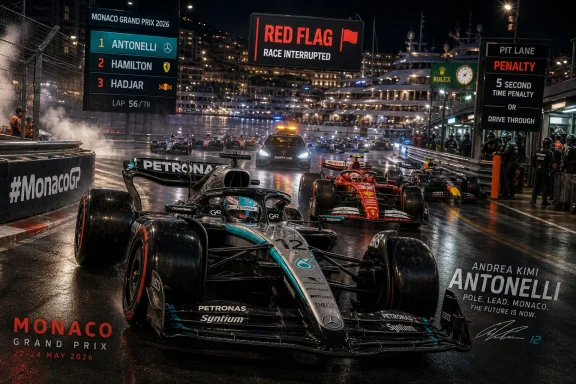
Andrea Kimi Antonelli won the 2026 Monaco Grand Prix on Sunday, June 7, in Monte Carlo, finishing ahead of Ferrari’s Lewis Hamilton and Red Bull’s Isack Hadjar after a stop-start race defined by retirements, penalties, safety cars, and a red-flag interruption. The result was not merely another precocious win by a teenager in a fast Mercedes. It was the clearest sign yet that Formula 1’s center of gravity has shifted faster than its institutions, rivals, and even its broadcasters were ready to admit. Monaco, the sport’s most stubborn monument to the past, became the stage for its future.
Antonelli’s victory will be remembered first for the age line: 19 years old, winner at Monaco, a name now threaded into the race’s most exclusive mythology. That is the easy headline, and it is not wrong. Monaco is where Formula 1 has traditionally asked young drivers to be patient, to accept the hierarchy, and to wait for the walls to teach them humility.
Antonelli did not wait. He took pole, controlled the race, survived the interruptions, and still had enough composure to keep Hamilton behind him after the field had been compressed. On most circuits that would be impressive; in Monaco, where a driver lives inside the mirrors and the margin for error is measured in paint scratches, it was something more pointed.
The chaotic race around him made the win more revealing rather than less. Verstappen’s failure to get away properly and subsequent retirement removed one obvious antagonist, while Charles Leclerc’s crash robbed the home crowd of its annual emotional bargain. George Russell’s penalty spiral turned Mercedes’ afternoon into a split-screen study in control and collapse.
That is why the race felt less like a fluke result than a referendum. Antonelli did not win because the Monaco Grand Prix became orderly. He won because it became disorderly and he remained the one driver who appeared least interested in contributing to the mess.
What Monaco did was strip away the marketing and leave only the driving. He had to launch, manage pace, respond to interruptions, keep temperature in the tyres, and resume command after the race had been stopped. That is not the job description of a future star. That is the job description of a current title contender.
The most impressive thing was not his speed but his refusal to be theatrical about it. Monaco invites drama because the track is narrow enough to make every camera angle look fatal. Antonelli’s race, by contrast, was controlled almost to the point of severity.
That temperament matters. The modern Formula 1 driver is not merely a sprinter in a carbon-fiber machine. He is a systems manager, a public company spokesperson, a tyre whisperer, and a risk model operating at 180 mph between concrete barriers. Antonelli looked less like a teenager performing maturity than a driver for whom maturity is already part of the lap time.
Yet reducing Hamilton’s performance to nostalgia misses the bite in it. He was not merely present; he was competitive, opportunistic, and alert to a race that punished indecision. In a Ferrari season still searching for its defining rhythm, second place at Monaco gives the team something more useful than optimism: evidence.
It also complicates the generational narrative. Antonelli did not beat a fading field of placeholders. He beat Hamilton on a day when Hamilton reminded everyone why he remains dangerous. That distinction matters because Formula 1’s great transitions are never clean handovers; they are usually fought out in uncomfortable overlap.
Hamilton’s result says Ferrari still has a driver capable of extracting a podium from chaos. Antonelli’s result says that may no longer be enough. The great champions do not disappear all at once. They are first forced to accept that perfect execution may now only get them to second.
That absence will tempt some to discount Antonelli’s win. They should resist the temptation. Formula 1 is not a laboratory where every contender gets the same experiment under ideal conditions. It is a championship built from weekends in which someone’s clutch setting, tyre temperature, traffic window, or wall contact changes the shape of history.
Verstappen’s retirement mattered because it showed how fragile Red Bull’s race execution has become when the script does not go cleanly. Hadjar’s podium helped rescue the team’s day, but it did not erase the more troubling picture. Red Bull left Monaco with one driver on the podium and another central storyline about a failed launch into a failed race.
That kind of split outcome is both relief and warning. Hadjar’s result demonstrated the depth of the driver pool and the value of staying alive in a race that punished nearly everyone. Verstappen’s result showed that even the most decorated driver of the current era can be made irrelevant by a bad opening act at Monaco.
This one hurt because Ferrari appeared positioned for a meaningful double result. Hamilton was already in the fight, Leclerc was in podium territory, and the race’s attrition was opening a path to heavy points. Instead, Leclerc’s exit turned Ferrari’s day from a possible statement into a narrower proof of life.
The contrast with Antonelli was unavoidable. One driver looked like he had reduced Monaco to its fundamentals; the other was once again swallowed by the place that should mean the most to him. That is harsh, but Monaco has never been sentimental toward local mythology.
For Ferrari, the result is therefore both useful and aggravating. Hamilton’s second place gives Maranello reason to believe the package can contend on particular weekends. Leclerc’s retirement is another reminder that speed and storybook setting do not guarantee a result when the walls are this close.
Russell’s five-second penalty for speeding in the pit lane was damaging enough. The later drive-through for failing to serve that penalty correctly transformed a recoverable mistake into a points-killing sequence. Finishing 13th in a car from the winning team is the kind of outcome that forces uncomfortable debriefs.
The danger for Russell is not simply the lost points. It is the optics of being the senior teammate who looked rushed while the teenage teammate looked serene. Formula 1 is a sport of data, but it is also a sport of internal mythology, and garages can pivot around a driver faster than anyone admits publicly.
Mercedes will insist, correctly, that both drivers matter across a championship. But Monaco sharpened the hierarchy. Antonelli is no longer just the exciting future inside the team; he is the driver currently converting volatility into trophies.
Every season brings the same debate. Monaco is too narrow for modern cars. Overtaking is too difficult. The spectacle often belongs more to Saturday qualifying than Sunday racing. And yet, year after year, the sport returns because Monaco is not merely a circuit on the calendar; it is a brand asset with harbor views.
This year, the race gave both sides ammunition. The spectacle was undeniable, with interruptions, failures, penalties, crashes, and a compressed finish. But much of that spectacle came from breakdown rather than racing purity, which is precisely why critics will argue that Monaco’s drama is increasingly accidental.
Still, the red flag did something the race badly needed: it forced the drivers to prove themselves again. Antonelli’s lead could have become a procession. Instead, the interruption created a late test of nerve, and he passed it.
For years, teams have talked about academies, simulator preparation, and the smoother path from junior categories to Formula 1. Monaco showed the endpoint of that system. The new generation arrives not as raw talent in need of seasoning but as drivers already trained in the language of data, energy deployment, tyre strategy, and media pressure.
That is a profound change from the old mythology of the rookie. The modern young driver has often spent years inside a professional machine before his first Grand Prix start. By the time he reaches Formula 1, he may lack race mileage at the top level, but he does not lack institutional preparation.
Antonelli is the clearest expression of that pipeline. His age makes the achievement feel shocking; his method makes it feel rational. The surprise is not that he can win. The surprise is how quickly the rest of the grid must now treat his winning as normal.
Rivals begin making riskier strategy calls. Teammates begin pressing in marginal windows. Engineers start managing weekends not just against the track but against the psychological pressure of a points gap. That is where a championship can begin to tilt before it is mathematically obvious.
Hamilton’s second place also matters in the standings because Ferrari needs more than isolated moments of brilliance. It needs weekends where both cars finish and the team steadily reduces the damage from Mercedes’ best days. Monaco offered pace but not completeness.
Red Bull’s picture is harder to read. Hadjar’s podium was significant, especially amid the team’s misfortune elsewhere, but Verstappen’s retirement keeps the broader concern alive. A team can survive a bad weekend; it cannot build a title campaign around afternoons where its lead reference disappears before the race has settled.
Russell’s race made that point brutally. One penalty damaged his result; the mishandling of it destroyed the afternoon. The rules did not merely record his mistakes after the fact. They actively reshaped the order.
That is the modern Formula 1 bargain. Fans often complain that stewards and procedures have too much influence, but the cars and circuits have become so optimized that governance is part of the competition. Teams win by designing machines, yes, but also by managing rules with almost legalistic precision.
Monaco magnifies this because the racing surface offers so little room for recovery. A driver can be fast, and a team can be broadly competitive, and still a procedural error can drop them into irrelevance. At most circuits, time can be won back. In Monaco, it is usually only lost more slowly.
But Antonelli’s victory resists that skepticism because his performance was not built on opportunism alone. He was not a midfield driver inheriting a win through attrition. He was the pole-sitter and pace-setter who still had to execute when the race kept finding new ways to become unstable.
That is the difference between surviving chaos and mastering it. The former produces lucky podiums and charming anomalies. The latter produces championship signals.
The race around Antonelli was messy, but his own contribution was clean. In Formula 1, that contrast is often where greatness first becomes visible.
 Monaco Turned a Coronation Into a Stress Test
Antonelli’s victory will be remembered first for the age line: 19 years old, winner at Monaco, a name now threaded into the race’s most exclusive mythology. That is the easy headline, and it is not wrong. Monaco is where Formula 1 has traditionally asked young drivers to be patient, to accept the hierarchy, and to wait for the walls to teach them humility.Antonelli did not wait. He took pole, controlled the race, survived the interruptions, and still had enough composure to keep Hamilton behind him after the field had been compressed. On most circuits that would be impressive; in Monaco, where a driver lives inside the mirrors and the margin for error is measured in paint scratches, it was something more pointed.
The chaotic race around him made the win more revealing rather than less. Verstappen’s failure to get away properly and subsequent retirement removed one obvious antagonist, while Charles Leclerc’s crash robbed the home crowd of its annual emotional bargain. George Russell’s penalty spiral turned Mercedes’ afternoon into a split-screen study in control and collapse.
That is why the race felt less like a fluke result than a referendum. Antonelli did not win because the Monaco Grand Prix became orderly. He won because it became disorderly and he remained the one driver who appeared least interested in contributing to the mess.
The Teenager Did Not Drive Like a Prospect
Formula 1 is fluent in hype, especially around young drivers. The sport has learned to package teenagers as destiny before they have proved they can handle tyre degradation, political pressure, and the long boredom between spectacular moments. Antonelli arrived with more of that machinery around him than most.What Monaco did was strip away the marketing and leave only the driving. He had to launch, manage pace, respond to interruptions, keep temperature in the tyres, and resume command after the race had been stopped. That is not the job description of a future star. That is the job description of a current title contender.
The most impressive thing was not his speed but his refusal to be theatrical about it. Monaco invites drama because the track is narrow enough to make every camera angle look fatal. Antonelli’s race, by contrast, was controlled almost to the point of severity.
That temperament matters. The modern Formula 1 driver is not merely a sprinter in a carbon-fiber machine. He is a systems manager, a public company spokesperson, a tyre whisperer, and a risk model operating at 180 mph between concrete barriers. Antonelli looked less like a teenager performing maturity than a driver for whom maturity is already part of the lap time.
Hamilton’s Second Place Was a Warning, Not a Farewell
Hamilton’s runner-up finish for Ferrari will inevitably be framed as a sentimental subplot, and there is some truth in that. A seven-time champion in red, chasing a 19-year-old Mercedes driver through Monaco, is almost too clean a piece of Formula 1 symbolism. The past was close enough to see the future but not close enough to stop it.Yet reducing Hamilton’s performance to nostalgia misses the bite in it. He was not merely present; he was competitive, opportunistic, and alert to a race that punished indecision. In a Ferrari season still searching for its defining rhythm, second place at Monaco gives the team something more useful than optimism: evidence.
It also complicates the generational narrative. Antonelli did not beat a fading field of placeholders. He beat Hamilton on a day when Hamilton reminded everyone why he remains dangerous. That distinction matters because Formula 1’s great transitions are never clean handovers; they are usually fought out in uncomfortable overlap.
Hamilton’s result says Ferrari still has a driver capable of extracting a podium from chaos. Antonelli’s result says that may no longer be enough. The great champions do not disappear all at once. They are first forced to accept that perfect execution may now only get them to second.
Verstappen’s Exit Made the Race Stranger, but Not Smaller
Max Verstappen’s Monaco unraveling was the kind of incident that instantly changes the emotional weather of a Grand Prix. A driver who had reportedly been unhappy with the car, then more encouraged after qualifying near the front, failed to turn that promise into a race. His slow departure from contention removed one of the sport’s defining reference points before the contest had properly formed.That absence will tempt some to discount Antonelli’s win. They should resist the temptation. Formula 1 is not a laboratory where every contender gets the same experiment under ideal conditions. It is a championship built from weekends in which someone’s clutch setting, tyre temperature, traffic window, or wall contact changes the shape of history.
Verstappen’s retirement mattered because it showed how fragile Red Bull’s race execution has become when the script does not go cleanly. Hadjar’s podium helped rescue the team’s day, but it did not erase the more troubling picture. Red Bull left Monaco with one driver on the podium and another central storyline about a failed launch into a failed race.
That kind of split outcome is both relief and warning. Hadjar’s result demonstrated the depth of the driver pool and the value of staying alive in a race that punished nearly everyone. Verstappen’s result showed that even the most decorated driver of the current era can be made irrelevant by a bad opening act at Monaco.
Leclerc’s Monaco Curse Found a New Form
Charles Leclerc’s crash while running third carried the familiar cruelty of Monaco. Few modern Formula 1 storylines have been as persistently unforgiving as Leclerc’s relationship with his home race. Every year seems to offer either hope, complication, or heartbreak, and sometimes all three arrive in the same afternoon.This one hurt because Ferrari appeared positioned for a meaningful double result. Hamilton was already in the fight, Leclerc was in podium territory, and the race’s attrition was opening a path to heavy points. Instead, Leclerc’s exit turned Ferrari’s day from a possible statement into a narrower proof of life.
The contrast with Antonelli was unavoidable. One driver looked like he had reduced Monaco to its fundamentals; the other was once again swallowed by the place that should mean the most to him. That is harsh, but Monaco has never been sentimental toward local mythology.
For Ferrari, the result is therefore both useful and aggravating. Hamilton’s second place gives Maranello reason to believe the package can contend on particular weekends. Leclerc’s retirement is another reminder that speed and storybook setting do not guarantee a result when the walls are this close.
Russell’s Penalties Turned Mercedes’ Dominance Into an Internal Contrast
George Russell’s race was the hidden hinge of the championship narrative. On paper, Mercedes won Monaco. In practice, Mercedes produced the race winner and a case study in how quickly a strong car can be buried under procedural error.Russell’s five-second penalty for speeding in the pit lane was damaging enough. The later drive-through for failing to serve that penalty correctly transformed a recoverable mistake into a points-killing sequence. Finishing 13th in a car from the winning team is the kind of outcome that forces uncomfortable debriefs.
The danger for Russell is not simply the lost points. It is the optics of being the senior teammate who looked rushed while the teenage teammate looked serene. Formula 1 is a sport of data, but it is also a sport of internal mythology, and garages can pivot around a driver faster than anyone admits publicly.
Mercedes will insist, correctly, that both drivers matter across a championship. But Monaco sharpened the hierarchy. Antonelli is no longer just the exciting future inside the team; he is the driver currently converting volatility into trophies.
The Track Itself Became Part of the Argument
The reported track-surface concerns and the red-flag inspection gave this Monaco Grand Prix a strangely physical quality. The race was not only contested on the Circuit de Monaco; it seemed at moments to be contested against it. That matters because Monaco’s place in Formula 1 has always depended on romance outrunning practicality.Every season brings the same debate. Monaco is too narrow for modern cars. Overtaking is too difficult. The spectacle often belongs more to Saturday qualifying than Sunday racing. And yet, year after year, the sport returns because Monaco is not merely a circuit on the calendar; it is a brand asset with harbor views.
This year, the race gave both sides ammunition. The spectacle was undeniable, with interruptions, failures, penalties, crashes, and a compressed finish. But much of that spectacle came from breakdown rather than racing purity, which is precisely why critics will argue that Monaco’s drama is increasingly accidental.
Still, the red flag did something the race badly needed: it forced the drivers to prove themselves again. Antonelli’s lead could have become a procession. Instead, the interruption created a late test of nerve, and he passed it.
Formula 1’s Youth Movement Is No Longer Theoretical
Antonelli’s Monaco win lands differently because it is not isolated. The 2026 season has already become a study in how quickly young drivers can stop being projects and start becoming the standard. Hadjar’s podium only reinforced that point.For years, teams have talked about academies, simulator preparation, and the smoother path from junior categories to Formula 1. Monaco showed the endpoint of that system. The new generation arrives not as raw talent in need of seasoning but as drivers already trained in the language of data, energy deployment, tyre strategy, and media pressure.
That is a profound change from the old mythology of the rookie. The modern young driver has often spent years inside a professional machine before his first Grand Prix start. By the time he reaches Formula 1, he may lack race mileage at the top level, but he does not lack institutional preparation.
Antonelli is the clearest expression of that pipeline. His age makes the achievement feel shocking; his method makes it feel rational. The surprise is not that he can win. The surprise is how quickly the rest of the grid must now treat his winning as normal.
Monaco Exposed the Championship’s New Math
The championship implications are blunt. Antonelli’s fifth consecutive victory, combined with Russell’s failure to score, gives Mercedes a driver who is beginning to stretch the season around himself. In a long calendar, early dominance can still be reeled in, but streaks change behavior.Rivals begin making riskier strategy calls. Teammates begin pressing in marginal windows. Engineers start managing weekends not just against the track but against the psychological pressure of a points gap. That is where a championship can begin to tilt before it is mathematically obvious.
Hamilton’s second place also matters in the standings because Ferrari needs more than isolated moments of brilliance. It needs weekends where both cars finish and the team steadily reduces the damage from Mercedes’ best days. Monaco offered pace but not completeness.
Red Bull’s picture is harder to read. Hadjar’s podium was significant, especially amid the team’s misfortune elsewhere, but Verstappen’s retirement keeps the broader concern alive. A team can survive a bad weekend; it cannot build a title campaign around afternoons where its lead reference disappears before the race has settled.
The Penalties Were Not Noise; They Were the Race
It is tempting to treat the pit-lane speeding penalties and procedural sanctions as administrative clutter around the real sporting action. That would be wrong. In Monaco, where passing is scarce and track position is currency, a five-second penalty can be a strategic event as important as a wheel-to-wheel move.Russell’s race made that point brutally. One penalty damaged his result; the mishandling of it destroyed the afternoon. The rules did not merely record his mistakes after the fact. They actively reshaped the order.
That is the modern Formula 1 bargain. Fans often complain that stewards and procedures have too much influence, but the cars and circuits have become so optimized that governance is part of the competition. Teams win by designing machines, yes, but also by managing rules with almost legalistic precision.
Monaco magnifies this because the racing surface offers so little room for recovery. A driver can be fast, and a team can be broadly competitive, and still a procedural error can drop them into irrelevance. At most circuits, time can be won back. In Monaco, it is usually only lost more slowly.
The Race Was Chaotic, but Antonelli’s Win Was Not
The strongest argument against overhyping this Grand Prix is that chaos can make outcomes look more meaningful than they are. Retirements remove rivals. Safety cars compress gaps. Red flags rewrite momentum. Monaco, especially, can produce results that feel enormous on Sunday and less predictive by the next race.But Antonelli’s victory resists that skepticism because his performance was not built on opportunism alone. He was not a midfield driver inheriting a win through attrition. He was the pole-sitter and pace-setter who still had to execute when the race kept finding new ways to become unstable.
That is the difference between surviving chaos and mastering it. The former produces lucky podiums and charming anomalies. The latter produces championship signals.
The race around Antonelli was messy, but his own contribution was clean. In Formula 1, that contrast is often where greatness first becomes visible.
What the Monaco Shockwave Leaves Behind
Monaco gave Formula 1 a result that will be quoted for years, but the practical consequences are more immediate than the record books. The race clarified who is gaining authority, who is losing margin, and which teams can still turn disorder into points.- Antonelli’s victory confirmed him as a present-tense championship force, not merely a future Mercedes centerpiece.
- Hamilton’s second place showed Ferrari has usable race pace, but Leclerc’s retirement kept the team from converting Monaco into a broader statement.
- Russell’s penalties turned a difficult afternoon into a damaging one and widened the internal contrast at Mercedes.
- Verstappen’s early exit raised fresh questions about Red Bull’s reliability, launch execution, and ability to keep its title campaign stable.
- Hadjar’s podium mattered because it proved Red Bull’s weekend was not a total loss, even as it underlined how much the team needed someone else to salvage it.
- Monaco’s surface drama and red-flag interruption will renew debate over whether the race’s historic glamour still justifies its modern compromises.
References
- Primary source: The Bulrushes
Published: 2026-06-07T17:44:13.204789

Kimi Antonelli Makes History In Drama-Filled Monaco Grand Prix - The Bulrushes
Monte Carlo – The 2026 Monaco Grand Prix delivered one of the most dramatic races in recent Formula 1 memory, as 19-year-old Andrea Kimi Antonelli stormed to victory, becoming the youngest driver ever to win the prestigious event. His triumph came 21 years younger than veteran Lewis Hamilton... thebulrushes.com
- Related coverage: formula1.com

Hamilton grateful for Monaco podium in ‘hardest conditions’
Lewis Hamilton equalled Ayrton Senna’s podium record at the Monaco Grand Prix as he secured P2 behind Mercedes’ Kimi Antonelli.www.formula1.com
- Related coverage: si.com

F1 Results from a Wild Monaco Grand Prix 2026
Kimi Antonelli was in a class of one as he took his fifth victory in succession at the Circuit de Monaco in a captivating Monaco Grand Prix. While everything wawww.si.com
- Related coverage: skysports.com

Monaco GP: Kimi Antonelli wins fifth F1 race running with Lewis Hamilton second after dramatic, chaotic finish to Grand Prix
A flawless performance from Kimi Antonelli either side of a late red flag sees Mercedes youngster open 66-point world title lead; Lewis Hamilton moves ahead of George Russell in standings after another second place; Russell finishes 13th after penalty peril; Charles Leclerc crashes outwww.skysports.com
- Related coverage: crash.net

Full 2026 F1 Monaco Grand Prix race results after penalties applied
Full race results from the 2026 Formula 1 Monaco Grand Prixwww.crash.net
- Related coverage: theguardian.com

Kimi Antonelli holds nerve to win chaotic F1 Monaco GP after late red flag
The 19-year-old Italian has now won five grands prix in a row after holding off Lewis Hamilton in a race that featured a red flag and several penaltieswww.theguardian.com
- Related coverage: planetf1.com

F1 results: Monaco Grand Prix - Antonelli wins as Verstappen, Leclerc DNF
F1 Results from the 2026 Monaco Grand Prix show Kimi Antonelli winning from pole for Mercedes after a dramatic race. www.planetf1.com
- Related coverage: fr.motorsport.com
- Related coverage: as.com
- Related coverage: elpais.com
- Related coverage: cadenaser.com
- Related coverage: omni.se
Kimi Antonelli vinner Monaco Grand Prix
Italienaren Kimi Antonelli vinner formel 1-loppet Monaco Grand Prix – 19-åringens femte seger på raken, rapporterar Reuters.omni.se
