

Anyscale and Microsoft have launched a co‑engineered, first‑party Azure service that brings Ray’s AI‑native distributed compute into Azure as a fully managed offering, entering private preview on November 4, 2025 and positioned for general availability in 2026.
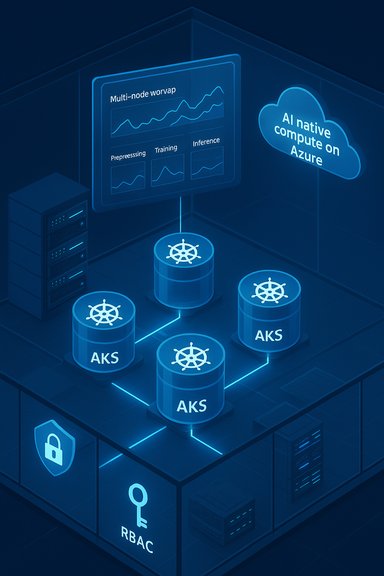
Modern AI workloads have moved beyond the capabilities of legacy batch‑oriented compute models. Pipelines now commonly mix CPU preprocessing, GPU‑accelerated training, and low‑latency inference in the same application flow — often across thousands of nodes and heterogeneous accelerators. Ray, the open‑source distributed compute framework created by the team behind Anyscale, was explicitly designed to coordinate those kinds of mixed workloads and to let engineering teams scale from a single machine to very large clusters without rebuilding orchestration layers. Ray’s ecosystem has grown rapidly and now sits at the center of many production AI platforms. Anyscale — the company founded by Ray’s creators — has taken Ray and layered a commercial control plane, developer tooling, and performance runtime around it. The new offering, delivered as a first‑party Azure service, is Anyscale running directly on Azure Kubernetes Service (AKS), making the Anyscale control plane and Anyscale Runtime available inside customers’ Azure accounts via the Azure Portal. The private preview began on November 4, 2025.
Key dates to note: the private preview began on November 4, 2025; general availability is expected in 2026. Validate exact GA timing and regional availability with your Microsoft account team before planning production migrations.
Source: The AI Journal Anyscale Collaborates with Microsoft to Deliver AI-Native Computing on Azure | The AI Journal
 Background
Modern AI workloads have moved beyond the capabilities of legacy batch‑oriented compute models. Pipelines now commonly mix CPU preprocessing, GPU‑accelerated training, and low‑latency inference in the same application flow — often across thousands of nodes and heterogeneous accelerators. Ray, the open‑source distributed compute framework created by the team behind Anyscale, was explicitly designed to coordinate those kinds of mixed workloads and to let engineering teams scale from a single machine to very large clusters without rebuilding orchestration layers. Ray’s ecosystem has grown rapidly and now sits at the center of many production AI platforms. Anyscale — the company founded by Ray’s creators — has taken Ray and layered a commercial control plane, developer tooling, and performance runtime around it. The new offering, delivered as a first‑party Azure service, is Anyscale running directly on Azure Kubernetes Service (AKS), making the Anyscale control plane and Anyscale Runtime available inside customers’ Azure accounts via the Azure Portal. The private preview began on November 4, 2025. What Microsoft and Anyscale are shipping
The product in plain terms
- A fully managed, first‑party Azure service that provisions and runs Ray‑based workloads inside a customer’s Azure subscription and AKS clusters.
- Native Azure integration for provisioning, billing (unified Azure billing), and identity (Azure Entra ID).
- Anyscale Runtime: a Ray‑compatible, performance‑optimized runtime designed to accelerate data preprocessing, batch inference, training and serving workloads without code changes.
- Observability, workspaces (multi‑node IDEs), dashboards, and lifecycle features (checkpointing, mid‑epoch resume, lineage tracking) intended to improve developer velocity and production resilience.
Headline claims (as announced)
- Private preview start: November 4, 2025; general availability planned in 2026.
- “Anyscale Runtime delivers up to 10x faster performance compared with self‑managed Ray OSS” on selected workloads, with example benchmarks showing 5× faster image batch inference, 10× faster feature preprocessing, and other gains on TPC‑H and reinforcement learning scenarios. These numbers are from Anyscale’s runtime announcements and Ray Summit 2025 materials.
- Ray usage and ecosystem scale: the Ray project is widely adopted in industry, and public statements show tens of thousands of GitHub stars and hundreds of millions of downloads (different announcements report slightly different metrics — see verification notes below).
Technical overview: how this differs from “Ray on AKS” today
Many enterprises already run open‑source Ray on AKS by installing Ray operators into Kubernetes clusters. The value proposition of Anyscale on Azure is primarily operational and experiential:- First‑party provisioning: Deploy Anyscale from the Azure Portal as a native service experience rather than glueing together Helm charts and custom operators. This reduces onboarding friction and lets Azure billing, Marketplace procurement, and enterprise policy work as they do for other Azure services.
- Control plane inside customer subscription: The Anyscale control plane operates inside the customer’s Azure account, meaning organizations keep data, credentials, and governance within their own tenancy and policies (BYOC control plane model). This is positioned as reducing compliance risk versus third‑party hosted control planes.
- Anyscale Runtime: A Ray‑compatible engine optimized for production scenarios (autoscaling, memory management, checkpointing, mid‑epoch resume). Anyscale’s published benchmarks claim substantial performance and cost improvements without application code changes. These improvements are attributable to runtime optimizations, autoscaler refinements, and cluster controller features.
- Integrated developer tooling: Interactive multi‑node workspaces, persistent logs, lineage tracking integrated with MLflow / Weights & Biases / Unity Catalog, and Ray‑specific dashboards designed to make debugging distributed workloads faster.
Why this matters to enterprise IT and WindowsForum readers
- Speed to production: Managed control planes and native portal provisioning can shorten the path from proof‑of‑concept to production. Instead of building custom operators and runbooks, teams will use Azure flows and Anyscale templates to set up Ray clusters and workspaces.
- Unified governance: Running the control plane inside the customer’s subscription and integrating with Azure Entra ID simplifies organizational policy enforcement and auditing compared with ad‑hoc deployments that require separate identity or secrets management.
- Better GPU utilization: Ray’s design (task scheduling, actor abstraction, and heterogeneous resource handling) is aimed to increase GPU utilization compared to siloed batch/online infrastructures. Anyscale says the Runtime and Cluster Controller improve start times and decrease idle GPU time, which can materially reduce cloud spend for GPU‑heavy workloads.
- Open‑source interoperability: Because Ray is open source, customers can still run the Ray OSS stack elsewhere or move workloads between clouds; the Anyscale runtime is described as Ray‑compatible, not Ray‑fork locking. That said, operational and runtime value is what customers pay for.
Strengths and strategic positives
1) Native portal integration reduces friction
Provisioning from the Azure Portal, combined with Azure Marketplace billing and support options, cuts procurement and onboarding time for enterprises that already centralize cloud spend and vendor management through Microsoft. This is a practical win for enterprise procurement and FinOps teams.2) Co‑engineering with AKS and Azure teams
The service is presented as co‑engineered with Microsoft AKS teams (quote included from Brendan Burns). That deep integration can be meaningful for topology‑aware scheduling, node replacement semantics, and tighter identity/role integration than third‑party operators.3) Performance claims backed by published benchmarks
Anyscale has published concrete benchmark numbers for the Anyscale Runtime showing large improvements for feature preprocessing, image batch inference, and other workloads. If those gains reproduce on your workloads, they translate directly to reduced cloud cost and faster iteration cycles.4) Enterprise security & governance model
Running the Anyscale control plane inside the customer’s Azure tenancy, and integration with Azure security primitives (Entra ID, role‑based access, network controls), gives enterprises a familiar surface for risk assessment and compliance checks.Risks, caveats, and what to validate before adoption
1) Benchmark caveats and real‑world reproduction
Vendor benchmarks are directional. The “up to 10×” claims are compelling but workload dependent: preprocessing pipelines, model architectures, dataset sizes, precision modes, and autoscaler behavior all influence results. Validate claims by running your own benchmarks, not just vendor examples. Anyscale provides templates and documented benchmarks to reproduce results, which should be the starting point for any proof‑of‑value.2) Cost model complexity
Higher utilization and performance do not automatically equal lower total cost. Faster jobs can mean higher concurrent peak usage and different spot / reserved instance dynamics. Enterprises must model:- GPU instance pricing (on‑demand vs reserved vs spot)
- Data egress and cross‑region traffic
- Autoscaler start/stop behavior and preemption policies
- Licensing or Anyscale runtime consumption billing via Azure Marketplace offers
A careful FinOps pilot is required.
3) Operational dependency and potential lock‑in
While Ray itself is open source and the Anyscale Runtime is Ray‑compatible, the operational benefits — dashboards, lineage tracking, runtime optimizations, cluster controller — represent value that can be hard to replicate in another environment. If you adopt the Anyscale control plane and features deeply, migrating away later will involve operational work. Treating Anyscale as a managed platform choice requires contract, SLA and exit strategy review.4) Supply constraints for accelerators
Access to high‑end GPUs (H100, H200, Blackwell‑class) remains constrained in many regions. A managed service that makes cluster provisioning easy does not remove the underlying market reality of accelerator availability or pricing volatility. Expect to negotiate placement, quota and capacity plans with your cloud account team.5) Security and data sovereignty details matter
Running the control plane in your subscription lowers some risks, but you still need:- Clear documentation on where logs, images, and artifacts are stored
- Details on who can access the Anyscale operator and Kubernetes service account scopes
- Policies for secrets and model artifacts management (customer‑managed keys, private networking)
Review the integration specifics with Azure Entra ID and AKS RBAC before production deployment.
Verification of key claims and data points
Because public metrics and vendor statements vary, these points were cross‑checked against multiple sources:- Private preview and timeline: Anyscale’s press release and announcement blogs state the private preview started on November 4, 2025 with GA expected in 2026. These are the authoritative published rollout timelines from Anyscale’s announcement.
- Anyscale Runtime performance claims: Anyscale’s Ray Summit and runtime announcement materials include benchmark tables showing up to 10× speedups on selected preprocessing and inference tasks, and other multiplicative improvements depending on workload class. These are vendor‑published benchmarks and include reproducibility notes. Independent third‑party benchmarks are not yet widely published for the Anyscale Runtime at scale; therefore, treat vendor numbers as promising but subject to verification on customer workloads.
- Ray project scale: Anyscale’s press materials and the PyTorch Foundation announcement both reference high adoption for Ray. Public data on the Ray GitHub repository shows roughly ~39k stars, and foundation and vendor communication report downloads in the hundreds of millions (figures vary by metric: monthly downloads vs cumulative). Different announcements cite 27 million monthly downloads, 237 million total downloads, or cumulative counts exceeding 200 million; these differences appear to be due to differing measurement windows and sources (PyPI, Docker Hub, combined package downloads). Where a specific number matters for decision‑making, teams should ask Anyscale for the metric definition and raw data.
- Independent coverage: Multiple trade outlets republished the Anyscale press release (standard practice for corporate PR); independent technical verification at scale (e.g., third‑party benchmarks or Microsoft official docs beyond quotes) will appear as the service reaches GA and customers publish real‑world results. At the time of the private preview announcement, the most reliable sources for technical details are the Anyscale blogs and Ray Summit materials.
Practical guidance: how to evaluate Anyscale on Azure (recommended pilot plan)
- Request private preview access and request documentation on billing, quotas, and data residency from your Microsoft account team.
- Create a short, reproducible benchmark that reflects your real preprocessing, training, and serving workload mix (same model, same dataset, same precision). Run it on:
- Your current self‑managed Ray-on‑K8s setup (baseline).
- An Anyscale on Azure managed cluster in the private preview (pilot).
- Measure:
- End‑to‑end wall time and CPU/GPU utilization
- Cost per run (cloud compute + service charge)
- Failure modes (preemption, OOM, scheduler delays)
- Observability experience and debugging time
- Test autoscaling behavior and multi‑resource clouds (if you have multi‑region or multi‑cloud needs) to verify cluster start times and queuing behavior.
- Perform a security review: RBAC, operator permissions, logging retention, sample artifact flow (where models and datasets are staged), and integration with your key‑management and SIEM.
- Build an exit plan: export formats for job metadata, ability to run Ray OSS images using the same code, and an estimate for re‑implementing observability if you ever need to move off the managed control plane.
Competitive and market context
- Multiple clouds already host Ray workloads (self‑managed), and Anyscale has been available through Azure Marketplace prior to this first‑party integration. The difference now is the first‑party co‑engineering and the portal experience. For organizations already standardized on Azure, that native experience has clear operational appeal.
- Other vendors (including cloud providers and GPU‑specialist providers) offer managed or semi‑managed AI compute fabrics. The decision to use Anyscale on Azure should weigh:
- Depth of integration needed with Azure stack (Entra, Purview, Foundry)
- Local availability of accelerators and region constraints
- Existing investments in Ray OSS or alternative distributed compute frameworks
Bottom line: who should care, and why now
- Platform engineering teams and enterprise ML/Ops organizations that need to run heterogeneous AI pipelines (CPU + GPU + custom accelerators), want a portal‑native experience, and need Azure‑centric governance should put Anyscale on Azure on the short list for pilots.
- Organizations that rely on open‑source Ray today will find the compatibility claims attractive — but must validate runtime performance and the operational cost/benefit tradeoffs on representative workloads.
- For CIOs and cloud architects, the important questions are not only raw performance but procurement, governance, accelerator access, and long‑term operational lock‑in. These should be framed in contracts and pilot acceptance tests before broad production rollout.
Conclusion
Anyscale’s first‑party service on Azure is a strategic play to bring an AI‑native compute fabric — Ray — into a native cloud experience. For enterprises already committed to Azure, the integration promises faster time to production, closer governance, and an optimized runtime that may substantially reduce cost and improve throughput for certain classes of workloads. The promise is credible: Anyscale published concrete benchmarks and Microsoft’s AKS integration is a logical fit for enterprise adoption. However, vendor benchmarks and high‑level download metrics require careful validation on your workloads and accounting models. The recommended path is a short, focused pilot that measures performance, cost, operational maturity, and security posture before any wide production rollout.Key dates to note: the private preview began on November 4, 2025; general availability is expected in 2026. Validate exact GA timing and regional availability with your Microsoft account team before planning production migrations.
Source: The AI Journal Anyscale Collaborates with Microsoft to Deliver AI-Native Computing on Azure | The AI Journal
