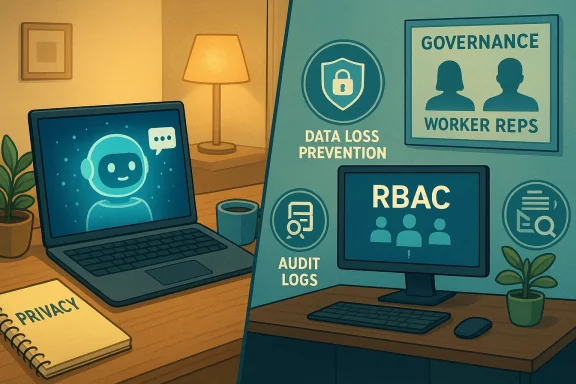
Australians and New Zealanders are taking AI home—and they want their workplaces to catch up, but only on their terms: more transparency, stronger controls, and clear security rules before generative tools become decision‑grade at work.
Salesforce this week published findings from a YouGov survey of 2,132 knowledge workers across Australia and New Zealand that show rapid consumer adoption of AI is reshaping worker expectations for enterprise tools. The headline numbers are stark: 86% of respondents reported using AI in their personal lives, about three‑quarters said those personal experiences increased their confidence in using AI at work, and 76% have experimented with multi‑step AI agents—autonomous assistants that carry out sequences of tasks. Those findings arrive against a shifting policy and industrial backdrop in Australia: Microsoft Australia has signed a framework agreement with the Australian Council of Trade Unions (ACTU) to embed worker voice and training into AI deployments, and the federal government released a National AI Plan last December that includes commitments to an AI Safety Institute and GovAI (secure public‑sector copilots). These parallel moves illustrate a fast‑moving domestic ecosystem where consumer familiarity, corporate deployments and public policy are colliding. This feature unpicks the Salesforce/YouGov results, tests them against independent reporting, and then explains the practical implications for IT leaders, security teams and policy makers who must turn personal AI fluency into safe, auditable workplace capability.
For IT leaders the imperative is clear: convert the energy of personal experimentation into enterprise value through rapid inventories, tenant‑grounded tooling, logging, role‑based policies and worker‑centred governance. Those steps preserve the upside—speed, inclusion, new skills—while keeping hallucinations, leakage and regulatory risk in check. The alternative is a two‑speed economy where consumer experimentation outpaces organisational safeguards and creates unnecessary exposure.
(Verification note: the Salesforce press release and contemporaneous media reporting substantiate the survey’s major figures and conclusions; public policy moves referenced here—Microsoft’s agreement with the ACTU and Australia’s National AI Plan—are documented in official releases and national reporting. Where exact methodological wording matters for legal or procurement purposes, organisations should request the full YouGov questionnaire and weighting appendix from the study sponsors.
Source: Yarrawonga Chronicle | Yarrawonga Chronicle
 Background / Overview
Salesforce this week published findings from a YouGov survey of 2,132 knowledge workers across Australia and New Zealand that show rapid consumer adoption of AI is reshaping worker expectations for enterprise tools. The headline numbers are stark: 86% of respondents reported using AI in their personal lives, about three‑quarters said those personal experiences increased their confidence in using AI at work, and 76% have experimented with multi‑step AI agents—autonomous assistants that carry out sequences of tasks. Those findings arrive against a shifting policy and industrial backdrop in Australia: Microsoft Australia has signed a framework agreement with the Australian Council of Trade Unions (ACTU) to embed worker voice and training into AI deployments, and the federal government released a National AI Plan last December that includes commitments to an AI Safety Institute and GovAI (secure public‑sector copilots). These parallel moves illustrate a fast‑moving domestic ecosystem where consumer familiarity, corporate deployments and public policy are colliding. This feature unpicks the Salesforce/YouGov results, tests them against independent reporting, and then explains the practical implications for IT leaders, security teams and policy makers who must turn personal AI fluency into safe, auditable workplace capability.What the survey actually says
Key findings at a glance
- 2,132 ANZ knowledge workers surveyed by YouGov on behalf of Salesforce.
- 86% used AI personally (consumer chatbots, weekend planning, personal assistants).
- Roughly 71–74% said personal AI use improved their trust in AI at work (news outlets report 71%; Salesforce materials cite a similar uplift figure).
- 76% had tried agentic AI that performs multi‑step tasks; most respondents expect positive workplace impact within two years.
- Worker demands: 47% asked for greater transparency and control in workplace tools; 43% demanded strict security and privacy rules.
How robust is the evidence?
Salesforce’s release includes a methodology summary (YouGov panel, weighting by demographics, sample dates in September 2025). Vendor‑commissioned surveys can be rigorous, but question wording and weighting choices materially affect reported percentages—so interpret headline figures as directional rather than immutable truths. Where policy or procurement decisions depend on fine‑grained thresholds, obtain the full questionnaire and weighting appendix from the study authors.Why personal AI use increases workplace confidence — but stops short of blind trust
Personal experimentation is a low‑risk sandbox: people test prompts, learn failure modes (hallucinations), and adjust expectations. That experiential learning builds conditional trust—workers report greater confidence in AI, but they explicitly ask for guardrails before the tools become part of regulated or customer‑facing workflows. Salesforce’s regional VP framed the pattern as “personal experimentation” shaping realistic expectations about limitations. Three behavioural dynamics explain the gap between personal use and workplace acceptance:- Consumers test for convenience and speed; organisations need reliability and auditability. Fast weekend planning with ChatGPT is not the same bar as legal advice, audit summaries, or regulated customer communications.
- Workers learn how AI fails when they tinker: hallucinations, missing context, and privacy leaks. That hands‑on knowledge creates healthy scepticism and demand for transparency controls.
- If employers don’t offer sanctioned, secure alternatives, employees will bring consumer apps into work tasks (BYOAI), raising data‑leakage risk and compliance exposure. Multiple independent reports have flagged BYOAI as the primary operational danger in early deployments.
Policy context: Government and unions are stepping in
Microsoft and the ACTU: a new model for worker‑centred AI governance
On January 15, 2026, Microsoft Australia and the ACTU announced a Memorandum of Understanding and framework that commits both parties to worker training, information sharing, and embedding worker voice into AI design and deployment. The agreement explicitly aims to ensure workers can contribute to how AI systems are introduced and to access reskilling resources through unions. This private‑sector pact is a notable precedent for collaborative AI governance between a major platform provider and labour organisations.National AI Plan: the government’s playbook for safer AI
Australia’s National AI Plan (released December 2, 2025) aims to accelerate investment while putting safety frameworks in place: it funds the AI Safety Institute, outlines GovAI for secure public deployments, and prioritises skills development and testing frameworks. The plan signals that regulators and procurement authorities will expect stronger safety and audit commitments from enterprise AI rollouts in the near future. Together, these developments create a two‑track incentive for employers: align with public safety guidance and engage workers in co‑design to lower industrial friction and systemic risk.Practical implications for IT, security and procurement teams
The Salesforce survey and the surrounding policy moves give IT leaders a clear mandate: move quickly from pilot curiosity to defensible production practices that respect worker expectations. Below are concrete priorities and a tactical playbook.Immediate (0–3 months)
- Inventory current usage. Identify which consumer AI tools employees use and for what tasks; quantify how often sensitive data is pasted into public models.
- Designate a sanctioned corporate assistant. Choose a tenant‑grounded copilot or enterprise model that offers non‑training contract terms, data residency, and connector controls. Migrate frequent users with incentives and clear migration steps.
- Enforce least‑privilege connectors and DLP. Block or log prompts that touch PII, PHI, IP, or contract text. Integrate prompt‑level DLP into gateways to public APIs.
Medium term (3–12 months)
- Instrument and log. Implement prompt/outputt logging, immutable audit trails, and retention aligned with compliance needs. Logs enable reproducibility, incident forensics and model‑behavior audits.
- Role‑based AUPs (acceptable use policies). Publish short, role‑specific rules that define what counts as production‑grade AI output and require human sign‑off for external communications or regulated decisions.
- Pilot agent governance. Treat multi‑step agents as products with owners, SLOs and lifecycle governance: design, test, monitor, retire.
Long term (12+ months)
- Reskilling and role redesign. Fund prompt design, verification training and new career paths (prompt designers, model auditors, data stewards). Make these roles visible as promotion paths.
- Contractual upgrades. Require vendor SLAs on non‑training guarantees, transparency on model provenance, and independent testing for high‑risk workloads. Negotiate data retention and deletion clauses.
Technical controls and architectures that matter
Tenant‑grounded copilots and retrieval‑augmented generation (RAG)
For regulated data, prefer tenant‑grounded deployments (private endpoints or enterprise models) and tightly control RAG pipelines. Ensure retrieval sources are approved, sanitized, and segmented by sensitivity. That prevents retrieval of confidential documents into a public model response stream.Prompt and output logging
Logging is non‑negotiable for auditability. Logs should capture prompt text, model version, retrieval context, and final outputs, plus human approvals. Define retention policies aligned with legal needs and privacy rules.Observable SLOs for agents
Runbooks for agents must include SLOs for accuracy, hallucination rates, latency, and human escalation. Monitor drift, and require periodic revalidation against authoritative sources before agents can act autonomously on consequential workflows.Risks every board and CIO must treat as real
- Hallucinations and legal exposure: generative outputs can invent facts. If left unchecked, that risk becomes a regulatory and reputational liability in sectors like finance, law and healthcare.
- Data leakage: BYOAI use of consumer models can expose sensitive information or create retention in unknown training datasets. Enterprise contracts and technical DLP are necessary defences.
- Fragmented governance: inconsistent rules across departments produce systemic risk at scale. Centralised policy plus delegated execution (domain owners) is the scalable pattern.
- Cognitive offload and skill erosion: repeated reliance without verification risks eroding critical thinking. Training must emphasize verification skills and maintain human‑in‑the‑loop disciplines.
How to translate worker demand for "transparency and control" into operational steps
- Publish a short “what AI can and cannot do” sheet for employees that explains hallucinations, provenance, and escalation paths. Keep it simple and role‑focused.
- Create an internal prompt library with vetted templates and red‑team results; make it the default starting point for common tasks.
- Set mandatory human verification for outputs that feed decisions, contracts or regulated customer advice. Make sign‑off auditable.
- Involve workers in procurement and pilot design. The Microsoft–ACTU agreement shows unions and vendors can co‑design training and voice mechanisms that reduce friction and improve uptake.
Strengths and opportunities: what organisations stand to gain
- Faster, higher‑quality drafting and summarisation: Copilots embedded in everyday apps reduce friction and reclaim time for higher‑value work.
- Inclusion and accessibility: real‑time captioning, language scaffolding and readability improvements help diverse workforces.
- Talent attraction and retention: modern, safe AI tooling is a recruiting differentiator for younger cohorts who expect AI‑enabled workflows.
Risks of inaction: shadow AI and operational fragility
If employers delay providing sanctioned, safe AI tools, employees will continue to use consumer apps for work tasks. That creates three predictable outcomes: increased data leakage risk, inconsistent quality standards across the business, and growing worker frustration as public policy and unions step in to demand enforceable worker protections. The Salesforce data shows patience is wearing thin; 2026 is being framed as a turning point for workplace availability and governance.Tactical checklist for boards and CIOs (prioritised)
- Run a rapid AI usage inventory and map regulated data (0–2 weeks).
- Choose and provision a default, tenant‑grounded copilot for knowledge workers; migrate heavy users (1–3 months).
- Implement prompt/output logging and DLP for all AI endpoints (1–3 months).
- Publish role‑specific AUPs and require human verification for external/regulatory outputs (3–6 months).
- Establish an AI governance board with legal, HR, security and worker representatives; run sectoral pilots before scale (3–12 months).
Conclusion
The Salesforce/YouGov study captures a pivotal dynamic: consumer AI use is widening the base of worker fluency, creating a workforce that is ready to adopt AI at work—but only if employers match convenience with transparency, control, and demonstrable security. That expectation is being echoed in Australian policy (National AI Plan) and industrial practice (Microsoft–ACTU framework), signalling that the next phase of workplace AI adoption will be judged not only by productivity gains but by how well organisations protect data, involve workers, and make AI outputs auditable.For IT leaders the imperative is clear: convert the energy of personal experimentation into enterprise value through rapid inventories, tenant‑grounded tooling, logging, role‑based policies and worker‑centred governance. Those steps preserve the upside—speed, inclusion, new skills—while keeping hallucinations, leakage and regulatory risk in check. The alternative is a two‑speed economy where consumer experimentation outpaces organisational safeguards and creates unnecessary exposure.
(Verification note: the Salesforce press release and contemporaneous media reporting substantiate the survey’s major figures and conclusions; public policy moves referenced here—Microsoft’s agreement with the ACTU and Australia’s National AI Plan—are documented in official releases and national reporting. Where exact methodological wording matters for legal or procurement purposes, organisations should request the full YouGov questionnaire and weighting appendix from the study sponsors.
Source: Yarrawonga Chronicle | Yarrawonga Chronicle