

The AP’s compact “Trending” roundup that ran on regional sites this week reads like a stitched‑together newsroom mixtape — an odd but revealing cross‑section of public affairs, corporate strategy, extreme weather and digital culture that tells us as much about how news is packaged as it does about the stories themselves.
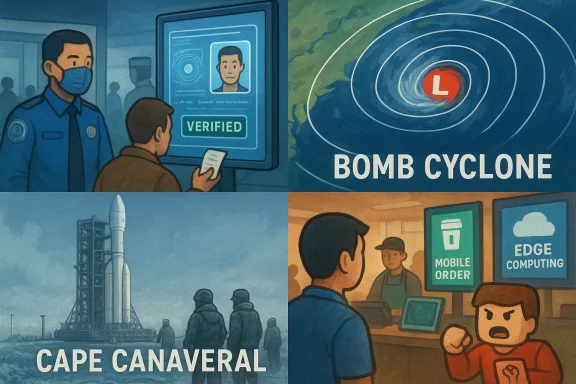
AP Trending briefs are short, syndicated capsules designed for rapid consumption and wide distribution on local outlets. They collect a handful of short items — human‑interest pieces, science explainers, business briefs and international spot news — and deliver them in a single scrollable list that editors can republish nearly verbatim. That same format is the reason the January 31, 2026 edition included items as disparate as a Westminster Kennel Club agility primer, an explainer on “bomb cyclones,” a practical advisory about TSA’s new ConfirmID fee, a NASA launch delay, Starbucks’ expansion plans, and a report on young people staging protests and reenactments inside Roblox.
The value of short, syndicated briefs is obvious: they let local sites fill space quickly with timely national reporting. The downside is equally obvious: short formats flatten context, encourage listlike consumption, and — when combined with templated CMS ingestion — make it easy for headlines to be lifted and republished without deeper verification. This matters for technology readers because several of the week’s briefs center on identity verification, digital platforms, critical infrastructure and large‑scale cloud/consumer services — areas where small technical details can meaningfully affect users’ decisions.
What to watch next: ConfirmID implementation guidance and privacy disclosures from TSA; NOAA intermediate forecasts for bomb‑cyclone prone systems; NASA wet dress rehearsal technical reports and launch cadence updates; Starbucks operational rollouts for new formats; and Roblox transparency reports on enforcement metrics — each of these will determine whether headlines are a passing buzz or the start of lasting shifts in practice and policy.
Source: Caledonian Record AP Trending SummaryBrief at 2:27 p.m. EST
 Background and overview
AP Trending briefs are short, syndicated capsules designed for rapid consumption and wide distribution on local outlets. They collect a handful of short items — human‑interest pieces, science explainers, business briefs and international spot news — and deliver them in a single scrollable list that editors can republish nearly verbatim. That same format is the reason the January 31, 2026 edition included items as disparate as a Westminster Kennel Club agility primer, an explainer on “bomb cyclones,” a practical advisory about TSA’s new ConfirmID fee, a NASA launch delay, Starbucks’ expansion plans, and a report on young people staging protests and reenactments inside Roblox.The value of short, syndicated briefs is obvious: they let local sites fill space quickly with timely national reporting. The downside is equally obvious: short formats flatten context, encourage listlike consumption, and — when combined with templated CMS ingestion — make it easy for headlines to be lifted and republished without deeper verification. This matters for technology readers because several of the week’s briefs center on identity verification, digital platforms, critical infrastructure and large‑scale cloud/consumer services — areas where small technical details can meaningfully affect users’ decisions.
What readers need to know — verified claims and immediate takeaways
TSA ConfirmID: real cost, real caveats
- What changed: Starting February 1, 2026, air travelers aged 18 and older who arrive at U.S. TSA checkpoints without a REAL ID‑compliant driver’s license or another accepted ID can choose to pay a $45 fee for TSA’s alternative identity‑verification system, called TSA ConfirmID. That fee covers identity verification for a 10‑day travel window.
- How the process works in practice: Travelers are expected to pay online in advance or be directed to a payment workflow at the checkpoint. Payment receipts — electronic or printed — must be presented to continue the verification steps, which can take up to 30 minutes and do not guarantee that the passenger will be allowed through security. The fee is non‑refundable and intended as a cost‑recovery mechanism.
- Why it matters for WindowsForum readers: the ConfirmID rollout raises practical and privacy questions about how identity data is captured and stored, who has access to it, and whether payment processors and third‑party verification partners are sufficiently secured. The government’s stated aim is cost recovery; the operational effect will be longer checkpoint delays for non‑compliant travelers and a potential increase in ad‑hoc identity workflows that interact with commercial infrastructure.
Bomb cyclones: the definition and why meteorological precision matters
- The technical definition: Bombogenesis is a meteorological term describing a midlatitude cyclone that intensifies rapidly — commonly defined as a drop in central pressure of about 24 millibars (24 hPa) in 24 hours, though the threshold varies with latitude. At New York’s latitude the equivalent threshold is lower (around ~17.8 mb). These storms can produce hurricane‑force winds, heavy precipitation and coastal flooding.
- Practical implications: Forecast language like “bomb cyclone” is correct when the rapid deepening threshold is met, but the sea‑level pressure threshold and expected impacts should be communicated alongside the term. For readers and admins who manage infrastructure — from datacenter operations to regional service continuity — short notice and high winds are the operational risks to plan for.
NASA Artemis schedule slip: cold weather is operationally consequential
- The concrete change: NASA postponed a critical Artemis wet dress rehearsal and moved the crewed Artemis launch window out by a few days — with the mission targeted no earlier than Feb. 8, 2026 — because of forecast near‑freezing temperatures at Cape Canaveral that would jeopardize fueling operations and systems checks. Subsequent wet dress rehearsal runs also encountered hydrogen leak technicalities that pushed potential launch dates further into March in later updates.
- Why environmental constraints matter: modern launch campaigns tightly couple cryogenic propellant handling with pad and ground system capabilities. Even modest temperature swings can force an agency to add heaters and change vent/purge protocols, which has cascading schedule and resource implications for related missions (for example, International Space Station crew rotations). For engineers and technologists, the episode is a reminder that environmental edge cases remain a major source of risk even in highly automated systems.
Starbucks expansion: a business pivot with operational angles
- The headline: Starbucks announced plans to open up to 175 new U.S. cafes in 2026 and about 400 by 2028, along with a target to build as many as 5,000 additional locations over time using smaller, lower‑cost formats. The company also plans to add roughly 25,000 seats across U.S. locations and roll out loyalty program upgrades.
- Why IT and retail operators should watch: smaller formats and higher seat counts imply backend changes — more robust point‑of‑sale deployments, improved connectivity in suburban locations, expanded mobile order capacity and potential increases in edge compute and networked queue management systems. The planned rollout of next‑generation espresso automation will also change store workflows and telemetry needs.
Westminster Kennel Club turns 150 — culture and continuity
- The numbers: The 150th Westminster show featured roughly 2,500 dogs and up to 212 breeds/varieties, with agility and other dog sports increasingly prominent alongside traditional conformation classes. The event is both cultural spectacle and a modern, standardized competitive sport for handlers and breeders.
- The human‑tech angle: the show’s expansion of agility and digital broadcast elements highlights how niche sports use streaming, analytics and social platforms to engage audiences — relevant to anyone tracking how live event production and fan engagement evolve in a hybrid broadcast/streaming world.
Roblox as a social stage: protests, play and community standards
- What’s happening: Young people have been staging virtual protests and reenacting immigration raids in roleplaying spaces on Roblox, prompting a platform response that these activities violate community rules that prohibit recreating sensitive real‑world events. Roblox said it uses human moderation, user reports and AI systems to enforce its policies.
- Why platforms must balance moderation and context: these behaviors are a case study in how children process real‑world news through play, but also in how quickly platform mechanics can be repurposed for political expression. For tech operators, the core questions are policy clarity, detection fidelity (false positives/negatives), age gating and the transparency of enforcement actions.
Human cost: South Africa minibus crashes
- The brief fact: A minibus taxi and truck collision in KwaZulu‑Natal killed at least 11 people, including a child; the crash followed another deadly minibus‑truck collision earlier in the month that killed 14 schoolchildren. South African authorities called for urgent investigations into vehicle and driver safety standards.
- Systems‑level considerations: public transport safety failures are not just enforcement issues; they implicate vehicle maintenance supply chains, regulatory monitoring systems and data‑driven inspection regimes — all areas where digital tools and telemetry could provide measurable safety gains if implemented and governed transparently.
Deeper analysis: what the collection of briefs tells us
1) Syndication speeds but flattens nuance
Syndicated briefs like AP Trending are effective at distributing short, verified reporting to many outlets quickly. However, they encourage a “headline plus one sentence” consumption pattern. That’s useful for scanners, but it increases the risk that technical caveats are missed — for example, the latitude dependence of the bombogenesis threshold, the non‑guaranteed nature of ConfirmID verification, or the logistical complexity behind NASA’s fueling operations. The basic facts are sound, but the operational details that matter most to engineers and IT operators are often compressed.2) Tech trust and data flows are now national public policy
Consider TSA ConfirmID: a $45 fee sounds simple, but every instance of identity verification is also a data event. Who stores the identity data? For how long? What data minimization safeguards exist? The official pay.gov form and TSA guidance outline the payment workflow, but they do not, in public briefings, lay out a comprehensive data retention and sharing map for third‑party verification components. Practically, that’s a risk for travelers and for IT teams planning kiosk or checkpoint integrations.3) Environmental edge cases remain a system‑level failure mode
NASA’s slip for Artemis is not a failure of hardware alone; it’s a reminder that environmental conditions are first‑order inputs to large‑scale technical campaigns. Launch automation and cryogenic systems are robust up to a point — but the margin matters. Enterprises running distributed infrastructure should take note: environmental stress testing is not optional, and contingency plans for short windows (like launch windows or business‑critical batch jobs) require explicit compensating controls.4) Platforms are the new public square, and moderation is technical policy
Roblox’s use as a space for protest and reenactment shows how a gaming platform becomes a political communication medium almost by accident. The enforcement stack — AI classifiers, human moderators, user reports — is a distributed technical governance model that trades scale for explainability. For platform engineers and product managers, this is a classic tradeoff: scale requires automated enforcement, but automation introduces edge cases and potential harms. Transparency, appeals processes and auditability are key mitigations.Risks and potential harms flagged
- ConfirmID privacy gap: official materials confirm the fee and process but do not fully disclose third‑party vendor relationships or retention windows in user‑friendly language. Travelers should assume identity verification steps create electronic records; privacy policies and FOIA/FOIA‑like oversight may be the only ways to verify retention and access.
- Sensational language risk: terms like “bomb cyclone” are meteorologically valid but carry emotive weight. Outlets should pair the label with the technical threshold and a clear local impact assessment to avoid false alarms or complacency. The NOAA explainer helps here by explaining the latitude dependence.
- Platform moderation opacity: Roblox’s statement about enforcement methods is high level; the company reports using AI and human moderators but does not publish classifier performance metrics or appeal timelines for under‑18 users. This opacity risks inconsistent enforcement and community trust erosion.
- Systemic safety problems: the repeat catastrophic minibus crashes in South Africa point to a systemic failure — maintenance, enforcement, and regulatory oversight. Short reports give the immediate toll but do not replace structured safety audits and implementation of data‑driven inspection systems.
Practical takeaways for WindowsForum readers (what to do next)
- If you travel: confirm you have a REAL ID or passport before you go to the airport, or be prepared to use ConfirmID and pay the $45 fee; pay before you get to the checkpoint to avoid line delays. Keep screenshots of receipts and understand the process does not guarantee boarding.
- If you run systems or datacenters in storm‑prone regions: test for rapid‑failure scenarios caused by extreme winds and power flicker — simulate the sorts of high‑load failovers and emergency buys that come with bomb‑cyclone conditions. Use NOAA briefings for planning thresholds.
- If you work in platform moderation or policy: demand and publish measurable metrics for detection and enforcement fidelity, and insist on user‑friendly appeals for underage users. Trial policy changes in limited environments to gauge false‑positive rates.
- If you manage retail or edge IoT deployments: Starbucks’ pivot to smaller formats suggests renewed demand for reliable store‑level connectivity, mobile order integrations and edge POS optimization. Revisit your store network designs and capacity planning for increased concurrent mobile orders.
How to read syndicated briefs responsibly
- Treat list briefs as signposts, not final analysis. Use the short item to identify the topic and then follow up with primary documents or longform coverage when you need operational detail.
- Expect compression: numbers and dates are correct more often than not in AP briefs, but nuanced qualifiers are often omitted; ask for the primary source (e.g., NOAA explainer for meteorology, NASA statements for launch schedules, agency pay.gov forms for fee mechanics).
- For technologists: translate the human‑facing headline into an operational question (Who stores what? When? Under what SLA? How can we test it?). That transforms speed reading into pragmatic resilience planning.
Conclusion
The week’s AP Trending brief does precisely what it’s meant to do: surface a curated mix of national stories that are quick to scan and easy to republish. But the collision of a $45 identity‑verification fee, rapidly intensifying storms, a human‑rated lunar mission under schedule pressure, major corporate retail pivots, and children using a gaming platform to roleplay protests is a useful reminder that technology and society are tightly intertwined. Short briefs give you the headlines; the responsible reader — especially one whose work touches IT systems, retail ops, platform governance or infrastructure resilience — must treat those headlines as entry points and follow the thread back to primary documentation before making decisions.What to watch next: ConfirmID implementation guidance and privacy disclosures from TSA; NOAA intermediate forecasts for bomb‑cyclone prone systems; NASA wet dress rehearsal technical reports and launch cadence updates; Starbucks operational rollouts for new formats; and Roblox transparency reports on enforcement metrics — each of these will determine whether headlines are a passing buzz or the start of lasting shifts in practice and policy.
Source: Caledonian Record AP Trending SummaryBrief at 2:27 p.m. EST