

Apacer at Embedded World 2026: Embedded AI Needs Reliable PCIe Gen5 Storage

  • Thread Author
Apacer is using Embedded World 2026 to make a broader argument than a product launch: in the age of embedded AI, storage is no longer a passive component but a primary determinant of system reliability, recoverability, and total performance. The company’s Netherlands arm is positioning PCIe Gen5 enterprise SSDs, DDR5 6400 industrial memory, and Raspberry Pi-oriented storage as the infrastructure layer that keeps edge AI practical rather than merely impressive. The show floor message is clear: if compute is the brain of the system, then storage is the nervous system. dded World has become one of the most important stages for industrial computing vendors because it sits at the intersection of hardware design, automation, edge AI, and long-lifecycle deployment. The 2026 event runs from 10–12 March 2026, and Apacer’s exhibitor presence is listed in Hall 1, Booth 1-310, with the company describing its mission as a push to help enterprises process data closer to the source while supporting robotics, smart manufacturing, mobility, and next-generation IoT.
That context matters because embedded AI has changed the requirements for storage. A decade ago, many industrial systems only needed modest flash capacity, durable write endurance, and straightforward compatibility. Today, the workload profile is harsher: local inference, log capture, model updates, sensor fusion, and rapid data shuttling can all happen on the same device, often in constrained thermal and power envelopes. Storage now has to behave more like a mission-critical subsystem than a commodity part.
Apacer has been building toward this message for some time. In late 2024, the company announced mass production of industrial DDR5-6400 CUDIMM and CSODIMM modules, highlighting fully lead-free resistor design and the use of CKD and TVS components for HPC and AI applications. By 2025 and into 2026, Apacer’s trade-show messaging expanded that theme into a wider industrial portfolio that also includes enterprise SSDs, recovery-oriented firmware, and power-stability technologies.
What stands out in the current announcement is the combination of enterprise data-center storage, industrial DRAM, and hobbyist-friendly Raspberry Pi accessories under one umbrella. That mix tells you where the market is dor now wants to serve cloud-adjacent workloads, industrial edge boxes, and maker projects that increasingly act as prototypes for real-world embedded deployments.
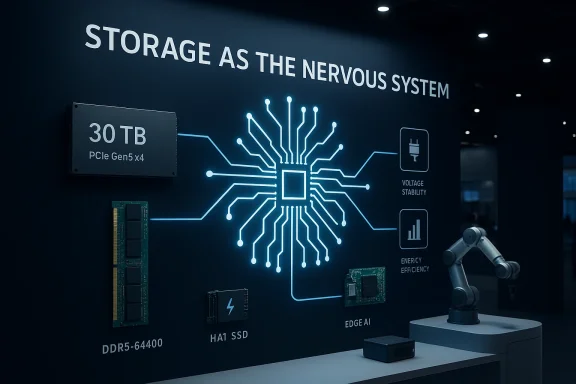
A digital visualization related to the article topic.Enterprise SSDs for Edge AI​

Apacer’s headline claim is that its Enterprise SSD series for edge and cloud servers, as well as mid-sized data centers, has passed multiple server test patterns and is compliant with Windows 11, Windows Server, and the latest Linux kernels. It also says the family uses PCIe Gen5 x4 flash technology and reaches capacities of up to 30 TB. That combination matters because edge AI systemingesting data; they are storing intermediate results, retraining artifacts, telemetry, and rollback images alongside normal application data.

Why Gen5 matters now​

PCIe Gen5 is not just a speed badge. In industrial and server contexts, it widens the headroom available for queue depth, mixed workloads, and fast checkpointing, which are increasingly important when AI software is being refreshed frequently or when data has to be retained locally for resilience. Apacer’s own business and professional SSD pages already frame Gen5 as a platform for performance plus data protection, and the company’s industrial materials emphasize higher-capacity PCIe offerings into the 30.72 TB range.
The practical implication is that embedded AI systems are converging with server design principles. Even when a device is deployed at the edge, it often behaves like a small server: it needs predictable latency, high endurance, and enough storage density to reduce the number of drives in the box. Fewer components mean fewer failure points, simpler validation, and lower service complexity. That is the real value proposition beneath the capacity figure.
Key takeaways:
  • 30 TB-class capacity shifts the product into serious data-retention territory.
  • Gen5 x4 giveete on bandwidth as AI workloads intensify.
  • Server test pattern validation signals deployment readiness rather than bench-only marketing.
  • Windows and Linux compatibility reduces integration friction for OEMs and integrators.
  • Edge and cloud overlap reflects how industrial AI is now architected.

Compatibility as a commercial weapon​

The mention of Windows 11, Windows Server, and modern Linux kernels is not boilerplate. In industrial procurement, compatibiliest ways to eliminate risk from the buying decision. If a drive family has already been validated against common server patterns, it cuts down engineering time and can shorten qualification cycles for integrators who are juggling firmware, controller, thermal, and OS certification issues at once.
That matters for enterprise customers even more than raw throughput. A storage platform that is good enough but unstable under particular workloads becomes a liability in a fleet environment. Apacer is clearly trying to make the case that the SSD series can serve as a stable building block in edge servers, where AI inference, database caching, and local analytics may all collide in the same chassis.

What rivals will notice​

Competitors such as Kioxia, Micron, Samsung, and industrial specialists all have strong enterprise SSD portfolios, but the market is increasingly segmented by application confidence, not just specs. Vendors now have to prove that they can survive field reality—thermal swings, voltage instability, firmware recovery, and heterogeneous OS stacks. Apacer’s value proposition is that it is packaging these concerns together rather than selling a capacity number in isolation.

PC and AI​

Apacer is also showcasing an enhanced DDR5 6400 lineup that includes CUDIMM, CSODIMM, and REG DIMM modules. The company says these products use advanced clock drivers to improve timing and signal integrity, while built-in Transient Voltage Suppressors provide protection against voltage surges and electrostatic discharge. In plain English, this is memory designed to keep running in electrically noisy, thermally stressful, and uptime-sensitive environments.

The case for CKD and TVS​

Apacer has already been explicit in prior materials that its DDR5-6400 CUDIMM and CSODIMM modules use professional-grade Clock Driver (CKD) components and TVS diodes to support HPC and AI applications. That is important because at higher transfer rates, signal integrity becomes just as important as raw DRAM quality. If timing margins collapse, the system may still boot, but reliability under sustained load becomes unpredictable.
The industrial audience understands that memory is often the first weak link in edge systems pushed beyond signage or sensor capture. AI workloads are bursty and often run close to thermal ceilings, while industrial control systems can be exposed to unstable power and EMI. By talking about timing, ESD, and voltage resilience together, Apacer is signaling that it wants to be seen as an engineering partner, not a commodity DIMM vendor.

Sustainability meets compliance​

Apacer also emphasizes that its industrial DRAMs are fully lead-free and compliant with the EU RoHS Directive. That is not just a regulatory checkbox; it is increasingly a buying criterion in European industrial procurement, especially where supply-chain documentation is scrutinized and sustainability language has moved into vendor scorecards. The company’s earlier DDR5 release framed this as a product differentiation point because it eliminated the need for exemptions under RoHS.
For buyers, that creates a two-layer benefit. First, it reduces environmental compliance burden. Second, it signals manufacturing discipline, which tends to matter in high-reliability environments where customers assume that vendterials compliance are also more likely to maintain stable process control. That is not a guarantee, but it is the kind of inference procurement teams routinely make.

HPC, AI, and the edge​

Apacer’s inclusion of REG DIMM in the same lineup broadens the story beyond compact embedded designs. Registered DIMMs are part of the conversation whenever larger memory footprints and more stable multi-module configurations are needed, especially in servers and high-performance workstations. By placing these products alongside CUDIMM and CSODIMM, Apacer is essentially spanning the edge-to-server continuum with one memory narrative.
That continuum matters because AI deployment is no longer confined to hyperscale data centers. Many organizations are running smaller model-serving nodes in factories, labs, vehicles, and retail ba still need memory stability, and they often need it more than they need flashy RGB or consumer-grade overclocking.

Raspberry Pi and Maker-Grade Storage​

One of the more interesting parts of Apacer’s announcement is the Raspberry Pi angle. The company says it will show compatible storage solutions such as microSD cards from 64 GB, QVL-certified for Raspberry Pi 3, 4, and 5, and a new Pi HAT SSD that replaces the original Pi-HAT adapter while incorporating Apacer technologies such as CoreSnapshot 2. This is a smart move because the Raspberry Pi ecosystem has become a proving ground for lightweight edge applications, prototyping, and educational AI projects.

Why Raspberry Pi still matters​

Raspberry Pi is no longer just a hobby boardmon way to prototype automation, run lightweight inference, build kiosk systems, and test industrial concepts before they move into custom hardware. In that sense, a Pi-focused storage accessory is not a toy product; it is a bridge between the maker world and the embedded market.
The QVL certification for Raspberry Pi 3, 4, and 5 is also significant because compatibility assurance is often the difference between a neat demo and a reliable field deployment. If the storage has been vetted against the target platform, integrators can spend more time on the application and less on troubleshooting boot failures, driver quirks, or card instability. That lowers adoption friction in an ecosystem that is famously broad but sometimes inconsistent.

CoreSnapshot 2 and recoverability​

Apacer says the Pi HAT SSD uses CoreSnapshot 2, a firmware-based backup and recovery technology that can help solve unexpected data loss or operating-system failure through an incremental backup mechanism. That is a compelling feature in embedded settings because edge devices are often deployed in places where physical access is inconvenient, expensive, or slow. If the device can recover more quickly after corruption or shutdown, maintenance costs fall.
The strategic twist here is that Apacer is teaching makers and embedded developers to think like operators. A recovery-aware SSD is about resilience, not speed. That is exactly the mindset AI-driven embedded systems need, because the system that runs unattended for months must recover gracefully from the occasional bad power event or software crash. That is where storage earns its keep.

Product segmentation with purpose​

This Raspberry Pi messaging also broadens Apacer’s funnel. A developer who starts with a Pi HAT SSD may later move up into industrial SSDs or DRAM modules for a commercial product. That path is valuable because it creates brand familiarity before procurement formalities begin. In other words, the company is not merely selling accessories; it is cultivating future industrial customers.

Power Protection and Energy Efficiency​

Apacer is leaning heavily on its proprietary value-added technologies, especially CoreVolt 2 and CoreEnergy. CoreVolt 2 is described as a real-time voltage detection and stabilization system for SSDs that can trigger backup power using tantalum polymer capacitors when voltage fluctuations occur. CoreEnergy, by contrast, combines application-specific power management with hardware-software co-design to balance performance and energy efficiency.

CoreVolt 2 as uptime insurance​

CoreVolt 2 is a very industrial answer to a very industrial problem: unstable power. Voltage dips and fluctuations are a common cause of data corruption, unexpected reboot behavior, and silent hardware stress, especially at the edge where power quality may not resemble that of a well-er. Apacer’s own description frames the technology as real-time stabilization that protects both data and devices.
This is the kind of feature that often separates enterprise-grade storage from consumer-grade hardware. A consumer SSD may be fast, but if it fails to preserve data during a power event, it is not suited to industrial deployment. CoreVolt 2 is therefore less about elegance and more about reducing expensive field failure scenarios.

CoreEnergy and workload tuning​

CoreEnergy is equally interesting because it acknowledges a truth many vendors still ignore: industrial customers oftenst, heat output, and system envelope just as much as throughput. Apacer says the feature offers preset energy modes so users can choose the balance that fits the application, helping reduce consumption and avoid overheating. That is especially relevant in compact enclosures and fan-limited designs.
Energy-aware SSD behavior is also becoming a competitive differentiator in edge AI. Local inference devices are expected to stay onle work per watt than earlier generation embedded systems. If storage can help reduce thermal load while maintaining acceptable latency, it can make the rest of the hardware platform easier to design and cool.

Technology stack, not single features​

Taken together, CoreVolt 2 and CoreEnergy show that Apacer is trying to sell a system narrative rather than isolated components. The company is bundling reliability, efficiency, and recovery in a way that appeals to integrators who have learned that edge AI failures are often multi-causal. A power glitch can become a storage issue, which becomes an OS issue, which becomes a service outage.

Sustainability and RoHS Compliance​

Apacer says that all of its industriale PV250-M280 SSD, are fully lead-free and compliant with the EU RoHS Directive. The company attributes this to a completely lead-free resistor design and the use of low-temperature solder paste with underfill technology in the SMT process. In a European context, that is both a compliance statement and a competitive signal.

Why the materials story matters​

For industrial buyers, RoHS compliance is not just paperwork. It affects procurement eligibility, environmental reporting, and sometimes even customer tender qualification. Vendors that can prove lead-free construction reduce friction for customers who are trying to standardize globally while satisfying European environmental requirements.
The technical side is equally important. Underfill and low-temperature soldering are process choices that can improve mechanical resilience or help manage manufacturing constraints, especially when small form factors are expected to survive vibration or harsh handling. That makes the lead-free claim more meaningful than a simple checkbox because it suggests the company has adjusted its production model, not just its labeling.

ESG as procurement language​

A few years ago, sustainability messaging in storage was often broad and vague. Now it is becoming more specific, because enterprises increasingly want environmental compliance folded into supplier qualification. Apacer’s approach reflects that shift by tying lead-free construction to product identity and manufacturing process. That is a subtle but important difference.
It also broadens the company’s appeal in Europe, where industrial procurement teams often weigh lifecycle policy, compliance, and component traceability alongside raw performance. In that environment, a lead-free SSD or memory module can influence the shortlist long before benchmarks are run. That is how industrial purchasing actually works.

Industrial AI Market Positioning​

The larger strategic picture is that Apacer is trying to own a narrow but growing category: storage infrastructure for embedded AI. The company’s booth message, product mix, and exhibitor forum talk titled “Storage, empowering embedded AI growth” all point in the same direction. This is not a random product spread; it is a coheAI systems needing more dependable memory, more intelligent SSDs, and more platform-specific validation.

Why storage vendors are talking like systems vendors​

AI deployment has shifted the center of gravitformance to operational reliability. The market has learned that inference at the edge is only as good as the surrounding infrastructure, and storage is one of the infrastructure pieces that can quietly determine whether a system feels robust or brittle. Apacer is betting that customers increasingly understand this.
That is also why the company’s language emphasizes growth and empowerment rather than just speed. It is framing storage as the enabler of broader AI deployment in robotics, smart manufacturing, and modern mobility. In marketing terms, that’s a subtle shift from component supplier to platform enabler.

Enterprise vs consumer impact​

On the enterprise side, the offer is straightforward: validated SSDs, high-density DRAM, power protections, and recoverability features that reduce downtime and simplify qualification. Those are the ingredients that edge operators and data-center teams actually buy. Enterprise customers will likely focus most on the Gen5 SSD line, the DDR5 modules, and the CoreVolt/CoreEnergy stack.
On the consumer and developer side, the Raspberry Pi and microSD angle lowers the barrier to trying Apacer hardware in small projects. That matters because modern product innovation often starts in a lab or prototype environment ommercial purchase. If Apacer can win mindshare there, it may create a pipeline into industrial deployments later.

Competitive implications​

Competitively, this puts pressure on vendors that still market storage primarily through generic performance numbers. Industrial buyers are increasingly asking about power stability, signal integrity, OS compatibility, and recovery after failure. A vendor that can speak fluently about all of those points has an easier time defending price premium and securing design wins.

Strengths and Opportunities​

Apacer’s Embedded World 2026 strategy has several obvious strengths. It is technically coherent, it maps neatly to current market demand, and it spans multiple tiers of the embedded stack. Just as importantly, it blends performance claims with resilience claims, which is where a lot of industrial buying decisions are now made.
  • Clear edge AI positioning that aligns storage with the most important trend in embedded computing.
  • Broad portfolio coverage across SSDs, DRAM, recovery technology, and Raspberry Pi accessories.
  • Strong reliability story built around voltage protection, backup behavior, and compatibility testing.
  • European compliance advantages through lead-free and RoHS-aligned manufacturing.
  • Multi-platform credibility via Windows, Windows Server, and Linux kernel compatibility.
  • Developer-to-enterprise pipeline potential from Pi accessories to industrial-grade products.
  • Power-efficiency differentiation that matters in thermally constrained deployments.

Risks and Concerns​

The announcement is strong on breadth, but breadth can also create ambiguity. Apacer must be careful that the message does not feel too diffuse, because buyers in industrial computing often want a very tight answer to a very specific problem. There is also the issue of proving that headline features translate into measurable real-world gains.
  • Feature overload could blur the core message if every technology is given equal weight.
  • Capacity claims alone may not convince skeptical enterprise buyers without endurance and thermal data.
  • Raspberry Pi appeal may not translate automatically into industrial design wins.
  • Competitive pressure from larger storage vendors remains intense in both enterprise and edge segments.
  • Validation claims will need scrutiny from integrators who expect long-term field evidence.
  • Power-protection technologies are only as good as their impleloyment scenarios.
  • Sustainability messaging may be discounted if procurement teams see it as table stakes rather than differentiation.

Looking Ahead​

The next few months will show whether Apacer’s embedded AI message gains traction beyond the trade show floor. The company has made a credible case that storage deserves to sit at the center of edge AI discussions, but success will depend on whether OEMs, system integrators, and industrial customers treat these products as design-in candidates rather than nice-to-have showcase hardware. The market is receptive to reliability-first messaging, but only if the technical proof points are strong enough.
There is also a broader industry signal here. As AI workloads migrate closer to machines, vehicles, and factories, the vendors that win will not necessarily be the ones with the highest benchmark score. They will be the ones that can combine speed, resilience, compliance, and lifecycle support into a package that saves integrators time and reduces downstream risk. Apacer’s Embedded World 2026 showing suggests it understands that shift well.
  • Watch for deeper technical validation of the 30 TB enterprise SSD line.
  • Watch for field adoption of DDR5-6400 CUDIMM, CSODIMM, and REG DIMM modules.
  • Watch for any expansion of CoreVolt 2 and CoreEnergy into more product families.
  • Watch whether the Pi HAT SSD becomes a bridge product for developer and industrial customers.
  • Watch for competitive responses from other industrial storage brands at future trade shows.
In the end, Apacer’s Embedded World 2026 presentation is most persuasive when read as a bet on the future shape of edge computing. The company is saying, correctly, that embedded AI is not just about faster processors or bigger models; it is about dependable data movement, predictable recovery, and storage systems that can survive the realities of industrial deployment. If that thesis holds, then storage vendors like Apacer may find themselves playing a far bigger role in AI infrastructure than they did in the PC era.

Source: AD HOC NEWS Apacer Technology Inc. Netherlands
 

Apacer Technology Inc. is using Embedded World 2026 to deliver a pointed message: in the era of embedded AI, storage is no longer just infrastructure, it is a performance, reliability, and sustainability decision. The company’s Netherlands arm says it will showcase PCIe Gen5 enterprise SSDs, DDR5 6400 industrial memory, Raspberry Pi-oriented storage, and lead-free industrial components at the show in Nuremberg, where it also plans to frame storage as a core enabler of edge AI growth. The timing matters because the embedded market is moving quickly toward more compute-heavy workloads, while system integrators are being forced to balance speed, durability, power draw, and regulatory compliance at the same time. Apacer’s pitch is that it has products and proprietary technologies for all of those pressures in one package, from CoreVolt 2 to CoreEnergy and CoreSnapshot 2

Neon-lit server device and circuit modules with “Embedded World 2026” product feature icons.Background​

Embedded World has become one of the clearest annual snapshots of where the embedded industry is heading, and the 2026 edition underscores just how central AI has become to that conversation. The event runs from March 10 to 12, 2026 in Nuremberg, and the organizer says this year’s show includes 1,262 exhibitors from 43 countries across seven halls, reinforcing that it remains the global meeting point for embedded hardware, software, and system design. Apacer’s appearance at Hall 1, booth 310, and its exhibitor-forum slot in Hall 3, place the company directly inside that strategic conversation
Apacer is not arriving with a single-product message. Instead, it is packaging a broad industrial-storage narrative around embedded AI workloads, with enterprise SSDs for edge and cloud servers, industrial DDR5 modules, Raspberry Pi-compatible storage, and sustainability-oriented manufacturing claims. That matters because edge AI is punishing in a way that ordinary embedded workloads are not. It creates more writes, more heat, more timing sensitivity, and more operational consequences when storage or memory fails, especially in systems that are expected to run unattended for years
The company’s product choices also reflect the state of the market. Industrial customers increasingly want higher bandwidth, more predictable latency, and stronger power resilience, but they still need long-life platforms that fit within ruggedized, low-maintenance designs. That is why Apacer is pairing PCIe Gen5 x4 storage and DDR5 6400 memory with added-value features like voltage stabilization, backup power support, and anti-ESD protections. The broader implication is that embedded AI is pushing storage vendors to compete not only on speed, but on failure recovery, energy policy, and platform integration
A second theme is compliance. Apacer is emphasizing that its industrial DRAMs and its PV250-M280 SSD are fully lead-free and aligned with the EU RoHS Directive. That is not merely a check-the-box environmental note; it is a signal to OEMs and contract manufacturers that parts availability, future compliance, and bill-of-materials risk all matter in the industrial supply chain. In practice, greener materials and lower-temperature soldering are part of the same reliability story as flash endurance and voltage protection

Why this launch matters now​

The timing is significant because embedded AI has moved from proof-of-concept demos to deployed systems that must survive real operational conditions. As more inference happens at the edge, storage must handle larger datasets, faster logging, more frequent state capture, and more aggressive uptime requirements. That is the kind of shift that turns SSD firmware, DRAM signal integrity, and power-loss protection into boardroom topics rather than niche engineering details

The Enterprise SSD Story​

Apacer’s headline claim is its Enterprise SSD series, which the company says is built for edge and cloud servers as well as mid-sized data centers. According to the press material, the line has passed multiple server test patterns, is compliant with Windows 11, Windows Server, and the latest Linux kernels, and uses PCIe Gen5 x4 flash technology to reach capacities of up to 30 TB. If accurate in deployment, that combination puts it squarely into the class of storage aimed at mixed enterprise and embedded workloads rather than consumer tinkering
That matters because embedded AI and server-class AI are converging at the edge. Factory gateways, retail analytics boxes, medical imaging appliances, and local inference servers all increasingly need storage that can survive heavier logging and faster scratch activity while still fitting within compact thermal envelopes. In that context, the jump to PCIe Gen5 is less about marketing peak throughput and more about keeping the storage tier from becoming the bottleneck in a system built around AI acceleration

Capacity is only part of the message​

A 30 TB ceiling sounds impressive, but capacity alone does not define enterprise readiness. Buyers will also care about endurance, write amplification behavior, thermal throttling, and how well the drive behaves under abrupt power events. Apacer’s surrounding technologies, especially CoreVolt 2, suggest the company knows that reliability claims now need to be presented as an ecosystem, not a single spec sheet line
There is also an important nuance in the operating-system compatibility message. Windows 11 and Windows Server support matter because many OEMs still validate embedded platforms against Microsoft environments even when the endpoint itself is not a traditional PC. Likewise, Linux kernel compatibility is essential because a large share of industrial and edge AI deployments are Linux-based, often with specialized distributions or long-term support branches. The real value here is not compatibility in the abstract, but reduced integration friction for systems integrators

Enterprise vs. embedded: where the line is blurring​

What Apacer is really selling is convergence. In earlier years, enterprise SSDs and industrial SSDs were often separate product philosophies, one optimized for datacenter load patterns and the other for harsh embedded environments. AI at the edge is collapsing that distinction, because the same box may need cloud-like throughput and industrial-grade resilience at the same time. That makes the vendor’s “enterprise SSD” framing strategically smart, because it implies one platform can serve both classes of deployment
  • PCIe Gen5 pushes the storage tier closer to the pace of modern accelerators.
  • 30 TB capacity targets dense, log-heavy, data-rich deployments.
  • Server test pattern validation helps reassure enterprise buyers.
  • Windows and Linux compatibility lowers integration risk.
  • Power-loss resilience becomes more important as edge systems get more autonomous.

DDR5 6400 for High-Performance Industrial Systems​

Apacer is also highlighting an upgraded DDR5 6400 portfolio that includes CUDIMM, CSODIMM, and REG DIMM form factors. The company says these modules use advanced clock drivers to improve timing and signal integrity, while built-in Transient Voltage Suppressors (TVS) help protect against voltage surges and electrostatic discharge. In plain language, this is a memory line designed for systems that must remain stable under stress, not merely fast on a benchmark chart
That kind of positioning is increasingly relevant because AI workloads punish marginal signal quality. Faster memory speeds leave less room for slop in trace design, power delivery, and component tolerances, which is why industrial buyers care so much about timing stability and board-level protections. A module that holds up in a noisy industrial cabinet or an edge AI appliance can be more valuable than a marginally faster one that behaves beautifully only on a lab bench

Signal integrity is the hidden product story​

The mention of clock drivers and TVS diodes is easy to overlook, but it may be the most important part of the memory announcement. Clock driver technology helps preserve timing at higher transfer rates, while TVS protection helps shield against transient electrical events that can otherwise degrade reliability in real-world systems. For HPC and AI integrators, that combination is a practical acknowledgment that performance gains only matter if the memory remains stable under deployment conditions
Apacer is also speaking to a broader industrial trend: memory vendors increasingly have to differentiate through platform resilience rather than raw JEDEC speed alone. In consumer channels, DDR5 6400 can be sold as a high-performance number. In industrial channels, the same number needs context, such as thermal tolerance, electrical hardening, and long-term supply consistency. That is where Apacer is trying to sit in the value chain

HPC and AI buyers want fewer unknowns​

For enterprise procurement teams, the value of a hardened memory lineup is predictability. High-performance computing clusters and inference platforms are already difficult enough to qualify; memory instability can turn validation cycles into long delays and expensive support calls. Apacer’s framing suggests it wants to be seen as a supplier that reduces those unknowns rather than adding another variable to the build process
  • CUDIMM and CSODIMM address more advanced DDR5 platform needs.
  • REG DIMM extends the line into server-oriented use cases.
  • TVS protection targets electrical robustness.
  • 6400 MT/s-class performance supports demanding AI and HPC tasks.
  • Industrial validation matters as much as headline speed.

Raspberry Pi and the Maker-to-Industrial Continuum​

One of the more interesting parts of Apacer’s announcement is its attention to Raspberry Pi projects. The company says it will show microSD cards from 64 GB onward that are QVL-certified for Raspberry Pi 3, 4, and 5. It also introduces the Apacer Pi HAT SSD, which replaces the original Pi-HAT adapter and is said to save users from needing additional storage hardware while benefiting from Apacer technologies like CoreSnapshot 2
This is more than a hobbyist nod. Raspberry Pi has become a common prototyping platform for industrial and embedded teams, precisely because it lets engineers move fast before committing to a custom carrier board or production design. By offering QVL-certified storage and an all-in-one storage approach, Apacer is trying to capture the path from prototype to deployment, which is often where industrial suppliers either build a long-term relationship or get ignored entirely

Why the Pi HAT SSD is strategically smart​

The appeal of the Pi HAT SSD lies in simplification. Reducing the number of storage accessories and mounting components lowers assembly complexity, cuts physical footprint, and reduces the chance of mismatch between the base board and external storage. For compact AI edge systems, that can be the difference between a neat engineering concept and a product that can be manufactured repeatably at scale
The CoreSnapshot 2 angle is also important because snapshot and recovery tooling fits the kind of iterative development common in edge projects. When system states need to be rolled back after failed updates, power interruptions, or field testing, built-in snapshot logic can become a force multiplier. In that sense, Apacer is not just selling storage media; it is selling a recovery mindset for distributed devices

The maker market as a qualification funnel​

The Raspberry Pi segment may look consumer-friendly, but from a business perspective it is often a qualification funnel. Engineers who trust a vendor’s storage in prototype builds are more likely to specify that vendor when a project graduates to higher-volume production. That gives Apacer a pathway into industrial accounts by first establishing itself in environments where low-cost prototyping and reliability needs overlap
  • QVL certification reduces compatibility risk for common Pi boards.
  • Pi HAT SSD consolidates hardware and reduces assembly complexity.
  • CoreSnapshot 2 supports recovery and rollback workflows.
  • 64 GB microSD options fit entry-level and mid-tier projects.
  • Prototype-to-production continuity is a key commercial advantage.

Lead-Free Manufacturing and the EU RoHS Angle​

Apacer is also leaning hard into sustainability and regulatory compliance. The company says all of its industrial DRAMs, as well as the PV250-M280 SSD, are fully lead-free and compliant with the EU RoHS Directive. It says this is achieved with a completely lead-free resistor design, low-temperature solder paste, and underfill technology in the SMT process. That level of detail matters because industrial customers increasingly want proof, not just claims, when component compliance becomes part of procurement and audit readiness
The regulatory story is not merely environmental branding. It is a supply-chain strategy. If industrial buyers can source components that reduce future RoHS exposure and simplify compliance documentation, then vendors gain an advantage in design wins that may last years. For European customers in particular, a lead-free message is not optional; it is part of the qualification vocabulary

Sustainability as an engineering constraint​

Apacer’s approach shows that sustainability is no longer an externality tacked onto hardware design. It is now entwined with materials science, solder process choices, and manufacturing yield. A component that meets green supply-chain goals while still holding up under industrial stress has a meaningful competitive advantage because it satisfies both the ESG team and the engineering team at once
There is also a subtle market message here. As end customers demand lower environmental impact, component makers are under pressure to redesign older assumptions about what “industrial grade” means. Apacer’s lead-free emphasis suggests it believes environmental compliance can be a differentiator rather than just a cost of doing business. That is increasingly true in Europe, where procurement teams are scrutinizing both material compliance and long-term sourcing continuity

Compliance can accelerate design wins​

Industrial teams often underestimate how much friction compliance creates. Even a technically superior part can be rejected if documentation, materials, or process assumptions create risk for a larger system certification program. A lead-free SSD or DRAM family can therefore help shorten the path from evaluation to deployment because it removes one more hurdle from the approval chain
  • EU RoHS compliance reduces regulatory friction.
  • Lead-free resistor design supports sustainability goals.
  • Low-temperature solder paste helps with process control.
  • Underfill technology adds SMT robustness.
  • Documentation-ready compliance aids procurement teams.

CoreVolt 2 and CoreEnergy: The Value-Added Layer​

Apacer’s proprietary technologies may end up being the most important long-term differentiators in the announcement. CoreVolt 2 is described as a real-time voltage detection and stabilization system for SSDs. If voltage fluctuates, the technology can activate backup power through tantalum polymer capacitors, which is meant to preserve uninterrupted operation and protect data and devices from sudden power anomalies
That is especially relevant in embedded AI environments, where systems may be remote, loosely supervised, or subject to noisy power conditions. In those settings, an SSD is not just a storage device; it is a point of state retention, logs, and sometimes mission-critical data. A robust power-fail strategy can materially improve system survivability, and that can matter more than raw benchmark gains on a spec sheet

Why power protection is a first-order feature​

CoreVolt 2 reflects the reality that AI edge systems often live outside ideal datacenter power domains. The presence of backup power capacitors and voltage stabilization means the SSD is actively participating in continuity, not merely storing bits. That can be crucial for systems that must complete writes cleanly during brownouts, vehicle power cycles, or facility-level instability
CoreEnergy, by contrast, is about balancing performance and energy efficiency through application-specific SSD power management. Apacer says it uses a hardware-software co-design and multiple preset energy modes to help customers pick the right balance for their application requirements. That is a timely move because embedded AI deployments are increasingly constrained by heat, battery life, enclosure size, and operational cost

Energy policy is now product policy​

The significance of CoreEnergy is that it turns power management into a selectable product attribute rather than a background tuning exercise. In many edge deployments, thermal headroom is scarce and engineering teams are forced to trade peak performance against sustained operation. A configurable energy strategy can reduce overheating, ease thermals, and make systems easier to deploy in compact or fan-limited environments
This is also where Apacer can potentially differentiate against larger generalist storage suppliers. If a vendor can help a customer tune for lower wattage without losing enough performance to matter in the field, it gains a stronger value proposition than simply shipping faster NAND. That could be especially persuasive in industrial contracts where uptime and power budgets matter more than synthetic throughput charts
  • CoreVolt 2 addresses power-loss and voltage anomalies.
  • Tantalum polymer capacitors provide backup support.
  • CoreEnergy helps manage the performance-power trade-off.
  • Preset energy modes simplify deployment decisions.
  • Thermal control is central to embedded AI viability.

Competitive Positioning in a Crowded Market​

Apacer’s Embedded World message also has to be read against a dense competitive backdrop. Other storage and memory vendors are making similar AI-edge claims, and the embedded market is crowded with suppliers trying to own the language of reliability, inference, and long-life industrial design. What distinguishes Apacer here is the breadth of the story: enterprise SSDs, industrial DRAM, Pi-compatible storage, RoHS compliance, and proprietary recovery and power technologies all under one umbrella
That breadth can be a strength, but it can also raise expectations. Buyers will compare these claims against competing industrial SSD and DRAM vendors that are also leaning into DDR5 6400, NVMe Gen5, and ruggedized design. The differentiation will come down to execution, qualification support, field reliability, and how convincingly Apacer can prove that its technologies work in real deployments rather than just on a show floor banner

The real competitive battleground​

The battleground is shifting from raw speed to total system survivability. Vendors now need to explain how their storage reduces downtime, lowers failure risk, and supports AI workloads across different power and thermal conditions. That is a more demanding sales conversation, but it is also a richer one because it creates room for differentiated engineering rather than commodity price comparisons
Apacer’s presentation also suggests it sees embedded AI as a cross-market opportunity rather than a niche. The same underlying storage principles can apply to retail kiosks, industrial gateways, smart cameras, robotics, and compact servers. If the company can keep one product family relevant across those segments, it improves manufacturing scale and customer stickiness at the same time

Enterprise buyers will ask different questions than hobbyists​

The Pi story may be eye-catching, but enterprise and industrial customers will care more about qualification depth, lifecycle management, and supply stability. They will want to know whether a drive can survive sustained write loads, how firmware updates are handled, and what kind of field failure response is available. That is why Apacer’s challenge is to keep the narrative technically credible as it spans from maker-friendly hardware to serious industrial platforms
  • Breadth of portfolio gives Apacer a platform story.
  • Power and recovery features are the strongest differentiators.
  • Competitive parity on raw specs is less important than resilience.
  • Cross-segment relevance can improve customer lifetime value.
  • Proving reliability will matter more than promotional claims.

Strengths and Opportunities​

Apacer’s announcement is strongest when it connects performance to the messy reality of embedded AI deployment. The company is not just chasing speed; it is bundling capacity, stability, compliance, and recovery into a message that resonates with engineers and procurement teams alike. That creates multiple entry points into customer conversations and gives the company a chance to win in both industrial and enterprise channels. It also positions Apacer well for projects that begin in prototyping and end in volume production, which is where embedded vendors can build durable relationships.
  • PCIe Gen5 SSDs align with next-generation AI throughput needs.
  • 30 TB capacity supports dense edge and server use cases.
  • DDR5 6400 industrial memory addresses high-performance compute demands.
  • CoreVolt 2 and CoreEnergy add genuine value beyond raw specs.
  • CoreSnapshot 2 supports resilience and recovery workflows.
  • Lead-free manufacturing strengthens EU compliance positioning.
  • Raspberry Pi compatibility broadens the funnel from prototype to production.

Risks and Concerns​

The biggest risk is that the announcement may read as broader than the evidence can immediately support. Industrial buyers are skeptical by default, and claims around server validation, AI readiness, and power-management benefits must be backed by field data, not just product naming. There is also the danger of overextending into too many submarkets at once, which can dilute brand clarity if Apacer cannot prove leadership in each segment.
  • Validation claims will need real-world proof.
  • AI positioning is crowded and increasingly commoditized.
  • Thermal and endurance performance could become the true differentiators.
  • Competing vendors are making similar claims on DDR5 and Gen5 storage.
  • Broad messaging may obscure which products are best for which buyer.
  • Compliance language must remain consistent across all territories.
  • Edge deployments can expose failures that never appear in lab testing.

Looking Ahead​

What happens next will depend on whether Apacer can turn its show-floor narrative into design wins, not just attention. The strongest indicators will be customer case studies, platform certifications, and evidence that the new products are being adopted in real embedded AI systems with concrete reliability requirements. If the company can show that CoreVolt 2, CoreEnergy, and its lead-free industrial lines translate into fewer failures and easier qualification, its Embedded World message will have staying power.
The other thing to watch is whether the market starts to treat storage vendors as AI infrastructure partners rather than component suppliers. That would be a meaningful shift for the industrial ecosystem, because it gives storage and memory makers a broader role in system architecture, recovery planning, and power budgeting. In that world, Apacer’s emphasis on engineering nuance could become a competitive advantage rather than just a marketing theme.
  • Customer wins and deployments will validate the strategy.
  • Benchmarking against competitors will reveal whether Apacer’s claims hold up.
  • Firmware and recovery features could become decisive differentiators.
  • Power and thermal efficiency will matter more as edge AI scales.
  • Sustainability and compliance will increasingly shape purchasing decisions.
Apacer’s Embedded World 2026 appearance is best understood as a bet that the next phase of embedded computing will reward vendors who can solve several hard problems at once. In a market where AI makes every bottleneck more visible, that is a credible bet. If Apacer can keep delivering on reliability, power management, and compliance while preserving performance, it may find that the real value of its announcement is not a single product, but a coherent industrial storage platform built for the next wave of edge AI.

Source: AD HOC NEWS Apacer Technology Inc. Netherlands
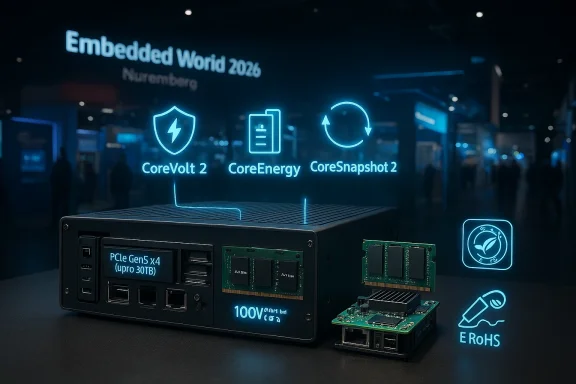
 

Embedded AI is pushing industrial storage and memory vendors into a new phase of the hardware race, and Apacer Technology Inc. is using embedded world 2026 to make a broad claim: the bottlenecks are no longer just compute, but also endurance, power stability, and system integration. In a March 3 announcement from Eindhoven, the company said it will showcase PCIe Gen5 enterprise SSDs, DDR5 6400 industrial memory, Raspberry Pi-ready storage, and its latest resilience features at Hall 1, booth 310 in Nuremberg. The message is clear: as edge AI workloads become more intense and more continuous, storage is being repositioned from a passive component into an active enabler of uptime, efficiency, and data integrity.

A digital visualization related to the article topic.Background​

Apacer’s embedded world message lands in a market that has been steadily shifting from general-purpose industrial storage toward application-specific design. The company has long sold SSDs and DRAM into industrial and embedded segments, but the 2026 pitch reflects a broader industry trend: AI inference at the edge is creating workloads that look more like miniature data-center jobs than traditional embedded control tasks. That means higher write volumes, more concurrent reads, greater thermal stress, and much tighter uptime expectations.
The timing also matters. embedded world 2026 runs in early March, and the exhibition has become one of the most visible stages for industrial hardware vendors to show how they are adapting to edge AI, machine vision, robotics, and real-time analytics. The event’s own materials underscore the market’s momentum, noting unusually strong participation and a surge of innovation across the embedded ecosystem.
Apacer is not entering this conversation from zero. The company already highlighted DDR5 6400 industrial modules, lead-free manufacturing, and CoreSnapshot recovery technology in its 2025 embedded world materials, and it publicly expanded those ideas later in 2025 with sustainability-oriented messaging around fully lead-free products and CoreEnergy power regulation. The 2026 announcement therefore looks less like a reinvention and more like a product-line maturation: a tighter, more explicit link between edge AI, power protection, and enterprise-class storage behavior.
For Windows-centric users, there is also a subtle but important compatibility angle. Apacer says its enterprise SSD series has passed multiple server test patterns and is compliant with Windows 11, Windows Server, and the latest Linux kernels. That matters because industrial and edge deployments increasingly mix operating systems, virtualization layers, and containerized services, and hardware vendors cannot assume a single software stack anymore. Compatibility is no longer a footnote; it is part of the value proposition.

Why this announcement matters now​

The industry is moving toward systems that must be both high-speed and fault tolerant. The market’s center of gravity is shifting from raw throughput alone to throughput plus operational resilience. Apacer’s framing follows that shift closely.
  • Edge AI requires low latency and stable write behavior.
  • Industrial deployments care about voltage stability and fault recovery.
  • Data-center-derived SSD features are moving into embedded environments.
  • Memory vendors are being asked to solve both performance and reliability problems.

Enterprise SSDs for Edge AI​

The headline product in Apacer’s announcement is the Enterprise SSD series, which the company says is aimed at edge and cloud servers as well as mid-sized data centers. The most eye-catching spec is capacity: up to 30 TB using PCIe Gen5 x4 flash technology. On paper, that places the series in the tier where dense storage is no longer merely supporting AI workloads, but enabling larger local datasets, more frequent model refreshes, and higher on-device retention.
The claim that the series passed multiple server test patterns is significant because industrial buyers rarely rely on benchmark slides alone. Server validation implies a focus on interoperability, thermal behavior, and consistency under sustained load. For buyers deploying to edge nodes, inference gateways, or compact server appliances, those characteristics often matter more than peak read/write numbers.

Server validation and real-world deployment​

The phrase “passed multiple server test patterns” signals an attempt to reassure integrators that the drives are not just fast, but deployable. In the industrial world, certification and validation reduce hidden integration costs, which can be higher than the SSD bill of materials itself.
The mention of Windows 11 and Windows Server compatibility is also a competitive signal. It suggests Apacer sees demand beyond pure Linux or appliance-style deployments, reaching into environments where IT departments still manage imaging, patching, and fleet consistency through Microsoft tooling. That broadens the addressable market, especially for hybrid edge scenarios.
Apacer’s server SSD pitch can be summarized as follows:
  • PCIe Gen5 x4 positions the drives for high-bandwidth workloads.
  • Up to 30 TB capacity targets dense storage use cases.
  • Server validation reduces deployment risk.
  • Windows and Linux compatibility widens adoption paths.
A storage vendor can no longer rely solely on interface speed. The industry now cares about how long the drive can sustain that speed, under what thermal envelope, and with what protection against unexpected power events. That is where Apacer’s broader portfolio comes in.

DDR5 6400 Memory for HPC and AI​

Apacer is also pushing its enhanced DDR5 6400 lineup, including CUDIMM, CSODIMM, and REG DIMM form factors. These modules use advanced clock drivers to improve timing and signal integrity, which is especially important at higher memory speeds where noise margins shrink and trace design becomes more demanding. For HPC and AI workloads, that stability is often the difference between scaling cleanly and spending months chasing intermittent faults.
The company also says built-in Transient Voltage Suppressors (TVS) provide protection against voltage surges and electrostatic discharge. That may sound like a small detail, but in industrial settings it is a large one. AI-enabled edge devices are increasingly installed in factories, transportation systems, and semi-controlled environments where electrical noise and power quality can vary substantially.

Why signal integrity is now a selling point​

As memory speeds rise, the memory subsystem becomes a system-design problem, not just a module-design problem. Clock drivers help maintain timing, while TVS protection helps shield the platform from the outside world. Together, those features make the module more suitable for deployments where uptime and predictable behavior matter more than the last few percentage points of raw bandwidth.
Apacer’s use of CUDIMM and CSODIMM also reflects where the market is heading. These newer module categories are part of the industry’s attempt to balance performance with manageability as AI and data-intensive workloads move closer to the edge. The company is not just selling DDR5; it is selling an answer to the practical headaches that come with DDR5 scaling.
The key technical implications are:
  • Higher DDR5 speeds demand stronger clock management.
  • Edge AI systems need more robust ESD and surge protection.
  • HPC buyers increasingly want industrial-grade component reliability.
  • Memory validation is becoming as important as memory frequency.

Industrial deployment implications​

There is a clear segmentation strategy here. Enterprise customers may buy the SSDs for high-density infrastructure, while industrial OEMs and system integrators may gravitate toward the DDR5 modules for ruggedized AI appliances or control platforms. In that sense, Apacer is building a portfolio that spans the stack.
That stack matters because AI edge systems are only as reliable as their weakest component. If storage survives but memory fails under electrical stress, the platform still goes down. Apacer’s memory narrative is therefore about system-level resilience, not just module specs.
  • CUDIMM and CSODIMM address modern performance needs.
  • REG DIMM targets server-style workloads.
  • TVS protection helps in harsh electrical environments.
  • Clock drivers support stable high-speed signaling.

Raspberry Pi and Maker-Grade Storage​

Apacer’s announcement also includes a more accessible angle: compatible storage solutions for Raspberry Pi projects, including microSD cards from 64 GB and a Pi HAT SSD. On the surface, this looks like a smaller story than enterprise SSDs or industrial DDR5, but strategically it is important. The Raspberry Pi ecosystem has become a bridge between hobbyist experimentation and low-cost industrial prototyping, especially in embedded AI education, proof-of-concept systems, and lightweight edge deployments.
The company says these products are QVL-certified for Raspberry Pi 3, 4, and 5. That certification matters because compatibility is frequently the first pain point for makers and integrators moving beyond enthusiast use. A QVL-listed device reduces the guesswork around bootability, stability, and long-run reliability.

The Pi HAT SSD angle​

The new Apacer Pi HAT SSD is especially notable because it replaces the original Pi-HAT adapter and is intended to save users from buying extra storage hardware. That kind of integration may seem incremental, but it speaks to a larger product philosophy: simplify the storage stack so projects can move from prototype to deployment with fewer accessories and less friction.
The company also says the Pi HAT SSD can benefit from patented technologies such as CoreSnapshot 2. That is a telling move, because it brings an enterprise-style recovery concept into a maker-friendly platform. If that works well in practice, it could make Apacer’s brand more visible among developers who later influence procurement decisions in small businesses or industrial labs.

From hobby boards to edge prototypes​

There is commercial logic in targeting Raspberry Pi users. Many industrial design cycles begin with inexpensive boards before maturing into custom hardware. If Apacer’s storage is used early in that process, the company may become the default choice when a prototype turns into a product.
The most important takeaway is that Apacer is trying to own the journey from hobbyist experimentation to industrial deployment. That is a smart channel strategy, because it creates familiarity before the procurement stage.
  • QVL certification reduces compatibility uncertainty.
  • 64 GB microSD options support entry-level projects.
  • Pi HAT SSD simplifies external storage integration.
  • CoreSnapshot 2 adds a recovery narrative to maker gear.

Lead-Free Manufacturing and Compliance​

One of the more consequential parts of the announcement is Apacer’s claim that all of its industrial DRAMs, along with the PV250-M280 SSD, are fully lead-free and compliant with the EU RoHS Directive. The company says this is achieved through a lead-free resistor design, low-temperature solder paste, and underfill technology in the SMT process. In a world increasingly focused on supply-chain responsibility and environmental compliance, that is more than a checkbox feature.
Lead-free manufacturing has moved from being a regulatory exercise to a strategic differentiator. Industrial buyers, especially those shipping into Europe, often need reassurance that components not only perform well but also align with sustainability and compliance requirements. For some programs, that can affect product approval timelines and documentation overhead.

Compliance as an engineering choice​

Apacer’s pitch here is that compliance is not just a paperwork issue; it is built into the manufacturing process. By calling out the resistor design and SMT process choices, the company is signaling that sustainability can coexist with durability and performance rather than undermine them.
That positioning also mirrors the broader embedded market, where long product lifecycles and environmental policies increasingly overlap. Industrial customers often keep platforms in service for years, so material choices made today can have downstream consequences for maintenance, repairability, and certification.
The practical implications include:
  • Easier alignment with EU RoHS requirements.
  • Lower friction for European deployments.
  • Improved ESG messaging for industrial buyers.
  • Greater consistency in long-life product programs.

Sustainability and procurement​

This kind of announcement matters because procurement teams now weigh sustainability alongside technical performance. A technically superior module that creates regulatory friction may lose to a slightly less flashy product that is easier to approve and ship.
Apacer is clearly trying to ensure that its industrial portfolio appeals to both engineering and purchasing stakeholders. That dual appeal is especially valuable in sectors where hardware decisions are cross-functional and slow-moving.
  • RoHS compliance can simplify market access.
  • Lead-free design supports sustainability goals.
  • Underfill technology helps preserve reliability.
  • Manufacturing discipline becomes part of the brand story.

CoreVolt 2 and Power Stability​

The announcement’s resilience features are among the most important for real-world industrial adoption. CoreVolt 2 is described as a technology that detects and stabilizes SSD voltage in real time, and when fluctuations occur it automatically activates backup power using tantalum polymer capacitors. That is the kind of feature that only becomes truly valuable when things go wrong, which is exactly why industrial buyers care about it.
Power disturbances are a constant risk in embedded environments. Brownouts, unstable rails, and transient events can corrupt data or damage devices, especially in systems expected to operate continuously. Apacer’s approach is to turn storage into an active participant in power protection rather than a passive consumer of electricity.

Why backup power matters​

The backup-power narrative is not new, but it remains one of the most practical ways to improve data integrity. In edge AI systems, a sudden power drop can interrupt logging, lose inference results, or corrupt file systems. If the SSD can bridge that gap, even briefly, the operational value is substantial.
That is especially relevant in unattended deployments such as kiosks, industrial gateways, and remote monitoring systems. These systems are often judged not by average performance but by how well they survive imperfect conditions.
CoreVolt 2’s significance can be broken down into:
  • Detect voltage instability quickly.
  • Stabilize SSD behavior during fluctuations.
  • Use capacitors to bridge brief interruptions.
  • Reduce the chance of corruption or downtime.

Industrial value beyond specs​

The feature also strengthens Apacer’s differentiation against commodity storage vendors. Many drives can advertise speed; fewer can credibly speak to resilience under stress. In industrial markets, that distinction often justifies the premium.
This is the kind of feature set that appeals to systems engineers, not just buyers. It suggests Apacer understands that edge AI deployment is as much about failure modes as it is about throughput.
  • Voltage detection is about prevention.
  • Capacitor-based backup is about continuity.
  • Storage stability protects higher-level applications.
  • Unattended systems benefit disproportionately.

CoreEnergy and Thermal Efficiency​

Apacer is also promoting CoreEnergy, a hardware-software co-design for SSD power management that offers preset energy modes. The company says the goal is to help users choose the right balance of performance and energy efficiency for specific applications, reducing power consumption and avoiding overheating. That is a timely message because edge AI and compact server platforms are often constrained by thermals long before they run out of compute.
Modern industrial hardware increasingly needs to be smart about power, not simply powerful. As more workloads move into fanless boxes, remote enclosures, and tightly packed systems, thermal management becomes a design constraint that can shape product architecture as much as CPU choice or storage capacity.

Power modes as a system tool​

Preset energy modes are valuable because they reduce the need for one-off tuning. In many deployments, IT teams want predictable behavior across fleets, not artisanal optimization for every device. A small menu of power profiles can make it much easier to standardize across environments while still preserving performance where needed.
This matters in edge AI because workloads are often bursty. A camera-processing device may be idle for long periods and then suddenly need a burst of storage activity. If the SSD can adapt its power behavior intelligently, the whole system becomes easier to cool and cheaper to run.
CoreEnergy’s likely value proposition includes:
  • Lower overall power draw.
  • Reduced thermal load in compact systems.
  • Better fit for fanless deployments.
  • Easier application-specific tuning.

Sustainability meets uptime​

There is a broader strategic point here: energy efficiency is no longer only about cost savings. It is also about reliability and lifespan. Lower heat generally means lower stress, and lower stress generally means fewer failures over time.
Apacer is smart to connect CoreEnergy with broader sustainability themes, because the industrial market is increasingly looking for solutions that support both operational and ESG goals. That dual framing is very marketable, especially among companies trying to modernize legacy systems without exploding their power budget.
  • Energy modes reduce unnecessary consumption.
  • Thermal management protects long-term reliability.
  • Hardware-software co-design supports fine-grained control.
  • Efficiency gains help edge AI deployments scale.

Competitive Positioning in Embedded AI​

Apacer is not the only storage vendor leaning into embedded AI, and the 2026 embedded world floor is crowded with companies making similar claims about DDR5, PCIe Gen5, and industrial robustness. What makes Apacer’s approach notable is the breadth of the story: enterprise SSDs, industrial DRAM, maker-friendly storage, lead-free manufacturing, and multiple proprietary resilience technologies all wrapped into one exhibit narrative.
That breadth can be an advantage if it helps Apacer stay relevant across multiple customer types. It can also be a challenge, because broad product messaging can become indistinct if competitors offer similar specs with stronger brand recognition or deeper channel penetration.

How Apacer differentiates​

Apacer’s real differentiator may be the integration of its value-added technologies with ordinary-sounding hardware categories. A Gen5 SSD is not especially unusual in 2026; what matters is whether the vendor can explain why its drive is better for unstable power, lower heat, and long uptime. The same goes for DDR5 modules, where frequency numbers alone no longer move the market.
The company’s 2026 pitch also benefits from continuity. Its 2025 embedded world presence already emphasized industrial SSDs, DDR5 6400, CorePower, CoreSnapshot, and CoreRescue. The 2026 update extends those ideas into a more explicit embedded AI context, which makes the brand seem consistent rather than opportunistic.

Competitive pressure points​

Rivals such as ADATA Industrial and Cervoz are also highlighting DDR5 6400, PCIe Gen5, and AI-focused storage at embedded world 2026, which suggests the market is converging on a similar feature set. That creates a classic competitive problem: when everyone offers speed, the vendors that win are the ones that solve integration pain and reliability concerns more convincingly.
The most important differentiators now are likely to be:
  • Power stability features.
  • Thermal efficiency under load.
  • Validation and compatibility breadth.
  • Product lifecycle support.
  • Real deployment proof, not just specs.

Market implications​

For enterprise buyers, this means storage vendors are becoming infrastructure partners rather than commodity suppliers. For consumer-adjacent ecosystems like Raspberry Pi, it means the line between hobby gear and industrial prep is thinning. That is a market transition worth watching closely, because it could reshape how early-stage AI hardware projects are built and later purchased.
  • Specs are necessary but insufficient.
  • Reliability features are becoming table stakes.
  • Integration stories matter more each year.
  • Embedded AI is accelerating feature convergence.

Strengths and Opportunities​

Apacer’s 2026 embedded world position has several clear strengths, especially for buyers who care about sustained performance and deployment stability. It combines high-end server storage with industrial memory and smaller-scale ecosystem products, which gives the company a wider sales funnel than a single-product vendor would have.
  • Broad portfolio coverage across SSD, DRAM, and Raspberry Pi accessories.
  • PCIe Gen5 and DDR5 6400 specs that match current performance expectations.
  • CoreVolt 2 and CoreEnergy that speak directly to reliability and efficiency.
  • Lead-free compliance that helps with European procurement and ESG programs.
  • Windows Server and Linux compatibility that widens enterprise appeal.
  • QVL-certified Raspberry Pi support that can seed developer loyalty early.
  • Multiple resilience features that differentiate the brand from pure commodity sellers.
The opportunity is not only to sell hardware, but to become part of the architecture conversation. If Apacer can prove these features in the field, it can build trust with OEMs, integrators, and industrial design teams that need more than benchmark numbers.

Risks and Concerns​

The flip side is that the storage market is moving quickly, and a crowded spec race can blur vendor differentiation. If many exhibitors can claim Gen5, DDR5 6400, and edge AI readiness, buyers may struggle to see why one brand deserves a premium unless the field evidence is strong.
  • Feature convergence could make the announcement feel less unique over time.
  • Thermal claims need real-world validation in harsh deployments.
  • Compatibility claims can be undermined by firmware or platform edge cases.
  • Lead-free manufacturing can introduce cost and process complexity.
  • Raspberry Pi messaging may not resonate with core enterprise buyers.
  • Proprietary technologies need proof, not just branding.
  • AI workload expectations may outpace product lifecycle planning.
There is also a subtle execution risk in spreading the message across too many segments. Enterprise datacenter buyers, industrial automation teams, and maker communities all care about different things, and one marketing story may not fit all three equally well. The company will need strong technical documentation and field examples to make the case stick.

Looking Ahead​

The next test for Apacer is whether the embedded world 2026 showcase translates into design wins, not just booth traffic. The announcement is well aligned with current market realities, but the industrial storage sector is unforgiving: customers tend to stay loyal only when products prove stable over time, across power conditions, temperature ranges, and software stacks.
The broader industry context suggests that edge AI hardware is entering a phase where resilience, efficiency, and compatibility are as important as raw speed. That favors vendors who can explain not just what they sell, but how their products behave when deployed into constrained, messy, and long-lived environments. Apacer is clearly aiming to be in that camp.
  • Field validation of CoreVolt 2 and CoreEnergy will matter.
  • Enterprise SSD adoption will depend on real server deployment results.
  • Industrial memory uptake will hinge on signal integrity and durability.
  • Raspberry Pi support could become a useful developer funnel.
  • Sustainability messaging may become a stronger differentiator in Europe.
  • Competition at embedded world will intensify around the same core specs.
If Apacer can convert this announcement into visible customer wins, it may strengthen its position as a storage vendor that understands embedded AI as a systems problem, not just a performance race. That is the right strategic framing for 2026, and arguably for the next several product cycles beyond it.

Source: AD HOC NEWS Apacer Technology Inc. Netherlands
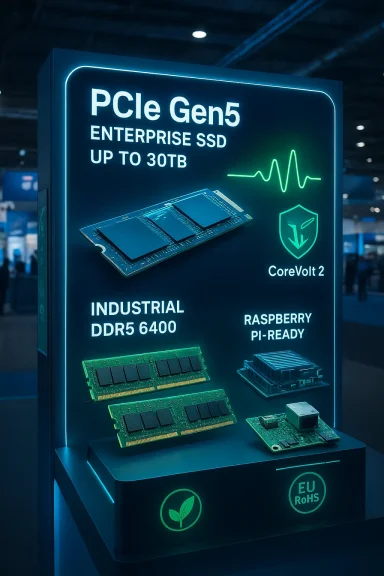
 

Back
Top