

Apacer’s presence at Embedded World 2026 is a clear bet on the idea that the next wave of embedded intelligence will be decided as much by storage as by processors: the company will show PCIe Gen5‑class enterprise SSDs, industrial DDR5‑6400 memory, and a purpose‑built Pi HAT SSD for Raspberry Pi platforms, alongside software and power‑management features aimed at keeping edge AI systems predictable and recoverable. The announcements — presented in Apacer’s March 3, 2026 release and reinforced on the company’s embedded‑world exhibitor page — frame storage as a first‑class system design decision for embedded and edge AI, not an afterthought.
Embedded AI is changing the technical constraints and procurement priorities for industrial designers. Where previous generations of embedded systems prioritized cost, ruggedness and I/O pinouts, the new workloads — local inferencing, continuous sensor fusion, on‑device analytics — demand sustained throughput, low latency, predictable bandwidth and robust data protection in environments that still have tight power and thermal budgets.
Exhibitor programming at Embedded World 2026 explicitly mirrors that shift: Apacer’s talk, titled “Storage, empowering embedded AI growth”, is scheduled for March 10, 2026 and the company lists a lineup that targets both the server edge and low‑power Raspberry Pi class devices. The event calendar and Apacer’s own show page place this as a deliberate strategic pivot to position storage as an enabling layer for edge AI systems.
Internally, thembedded‑Windows and maker communities has already started to treat specialized storage modules (and their firmware/tooling) as part of the reference architecture for on‑device AI — a point reflected in recent community briefings and thread summaries captured from user‑generated content.
Independent confirmation of Apacer’s Gen5 product family is visible across Apacer’s product pages: the company already lists several Gen5 M.2 products (client/professional-oriented drives such as AS2280F4 and PB5480) with very high sequential throughput numbers and more conservative capacity points (these consumer/professional outlines show 1–4 TB ranges on public spec pages today). That mismatch between the press claim of “up to 30 TB” and publicly documented M.2 capacities suggests the enterprise series referenced in the PR may be a distinct product family (E1.S / E3.L or other custom enterprise form factors) whose spec sheets were not posted on the public product catalog at the time of the announcement. Engineers should therefore treat the 30 TB figure as a company press claim that requires verification from product datasheets and sample evaluation before assuming it in procurement planning.
Key technical themes Apacer is promoting for its Gen5 family:
For embedded AI platforms, higher DDR throughput reduces model offloads to slower storage and narrows the memory‑bandwidth bottleneck that ricochets through latency‑sensitive inference pipelines. Apacer’s commercial emphasis on DDR5‑6400 is therefore meaningful: it maps to a tangible, measurable metric (bandwidth) that designers can tune against model requirements.
That said, engineering rigor is essential. Gen5 puts new demands on thermal and power architecture; high capacities and integrated HAT form factors change serviceability; and marketing claims about enterprise class sizes need datasheet‑level proof. Treat Apacer’s announcements as a strong invitation to test and qualify, not as a turnkey guarantee.
If you’re an OEM or systems integrator planning for on‑device AI, Apacer’s portfolio is worth adding to your evaluation queue — but make sure your qualification plan covers thermal soak, brown‑out behavior, endurance under your specific write patterns and secure key lifecycle management. Ask for sample hardware, full firmware change logs and representative test reports early in negotiations. With those guardrails, the features Apacer is demonstrating at Embedded World 2026 can materially reduce operational risk and simplify field service for embedded AI deployments.
Source: The Malaysian Reserve https://themalaysianreserve.com/202...d-2026-storage-solutions-for-embedded-ai/amp/
 Background
Embedded AI is changing the technical constraints and procurement priorities for industrial designers. Where previous generations of embedded systems prioritized cost, ruggedness and I/O pinouts, the new workloads — local inferencing, continuous sensor fusion, on‑device analytics — demand sustained throughput, low latency, predictable bandwidth and robust data protection in environments that still have tight power and thermal budgets.Exhibitor programming at Embedded World 2026 explicitly mirrors that shift: Apacer’s talk, titled “Storage, empowering embedded AI growth”, is scheduled for March 10, 2026 and the company lists a lineup that targets both the server edge and low‑power Raspberry Pi class devices. The event calendar and Apacer’s own show page place this as a deliberate strategic pivot to position storage as an enabling layer for edge AI systems.
Internally, thembedded‑Windows and maker communities has already started to treat specialized storage modules (and their firmware/tooling) as part of the reference architecture for on‑device AI — a point reflected in recent community briefings and thread summaries captured from user‑generated content.
What Apacer is showing at Embedded World 2026
Enterprise PCIe Gen5 SSDs for edge servers
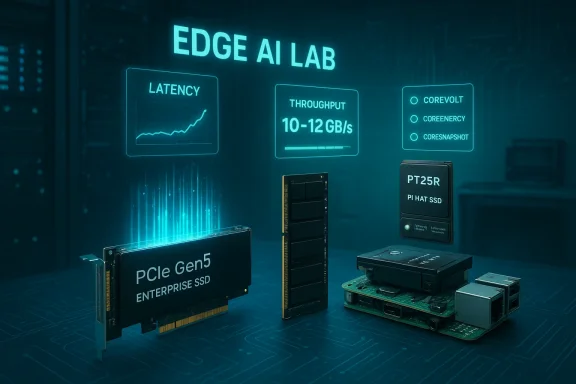
Apacer’s PR material highlights an Enterprise SSD series with PCIe Gen5 x4 connectivity, claiming full compliance with Windows 11, Windows Server and modern Linux kernels and capacities “up to 30 TB” for the enterprise-class line. The company positions these drives for edge and mid‑sized data‑center servers that run inference or heavy caching duties near the data source.Independent confirmation of Apacer’s Gen5 product family is visible across Apacer’s product pages: the company already lists several Gen5 M.2 products (client/professional-oriented drives such as AS2280F4 and PB5480) with very high sequential throughput numbers and more conservative capacity points (these consumer/professional outlines show 1–4 TB ranges on public spec pages today). That mismatch between the press claim of “up to 30 TB” and publicly documented M.2 capacities suggests the enterprise series referenced in the PR may be a distinct product family (E1.S / E3.L or other custom enterprise form factors) whose spec sheets were not posted on the public product catalog at the time of the announcement. Engineers should therefore treat the 30 TB figure as a company press claim that requires verification from product datasheets and sample evaluation before assuming it in procurement planning.
Key technical themes Apacer is promoting for its Gen5 family:
- High sustained sequential bandwidth to support model weights, cache warms and streaming inference.
- System compatibility with mainstream OS kernels and server platforms.
- Power‑interrupt protection and on‑module resiliency features tailored for 24/7 edge operation.
Industrial DDR5‑6400 memory
Apacer announced mass production of industrial DDR5‑6400 CUDIMM and CSODIMM modules with a fully lead‑free resistor design, enhanced clock drivers and embedded transient voltage suppressors (TVS) for surge/ESD robustness. The product messaging frames these modules as optimized for high‑performance computing and AI workloads in industrial environments where signal integrity and long‑term reliability are essential. The company explicitly calls out RoHS compliance and a sustainability angle tied to lead‑free componentization.For embedded AI platforms, higher DDR throughput reduces model offloads to slower storage and narrows the memory‑bandwidth bottleneck that ricochets through latency‑sensitive inference pipelines. Apacer’s commercial emphasis on DDR5‑6400 is therefore meaningful: it maps to a tangible, measurable metric (bandwidth) that designers can tune against model requirements.
PT25R Pi HAT SSD: storage specialized for Raspberry Pi form factors
Arguably the most immediately practical product for makers and integrators is Apacer’s PT25R‑Pi HAT SSD (the Pi HAT SSD). Built as a hardware HAT for Raspberry Pi platforms, the PT25R integrates a BGA SSD directly on a HAT that plugs into the Pi’s GPIO/FFC interface. Apacer’s product page and multiple independent reviews list features such as:- On‑HAT SSDs in capacities from ~60 GB up to 480 GB (BGA NAND).
- PCIe‑based low‑latency connectivity (PCIe Gen2 x1 or similar connector‑limited modes).
- Hardware features like CoreSnapshot 2 support, on‑HAT power‑loss protection capacitors, AES encryption and write‑protect / instant key‑change mechanisms.
Value‑added firmware and power features: CoreVolt 2, CoreEnergy and CoreSnapshot 2
Apacer is bundling system‑level features into its storage messaging:- CoreVolt 2: real‑time voltage detection and stabilization with onboard backup capacitor activation to protect writes during power anomalies.
- CoreEnergy: a hardware‑software power‑management suite with preset energy profiles to trade off performance for efficiency.
- CoreSnapshot 2: an instant backup/recovery capability for storage modules that claims to enable repeated, non‑disruptive backups and rapid system restoration.
Verifying the technical claims — what checks we can make now
Apacer’s messaging is consistent across company press material and product pages, but engineers and architects should validate the most consequential claims before deployment.- PCIe Gen5 throughput and form factor: Apacer’s public product pages list multiple Gen5 M.2 devices with clear throughput numbers (e.g., read/write bandwidths in the 10–12 GB/s range for some models). Those pages are reliable for client/pro‑level drives. The PR’s “up to 30 TB” capacity figure appears to reference a different enterprise class not fully documented on the public product catalog, so procurement teams must request formal datasheets and endurance/thermal curves for any enterprise drive claiming unusually high capacity.
- DDR5‑6400 industrial modules: Apacer’s December 2024 mass‑production announcement includes specific technical points — TVS devices, lead‑free resistor design and CKD timing components — that are verifiable on the company’s press pages. Those claims map directly to improved signal integrity and RoHS compliance and are corroborated by Apacer’s news pages.
- PT25R‑Pi HAT SSD features: Apacer’s own product detail page for the PT25R lists supported features (CoreSnapshot 2, AES encryption, thermal sensing, power‑loss protection) and CNX Software’s hands‑on reporting reproduces early spec lists (capacities, interfaces and optional CoreSnapshot support). Those two sources together make the HAT’s capabilities reasonably trustworthy for evaluation. However, the HAT’s sustained throughput in real Raspberry Pi workloads (RPi5 I/O characteristics under Linux, CPU/PCIe link sharing, and thermal behavior when enclosed) should be validated by testing in the target enclosure and workload.
- Power and thermal management claims (CoreVolt 2 / CoreEnergy): Apacer’s press materials describe the capabilities, but the effectiveness of these schemes is always implementation‑dependent. Ask for application notes or test reports demonstrating how CoreVolt 2 behaves under typical edge‑power rail conditions, and insist on firmware changelogs and PRT (power‑recovery test) results as part of any qualification.
Strengths: why this matters to embedded AI designers
- Systemic thinking about storage: Apacer is pushing the narrative that storage firmware, power protection and data‑resilience tools belong in the architecture conversation for edge AI. That reorientation is useful: optimizing only compute without matching storage and memory will leave predictable performance bottlenecks.
- Product breadth across scales: The company spans Raspberry Pi‑class HATs, rugged industrial M.2/2280 devices and enterprise SSD messaging. That breadth reduces vendor coordination overhead for OEMs who want a single supplier for both large‑scale edge servers and distributed micro‑gateways.
- Operational resiliency features: CoreVolt/CoreSnapshot style capabilities address the top operational causes of field failure — unexpected power rails and long restore times. For brown‑field retrofits and retail/IoT fleets where field visits are costly, these features can translate to lower MTTR and reduced logistics expense.
- Compliance and sustainability focus: Lead‑free DDR5 and explicit RoHS claims help make hardware selection less risky for long‑lifecycle industrial applications that must align with European and global environmental standards.
Risks, caveats and things to watch
- Thermals and sustained Gen5 performance in constrained enclosures: PCIe Gen5 SSDs generate considerably more heat than Gen4 parts at sustained throughput. In many embedded enclosures and slim industrial panels, maintaining Gen5 speeds without thermal throttling will require active cooling or custom heat spreaders. Product throughput numbers are typically achieved on test rigs with optimized cooling; field throughput may be lower. Demand explicit thermal throttling curves and test rigs that mimic your enclosure.
- Power delivery constraints in edge systems: Many embedded boards do not provide the 12 V / 3–5 A rails or hold‑up capacitors expected by enterprise SSDs. The CoreVolt backup concept helps, but don’t rely on it as a substitute for proper power architecture. Validate the drive under expected undervoltage and brown‑out scenarios.
- Compatibility and QVL limitations: Apacer advertises QVL certification for Raspberry Pi 3/4/5 on some microSD and Pi HAT lines. QVLs are helpful but do not guarantee performance equivalence under all firmware and kernel versions. Test with the exact kernel/configuration/bootloader you plan to ship.
- Endurance and real‑world write patterns: Enterprise capacities (if true) and client‑class BGA NAND have different endurance profiles. For AI inference caches or streaming log writes, confirm DWPD / TBW and request workload‑specific endurance modeling from the vendor. When a PR claims a very large capacity, insist on measured endurance and performance consistency metrics under your workload.
- Marketing vs. datasheet reality: The “up to 30 TB” enterprise claim from the PR is plausible given industry trends, but at the time of writing public product pages showed Gen5 M.2 devices with more modest capacity ranges. Verify whether the 30 TB claim maps to a specific, shippable product and ask for the enterprise form‑factor, endurance numbers, and thermal envelopes in writing.
Practical evaluation checklist for engineers (step‑by‑step)
- Request the official datasheet and FW changelog for the exact part number you intend to test; don’t accept general family literature.
- Obtain samples and perform a thermal characterization test inside your enclosure at your workload profile (sustained read/write, mixed IO, and idle).
- Run endurance and power‑loss tests (Power Recovery Test, abrupt rail removal) to validate CoreVolt/CoreSnapshot behavior claimed by marketing.
- Verify OS and kernel compatibility with your exact images; check NVMe driver behavior, multipath if used, and S.M.A.R.T. support across firmware revisions.
- Measure real‑world latency and bandwidth under concurrent CPU and peripheral loads — Pi HATs, in particular, share system buses and can be affected by GPU, USB and camera interfaces.
- Validate security features: AES key generation, instant key change, secure erase and integration with your device management/TPM approach.
- Ask for long‑term supply and lifecycle commitments for the product family if you plan to ship at scale.
- Assess RMA and field‑service procedures; integrated HATs change repair and replacement workflows relative to removable M.2 modules.
Market context: why competitors and capacity announcements matter
Apacer’s timing aligns with a broader industry move to Gen5 and ultra‑high capacity SSDs. Vendors across the stack — from Phison and Kioxia to the major NAND foundries — have announced Gen5 drives and enterprise capacities that push past historical limits, a trend driven by AI model sizes and the need for local model caches at the edge. That makes Apacer’s announcements strategically sensible: if your edge system needs both high bandwidth and local capacity for models and datasets, Gen5 storage is worth evaluating. But at the same time, vendors are differentiating on control‑plane features, firmware, and thermal optimization — not just raw capacity. Compare Apacer’s feature set to the ecosystem of Gen5 announcements and you see similar themes (high bandwidth, power tech and large capacities), which reinforces Apacer’s positioning but also increases the need to validate vendor claims in situ.Sustainability and regulatory posture
Apacer emphasizes lead‑free designs and RoHS alignment for its DDR5 modules and some SSD families, which is material for industrial buyers who need regulatory traceability. The company’s mass‑production announcement for DDR5‑6400 called out fully lead‑free resistor designs and related process changes to avoid exemptions under EU RoHS — a non‑trivial manufacturing shift that reduces the compliance burden for EU and global OEMs. Confirm the supplier’s declarations of conformity and request material composition reports as part of procurement.Recommendation: when to consider Apacer for an embedded AI project
- Consider Apacer when you have mid‑range to high I/O needs at the edge (sustained model loads, local dataset caching) and you prefer a single vendor to supply both rugged SSDs and industrial memory modules.
- Use the PT25R Pi HAT SSD for rapid prototyping and small‑volume Pi‑based gateways where simplified mechanical integration and CoreSnapshot backup tooling reduce service visits.
- For mission‑critical gateways that need 24/7 uptime and predictable restore behavior, insist on CoreVolt/CoreSnapshot validation in your test matrix before production sign‑off.
- If your project requires the very largest enterprise capacities a vendor claims (tens of terabytes in a single module), treat PR statements as promotional until you have datasheets, sample units and independent performance/endurance testing in your environment.
Final analysis and outlook
Apacer’s Embedded World 2026 program and product messaging bring storage into the foreground of embedded AI system design in a way that is overdue. The combination of Gen5 bandwidth, DDR5 memory bandwidth, embedded HAT‑level storage for Raspberry Pi platforms and operationally focused features (power stabilization, snapshot‑style recovery) is a practical toolkit for the kinds of distributed, latency‑sensitive AI systems proliferating in retail, manufacturing and distributed sensing.That said, engineering rigor is essential. Gen5 puts new demands on thermal and power architecture; high capacities and integrated HAT form factors change serviceability; and marketing claims about enterprise class sizes need datasheet‑level proof. Treat Apacer’s announcements as a strong invitation to test and qualify, not as a turnkey guarantee.
If you’re an OEM or systems integrator planning for on‑device AI, Apacer’s portfolio is worth adding to your evaluation queue — but make sure your qualification plan covers thermal soak, brown‑out behavior, endurance under your specific write patterns and secure key lifecycle management. Ask for sample hardware, full firmware change logs and representative test reports early in negotiations. With those guardrails, the features Apacer is demonstrating at Embedded World 2026 can materially reduce operational risk and simplify field service for embedded AI deployments.
Source: The Malaysian Reserve https://themalaysianreserve.com/202...d-2026-storage-solutions-for-embedded-ai/amp/
