

Apple quietly removed roughly two dozen products from its storefront and catalog over 2025, a summer‑to‑winter series of model retirements that included the symbolic end of the iPhone SE line and the phasing out of several MacBook Air M3 variants — a calculated rationalisation of Apple’s product stack that shifts the company entirely toward Face ID, OLED panels, USB‑C, and the newer A‑ and M‑series chips.
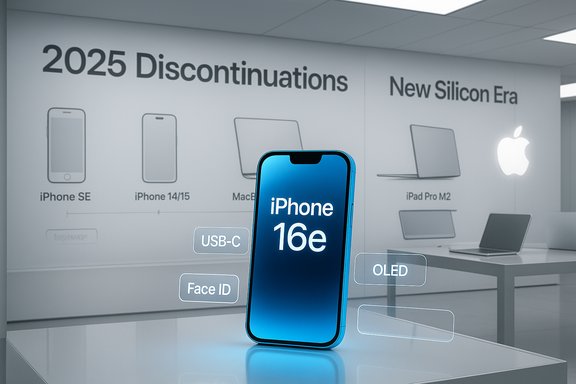
Apple’s 2025 retirements were not a single sweeping announcement but a sequence of normal product transitions amplified by a few notable breakpoints: the launch of the iPhone 16e (which replaced the long‑running iPhone SE), a broad Mac refresh that introduced M4/M5 silicon across several lines, and accessory rationalisation tied to the final industry‑wide USB‑C transition. These moves combined to remove nearly 25 SKUs — phones, tablets, watches, Macs, and accessories — from Apple’s actively sold lineup. That trimming followed Apple’s familiar cadence: older models step aside when successors arrive with updated chips or new feature sets. But 2025’s exits are notable because some retired products represented endings of design eras — the last iPhones with Home buttons and Lightning ports, and the last compact, low‑cost SE‑style hardware. Those symbolic retirements matter for product identity and for buyers who chose Apple specifically for those legacy features. A broader market context also matters: the global PC and device refresh cycle triggered by last year’s Windows 10 end‑of‑support nudged many consumers and enterprises to reassess endpoints, and Apple’s refreshed Mac strategy captured a meaningful portion of that replacement demand. The industry conversation around 2025 included higher Mac shipments and tighter focus from Apple on fewer, stronger SKUs — a trend that influenced product discontinuations.
Practical steps for users who own retiring devices:
From a practical standpoint, the retirements are manageable for most consumers and businesses if they follow standard lifecycle practices: audit, back up, trade in or migrate. Where caution is warranted is in the secondary market and repair planning: once Apple stops selling parts for older models, servicing costs and availability will shift.
Apple’s move is a strategic consolidation that maps neatly to the company’s engineering priorities for the next few years: fewer models, stronger silicon, and software experiences designed around a consistent hardware baseline. It will change purchase patterns, refocus accessory markets, and shrink the universe of Apple devices that represent the platform’s past. That matters — both for the industry and for the handful of users whose needs were uniquely met by those legacy models.
Apple’s 2025 product pruning is a clear signal about where the company is headed: a smaller, faster, and AI‑ready hardware baseline — but one that closes the door on several familiar, widely used design choices. Consumers and IT buyers should treat the retirements as a decision point: upgrade, refurbish, or adapt workflows to the new hardware baseline — and plan accordingly.
Source: ET Now Apple discontinues 25 devices in 2025: MacBook Air M3, iPhone SE in the list
 Background
Apple’s 2025 retirements were not a single sweeping announcement but a sequence of normal product transitions amplified by a few notable breakpoints: the launch of the iPhone 16e (which replaced the long‑running iPhone SE), a broad Mac refresh that introduced M4/M5 silicon across several lines, and accessory rationalisation tied to the final industry‑wide USB‑C transition. These moves combined to remove nearly 25 SKUs — phones, tablets, watches, Macs, and accessories — from Apple’s actively sold lineup. That trimming followed Apple’s familiar cadence: older models step aside when successors arrive with updated chips or new feature sets. But 2025’s exits are notable because some retired products represented endings of design eras — the last iPhones with Home buttons and Lightning ports, and the last compact, low‑cost SE‑style hardware. Those symbolic retirements matter for product identity and for buyers who chose Apple specifically for those legacy features. A broader market context also matters: the global PC and device refresh cycle triggered by last year’s Windows 10 end‑of‑support nudged many consumers and enterprises to reassess endpoints, and Apple’s refreshed Mac strategy captured a meaningful portion of that replacement demand. The industry conversation around 2025 included higher Mac shipments and tighter focus from Apple on fewer, stronger SKUs — a trend that influenced product discontinuations.What Apple discontinued in 2025 — quick, verified summary
Below is a consolidated, verified summary of the main retirements reported across the tech press in 2025. Where Apple explicitly announced a replacement (e.g., iPhone 16e replacing the SE), that relationship is noted.- iPhones (seven notable retirements reported): iPhone 16 Pro, iPhone 16 Pro Max, iPhone 15, iPhone 15 Plus, iPhone 14, iPhone 14 Plus, and the third‑generation iPhone SE (the SE was retired when Apple introduced the iPhone 16e).
- Macs: Mac Studio models with M2 Max/M2 Ultra were superseded by M4/M3 Ultra variations; Apple retired the 14‑inch MacBook Pro M4 and various MacBook Air M3 SKUs (13‑inch and 15‑inch M3 Airs and certain M2‑based 12‑inch Airs were pulled as M4‑equipped replacements arrived).
- iPads: iPad Pro (M4), iPad Air (M2), and the 10th‑generation iPad were phased out as Apple updated the iPad lineup with M5, M3 and A16 silicon, respectively.
- Apple Watch: Series 10 and Ultra 2, plus certain SE variants, were replaced by Series 11, Ultra 3 and SE 3 models (Apple trimmed the Watch range to consolidate its offers).
- Accessories and others: AirPods Pro 2 was succeeded by AirPods Pro 3; older chargers, Lightning‑era audio accessories, and legacy converters were removed as Apple finished the USB‑C transition.
Why Apple did it: strategy and engineering logic
1. Simplify the product roadmap and marketing
Apple’s product logic is increasingly about fewer SKUs that maximize margin and highlight flagship features. Consolidating overlapping models reduces channel confusion and helps focus marketing and inventory on the newest silicon and features — especially Apple Intelligence and the company’s NPU/ML story. The retirement of older models that duplicate modern features (but lack new chips or capabilities) makes that messaging clearer.2. Enforce the USB‑C and Face ID era
The retirement of the iPhone SE and Lightning‑dependent accessories signals an end to several legacy technical constraints: the last Home‑button phones, Touch ID‑only devices, LCD small‑screen phones, and Lightning‑based accessories are gone from Apple’s active catalog. That allows Apple to standardise on USB‑C, Face ID, and OLED panels — simplifying engineering and accessory certification.3. Make room for on‑device AI and newer SoCs
Apple’s hardware roadmap revolves around silicon that can support on‑device generative AI and Apple Intelligence features. That means a tilt toward chips (A18, M4/M5, and the like) that include more NPU horsepower and unified memory bandwidth — and the necessary software hooks. Retiring older silicon eases OS and feature support planning.4. Control inventory and channel economics
Retail and supply chain efficiency is another motive: trimming slow‑selling SKUs reduces inventory fragmentation. It also nudges trade‑in flows and resale dynamics in Apple’s favour — when older models leave the official store, trade‑in credits and refurbished channels become more attractive ways to move customers toward newer devices.What this means for consumers and businesses
For buyers: expectations and practical effects
- No more compact Touch ID iPhones from Apple. Small‑screen, Home‑button iPhones are effectively gone from Apple’s official lineup; the smallest current new iPhone size is 6.1 inches. This is a structural change for buyers who preferred compact hardware.
- USB‑C standardisation is now complete across Apple’s active catalog. Users will need USB‑C cables and adapters moving forward; Lightning accessories are no longer sold by Apple and will see dwindling vendor support.
- Trade‑in and resale windows are compressed. With Apple pulling certain models from sale, trade‑in programs and certified refurbished inventory will become the primary official channels for acquiring those devices — that can raise prices in the secondary market while also reducing availability.
For enterprises and IT teams
- Lifecycle and support planning must adapt. Retirements matter mostly for procurement and inventory refresh cycles: if your organisation uses iPhone SE–class devices or older iPad or Mac models, plan screen‑by‑screen replacements or extended support strategies with MDM vendors.
- Compatibility of line‑of‑business apps is usually stable, but check edge cases. macOS and iOS remain supported on a wide range of hardware for years, but companies should validate any bespoke peripherals, MDM integrations, or medical/industrial hardware tied to Lightning or older SDK features before purchasing refurbs or third‑party devices.
For repair and right‑to‑repair advocates
Apple’s move tightens the lifecycle of certain hardware types. When a manufacturer stops selling a product, support and parts availability often decline over time. Repair shops and consumers should expect a more limited pool of first‑party spare parts as Apple prioritises newer models in its parts and service ecosystem.The technical and commercial impacts: deeper analysis
Retiring the iPhone SE — why it matters beyond nostalgia
The iPhone SE was a low‑cost wedge device that kept alive several legacy features (Home button, Touch ID, compact size). Its removal signals three bigger shifts:- Design uniformity: Apple’s handset portfolio now presents a consistent UX anchored around Face ID and larger OLED displays. That simplifies iOS UI/UX design and accessory compatibility.
- Price floor movement: The replacement with the iPhone 16e shows Apple has raised its effective price floor; the new model starts at a higher price than the SE’s earlier low entry, altering affordability calculations in price‑sensitive markets.
- Accessibility choices shrink: Users who relied on a physical Home button for tactile accessibility now face fewer official hardware choices; third‑party options or older‑stock purchases are the remaining routes.
MacBook Air M3 models discontinued — what changed
Apple’s MacBook Air M3 machines were succeeded by M4 variants offering higher efficiency and new features. The business rationale is straightforward: upgrade the base silicon and compress overlapping SKUs to a smaller, more profitable product set. This reduces confusion in the retail channel and makes it easier for buyers to choose a single “current” MacBook Air family. Reuters’ coverage of Apple’s M4 MacBook launch confirms the timing and the market rationale.Accessories and the end of Lightning
Apple’s removal of Lightning‑era accessories (audio cables, older MagSafe adapters, etc. is not only symbolic; it is an ecosystem move. Accessory makers who still relied on Lightning must either adapt to USB‑C or exit categories. For consumers, this means planning cable replacements and checking car or home docks for compatibility before buying a new Apple device.Risks and consumer pain points
- Smaller‑phone users lose first‑party options. For people who need or prefer small phones, Apple’s lineup no longer has an official compact option — a legitimate consumer choice erosion.
- Affordability and the entry price shift. The entry price for a new Apple phone has moved upward compared to the SE era, which will push some budget buyers to Android alternatives or to the used market.
- Repairability and parts scarcity. As models are discontinued, third‑party and OEM spare parts become scarcer; warranty and AppleCare status still protect many buyers, but older devices will gradually incur higher third‑party repair premiums.
- Regional stock and channel differences. Discontinued on Apple’s storefront does not instantaneously vanish from every carrier or retailer. Regional inventory windows and authorised reseller stock can cause confusion about whether a model is still “supported” or purchasable. Treat “discontinued” as “no longer sold directly by Apple” rather than “unsupported immediately.”
How to interpret “discontinued” vs “vintage/obsolete” and what to do
Apple distinguishes between products it no longer sells and products classified under support programs (vintage/obsolete). Discontinuation simply means Apple has stopped selling that SKU; it does not instantly remove software updates or repair eligibility. Vintage and obsolete status are administratively distinct and affect serviceability and parts availability on a timeframe that can outlast retail availability.Practical steps for users who own retiring devices:
- Check Apple’s coverage and AppleCare status for your device immediately.
- Use Apple’s trade‑in program if you plan to upgrade; the timing often yields higher credit before devices become fully commoditised in the second‑hand market.
- For long‑term service needs, consider buying OEM spare parts or contract with reputable repair shops while parts remain plentiful.
- Back up devices and ensure critical data is migrated before the device is retired from Apple’s store channels.
Recommendations by audience
If you’re a consumer shopping for a phone or laptop
- If you want maximum longevity and resale value, buy current‑generation silicon (A18, M4/M5) from Apple or reputable resellers.
- If you prefer small phones or Touch ID, factor in the limited long‑term availability of those hardware designs and consider whether Android alternatives meet your requirements.
- For cable/accessory investments, move to USB‑C standards for new purchases.
If you manage IT or procurement
- Audit endpoints immediately: identify any devices that rely on now‑discontinued models or Lightning accessories.
- Test workflows on current Apple silicon before committing at scale; newer chips enable Apple Intelligence features that might justify migrations for knowledge workers.
- Plan for phased device refreshes and budget for MDM/EDR adjustments that support macOS/iOS on updated silicon.
If you repair or refurbish devices
- Lock in parts supply contracts while first‑party spares remain available.
- Educate customers about trade‑offs between buying new, refurbished, or keeping older devices in service with third‑party repairs.
Strengths of Apple’s approach — what the company gains
- Cleaner, more modern lineup: A smaller number of SKUs is easier to support, market and update.
- Easier engineering focus: Standardising USB‑C, Face ID and OLED panels reduces fragmentation for hardware and OS teams.
- Stronger product identity: The move accelerates Apple toward a unified ecosystem designed for on‑device AI and contiguous user experiences.
Weaknesses and strategic downside
- Reduced choice for niche users: Apple risks alienating compact‑phone adopters and buyers who valued Touch ID and lower price points.
- Price floor implications: Raising the effective entry price can push some buyers to competitors, particularly in cost‑sensitive markets.
- Regulatory and antitrust attention: Consolidating products and removing certain options may attract more scrutiny in markets sensitive to competition and consumer choice.
Final assessment — measured, not sensational
Apple’s 2025 discontinuations amount to a strategic tightening of the lineup around newer silicon, unified connector standards, and a stronger push for on‑device AI capability. For most mainstream buyers, these changes simplify choice and deliver modern features; for others — especially those who valued the SE’s form factor, Touch ID, or Lightning accessories — the change is a genuine loss of choice.From a practical standpoint, the retirements are manageable for most consumers and businesses if they follow standard lifecycle practices: audit, back up, trade in or migrate. Where caution is warranted is in the secondary market and repair planning: once Apple stops selling parts for older models, servicing costs and availability will shift.
Apple’s move is a strategic consolidation that maps neatly to the company’s engineering priorities for the next few years: fewer models, stronger silicon, and software experiences designed around a consistent hardware baseline. It will change purchase patterns, refocus accessory markets, and shrink the universe of Apple devices that represent the platform’s past. That matters — both for the industry and for the handful of users whose needs were uniquely met by those legacy models.
Quick checklist: what to do if you own one of the discontinued devices
- Confirm your device’s AppleCare/warranty status and consider extending coverage if available.
- Back up critical data and prepare migration plans to current models.
- If you plan to sell or trade in, do it sooner rather than later to maximise value.
- For mission‑critical hardware (enterprise), run compatibility tests for LOB apps on replacement devices before mass procurement.
- If repairs are essential, source parts and trusted repair partners now; parts availability will decline over time.
Apple’s 2025 product pruning is a clear signal about where the company is headed: a smaller, faster, and AI‑ready hardware baseline — but one that closes the door on several familiar, widely used design choices. Consumers and IT buyers should treat the retirements as a decision point: upgrade, refurbish, or adapt workflows to the new hardware baseline — and plan accordingly.
Source: ET Now Apple discontinues 25 devices in 2025: MacBook Air M3, iPhone SE in the list
