

Apple’s move to a 2‑nanometer A20 chipset for the iPhone 18 is shaping up to be both a technological leap and a commercial puzzle: the shift to TSMC’s Gate‑All‑Around (GAA) nanosheet transistors promises meaningful gains in performance and power efficiency, but industry reports now place the per‑unit manufacturing cost of those chips far above prior generations — to the point where a single A20 could cost Apple roughly $280 to produce, with downstream effects on margins and potential retail pricing.
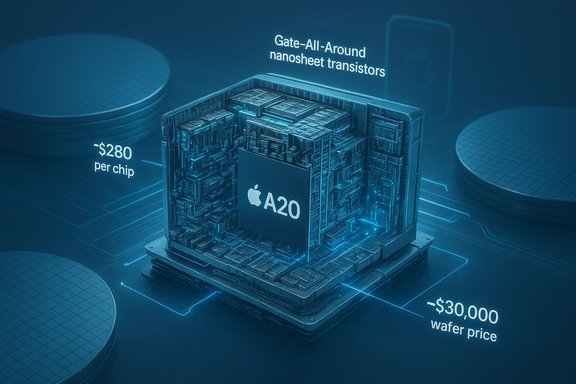
Apple’s rumored A20 chipset marks the company’s first major foray into mass‑produced 2nm silicon, using TSMC’s N2 family (and likely the N2P variant for higher performance). That migration brings two headline advantages: higher transistor density and substantial power/performance efficiency improvements driven by nanosheet GAA transistors and packaging advances. Independent industry reporting and TSMC’s own technical disclosures indicate density uplifts in the mid‑teens to roughly 1.15–1.2× versus advanced 3nm designs, along with double‑digit percentage gains in performance at iso‑power or dramatic power savings at iso‑frequency. Yet these gains come at a cost. Foundry pricing, wafer economics, and advanced packaging add materially to bill‑of‑materials (BOM) pressure. Multiple supply‑chain reports suggest TSMC’s 2nm wafer economics are markedly higher than 3nm, with published wafer price estimates near $30,000 per wafer and analyst reconstructions that translate this into per‑chip silicon costs as high as $280 for flagship SoCs — numbers that have been repeated across trade outlets. If accurate, they represent a step change in component cost that Apple and other OEMs must manage.
TSMC’s N2 family (including N2P/N2X variants) is positioned as a full‑node advancement over N3, offering a mix of:
However, the commercial reality of cutting‑edge process economics complicates the narrative. Foundry wafer economics and packaging premiums have produced credible estimates that the A20 could cost Apple in the neighborhood of $280 per unit in early volumes — a near‑term shock relative to previous generations. That shift, when combined with elevated DRAM and NAND prices and constrained capacity driven by AI infrastructure demand, places pressure on Apple’s pricing choices and product segmentation.
Readers should treat the exact per‑chip dollar figure as an informed early estimate rather than a definitive invoice: the number is reconstructed from wafer pricing, packaging choices, and yield assumptions reported by multiple trade outlets. What is certain is the structural trade‑off: pushing silicon forward at the frontier of semiconductor physics brings measurable user benefits — and material, sometimes rapid, cost consequences that echo across supply chains and retail pricing. For consumers, the A20 promises better battery life and speed; for Apple and its competitors, it’s a test of commercial balancing: capture technological leadership, or manage the immediate cost shock to preserve margins and market momentum.
Source: sigortahaber.com Apple A20 Chipset Brings 2nm Revolution with a Sharp Cost Increase
 Overview
Apple’s rumored A20 chipset marks the company’s first major foray into mass‑produced 2nm silicon, using TSMC’s N2 family (and likely the N2P variant for higher performance). That migration brings two headline advantages: higher transistor density and substantial power/performance efficiency improvements driven by nanosheet GAA transistors and packaging advances. Independent industry reporting and TSMC’s own technical disclosures indicate density uplifts in the mid‑teens to roughly 1.15–1.2× versus advanced 3nm designs, along with double‑digit percentage gains in performance at iso‑power or dramatic power savings at iso‑frequency. Yet these gains come at a cost. Foundry pricing, wafer economics, and advanced packaging add materially to bill‑of‑materials (BOM) pressure. Multiple supply‑chain reports suggest TSMC’s 2nm wafer economics are markedly higher than 3nm, with published wafer price estimates near $30,000 per wafer and analyst reconstructions that translate this into per‑chip silicon costs as high as $280 for flagship SoCs — numbers that have been repeated across trade outlets. If accurate, they represent a step change in component cost that Apple and other OEMs must manage. Background: Why 2nm matters
The engineering case for 2nm and GAA
The semiconductor industry’s steady progression from FinFETs to Gate‑All‑Around (GAA) nanosheet transistors is not just marketing — it’s a fundamental change in gate control and scaling mechanics. GAA transistors wrap the gate around the channel entirely, improving electrostatic control, reducing leakage, and enabling tighter packing of transistors without the same thermal and leakage penalties earlier nodes encountered.TSMC’s N2 family (including N2P/N2X variants) is positioned as a full‑node advancement over N3, offering a mix of:
- ~10–15% raw performance uplift at equal power, or
- ~25–35% power reduction at the same performance, and
- ~15–20% transistor density increase for heterogeneous, mixed designs — approximated in vendor language as ~1.15–1.2× logic density.
Packaging and system‑level advances
Beyond the raw node, packaging is shaping SoC value. Apple and TSMC are reported to be using more sophisticated wafer‑level and multi‑chip module techniques (WMCM/InFO evolution) to densify memory and I/O close to the compute die, improving bandwidth and energy efficiency. These packaging choices can increase BOM and assembly cost but enable performance and power behaviors not achievable with traditional packaging schemes.Economics: wafers, yields, and the $280 figure
How wafer cost becomes per‑chip cost
Foundry economics are a compound of wafer pricing, die size, yield, test & packaging costs, and overhead allocation. At advanced nodes, wafer processing costs rise due to more lithography passes, exotic materials, and stricter yield engineering. Recent industry reporting cites ~$30,000 per 300mm wafer for TSMC’s early 2nm volumes, a step up from the $20k–$25k band seen on leading 3nm derivatives in the prior cycle. That wafer delta alone materially increases the baseline per‑die silicon cost, particularly for large‑die SoCs like Apple’s A‑series. Assuming a typical smartphone SoC die area in Apple’s ballpark (one analyst band cites ~100–115 mm² for prior A‑series parts), a 300mm wafer yields a finite number of dies — and once you factor in realistic test yields and packaging/test losses, the effective cost per good die can be tens of dollars higher than an earlier node. When packaging complexity (WMCM), memory stacking, and premium substrate charges are added, some supply‑chain reconstructions reach an estimated $200–$300 per SoC figure for first‑wave 2nm SoCs. Multiple independent outlets have reported a commonly‑cited per‑unit figure of ~$280 for Apple’s A20 chips, with caveats tied to yield maturation and which packaging/variant is used.Who’s reporting what (summary)
- Reporting based on supply‑chain notes and DigiTimes/Commercial Times places TSMC 2nm wafer pricing near $30k, and Apple as a major early customer securing large initial allocations.
- News outlets cross‑referencing Taiwanese business press and UDN estimate A20 per‑unit costs approaching $280, a roughly 80–90% jump versus some prior A‑series cost estimates. These numbers appear in multiple trade stories and analyst summaries.
- TSMC’s public technical messaging frames N2/N2P gains in performance, power, and ~1.15–1.2× logic density; independent technical media corroborates those figures.
Caveat: early node math is noisy
Translating wafer price to per‑chip cost is technically involved. It depends heavily on:- the actual die area of the final A20 variant,
- realized yields (initial yields for N2 may be lower and improve over quarters),
- the mix of Pro vs non‑Pro dies per wafer (chiplets and binning change effective yield accounting),
- packaging selection (WMCM and high‑bandwidth memory or on‑package LPDDR increase costs),
- and any supplier premiums Apple negotiates to secure capacity.
Ripple effects: iPhone pricing, DRAM, and supply competition
Apple’s allocation strategy and premium pricing for capacity
Reports indicate Apple secured a disproportionate share of initial 2nm capacity — a familiar strategy that ensures product continuity but often costs the buyer a premium in allocation or price. When demand for an advanced node spikes, foundries can and do price slots and wafer starts at a premium, particularly in early volume ramps. That dynamic appears to be in play with N2, where Apple’s leadership position in TSMC’s customer list gives it production certainty at the price of higher per‑unit BOM today.DRAM and memory pricing amplify the pass‑through risk
The SoC is only one component of the smartphone BOM. Global memory supply tightness — driven by hyperscaler AI demand for HBM and server DRAM — has elevated DRAM spot and contract prices. Industry trackers and community analysis warn that DRAM and NAND prices rose substantially in late 2025 and remain pressured into 2026, which compounds the A20’s cost impact when building a high‑end iPhone SKU with higher RAM and storage configurations. The combined effect increases the odds that Apple must choose among absorbing margin compression, trimming features on lower‑tier SKUs, or passing part of the cost onto consumers through higher retail prices.Competitive pressure from other foundries
Samsung’s publicized 2nm wafer pricing and capacity posture also matter: Samsung is reported to be offering 2nm wafers at lower sticker prices (reports cite ~$20k per wafer in some public coverage), which creates a pricing differential and a real sourcing alternative for some customers. Apple’s long‑standing design and yield preference for TSMC, however, likely keeps Apple anchored to TSMC despite a potential price gap. For other vendors, the foundry price differential could decide which supplier they target for 2nm, and that will influence market allocations and competitive dynamics in late‑2026 and beyond.Technical verification: what is verified, what is rumor
Verified or well‑supported claims
- TSMC has introduced GAA nanosheet transistors on its N2 family, with stated power/performance and density gains over N3-class processes. This is supported by TSMC’s technical materials and corroborated by independent technical journalism.
- Early production ramps for N2 were reported in 2025, and Apple is widely reported to be a major initial customer seeking significant capacity. Multiple supply‑chain outlets report Apple securing a large portion of initial N2 capacity.
Plausible but not fully verifiable claims
- The $280 per‑unit A20 cost: widely reported by trade outlets and reconstructed from wafer and packaging pricing, but not confirmed by Apple, TSMC, or their suppliers. Treat as a credible early‑volume estimate rather than a corporation‑confirmed figure.
- Exact transistor density multiplier (e.g., “1.2×”): vendor materials provide ranges and different metrics (logic density vs SRAM scaling vs mixed‑IC “chip density” calculus). The 1.15–1.2× logic density figure is consistent with TSMC’s disclosures and industry reporting, but precise gains for any specific Apple SoC will vary by design and SRAM share.
Unverifiable or speculative areas to watch
- Whether Apple will ship all iPhone 18 SKUs on 2nm or restrict N2 to Pro models initially. Some analysts suggest Apple may reserve 2nm for flagship SKUs to control cost exposure; this remains speculative until Apple confirms product SKUs.
- The timing and magnitude of potential retail price increases; OEMs balance margin preservation, competitive positioning, and demand elasticity, and Apple’s final pricing calculus is not publicly disclosed.
What this means for consumers and enterprise buyers
For prospective iPhone buyers
- Expect the iPhone 18 Pro family to bring measurable battery and performance improvements, particularly for AI‑assisted tasks and GPU workloads, driven by the A20/N2 combination and advanced packaging. These are real benefits for users who prioritize longevity and sustained performance.
- Be prepared for the possibility of higher premium pricing on flagship models if Apple elects to pass some or all of the silicon and memory cost increases to retail. Apple has several levers it can use (absorb costs, adjust product mix, restrict 2nm to high‑end SKUs); none are guaranteed.
For enterprise and procurement managers
- If your organization buys iPhones in volume, expect procurement windows to be volatile as Apple balances allocation against demand. Budgeting for potential ASP increases on premium SKUs is prudent.
- For fleet devices where price sensitivity is high, consider staggered refreshes or prioritize models whose BOM exposure to advanced packaging and premium memory is lower.
Strengths, risks, and strategic trade‑offs
Strengths and opportunities
- Performance leadership: Moving to 2nm underscores Apple’s silicon advantage, enabling higher performance per watt and competitive differentiation in mobile AI.
- System integration leverage: Apple’s vertical software/hardware integration amplifies the user‑visible benefits of node improvements, making real‑world gains more meaningful than raw benchmark numbers alone.
- Long‑term platform benefits: Early adoption of N2 and advanced packaging secures headroom for future features (more on‑device AI, better graphics, and energy‑efficient multitasking).
Risks and potential downsides
- Margin pressure: If Apple absorbs the cost, gross margins on flagship devices could compress. If it passes the cost to consumers, price elasticity risks demand softness in some regions.
- Supply‑side fragility: 2nm capacity is finite in early ramps. If yields or demand misalign, inventory constraints could limit availability or force Apple to stagger SKU launches. That leaves room for disappointment or channel shortages at launch.
- Component stacking risk: High DRAM and NAND prices driven by datacenter demand make the broader BOM expensive; packaging advances that require more on‑package memory raise per‑unit costs further.
Practical scenarios and likely outcomes
- Apple absorbs a portion of the cost and keeps retail pricing stable.
- Outcome: Margin compression on high‑end SKUs for one or two cycles while yields improve and memory pricing stabilizes.
- Likelihood: plausible given Apple’s balance sheet and strategic premium positioning.
- Apple restricts 2nm to Pro models and uses cheaper 3nm variants for base models.
- Outcome: SKU differentiation preserves entry‑level pricing while flagship SKUs command higher prices and margins.
- Likelihood: high; it aligns with product segmentation strategies Apple has used historically.
- Apple passes costs to consumers with a price increase for certain iPhone 18 SKUs.
- Outcome: Possible demand softening in price‑sensitive segments and incremental pressure on mid‑cycle refresh volumes.
- Likelihood: dependent on competitive behavior and the macro environment; possible if memory and wafer costs remain elevated.
Recommendations and what to watch next
- Watch TSMC yields and public wafer price disclosures: if wafer pricing moderates or yields ramp quickly, the worst per‑chip cost scenarios will ease. TSMC’s own published metrics and major customers’ commentary are leading indicators.
- Monitor DRAM and NAND contract indices: sustained memory price elevation will keep device ASP pressure high across the industry. Industry trackers and OEM procurement notices are informative.
- Track Apple product SKU disclosures at launch: whether 2nm is limited to Pro models or used more broadly will be decisive for retail pricing and availability.
- For enterprise buyers, consider procurement flexibility (staggering orders, locking prices where possible) and evaluate whether the incremental capability of a 2nm‑based device is critical for your workflows.
Conclusion
The Apple A20’s leap to a 2‑nanometer, GAA‑based SoC represents a meaningful technical inflection point for smartphone silicon: better energy efficiency, higher sustained performance, and opportunities for advanced packaging to boost bandwidth and on‑device AI. Those engineering wins are real and will matter to users.However, the commercial reality of cutting‑edge process economics complicates the narrative. Foundry wafer economics and packaging premiums have produced credible estimates that the A20 could cost Apple in the neighborhood of $280 per unit in early volumes — a near‑term shock relative to previous generations. That shift, when combined with elevated DRAM and NAND prices and constrained capacity driven by AI infrastructure demand, places pressure on Apple’s pricing choices and product segmentation.
Readers should treat the exact per‑chip dollar figure as an informed early estimate rather than a definitive invoice: the number is reconstructed from wafer pricing, packaging choices, and yield assumptions reported by multiple trade outlets. What is certain is the structural trade‑off: pushing silicon forward at the frontier of semiconductor physics brings measurable user benefits — and material, sometimes rapid, cost consequences that echo across supply chains and retail pricing. For consumers, the A20 promises better battery life and speed; for Apple and its competitors, it’s a test of commercial balancing: capture technological leadership, or manage the immediate cost shock to preserve margins and market momentum.
Source: sigortahaber.com Apple A20 Chipset Brings 2nm Revolution with a Sharp Cost Increase
